Information
.avif)

Infosys and GHCL Announce Share Buybacks — Here’s What Investors Should Know
.webp)

Key Takeaways
- Infosys announces ₹18,000 crore buyback via tender offer at ₹1,800 per share.
- GHCL launches ₹725 per share buyback opening on 6 Nov 2025.
- Record date for both buybacks: 14 November 2025.
- Buybacks aim to reward shareholders and boost return ratios.
- Investors should review eligibility, acceptance ratio, and tax implications before participating.
Buyback Season Returns: Infosys and GHCL Lead the Way
Two notable Indian companies—Infosys Ltd. and GHCL Ltd.—have rolled out share buybacks in November 2025, rekindling investor interest in the ongoing market rally.
Buybacks are often viewed as a strong signal of management confidence, indicating that the company believes its stock is undervalued or has surplus cash to distribute to shareholders.
Infosys, a large-cap IT giant, and GHCL, a mid-cap chemicals and textiles player, have both announced buybacks with attractive premiums, giving investors an opportunity to realize quick gains while reinforcing long-term confidence in the businesses.
Infosys Buyback 2025: Returning ₹18,000 Crore to Shareholders
Buyback Type: Tender Offer
Buyback Price: ₹1,800 per share
Issue Size: ₹18,000 crore (10 crore shares)
Last Date to Buy Shares: 13 November 2025
Record Date: 14 November 2025
Infosys’ buyback announcement comes at a time when the IT sector is navigating global uncertainties but remains cash-rich and operationally strong.
The tender offer route allows investors to tender some or all of their shares at the buyback price. With the stock trading below ₹1,800 before the announcement, the buyback provides an attractive premium, creating short-term arbitrage potential.
From a fundamental standpoint, Infosys’ robust free cash flow, high return on equity, and consistent dividend policy underline its commitment to capital efficiency and shareholder value creation.
Why This Matters:
- Reinforces Infosys’ healthy balance sheet.
- Supports the stock price by reducing outstanding shares.
- Enhances earnings per share (EPS) post-buyback.
Historically, Infosys has executed buybacks in 2017, 2019, and 2022—all resulting in positive investor sentiment and short-term price appreciation.
GHCL Buyback 2025: Midcap Confidence in Focus
Open Date: 6 November 2025
Record Date: 14 November 2025
Buyback Price: ₹725 per share
GHCL Ltd., known for its chemicals and textiles business, announced a buyback at ₹725, a notable premium to its prevailing market price around ₹650–₹675 before the announcement.
The move highlights GHCL’s strong cash reserves and strategic focus on rewarding shareholders amid steady financial performance. The company’s chemicals division, particularly in soda ash and industrial products, has been witnessing healthy demand, while its textile arm continues to contribute steadily.
For mid-cap investors, such buybacks are particularly appealing as they:
- Improve stock liquidity and investor perception.
- Reflect management confidence in long-term prospects.
- Offer potential short-term returns through premium realization.
What Buybacks Indicate About the Market
Buybacks serve as a vote of confidence from management, suggesting that companies view their current valuations as attractive.
In an era of rising global volatility and shifting interest rate cycles, cash-rich Indian firms are increasingly using buybacks as a strategic capital allocation tool.
According to SEBI’s framework, companies opting for the tender offer route must treat all shareholders equitably, ensuring that retail investors (holding shares worth ≤ ₹2 lakh) receive priority allocation.
In 2025, buybacks are emerging as a preferred way for companies to balance shareholder rewards and financial prudence, especially with dividend distribution tax reforms already in place.
Impact on Investors and Market Sentiment
Both Infosys and GHCL’s buybacks have added positive momentum to their respective stock prices. For Infosys, it enhances stability amid subdued global tech demand, while GHCL’s move signals mid-cap sector confidence.
However, investors must note that buybacks are not risk-free.
- The acceptance ratio—the percentage of shares accepted in the buyback—depends on overall shareholder participation.
- There could be post-buyback corrections, especially if the stock rallies sharply beforehand.
- Tax implications under Section 115QA (for companies) and capital gains tax (for shareholders) should be reviewed before participating.
Investor Perspective: How to Participate
If you’re eligible based on the record date, here’s how to participate in a buyback:
- Check Eligibility: Ensure you hold shares before the record date.
- Receive Offer Letter: Companies send buyback offers to eligible shareholders.
- Tender Shares: Submit your shares via your broker platform (like Swastika Investmart).
- Wait for Allotment: Once accepted, funds are credited to your account, and unaccepted shares are returned.
For first-time investors, this process can be confusing—but platforms like Swastika Investmart simplify participation with expert guidance, intuitive digital tools, and real-time tracking.
Real-World Example: Infosys’ 2019 Buyback
In its 2019 buyback, Infosys offered shares at ₹800, a ~15% premium to the market price. Investors who participated not only realized gains but also benefited from a short-term price rally post-buyback closure.
A similar pattern could unfold in 2025, although the acceptance ratio will depend on overall participation.
FAQs
Q1. What is a share buyback?
A share buyback is when a company repurchases its shares from existing shareholders, reducing the number of outstanding shares and rewarding investors.
Q2. What is Infosys’ buyback price and record date?
Infosys has set a buyback price of ₹1,800 per share, with a record date of 14 November 2025.
Q3. How much is GHCL offering in its buyback?
GHCL’s buyback is priced at ₹725 per share, with the same record date—14 November 2025.
Q4. Is it beneficial to participate in a buyback?
Buybacks can offer attractive short-term gains if the company offers a premium price. However, investors should assess fundamentals and acceptance ratio expectations.
Q5. How can investors apply for a buyback through Swastika Investmart?
Swastika Investmart provides an easy online process to tender shares, track buyback offers, and get expert advice on corporate actions.
Conclusion: Buybacks Reflect Confidence, Not Just Cash Surplus
The twin buyback announcements from Infosys and GHCL underline a broader trend—Indian corporates are prioritizing shareholder value creation through efficient capital management.
Whether you’re a long-term investor or seeking short-term opportunities, understanding buyback dynamics is essential.
For expert guidance, research-driven insights, and a smooth trading experience, Swastika Investmart offers everything you need to make informed investment decisions.
.avif)
Corporate Action Update: Sampre Nutrition, HDFC AMC, and Others Cheer Investors with Splits & Bonuses.
Key Takeaways
- Sampre Nutrition, HDFC AMC, and Websol Energy announce splits and bonus shares in November 2025.
- Sampre Nutrition declares a 1:1 bonus and a 10:5 stock split.
- HDFC AMC rewards shareholders with a 1:1 bonus issue.
- Websol Energy and Unison Metals announce stock splits to enhance liquidity.
- These corporate actions reflect strong fundamentals and investor-friendly policies.
Corporate Actions 2025: The Season of Splits and Bonuses Begins
The Indian stock market is buzzing again, this time not because of volatility or new listings, but due to a wave of corporate actions from established and emerging companies. As of November 2025, several companies—including Sampre Nutrition, HDFC Asset Management Company (HDFC AMC), Websol Energy, and Unison Metals—have announced stock splits and bonus shares to reward their shareholders.
These moves have caught the attention of both retail and institutional investors, signaling strong balance sheets, confidence in future growth, and a desire to improve liquidity in the market.
Let’s decode what these actions mean, their timelines, and how they could impact investor sentiment.
What Are Stock Splits and Bonus Shares?
Before diving into the company-wise details, it’s essential to understand the difference:
- Stock Split:
A stock split divides existing shares into multiple units, lowering the stock’s face value but keeping the overall market capitalization unchanged. It improves liquidity by making shares more affordable. - Bonus Issue:
A bonus issue gives existing shareholders additional shares free of cost, typically drawn from the company’s reserves. This rewards long-term investors and signals management confidence.
Both actions often indicate financial stability, sound growth prospects, and a commitment to shareholder value creation.
1. Sampre Nutrition: Double Delight for Investors
LTP: ₹141.40 (-1.98%)
Stock Split Ratio: 10:5
Bonus Ratio: 1:1
Announcement Date: 19 September 2025
Ex-Date: 11 November 2025
Sampre Nutrition surprised investors with not one but two shareholder-friendly announcements—a stock split and a bonus issue.
- The 10:5 stock split effectively doubles the number of shares, reducing the face value and increasing liquidity.
- The 1:1 bonus issue means investors receive one additional share for every share they hold.
This combination is rare and typically reflects high confidence in business expansion. Sampre’s strong presence in the nutrition and FMCG segment, coupled with robust quarterly results, positions it as a promising mid-cap contender.
Post-corporate action, analysts expect higher retail participation and improved trading volumes in the stock.
2. HDFC AMC: Rewarding Long-Term Shareholders
LTP: ₹5,388.50 (-0.26%)
Bonus Ratio: 1:1
Announcement Date: 15 October 2025
Ex-Date: 26 November 2025
HDFC AMC, one of India’s largest and most respected asset management companies, announced a 1:1 bonus issue to reward its loyal investors.
This move reflects HDFC AMC’s steady revenue growth, strong asset base, and consistent dividend record. By doubling the number of shares held by investors, the company aims to make its stock more accessible while maintaining its strong market capitalization.
From a market standpoint, this decision underlines the AMC’s long-term commitment to shareholder wealth creation, especially as the mutual fund industry in India crosses ₹60 trillion in AUM.
3. Websol Energy: Riding the Renewable Boom
LTP: ₹1,337.60 (+10.37%)
Stock Split Ratio: 10:1
Announcement Date: 1 September 2025
Ex-Date: 14 November 2025
Websol Energy’s 10:1 stock split comes amid India’s renewable energy revolution. The company’s stock price has been on a strong upward trajectory, mirroring the sector’s bullish outlook.
This split will significantly improve liquidity, allowing smaller investors to participate in the green energy wave. With government support for solar manufacturing and production-linked incentives, Websol’s corporate action appears both timely and strategic.
4. Unison Metals: Improving Market Participation
LTP: ₹24.00 (-2.40%)
Stock Split Ratio: 10:1
Announcement Date: 22 August 2025
Ex-Date: 28 November 2025
Unison Metals’ decision to implement a 10:1 stock split aims to make its shares more affordable and attract broader market participation.
The company, which operates in the industrial metals segment, has been focusing on operational efficiency and product diversification. The stock split is expected to bring fresh retail interest and support long-term liquidity on the exchanges.
What These Corporate Actions Indicate About Market Sentiment
These announcements aren’t isolated—they reflect a broader optimism across sectors. Whether it’s renewable energy, financial services, or FMCG, companies are signaling robust health and confidence.
Such actions often precede expansion plans or higher profitability phases, aligning with SEBI’s emphasis on transparency and equitable shareholder participation.
In addition, these corporate actions are a positive sign for retail investors, as they improve accessibility and trading flexibility.
How Investors Should Approach Corporate Actions
While bonus issues and stock splits create excitement, investors must evaluate:
- Company Fundamentals: Is the growth backed by earnings, not just sentiment?
- Valuation: Does the post-split/bonus valuation still make sense?
- Liquidity Impact: More shares don’t always mean more value—watch volume patterns.
- Long-Term Vision: Focus on companies using these actions to support expansion.
This is where Swastika Investmart stands out. As a SEBI-registered financial services firm with decades of experience, Swastika offers strong research tools, robust customer support, and AI-powered investing platforms that help you analyze such corporate events with clarity.
FAQs
Q1. What is the difference between a stock split and a bonus issue?
A stock split increases the number of shares by reducing their face value, while a bonus issue distributes additional shares from reserves without changing the face value.
Q2. Do stock splits or bonus issues change a company’s valuation?
No. They do not alter the company’s overall market capitalization; they simply redistribute value across more shares.
Q3. Is it a good time to buy Sampre Nutrition or HDFC AMC after the corporate action?
It depends on your investment horizon. Evaluate fundamentals, profitability, and future growth before making decisions.
Q4. How do corporate actions affect liquidity?
Corporate actions like splits typically increase liquidity by making shares more affordable to retail investors.
Q5. How can investors track upcoming corporate actions?
You can monitor announcements via NSE/BSE portals or use Swastika Investmart’s research tools for timely updates.
Conclusion: A Bullish Signal for Investors
The recent series of stock splits and bonus issues from Sampre Nutrition, HDFC AMC, Websol Energy, and Unison Metals highlight the growing confidence of Indian corporates. These actions, while not altering intrinsic value, reflect strong financial health and investor-centric strategies.
For investors, such developments signal opportunities to reassess portfolio holdings and capitalize on upcoming growth phases.
If you’re looking to navigate corporate actions with expert guidance, Swastika Investmart offers the perfect blend of technology, experience, and trust to help you make smarter investment decisions.

Paytm Check-in Takes Off! AI-Powered Travel Bookings Now at Your Fingertips
Key Takeaways
- Paytm introduces AI-powered Check-in to revolutionize travel booking in India.
- Offers seamless, personalized flight, hotel, and travel deals within the app.
- Uses artificial intelligence to optimize prices, timing, and itineraries.
- Strengthens Paytm’s diversification beyond fintech into travel tech.
- Investors eye positive sentiment around India’s growing digital travel market.
The AI Revolution Arrives in Travel: Paytm’s Smart Move
India’s travel industry is entering a new digital phase—and this time, Paytm is at the forefront. The fintech giant, best known for transforming digital payments, has now expanded into AI-driven travel bookings through its “Paytm Check-in” platform.
This new feature harnesses artificial intelligence and data analytics to simplify how Indians plan, book, and manage their trips. Whether it’s spotting the best airfare deal or suggesting hotels based on your preferences, Paytm’s AI Check-in aims to make travel as effortless as booking a UPI transaction.
With India’s travel sector projected to reach $125 billion by 2027, the timing couldn’t be better. The integration of AI in travel booking apps is no longer futuristic—it’s essential.
Why Paytm’s AI Check-in Matters
1. Smart, Personalized Travel Planning
The AI engine in Paytm Check-in analyzes user behavior, travel history, and pricing trends to curate custom suggestions. Imagine getting alerts when fares for your preferred route drop, or when a hotel you stayed at last year offers discounts.
This move mirrors global trends—companies like Booking.com and Expedia have already adopted machine learning to improve user experience. Paytm’s localized approach, however, could give it a powerful edge in India’s competitive travel market.
2. Seamless Integration with Paytm Ecosystem
One of Paytm’s greatest strengths lies in its ecosystem. Users can book tickets, make payments, and access insurance or EMI options—all within one app.
This integrated experience reduces friction and enhances user trust, something international players still struggle to replicate in the Indian market.
3. Boost to India’s Digital Travel Economy
The launch reinforces India’s position as one of the fastest-growing travel-tech markets globally. With rising disposable incomes, increasing smartphone penetration, and a strong post-pandemic travel rebound, AI-powered platforms like Paytm Check-in could accelerate digital adoption even further.
According to IBEF, digital travel sales in India crossed ₹1.2 lakh crore in 2024, with a large portion driven by mobile-first users. Paytm’s AI push perfectly aligns with this growth trajectory.
Investor View: Diversification Beyond Payments
Paytm’s pivot into AI-enabled services is a clear signal of its strategic diversification. As regulatory scrutiny and competition in the fintech space intensify, expanding into travel and commerce offers new monetization avenues.
Market experts believe this move could:
- Strengthen Paytm’s non-fintech revenue streams.
- Improve customer retention through cross-selling.
- Enhance data-driven insights for personalized marketing.
While competitors like MakeMyTrip and EaseMyTrip have deep travel domain expertise, Paytm’s advantage lies in its massive user base and AI-driven personalization—two elements that could redefine how Indians book their next vacation.
What It Means for the Indian Market
AI Adoption in Indian Travel-Tech
India’s AI adoption rate in travel has accelerated sharply post-2023. From chatbots assisting with itinerary queries to AI engines predicting peak pricing, the industry is shifting toward automation and intelligence.
Paytm’s Check-in feature could act as a catalyst, pushing smaller travel platforms to follow suit and integrate AI into their services.
Regulatory & Consumer Data Context
As AI tools process vast amounts of user data, data privacy and transparency will be crucial. Paytm’s compliance with RBI and SEBI guidelines, along with adherence to India’s Digital Personal Data Protection Act, 2023, will play a pivotal role in maintaining consumer trust.
The Competitive Edge: How Paytm Stands Out
Despite fierce competition, Paytm’s edge lies in its multi-vertical integration. Few players offer:
- Unified payments and bookings in one ecosystem
- AI-based dynamic pricing predictions
- Reward programs tied to travel and payments
- Seamless wallet and UPI integration
Moreover, Paytm’s brand recall and existing user loyalty provide a head start that pure-play travel apps might envy.
Investor Insight: What Should You Watch?
For investors tracking the digital economy, Paytm’s AI Check-in marks a significant development. Here’s what to monitor next:
- Adoption rate – How quickly users embrace this new feature.
- Revenue diversification – The impact on non-fintech income.
- Partnerships – Collaborations with airlines, hotels, and tourism boards.
- Regulatory updates – Compliance with emerging AI and data regulations.
A strong performance in these areas could signal long-term value creation, especially as Paytm continues to rebrand itself as a technology-driven consumer ecosystem.
Real-World Impact Example
Imagine Riya, a young professional from Mumbai, planning a Diwali trip to Goa. With Paytm Check-in, she receives:
- AI-suggested flight options based on her budget and timing preferences.
- Hotel recommendations using her previous stay data.
- Instant payment and cashback through Paytm Wallet.
In under five minutes, her trip is planned—no multiple apps, no manual comparison.
This is precisely the kind of AI-driven simplicity that defines the next phase of India’s digital economy.
FAQs
Q1. What is Paytm Check-in?
Paytm Check-in is an AI-powered feature that simplifies travel bookings—covering flights, hotels, and trip planning—within the Paytm app.
Q2. How does the AI in Paytm Check-in work?
It uses machine learning to analyze user preferences, pricing trends, and travel data to offer real-time, customized recommendations.
Q3. Is Paytm Check-in secure?
Yes. Paytm follows stringent RBI and data protection norms, ensuring all transactions and personal information remain secure.
Q4. Will this affect competitors like MakeMyTrip or EaseMyTrip?
It could intensify competition by pushing others to adopt AI-driven personalization and better pricing algorithms.
Q5. How can investors benefit from this development?
If successful, Paytm’s diversification into AI-based travel tech could enhance its revenue mix and support long-term growth potential.
Conclusion: A Smarter Way to Travel—and Invest
Paytm’s AI-powered Check-in isn’t just another feature—it’s a strategic evolution reflecting how India’s digital economy is fusing technology, convenience, and intelligence.
For travelers, it means effortless trip planning.
For investors, it signals Paytm’s intent to expand beyond payments into a full-fledged consumer-tech ecosystem.
And for those seeking a smarter way to invest in this evolving digital landscape—Swastika Investmart provides the expertise, tools, and guidance to help you make informed decisions.

Pine Labs IPO Review 2025: Should Investors Apply or Avoid?
Key Takeaways
- Pine Labs is a leading merchant commerce and payments platform with a large merchant footprint but still reports recent losses.
- IPO size around ₹3,900 crore at a price band of ₹210–221, consisting of a mix of fresh issue and offer for sale.
- FY25 shows strong revenue growth and improving EBITDA margins, though the company remains loss-making.
- Key risks include high valuation, profitability visibility, and rising competition in the fintech sector.
- Best suited for long-term, high-risk investors; conservative investors may prefer to wait for post-listing stability.
Pine Labs: The Fintech Giant Enters the Market
Pine Labs is one of India’s most established fintech names in the merchant commerce space. The company provides point-of-sale (PoS) systems, payment processing, merchant financing, and a suite of value-added services to offline and online merchants across India and overseas markets.
With over one million merchants on its platform and billions of transactions processed annually, Pine Labs plays a vital role in India’s digital payment ecosystem. Its IPO has generated buzz because it offers retail investors exposure to a fast-growing fintech infrastructure story at a time when digital payments and merchant services are seeing exponential adoption.
IPO Snapshot: Key Details Investors Should Know
The IPO proceeds from the fresh issue are expected to be used primarily for growth initiatives, technology investments, and strengthening the balance sheet, while the OFS allows existing investors to partially exit.
Financial Snapshot: Growth with Caution
Pine Labs has showcased steady revenue growth in recent years as digital adoption expands among small and mid-sized businesses. Revenue rose to over ₹2,300 crore in FY25, and EBITDA margins improved to nearly 14%, reflecting strong operating leverage.
However, the company still reported a net loss of around ₹145 crore, and its net worth remains negative — a concern for value-focused investors. While revenue momentum is encouraging, profitability remains a key milestone yet to be achieved.
Strengths: Why Pine Labs Stands Out
- Market Leadership in Merchant Payments
Pine Labs enjoys a dominant position in the merchant commerce technology space, with an integrated platform combining hardware, software, and lending solutions. - Strong Merchant Ecosystem
Its large merchant base enables cross-selling of high-margin services like EMIs, loyalty programs, and working capital loans — expanding revenue streams. - International Footprint
The company’s growing presence in Southeast Asia and the Middle East adds geographical diversification and reduces dependence on the Indian market. - Tech-Driven Innovation
Focus on digital-first solutions, cloud-based PoS systems, and data analytics keeps Pine Labs ahead in terms of scalability and efficiency.
Risks: What Investors Should Watch
- Profitability Uncertainty
Despite rising revenues, the path to sustainable profitability is unclear, with ongoing technology and expansion-related costs. - High Valuation
The asking valuation implies high growth expectations. Any slowdown in transaction volumes or merchant acquisition could trigger re-rating risks. - Competitive Landscape
Pine Labs faces intense competition from fintech giants like Paytm, Razorpay, PhonePe, and traditional banks expanding into the merchant payment ecosystem. - Operational Risks
Exposure to frauds, chargebacks, and disputes inherent to payment processing can affect margins and trust. - Regulatory Environment
The fintech industry operates under evolving RBI guidelines. Compliance costs and new digital payment regulations may impact growth.
Real-World Context and Market Impact
Pine Labs’ IPO comes at a time when India’s fintech ecosystem is maturing. Investors are increasingly cautious after seeing volatility in previously listed new-age companies. However, Pine Labs differentiates itself through its B2B focus — serving merchants rather than end consumers.
If the company successfully monetizes its large merchant network through lending, analytics, and subscription services, it could transition toward profitability faster than peers. Conversely, failure to control operating expenses or regulatory tightening could slow progress.
The IPO also reflects India’s growing role as a fintech innovation hub, attracting global investors and reinforcing confidence in the digital payments sector.
Should You Apply for the Pine Labs IPO?
- For Long-Term Investors:
The company’s scale, technology leadership, and long-term market opportunity make it attractive for investors who can handle short-term volatility. - For Traders or Short-Term Investors:
Listing gains will depend on demand, subscription levels, and overall market sentiment during the IPO window. - For Conservative Investors:
Given the high valuation and current losses, it may be wiser to wait for the company to achieve profitability and observe post-listing performance.
Frequently Asked Questions
Q1: Is Pine Labs profitable?
Not yet. The company has reduced its losses and improved margins but still reports a net loss as of FY25.
Q2: What makes Pine Labs different from other fintechs?
Unlike consumer-facing payment firms, Pine Labs focuses on merchant solutions and infrastructure, providing more diversified and recurring revenue opportunities.
Q3: How does the IPO valuation look?
At a post-issue market cap of around ₹25,000 crore, valuations appear premium considering the lack of consistent profitability — a factor investors should evaluate closely.
Q4: What are the main risks of investing in Pine Labs?
Key risks include profitability uncertainty, regulatory changes, competition from other fintechs, and operational exposure to fraud and chargebacks.
Q5: Should retail investors apply for this IPO?
Avoid this IPO for now, considering the high valuation and limited short-term visibility.
Conclusion: A Fintech Play for the Patient Investor
The company is engaged in providing digital payments and related solutions across the e-commerce platform. Although the Government’s Digital India initiative supports future potential, Pine Labs still faces challenges in achieving stable profitability. Based on current financials, the IPO seems aggressively valued. Hence, investors are advised to avoid this IPO for now, considering the high valuation and limited short-term visibility.
%20(4)%20(2).avif)
November Market Outlook 2025: Can Bulls Sustain the Momentum?
Key Takeaways
- Indian markets entered November with strong bullish momentum post-Q2 earnings.
- Key triggers: Fed policy cues, crude oil trends, festive demand, and election outcomes.
- PSU banks, metals, auto, and FMCG sectors led the October rally.
- Stable macros and easing inflation support positive sentiment.
- Bihar elections and global liquidity trends could influence near-term direction.
India’s Market Carries Forward a Bullish Tone
The Indian stock market ended October on a strong note, powered by robust domestic growth, healthy Q2 earnings, and an improvement in global sentiment.
The Nifty surged 4.51%, while the Sensex climbed 4.57%, marking one of the best monthly performances of 2025.
The Bank Nifty hit a record high at 57,776.35, driven by PSU banks and financials, while Nifty PSU outperformed with an impressive 8.74% gain.
Several macroeconomic factors worked together to keep the market buoyant —
- Falling crude oil prices,
- Strong festive demand,
- Improving India–U.S. trade ties, and
- Renewed optimism around GST 2.0 rollout.
As we step into November, investors are keenly watching whether this bullish momentum can sustain amid evolving domestic and global triggers.
Key Triggers for November 2025
1. Q2 Earnings Wrap-up
The final leg of quarterly results will determine whether markets extend the rally or face mild profit-booking.
Sectors like banking, auto, and FMCG continue to report healthy earnings, reflecting strong consumption and credit growth.
2. FII Flows & Fed Outlook
Global liquidity and the U.S. Federal Reserve’s policy stance remain crucial.
A dovish Fed could further boost foreign institutional inflows, while any hawkish surprise might trigger short-term volatility.
3. Crude Oil Prices
Persistently low crude oil prices are supporting India’s fiscal and inflation outlook.
Refining companies and oil marketing firms may continue to benefit from better margins, providing further sectoral strength.
4. Domestic Macro Data
Upcoming IIP (Index of Industrial Production) and CPI (Consumer Price Index) readings will guide RBI’s next policy move.
A stable inflation trajectory strengthens the case for sustained policy support and investor confidence.
5. India–U.S. Trade Progress
Ongoing trade negotiations have shown progress, especially in technology and manufacturing cooperation.
Improved bilateral ties could enhance India’s export outlook and attract long-term FDI.
6. State Election Outcomes
The results of key Bihar elections may impact policy continuity and market mood.
A favorable outcome for the NDA could further reinforce investor confidence in India’s economic reforms and fiscal discipline.
October Month Wrap-up: Bulls Back in Charge
Key October Highlights
- Strong Market Recovery: Nifty held firm above 26,000, driven by earnings and positive sentiment.
- Sectoral Strength: PSU banks and metals were top performers, supported by global demand and Q2 numbers.
- Crude Relief: Declining oil prices boosted refining margins for energy companies.
- Festive Boost: Robust consumption trends and GST 2.0 optimism added tailwinds.
Sectors to Watch in November
Metals
Metals may extend their outperformance amid a weakening dollar index and steady global demand recovery.
Steel and aluminum producers are likely to benefit from improved export orders and domestic infrastructure spending.
Auto & FMCG
These sectors are expected to gain from festive season sales, GST 2.0 rollout, and easing input costs.
Companies like Maruti Suzuki, Tata Motors, HUL, and Nestlé India are well-positioned to benefit from sustained consumer demand.
Banking & Financials
With improving credit demand, stable interest rates, and robust asset quality, banking remains a cornerstone of the rally.
PSU banks have seen a sharp recovery in valuations, supported by better-than-expected earnings.
Oil & Gas
Energy majors are likely to sustain momentum as lower crude prices and strong refining margins enhance profitability.
Improved refining spreads could continue to lift companies like Reliance Industries and ONGC.
Investor Outlook: November’s Risk–Reward Balance
While the market sentiment is constructive, investors should remain mindful of potential risks such as:
- Sudden spikes in global crude oil prices,
- Hawkish surprises from the Fed,
- Global geopolitical tensions, or
- Profit-booking in overbought segments like midcaps.
However, strong macro fundamentals, festive consumption, and steady liquidity suggest that India’s market could maintain its upward bias through November.
FAQs
Q1: What are the main market triggers for November 2025?
A: The key triggers include Q2 earnings wrap-up, FII flows, crude oil prices, domestic macro data, and election outcomes.
Q2: Which sectors are expected to perform well in November?
A: Metals, banking, auto, FMCG, and oil & gas sectors may continue to see positive momentum.
Q3: How will the Fed’s outlook impact Indian markets?
A: A dovish stance could attract more FII inflows, while a hawkish tone may lead to short-term volatility.
Q4: Will festive demand sustain the rally?
A: Yes, festive consumption combined with GST 2.0 rollout is expected to support near-term growth.
Q5: Should investors book profits or stay invested?
A: Long-term investors can stay invested with a focus on high-quality large-cap and sector leaders, while traders may consider partial profit-taking.
Conclusion: Festive Cheer Meets Market Optimism
With banking strength, festive demand, and supportive global cues, India’s equity market enters November on a strong footing.
While short-term volatility cannot be ruled out, the overall setup remains constructive for equities.
Swastika Investmart, with its SEBI registration, expert research team, and tech-enabled investing platform, offers investors the tools and insights needed to navigate these dynamic markets confidently.
%20(2)%20(2).avif)
Wedding Bells Ring for Dalal Street: Stocks Set to Shine This Shaadi Season
Key Takeaways
- India’s wedding season lifts spending across jewellery, travel, hotels and apparel — a tailwind for select listed stocks.
- Titan, Vedant Fashions, IndiGo, Lemon Tree, and Indian Hotels are well-placed to benefit from higher demand.
- Look at fundamentals and valuations; seasonal boosts can be short-lived.
- Swastika Investmart offers research, customer support and tech tools to help investors evaluate these plays.
Why the wedding season matters for markets
Every year millions of weddings in India trigger a surge in discretionary spending: jewellery, ethnic clothing, footwear, hospitality, travel and gifting. For listed companies with strong brands or scale, this translates into higher sales and improved quarterly numbers. Investors often spot short-term trading and long-term thematic opportunities from the seasonal uptick — but only when fundamentals align.
The five wedding-season stocks to watch and why
Titan - the jewellery & lifestyle leader
Titan’s marquee jewellery brands attract brides, grooms and families. Branded jewellery sales are less volatile than unbranded alternatives because consumers prefer trusted labels for large purchases. A strong festival and wedding season often means higher footfalls at showrooms and a better mix of gold versus lightweight jewellery, which can expand margins.
Real-world scenario: A wedding shopping weekend in a tier-2 city sees a surge in store visits to Tanishq outlets, lifting weekend revenue and same-store sales growth — a number analysts track closely.
Vedant Fashions Ltd - manyavar & ethnic wear
Vedant Fashions (Manyavar) directly targets the wedding wardrobe market. Their focus on bridal and groom wear, franchise roll-outs, and category expansion make them a natural beneficiary when demand for ethnic wear rises.
IndiGo - travel demand and destination weddings
IndiGo benefits from increased travel for weddings, especially destination ceremonies. Rising passenger volumes and improved load factors during peak wedding months can raise airline revenue per available seat. For investors, look at capacity additions, fuel costs and fare mix to judge the sustainability of gains.
Lemon Tree Hotels - mid-market wedding venues
Mid-scale hotels often capture banquet and room demand during wedding season. Lemon Tree’s pan-India presence, cost control and banquet offerings make it a good proxy for domestic wedding hospitality demand. Higher occupancy and banquet bookings typically lift margins for such players.
Indian Hotels - luxury and destination weddings
Indian Hotels (Taj) is a play on high-end and destination weddings. Luxury properties command premium rates and see sizeable event revenues. Large marquee weddings that book entire properties can materially boost quarterly revenue for city-leading hotels.
How to use these ideas - short term vs long term
- Short term (trading): Seasonal momentum can create short windows of price appreciation. Traders often position ahead of peak booking periods but should manage risk with stop-loss rules.
- Long term (investing): Look for companies with healthy balance sheets, consistent return ratios, and scalable distribution. A one-season bump does not replace structural growth.
What investors should check before buying
- Valuation: Is the price already factoring in the wedding season? High multiples can reduce upside.
- Margins & inventory: Retailers with bloated inventory may not convert seasonal interest into profit.
- Leverage: Hotels and airlines with high debt are more sensitive to cost shocks.
- Regulatory environment: GST, consumer protection norms and SEBI rules affect listed companies and investor protections. Always factor in compliance and governance.
Indian market context & regulation
Seasonal demand translates to macro signals: higher rural and urban consumption, GST collections upticks in hospitality/retail, and improved earnings for consumer-facing companies. For listed stocks, SEBI’s disclosure norms and quarterly reporting provide transparency on how companies capture seasonal gains. Investors should read statutory filings and rely on registered brokers for compliant execution and research.
Why use Swastika Investmart for wedding-season ideas
Swastika Investmart is SEBI-registered and combines strong research tools, tech-enabled platforms and investor education to help you separate noise from signal. Whether you need a fundamental report on Titan or real-time alerts on hotel occupancy data, Swastika’s support and customer service can help you act with confidence.
FAQs
Q: Do wedding seasons always lift stock prices?
Not always. Seasonal demand can boost revenue, but stock moves depend on expectations, valuations and broader market sentiment.
Q: Which sector benefits most from weddings?
Jewellery and apparel usually see the clearest impact, followed by hospitality and travel.
Q: Should I buy all five stocks listed here?
Diversify and study each company’s fundamentals. Buying a basket makes sense only if you understand the risk profile of each stock.
Q: How can Swastika Investmart help me act on these ideas?
Swastika provides SEBI-registered brokerage services, research reports, tech tools and customer support to guide both investors and traders.
Conclusion
Wedding season is a recurring, predictable demand driver that offers both trading and investment opportunities. Titan, Vedant Fashions, IndiGo, Lemon Tree and Indian Hotels each capture different parts of the wedding ecosystem — jewellery, apparel, travel and hospitality. But remember: a seasonal tailwind is not a substitute for solid fundamentals. Use reliable research, check valuations, and consider Swastika Investmart’s tools and support before you decide.

SBI’s Q2 FY26 Results Decode: How India’s Largest Bank is Managing Margins & Growth
Key Takeaways
- SBI reports a net profit of ₹20,160 crore, up 10% YoY, surpassing market estimates.
- Net Interest Income (NII) grew to ₹42,985 crore, supported by healthy credit growth.
- Margins remain resilient amid rising deposit costs.
- Asset quality improves, reflecting disciplined risk management.
- Retail, corporate, and digital banking continue to drive performance.
Introduction
India’s largest public sector bank, State Bank of India (SBI), delivered yet another strong quarter in Q2 FY26, reinforcing its leadership in the banking sector. Despite challenges like deposit cost pressures and intense competition from private peers, SBI showcased remarkable strength in both profitability and operational efficiency.
For investors, this quarter’s performance highlights the bank’s balanced approach to growth, margin stability, and asset quality—three pillars crucial to sustainable returns in the banking sector.
Strong Profit Beat and Healthy NII Growth
SBI reported a net profit of ₹20,160 crore for Q2 FY26, up from ₹18,331 crore in the same quarter last year—a 10% year-on-year increase, comfortably exceeding CNBC’s estimate of ₹17,048 crore.
The bank’s Net Interest Income (NII) also rose to ₹42,985 crore, compared to ₹41,620 crore in Q2 FY25, showing a steady improvement in core income generation. This growth was largely supported by expanding loan volumes in retail and corporate segments.
The performance reflects SBI’s ability to maintain profitability even amid rising deposit rates, a challenge that has put pressure on margins across the banking sector.
Margins Remain Stable Amid Competitive Pressure
The key to SBI’s sustained profitability lies in its margin management. Despite increasing competition for deposits and the Reserve Bank of India’s tight liquidity stance, the bank maintained stable Net Interest Margins (NIMs).
Its large CASA (Current Account Savings Account) base continues to provide a low-cost funding advantage, while smart repricing of loans has helped offset higher deposit costs. SBI’s strong franchise across India gives it a cost-efficiency edge over private banks that rely more heavily on wholesale deposits.
Asset Quality: Continuing the Improvement Trend
Another major highlight of SBI’s Q2 FY26 results is the continued improvement in asset quality. Non-performing assets (NPAs) have seen a steady decline, backed by strong recovery and write-back trends.
This improvement underscores the bank’s prudent credit assessment and its focus on secured, diversified lending. Moreover, provisions remained moderate, helping boost profitability. The provision coverage ratio (PCR) continues to stay at a comfortable level, indicating that SBI is well-prepared for any unforeseen stress in the system.
Digital Leadership and Retail Momentum
SBI’s digital transformation continues to be one of its strongest growth drivers. The YONO platform—now one of India’s most widely used digital banking apps—has played a vital role in expanding the bank’s customer base, especially among younger and urban demographics.
Over 90% of SBI’s transactions are now digital, which has helped the bank reduce operational costs and enhance efficiency.
Retail loans, particularly home loans, personal loans, and SME credit, grew robustly during the quarter. This aligns with India’s overall economic momentum, supported by rising consumer spending and infrastructure development.
Comparison with Peers and Market Impact
SBI’s Q2 FY26 results place it among the top-performing banks this earnings season. Private sector giants like HDFC Bank and ICICI Bank have also posted healthy numbers, but SBI’s scale, government backing, and rural reach give it a unique edge.
Market experts believe this performance strengthens investor confidence in PSU banks as a whole. The stock remains a long-term value pick for investors seeking stability, consistent dividend payouts, and exposure to India’s economic growth story.
What’s Driving SBI’s Growth?
- Retail and SME Loan Expansion – Consistent credit demand in housing and MSME segments.
- Cost Efficiency – Low-cost CASA base and digital operations boosting margins.
- Improving Asset Quality – Lower slippages and strong recoveries.
- Digital Ecosystem – YONO driving deposits, cross-selling, and fee income.
- Macro Tailwinds – Strong GDP growth and improving business sentiment aiding credit offtake.
Outlook: Prudent Growth and Margin Stability Ahead
Looking ahead, SBI’s focus will remain on sustaining growth while preserving asset quality. With the economy on a strong footing and credit demand expected to stay high, the bank’s diversified portfolio and digital push will likely drive future earnings.
Analysts expect the bank to continue maintaining NIMs around current levels, while advances growth may outpace the industry average. The bank’s capital adequacy and provision buffers provide further comfort to long-term investors.
FAQs on SBI Q2 FY26 Results
1. What is SBI’s Q2 FY26 net profit?
SBI reported a net profit of ₹20,160 crore, up from ₹18,331 crore last year, beating market expectations.
2. How did SBI’s NII perform this quarter?
SBI’s Net Interest Income (NII) rose to ₹42,985 crore, showing healthy growth driven by higher loan volumes.
3. How is SBI managing rising deposit costs?
Through its strong CASA base, strategic loan repricing, and efficient cost management, SBI has kept margins stable.
4. What’s the outlook for SBI’s stock post-results?
With improving asset quality and strong earnings visibility, SBI remains a solid long-term investment choice.
5. How can investors invest in SBI shares?
You can easily invest in SBI and other top banking stocks through Swastika Investmart’s online trading platform.
Conclusion
SBI’s Q2 FY26 results underscore the bank’s strength in balancing growth, profitability, and prudence. Its ability to maintain margins despite rising funding costs, coupled with a focus on digital transformation, positions it as a standout performer in the Indian banking landscape.
For investors, SBI continues to represent a blend of stability and long-term value, benefiting directly from India’s economic expansion and strong credit growth trends.
Start your investing journey with Swastika Investmart — a SEBI-registered, tech-driven brokerage offering research-backed insights, investor education, and dedicated customer support.

Top 5 Mistakes Beginners Make in Options Trading (and How to Avoid Them)
Key Takeaways
- Most beginners lose in options due to overtrading, wrong strikes, and no stop loss.
- Ignoring Open Interest (OI) and time decay leads to poor timing.
- Success requires understanding risk-reward and probability, not prediction.
- Swastika Investmart’s AI tools simplify strategy, OI tracking, and trade discipline.
- Learn from mistakes early protect capital, trade smart.
Introduction: Futures Trading in 2025
Introduction: Why Beginners Lose in Options
Options trading is powerful small capital, large potential but that same leverage can hurt if misused.
In India’s fast-growing F&O market, many new traders jump in without understanding the rules of probability and risk that govern options.
According to SEBI’s 2024 investor report, most retail traders lose due to poor risk management, lack of discipline, and wrong strike selection.
Let’s decode the 5 most common mistakes beginners make in options trading and more importantly, how to avoid them.
1️⃣ Trading Without Understanding Option Greeks and Time Decay
The Mistake:
Beginners often treat options like stocks assuming price movement directly equals profit.
In reality, options lose value over time because of Theta (time decay) and move differently based on Delta, Vega, and implied volatility (IV).
Example: You buy a NIFTY 22,000 Call Option at ₹100.
Even if NIFTY rises slightly to 22,020, your option might fall to ₹85 because time value eroded and IV dropped.
✅ How to Avoid It:
- Learn basics of Option Greeks focus on Delta (trend) and Theta (decay).
- Avoid buying far OTM options close to expiry; they lose value fastest.
- Use Swastika Investmart’s Options Analytics Tool to visualize decay and Greeks before entry.
2️⃣ Choosing Wrong Strike Prices
The Mistake:
Beginners chase low-premium, far Out-of-the-Money (OTM) options thinking they’re cheap but most expire worthless.
Example: Buying NIFTY 22,800 CE when the index is at 22,000 looks “cheap” at ₹10, but has less than 10% probability to end in profit.
✅ How to Avoid It:
- Focus on ATM or slightly ITM options for better odds.
- Check probability and OI concentration before buying any strike.
- Swastika Investmart’s OI Heatmap instantly shows where smart money is positioned helping you pick the right strike.
3️⃣ Ignoring Open Interest (OI) and Volume Data
The Mistake:
OI tells where traders are building positions.
Ignoring it means you’re trading blind.
Example: NIFTY 22,200 CE shows rising price but falling OI that’s short covering, not a fresh rally.
✅ How to Avoid It:
- Always pair price with OI and volume.
- Rising OI + rising price = bullish buildup; falling OI = trend reversal.
- Swastika’s Derivatives Dashboard visualizes this data live for NSE stocks and indices.
4️⃣ Not Setting Stop Loss and Targets
The Mistake:
Many traders skip stop loss thinking “I’ll exit later” but options move fast.
One big move against you can wipe your capital due to leverage and time decay.
Example: You buy Bank NIFTY 48,000 CE at ₹200, no SL. Within minutes it drops to ₹120 that’s a 40% loss.
✅ How to Avoid It:
- Always set Stop Loss (20–30%) and Target (1:2 ratio) before entry.
- Use Bracket Orders (BO) or Cover Orders (CO) both available in Swastika Investmart’s platform.
- Never risk more than 2% of your total capital per trade.
5️⃣ Overtrading and Emotional Decisions
The Mistake:
Beginners often revenge-trade after a loss or chase profits without logic.
Overtrading leads to:
- High brokerage & slippage
- Emotional burnout
- Compounding losses
✅ How to Avoid It:
- Trade maximum 2–3 setups per day only high-probability trades.
- Journal every trade: reason, setup, outcome.
- Use AI-driven alerts or virtual simulations (like Swastika’s paper trading module) before risking real money.
Bonus: The Discipline Framework for Options Success
This 4-step discipline framework is used by professionals and reinforced in Swastika Investmart’s training webinars and AI-powered dashboards.
FAQs
1. Why do most beginners lose in options trading?
Because they trade emotionally, overleverage, or ignore time decay and OI data.
2. How can I avoid these mistakes?
Use stop losses, learn basics of Greeks, and trade via a regulated broker offering analytical tools like Swastika Investmart.
3. Are OTM options bad?
Not always but they carry a low probability of profit. For beginners, stick to ATM or ITM options.
4. What’s the best capital to start with?
₹10,000–₹20,000 is ideal for learning. Focus on consistency, not high returns.
5. How does Swastika Investmart help beginners?
Swastika offers strategy builders, risk calculators, AI alerts, and SEBI-compliant advisory making it one of India’s most trusted brokers for retail traders.
Pro Tip:
Mean reversion works best with strict stop losses. AI risk managers at Swastika’s platform automatically calculate dynamic stop levels using ATR and volatility signals.
Conclusion
Options trading is a high-potential market but also a high-discipline game.
Most beginners lose not because markets are unfair, but because they ignore rules that pros live by.
Avoiding these 5 common mistakes: poor education, wrong strikes, ignoring OI, no stop loss, and overtrading is half the battle won.
With Swastika Investmart’s analytics, regional support, and SEBI-compliant ecosystem, you can turn options from a gamble into a guided strategy.
In 2025, trade with insight not impulse. Because in options, survival is the real profit.

Top 5 Profitable Futures Trading Strategies for 2025 (With Real Examples)
Key Takeaways
- Futures trading is profitable when guided by structured strategies and risk control.
- Top 5 in 2025: Trend-Following, Hedging, Calendar Spread, Breakout, and Mean-Reversion.
- Combine Open Interest, Volume, and Volatility for better entries.
- Use SEBI-regulated brokers like Swastika Investmart for safe, data-backed futures execution.
- AI tools now improve timing, stop loss, and leverage optimization in futures markets.
Introduction: Futures Trading in 2025
The futures market in 2025 is more dynamic, tech-driven, and AI-assisted than ever before.
From NIFTY futures to Crude Oil and Gold contracts, traders are leveraging real-time analytics, volatility scanners, and advanced algorithms to spot profitable setups.
But the real edge doesn’t come from technology alone it comes from using time-tested strategies that combine discipline, risk control, and market structure understanding.
Let’s explore the Top 5 Profitable Futures Trading Strategies for 2025, complete with real-world examples and practical guidance.
1️⃣ Trend-Following Strategy Ride the Direction, Don’t Fight It
Concept:
This is the simplest yet most powerful strategy. You identify the prevailing market trend up or down and take positions accordingly.
Tools Used:
- 20 EMA & 50 EMA crossover
- Average Directional Index (ADX) > 25
- Volume + Open Interest confirmation
When to Use:
- Trending markets with strong directional momentum
- High volatility in index or commodity futures
Example:
NIFTY Futures trade above 50 EMA with rising OI and ADX = 30 →
✅ Go Long with Stop Loss below 50 EMA.
If price breaks below both EMAs with OI rising →
✅ Go Short.
Pro Tip:
Confirm trend strength using Swastika Investmart’s live OI heatmaps it shows if institutions are building long or short positions across expiries.
2️⃣ Hedging Strategy Protect Profits, Limit Risk
Concept:
Hedging involves opening an opposite position in another market (spot, futures, or options) to offset potential losses.
It’s widely used by portfolio managers and professional traders.
When to Use:
- You already hold physical or spot positions (e.g., long gold or equities).
- Market uncertainty or major events (Budget, Fed policy, OPEC meet).
Example
If you hold 1 lot of long Crude Oil futures and expect short-term volatility:
✅ Hedge by shorting Mini Crude futures for partial protection.
Pro Tip:
Swastika’s Advisory Desk provides pre-event hedging strategies with SEBI-compliant research notes reducing panic-driven losses.
3️⃣ Calendar Spread Strategy Profit from Time & Price Differentials
Concept:
A Calendar Spread involves simultaneously buying and selling the same commodity/index futures with different expiries.
The goal is to profit from the spread movement between two series.
When to Use:
- When market direction is unclear but you expect volatility shifts.
- During rollover week to capture time-value differences.
Example:
Buy Gold February Futures @ ₹62,000 and sell Gold March Futures @ ₹62,300. If the spread (₹300) widens to ₹500, you earn ₹200 profit per lot.
Pro Tip:
Swastika Investmart’s Spread Analyzer Tool tracks contract-wise spreads and basis points in real-time, making this complex strategy beginner-friendly.
4️⃣ Breakout Strategy Trade the Momentum Explosion
Concept:
Markets often move sideways before big breakouts.
The breakout strategy identifies these accumulation zones and trades the surge with momentum confirmation.
Indicators Used:
- Bollinger Bands
- VWAP & Volume Surge
- Open Interest Jump
When to Use:
- Before high-impact news or post-consolidation phases.
Example:
Silver futures consolidate between ₹74,000–₹75,000 for 3 days.
Price breaks ₹75,000 with volume + OI rise → Buy with SL ₹74,800.
Pro Tip:
Use AI-based volume breakout scanners (available on Swastika’s platform) to catch these moves early without manually scanning hundreds of charts.
5️⃣ Mean Reversion Strategy Buy Low, Sell High (Systematically)
Concept:
Prices oscillate around their mean. When a commodity or index deviates too far from its average, it tends to revert.
This strategy identifies overbought/oversold situations.
Indicators Used:
- RSI (Relative Strength Index)
- Bollinger Bands
- Moving Average (20 or 50-period)
When to Use:
- In range-bound or low-volatility markets.
Example:
Copper Futures RSI falls below 30 → Oversold zone.
Price touches lower Bollinger Band near ₹720 → Buy.
Target: Middle Band ₹730, SL: ₹716.
Pro Tip:
Mean reversion works best with strict stop losses. AI risk managers at Swastika’s platform automatically calculate dynamic stop levels using ATR and volatility signals.
Quick Comparison of Futures Trading Strategies
How Swastika Investmart Supports Futures Traders
Swastika Investmart a SEBI-registered full-service broker empowers futures traders with:
- AI-driven derivative analytics (OI, rollover, and volume dashboards).
- Futures & Options screeners for top gainers/losers by OI change.
- Rollover analytics for commodities and indices.
- Advanced order types (Bracket Orders, Cover Orders, Stop-Loss Triggers).
- Regional support & training for beginner derivatives traders.
This combination of research + technology + compliance makes it ideal for traders who want to move from manual guesses to structured, data-backed trading.
FAQs
1. Which futures strategy is best for beginners?
Start with Trend-Following and Breakout strategies easy to understand and visually confirm on charts.
2. How do professionals manage risk in futures trading?
They use strict stop losses, hedging, and position sizing based on volatility and margin availability.
3. Can AI help in futures trading?
Yes. AI-powered systems analyze OI shifts, momentum, and volatility to alert you to potential breakouts or reversals.
4. How is futures trading regulated in India?
All futures and options trading is governed by SEBI and executed on NSE, BSE, MCX, or NCDEX, ensuring investor protection.
5. Why choose Swastika Investmart for futures trading?
Swastika offers trusted research, AI analytics, regional guidance, and SEBI-compliant systems for safe and profitable trading.
Conclusion
Futures trading can be highly profitable when guided by clear strategies, strong discipline, and reliable analytics.
In 2025, combining Trend-Following, Hedging, Calendar Spreads, Breakout, and Mean-Reversion with AI-driven insights creates a powerful trading edge.
Trade smarter, not harder and choose a trusted partner like Swastika Investmart for research, compliance, and cutting-edge technology.

Should You Apply for Groww IPO? Expert View & Key Highlights
Key Takeaways
- Groww IPO opens from November 4 to November 7, 2025
- Price band: ₹95–₹100 per share; issue size around ₹6,632 crore
- Strong user base and 26%+ market share in online investing
- FY24 dip due to one-time accounting adjustment, not weak fundamentals
- Fair valuation — suitable for medium to long-term investors
From Startup to Stock Market: Groww’s Inspiring Journey
“Ek time tha jab investing sirf experts ka game mana jaata tha…” — but Groww changed that forever.
Founded in 2017, this Bengaluru-based fintech turned millions of first-time investors into confident wealth creators through its simple app interface and easy-to-understand investing tools. Within just a few years, Groww emerged as one of India’s fastest-growing digital investment platforms, capturing over 26% of the mutual fund distribution market.
And now, it’s stepping into a new league — the Indian stock market, with its much-awaited Groww IPO opening between November 4 and November 7, 2025.
GROWW IPO Timeline:
Groww’s IPO is a mix of fresh issue and offer-for-sale (OFS), aimed at expanding technology infrastructure, enhancing financial literacy initiatives, and meeting regulatory capital requirements.
Financial Performance: The Numbers Tell a Strong Story
Groww has showcased impressive growth in user acquisition, AUM (Assets Under Management), and revenue since its inception. The company’s financials reveal a consistent upward trend in topline growth, supported by rising customer activity and diversification of investment products.
- Revenue Growth: Significant increase across reporting periods, driven by higher transaction volumes and premium product adoption.
- FY24 Dip: A marginal decline in net profit was noted, primarily due to a one-time tax-related accounting adjustment. Importantly, the core business fundamentals remain robust.
- User Metrics: Groww boasts over 4 crore registered users, with millions of active investors using its app monthly — a testament to its brand trust and reach.
This performance cements Groww’s position as a category leader in India’s digital investing ecosystem.
Valuation & Expert Analysis
At the given price band, the Groww IPO appears fairly valued, especially considering the company’s rapid scalability, technology-driven model, and market share dominance.
While some analysts caution that valuations are on the higher side compared to traditional brokers, the growth potential in digital investing justifies the premium. With rising financial literacy and increasing retail participation in markets, platforms like Groww could continue to benefit from structural tailwinds.
Expert View:
For investors with a medium-to-long-term horizon, the Groww IPO presents a stable and promising investment opportunity. Short-term listing gains might depend on overall market sentiment and subscription demand, but long-term value creation seems intact.
Competitive Landscape: Where Groww Stands
Groww competes with other online investment platforms like Zerodha, Upstox, Angel One, and traditional brokers. However, its unique advantage lies in:
- Simple, intuitive interface appealing to new-age investors
- Strong brand recall among millennials and Gen Z
- Focus on investor education through Groww Academy and content outreach
Still, competition in this space remains fierce, making differentiation through research, technology, and support even more critical.
This is where Swastika Investmart holds an edge — with its SEBI registration, robust research tools, dedicated customer support, and a tech-enabled platform designed for both beginners and experienced traders.
Market Context: Why the Groww IPO Matters
The Groww IPO isn’t just another fintech listing — it’s symbolic of India’s digital finance revolution.
With over 11 crore demat accounts now open in India (as of FY25), the democratization of investing has reached unprecedented levels. Regulatory initiatives by SEBI and RBI continue to support transparency and investor protection — creating a healthy environment for platforms like Groww to thrive.
This IPO reflects confidence in India’s fintech story and retail participation boom — a structural shift that will likely continue through the decade.
Risks to Consider
While the growth story is impressive, investors should be mindful of certain risks:
- Regulatory dependencies: Any change in SEBI norms or compliance costs can impact operations.
- Competition: High customer acquisition costs in fintech could pressure margins.
- Market volatility: As an investment-driven business, Groww’s revenues may fluctuate with trading volumes.
Hence, investors should align expectations with their risk appetite and investment horizon.
FAQs
1. What are the Groww IPO dates?
The Groww IPO opens on November 4, 2025, and closes on November 7, 2025.
2. What is the Groww IPO price band?
The price band is ₹95 to ₹100 per share.
3. Is Groww profitable?
Yes, Groww has shown profitability in recent periods. The FY24 dip was due to a one-time tax-related adjustment, not operational weakness.
4. Should retail investors apply for the Groww IPO?
If you have a medium to long-term view, Groww’s IPO can be considered a stable investment backed by strong fundamentals and brand trust.
5. Where can I apply for the Groww IPO?
You can apply through your broker, bank ASBA, or trusted platforms like Swastika Investmart.
Final Verdict: Should You Apply?
In simple terms — Groww IPO looks promising for long-term investors who believe in India’s fintech growth story. The company’s strong market share, customer base, and tech-driven innovation make it a strong player in the evolving financial landscape.
However, as with any IPO, investors should review their risk tolerance and avoid expecting overnight returns.
If you’re looking to apply for the Groww IPO or explore other investment opportunities, consider opening your trading account with Swastika Investmart — your trusted SEBI-registered partner for research-driven, tech-enabled, and transparent investing.

How to Set Stop Loss and Target Levels in Intraday Trading: A Practical Guide for 2025
Key Takeaways
- A Stop Loss (SL) limits downside risk; a Target (TP) secures profit.
- Use a Risk–Reward Ratio (1:2 or 1:3) to balance trades.
- ATR, support/resistance, and VWAP help find logical SL/TP zones.
- Avoid emotional exits follow data and discipline.
- Swastika Investmart provides tools & research-backed alerts for smart intraday traders.
Introduction: Why Stop Loss and Target Levels Matter
In intraday trading, profitability isn’t about how many trades you win it’s about how much you lose when you’re wrong.
That’s why professional traders swear by two golden tools:
- Stop Loss (SL) the price level where you’ll exit if the trade goes against you.
- Target (TP) the price level where you’ll lock in profit when your analysis plays out.
Setting them wisely protects you from emotional trading and ensures consistent returns.
Let’s explore how to calculate and execute stop loss and target levels using both data and discipline.
1. What Is Stop Loss in Intraday Trading?
A Stop Loss is a pre-decided exit price that limits your potential loss.
It ensures that one bad trade doesn’t wipe out your capital.
Example:
You buy Infosys at ₹1,500 expecting a rise to ₹1,530.
If your Stop Loss is ₹1,490, your maximum loss = ₹10 per share.
Stop Loss is your safety shield, not a weakness.
Key Benefits:
✅ Protects capital in volatile markets.
✅ Removes emotional decision-making.
✅ Builds discipline and consistency.
2. What Is a Target Price (Take Profit)?
A Target Price (TP) is the level at which you plan to book profit.
It’s usually based on your risk–reward ratio or technical resistance levels.
Example:
If you risk ₹10 per share and aim for ₹20 gain, your target is ₹1,520 (2× your risk).
That’s a 1:2 risk–reward ratio the benchmark for sustainable trading.
3. The Risk–Reward Ratio: Your Secret Formula
The Risk–Reward Ratio (RRR) compares how much you could gain to how much you’re risking.
Risk–Reward Ratio = (Target – Entry) ÷ (Entry – Stop Loss)
Pro Tip:
Never take trades below 1:1.5 risk–reward. Professionals aim for 1:2 or higher, ensuring small losses, big wins.
4. How to Set Stop Loss: Proven Techniques
There’s no “one-size-fits-all” stop loss it depends on your strategy and volatility.
(a) Technical Stop Loss (Chart-Based)
Use support or resistance zones on charts:
- For long positions, place SL just below support.
- For short positions, place SL just above resistance.
(b) ATR-Based Stop Loss (Volatility Method)
Use Average True Range (ATR) to set SL dynamically.
Stop Loss = Entry – (1.5 × ATR) for buy trades.
Stop Loss = Entry + (1.5 × ATR) for sell trades.
ATR adapts your stop to market volatility tighter when calm, wider when volatile.
(c) Percentage-Based Stop Loss
Decide risk per trade as a % of your capital (e.g., 1%).
If your capital = ₹1,00,000, you can risk ₹1,000 per trade.
If stock = ₹500, lot size = 100 shares → ₹10 per share risk = ₹1,000 total.
5. How to Set Target Levels
Targets should always align with market structure not just your wish list.
(a) Fixed Risk–Reward Method
Use ratios like 1:2 or 1:3 (risk ₹10 → aim ₹20–₹30 profit).
(b) Swing High/Low Method
Identify the next resistance (for buy) or support (for sell) on charts as your target.
(c) VWAP or Pivot Levels
These dynamic indicators show where price may pause or reverse perfect for setting smart targets in intraday trades.
6. Stop Loss & Target Example
Let’s put it all together 👇
This approach lets you plan the trade before placing it, ensuring emotion-free decision-making.
7. Common Mistakes to Avoid
🚫 Moving Stop Loss after entry discipline first!
🚫Setting tight SL in volatile stocks allow breathing room.
🚫 No defined target leads to greed-based exits.
🚫 Ignoring trailing stop loss use it to lock in profits as price moves in your favor.
8. How SEBI and Brokers Help You Stay Disciplined
The Securities and Exchange Board of India (SEBI) mandates robust risk systems for intraday traders.
Modern brokers like Swastika Investmart enhance this with:
- AI-driven trade alerts for price breaches.
- Margin tracking dashboards for capital safety.
- Auto Stop Loss & Bracket Order (BO) features for risk control.
- Educational webinars to teach retail traders smart risk strategies.
Trading with a SEBI-regulated broker ensures your trades are secure, transparent, and compliant.
9. AI + Stop Loss: The Future of Risk Control
AI now plays a big role in intraday trading.
AI-powered systems track your trade history, volatility patterns, and win-loss ratios to suggest personalized stop loss and target levels.
Swastika Investmart’s next-gen platforms are integrating machine learning analytics that automatically recommend stop levels based on past volatility and trader behavior a big leap toward smarter, emotion-free trading.
FAQs
1. What is the ideal risk–reward ratio for intraday traders?
A minimum of 1:2 ensures your average profits outweigh occasional losses.
2. How to choose between fixed and dynamic stop loss?
Use fixed SL for stable stocks and ATR-based SL for volatile ones like Bank NIFTY or crude oil.
3. Should I always place a stop loss?
Yes skipping SL is the number one reason traders lose money. Always protect your downside.
4. What is a trailing stop loss?
A trailing SL moves up as the price moves in your favor locking profits without exiting too early.
5. How does Swastika Investmart help in stop loss management?
Swastika provides auto SL order types, AI alerts, and risk calculators, making trade management easy, even for beginners.
Conclusion
In intraday trading, success doesn’t come from predicting it comes from protecting.
Your stop loss defines how much you can lose; your target defines how much you can earn.
By applying a disciplined risk–reward strategy, aligning trades with support/resistance or ATR levels, and using AI-powered broker tools like those from Swastika Investmart, you can trade confidently and sustainably.
Because in the long run, traders who control risk control success.
SEBI Tightens Rules for Index Derivatives — Here’s What’s Changing
Key Takeaways
- SEBI introduces stricter eligibility and risk-control measures for index derivatives.
- New rules focus on liquidity, volatility control, and better risk management.
- Retail traders will see changes in contract design and margin norms.
- Broader aim: to curb speculation and protect investor interests.
- Swastika Investmart’s tools and research help investors adapt seamlessly to the new framework.
A Major Overhaul in India’s Derivatives Market
The Securities and Exchange Board of India (SEBI) has once again stepped up to tighten the regulatory framework around index derivatives — one of the most actively traded segments in India’s financial markets.
The move comes after SEBI observed rising speculative activity and excessive short-term volatility in index futures and options, especially in popular benchmarks like Nifty50 and Bank Nifty.
These changes are not meant to discourage trading but to ensure that derivatives serve their true purpose — risk management and hedging, not unchecked speculation.
What Exactly Has Changed?
Here’s a simple breakdown of what SEBI’s new rules bring to the table 👇
1. Stricter Eligibility Criteria for New Index Launches
Earlier, exchanges could easily introduce new sectoral or thematic indices for trading in futures and options.
Now, SEBI mandates that:
- The index must represent a broad-based market segment (not just a handful of stocks).
- Each constituent stock must have adequate liquidity.
- At least 80% of the index weight should come from stocks that are already part of existing derivatives.
Impact: This ensures that new indices are less prone to manipulation and have sufficient depth for fair price discovery.
2. Revised Contract Design and Lot Sizes
SEBI has asked exchanges to review lot sizes and contract values regularly.
- The minimum contract value must now align with current volatility and liquidity levels.
- Smaller lot sizes may be adjusted upwards to reduce over-leveraging by retail traders.
Example: If a Nifty derivative lot currently represents ₹10 lakh exposure, the revised rules may increase this threshold to ₹15–20 lakh depending on volatility.
Impact: Retail traders will need to manage position sizing and margin requirements more prudently.
3. Enhanced Risk Management Norms
To prevent extreme swings, SEBI has strengthened its risk and margin framework:
- Dynamic margin requirements will adjust in real time to volatility.
- Exposure limits will be more closely monitored, especially for high-frequency or intraday traders.
- Stress-testing mechanisms will ensure clearing corporations can handle worst-case market scenarios.
Outcome: A more stable and resilient derivatives ecosystem, especially during high-stress events like elections or global market shocks.
4. Tightened Rules for Weekly Expiries
In recent years, weekly options — especially Bank Nifty contracts — have become a trader favorite. But they’ve also increased short-term speculative volatility.
SEBI has asked exchanges to review and rationalize the number of weekly expiries available for trading.
Impact: This may reduce ultra-short-term speculation but improve long-term market health by focusing on monthly contracts.
5. Greater Transparency and Data Reporting
Exchanges must now publish more detailed data on open interest, position concentration, and volatility patterns.
This gives retail investors and analysts better visibility into market behavior.
Investor Benefit: Transparent data leads to more informed decision-making and helps prevent herd behavior.
Why SEBI Is Tightening the Rules Now
Over the past year, India’s derivatives volumes have exploded — daily F&O turnover crossed ₹400 trillion, far outpacing the cash market. While high participation signals growing market depth, it also raises concerns about:
- Speculative trading overshadowing investment activity.
- Retail traders taking excessive leveraged positions.
- Systemic risks during sharp market corrections.
By tightening the rules, SEBI aims to strike a balance between accessibility and accountability. The reforms align India’s markets with global best practices, similar to frameworks followed by the U.S. SEC and European ESMA.
Impact on Indian Markets
Short-Term:
- Lower intraday volatility in popular indices like Nifty and Bank Nifty.
- Possible dip in trading volumes as retail traders recalibrate strategies.
Long-Term:
- Improved market stability and reduced manipulation.
- Healthier participation from institutional investors.
- Enhanced trust and confidence in India’s derivatives ecosystem.
For Indian markets, this is a sign of maturing regulation — a necessary step to protect investors and ensure sustainable growth.
How Traders Can Adapt
- Revisit trading strategies: Focus on quality setups instead of high-frequency trades.
- Manage leverage smartly: Keep margins ready for higher exposure requirements.
- Use analytical tools: Platforms like Swastika Investmart offer market data, research reports, and derivatives screeners to track open interest and volatility trends.
- Stay updated: Regularly check SEBI circulars and exchange notifications.
How Swastika Investmart Helps You Navigate the Change
As a SEBI-registered brokerage and research house, Swastika Investmart combines robust research tools with investor education and real-time market analytics.
With features like:
- Smart derivatives tracking
- Advanced margin calculators
- Personalized support and research insights
Swastika helps both beginners and experienced traders adapt to regulatory changes smoothly — ensuring your trades remain informed, compliant, and efficient.
FAQs
1. Why did SEBI introduce new rules for index derivatives?
To reduce excessive speculation, enhance transparency, and strengthen risk management in India’s fast-growing F&O market.
2. Will these rules affect retail traders?
Yes, mainly through higher contract values and dynamic margining, encouraging disciplined and risk-aware trading.
3. Are weekly options being removed?
No, but SEBI has advised exchanges to rationalize weekly expiries to curb short-term volatility.
4. How do these changes benefit long-term investors?
Lower volatility and better liquidity create a more stable market, benefiting investors with long-term equity positions or index-based portfolios.
5. How can I prepare for these changes?
Stay informed, manage your positions conservatively, and use research-backed platforms like Swastika Investmart for guidance.
Conclusion
SEBI’s new rules for index derivatives mark a crucial step toward a healthier and more disciplined market structure. While traders may initially feel the pinch of tighter margins and contract adjustments, the long-term impact is overwhelmingly positive — improved transparency, reduced volatility, and stronger market integrity.
For investors and traders who want to stay ahead with expert insights, Swastika Investmart offers a trusted, SEBI-registered platform with advanced research tools and personalized assistance to help you make smarter, safer trading decisions.
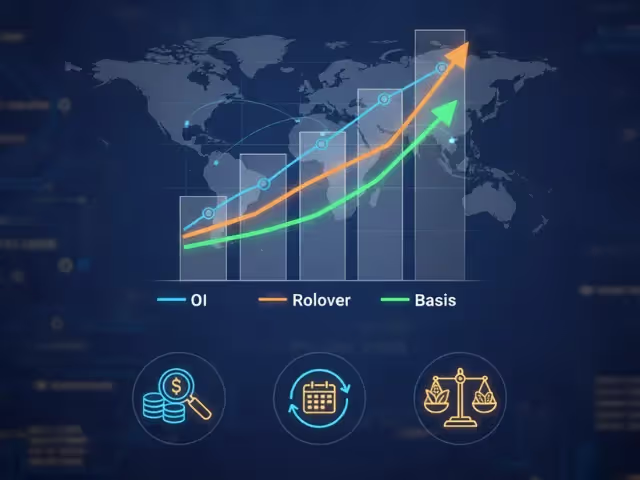
How to Read Commodity Futures Data: OI, Rollover & Basis Explained
Key Takeaways
- Open Interest (OI) shows trader participation and trend strength.
- Rollover reveals how many contracts are carried to next month’s expiry.
- Basis measures spot–futures price gap and sentiment.
- Together, they help traders spot long/short build-ups in commoditie
- Swastika Investmart provides SEBI-compliant analytics & expert insights for futures traders.
Introduction: Why Commodity Futures Data Matters
Commodity futures trading in India has evolved into a data-driven discipline. Successful traders today don’t just rely on price they decode Open Interest (OI), Rollover, and Basis to understand market positioning, strength, and sentiment.
Whether you trade on the Multi Commodity Exchange (MCX) or National Commodity & Derivatives Exchange (NCDEX), learning to interpret these metrics can transform the way you make decisions.
Let’s break them down in simple terms and see how brokers like Swastika Investmart help you read them efficiently.
1. What Is Open Interest (OI)?
Open Interest (OI) refers to the total number of outstanding contracts (buy or sell) that remain open in a commodity’s futures market.
- Rising OI means new positions are being built.
- Falling OI means traders are closing their positions.
In simple words: OI shows how many traders are active and how confident they are in the trend.
Example:
If Crude Oil futures prices rise from ₹6,800 to ₹7,000 and OI also rises, it means new long positions are being added bullish sentiment.
Swastika Investmart’s live OI trackers and heatmaps help traders identify these patterns in real time across commodities.
2. What Is Rollover in Commodity Futures?
Futures contracts have expiry dates monthly for most commodities. As expiry nears, traders either square off or roll over their positions to the next month’s series.
Rollover (%) = (Next Month OI / Current Month OI) × 100
A higher rollover percentage shows continuity of conviction traders are carrying their view forward.
Example:
If Gold futures rollover is 85%, it means most traders are confident about the trend continuing in the next month’s contract.
Swastika Investmart’s derivatives dashboard visually compares rollover ratios across series, helping you track where institutional money is flowing.
3. What Is Basis and Why Does It Matter?
Basis = Futures Price – Spot Price
It measures the difference between current futures and spot (cash) prices.
- Positive Basis (Futures > Spot): Bullish tone (cost of carry or storage).
Negative Basis (Futures < Spot): Bearish tone (weak demand or oversupply).
Example:
If Copper spot = ₹720 and Futures = ₹730, basis = +₹10 → bullish undertone.
If Futures = ₹710 → basis = –₹10 → bearish tone or oversupply.
4. Combining OI, Rollover, and Basis for Better Analysis
Smart traders don’t look at these metrics in isolation they combine all three to read the full market picture.
5. SEBI’s Role in Safeguarding Commodity Traders
SEBI (Securities and Exchange Board of India) ensures commodity futures trading remains transparent and regulated through:
- Margin requirements to control leverage risk.
- Daily mark-to-market (MTM) settlement.
- Position limits to avoid excessive speculation.
- Real-time data disclosure for OI, rollover, and basis via MCX/NCDEX.
Swastika Investmart’s trading systems follow all SEBI guidelines, ensuring traders have safe, compliant access to futures data.
6. AI & Analytics in Reading Commodity Data
The future of commodity analysis is AI-enhanced.
Modern platforms now use machine learning to analyze OI spikes, basis fluctuations, and rollover trends.
AI tools can even predict probable breakouts in commodities like Gold, Crude, or Copper by studying patterns across contracts.
FAQs
1. What does Open Interest indicate in commodity futures?
It shows total open contracts rising OI means new positions (bullish or bearish), falling OI means closure or unwinding.
2. How can rollover help traders?
Rollover reveals how many traders carry positions to the next month, reflecting conviction in the trend.
3. What does basis tell us?
Basis shows whether futures are trading at a premium or discount to spot indicating market sentiment.
4. How is SEBI involved in commodity futures?
SEBI regulates all trading activity, margins, and reporting standards to ensure transparency and investor protection.
5. How does Swastika Investmart help commodity traders?
Swastika offers real-time analytics, AI-integrated insights, and SEBI-compliant execution, helping traders decode OI, rollover, and basis effectively.
Conclusion
Reading commodity futures data is the art of understanding what the market is thinking not just what the price is doing.
By tracking Open Interest, Rollover, and Basis, you gain insights into trader psychology, institutional positioning, and upcoming trends.
And when you trade through Swastika Investmart, you combine that insight with research-backed data, advanced dashboards, and SEBI-regulated safety.
In the AI-driven era of 2025, data isn’t just information it’s your competitive advantage.
👉 Open your Demat & Trading Account with Swastika Investmart — trusted SEBI-registered broker with expert research, powerful tools, and dedicated customer support.
%20(9).avif)
Is Lenskart IPO Worth Your Money? Full Reality Check!
Key Takeaways
- IPO size: ₹7,278 crore (₹2,150 crore fresh issue + ₹5,128 crore OFS)
- Valuation: Extremely high – P/E above 200x, EV/Sales near 10x
- Profit quality: FY25 profit inflated by a one-time non-cash gain
- Strengths: Strong brand, omnichannel presence, investor confidence
- View: Solid business, but valuations look stretched → Neutral rating.
A Stylish IPO with a Price Tag to Match
Lenskart Solutions Ltd., founded in 2008, has transformed from an online eyewear seller into India’s largest tech-enabled eyewear retailer. With over 2,723 stores across India and overseas, the company manufactures, designs, and retails prescription glasses, sunglasses, and contact lenses through its own platform and app (over 100 million downloads).
After years of steady growth, Lenskart turned profitable in FY25 with a net profit of ₹297 crore and an EBITDA margin of 13.85%, up from 11.98% in FY24. The company’s revenue jumped 22.6% YoY to ₹6,652 crore, showing strong operating momentum.
But is that enough to justify its ₹70,000 crore market cap? Let’s break it down.
IPO Details at a Glance
Where the Money Will Go
The company plans to use the IPO proceeds for:
- Expanding company-owned stores (CoCo model) and meeting related lease costs.
- Investing in technology infrastructure, cloud systems, and marketing.
- Acquisitions and general corporate purposes.
Why Investors Are Interested
1. India’s Eyewear Market = Huge Opportunity
India’s eyewear industry is under-penetrated, with a large unorganized segment. Lenskart’s direct-to-consumer approach, backed by tech-driven supply chains and omnichannel reach, gives it a strong foothold in this expanding market.
2. Strong Brand Recall
With affordable yet trendy eyewear, Lenskart enjoys strong customer loyalty, particularly among millennials and Gen Z consumers.
3. Veteran Investor Backing
The entry of Radhakishan Damani, a respected market veteran, has boosted confidence among investors and analysts alike.
The Flip Side: Why You Should Be Cautious
1. Aggressive Valuation
Lenskart’s valuation metrics are sky-high.
- P/E: 200x+
- EV/Sales: ~10x
At these levels, the stock is priced for perfection, leaving minimal room for error if growth slows or margins shrink.
2. Profit Quality Concerns
FY25’s ₹297 crore profit primarily came from a one-time non-cash accounting gain, raising questions about the sustainability of earnings in future periods.
3. High Dependence on China
Over 40% of raw material and component sourcing is tied to Chinese suppliers via joint ventures, exposing the company to geopolitical risks and supply disruptions.
4. Competitive Pressure
Competition is rising from both online and offline eyewear players, including Titan’s Eye+ and new D2C startups. Maintaining growth while preserving margins could be challenging.
Market Context: Why It Matters
The Lenskart IPO arrives at a time when investor appetite for consumer tech companies is strong, but valuations are under scrutiny. With peers like Mamaearth and Boat facing post-listing volatility, investors are becoming cautious.
The company’s ₹7,278 crore issue, where 70% of funds (OFS) go to existing shareholders, signals that much of the offer is an exit opportunity for early investors rather than a pure growth capital raise.
Swastika Investmart’s View
Swastika Investmart has assigned a Neutral Rating to the Lenskart IPO.
The business fundamentals are solid — large customer base, strong brand, scalable tech model — but valuation comfort is missing.
For long-term investors, it may be worth watching post-listing performance before taking exposure.
FAQs
1. What is the Lenskart IPO price band?
The price band is set between ₹382 and ₹402 per share.
2. How much of the IPO is fresh issue?
₹2,150 crore is a fresh issue, while ₹5,128 crore is an offer for sale by existing shareholders.
3. Is Lenskart profitable?
Yes, the company turned profitable in FY25 with ₹297 crore net profit, though most of it came from a one-time accounting gain.
4. What is Swastika’s recommendation?
Swastika Investmart gives a Neutral rating — strong business, but valuations are on the higher side.
5. Should retail investors apply?
Apply only if you believe in long-term growth potential and can tolerate near-term valuation risk.
Conclusion
Lenskart’s IPO brings together a powerful mix of brand strength, tech-driven growth, and a booming consumer market. However, the steep valuation and profit quality concerns make it a case of “great company, expensive price.”
For investors looking for balanced, research-backed guidance and reliable support, Swastika Investmart offers SEBI-registered expertise, strong research tools, and tech-enabled investing platforms to help you make informed decisions.
👉 Open your Demat & Trading Account with Swastika Investmart — trusted SEBI-registered broker with expert research, powerful tools, and dedicated customer support.
.avif)
Why Every Investor Needs a Demat Account in the AI-Driven Era
Key Takeaways
- A Demat account is your digital locker for investments, essential for AI-based investing and automation.
- AI tools now analyze portfolios, trends, and risks directly linked to your Demat holdings.
- SEBI, NSDL, and CDSL ensure Demat safety and investor protection.
- Swastika Investmart merges AI-powered insights with traditional trust.
- Investing without a Demat account means missing out on future-ready financial ecosystems.
Introduction: The New Age of Investing
We’ve entered an era where algorithms predict market moves, AI tools build personalized portfolios, and data-driven insights guide investment decisions.
Yet, at the center of this high-tech transformation lies a humble yet vital foundation the Demat Account.
A Demat (Dematerialized) Account is more than a place to hold your shares digitally it’s the gateway to AI-powered wealth creation, offering security, automation, and integration with new-age trading tools.
Let’s explore why every investor beginner or seasoned needs one in the AI-driven era of investing.
What Is a Demat Account?
A Demat Account stores shares, ETFs, bonds, and mutual fund units in electronic form, eliminating the need for physical certificates.
It’s regulated by SEBI and maintained through depositories like NSDL (National Securities Depository Limited) and CDSL (Central Depository Services Limited).
In simpler terms, it’s your digital locker where all your investments live securely.
You can open one through SEBI-registered brokers like Zerodha, Groww, Angel One, Upstox, or Swastika Investmart, each connected to NSDL/CDSL systems.
Why a Demat Account Is Non-Negotiable in 2025
In the past, investors tracked stock certificates manually. Today, everything from IPOs to ETFs happens digitally.
Without a Demat account, you can’t even buy or sell listed securities on Indian exchanges.
But in 2025, the importance goes beyond compliance it’s about unlocking AI-powered efficiency.
Here’s why 👇
1. AI-Driven Portfolio Insights
AI systems analyze your holdings to recommend rebalancing, risk management, and tax-efficient moves all possible through your linked Demat data.
2. Automated Risk Management
Modern trading platforms use machine learning to monitor price movements and auto-trigger stop-loss or alerts based on your Demat positions.
3. Smart Order Execution
AI-powered brokers use predictive analytics to optimize entry/exit points, saving time and reducing emotional bias.
4. One-Tap Portfolio Visualization
AI dashboards visualize your holdings in real time across stocks, mutual funds, ETFs, and bonds all synced to your Demat account.
5. Enhanced Security & Fraud Detection
AI algorithms track unusual transactions, flagging unauthorized access, and protecting investors under SEBI’s investor protection framework.
AI + Demat: A Future-Ready Partnership
The integration of Artificial Intelligence with Demat systems has revolutionized how investors interact with markets.
As AI grows, your Demat account becomes the central nervous system of your financial profile, connecting multiple apps, analytics, and strategies in one ecosystem.
SEBI’s Role: Keeping the AI Age Investor-Safe
Even in this high-tech world, SEBI remains the ultimate safeguard.
It ensures brokers, platforms, and AI tools adhere to transparency, risk disclosure, and investor data protection norms.
Key measures include:
- Mandatory KYC verification for Demat account holders.
- Two-factor authentication (TPIN/eDIS) for trades.
- Periodic audits of brokers and depositories.
- Real-time alerts via NSDL/CDSL for every transaction.
This ensures that technology serves investors not the other way around.
Why Swastika Investmart Is Built for the AI Era
While fintech startups focus on automation, Swastika Investmart combines the best of both worlds human expertise + artificial intelligence.
Here’s why it stands out in 2025:
- AI-powered research and portfolio screeners built for retail investors.
- SEBI-registered advisory and compliance-first execution.
- Regional support centers for vernacular assistance and onboarding.
- Smart notification systems for order tracking, margin alerts, and data security.
- Integration with CDSL’s eDIS and TPIN protocols for fraud-free investing.
In short, Swastika isn’t just offering a Demat account it’s offering a secure, intelligent, and intuitive investing experience.
Beginner Scenario: How AI Empowers New Investors
Let’s take Riya, a 27-year-old new investor from Pune.
She opens a Swastika Demat account, links it to an AI-driven app, and starts her first SIP in ETFs.
The AI platform analyzes her portfolio:
- Suggests rebalancing when midcaps get overweighted.
- Sends alerts when her holdings approach target profit.
- Recommends switching to tax-efficient ELSS in March.
Her investments are safe (SEBI-regulated), accessible (24/7 dashboard), and optimized (AI-driven).
That’s the future where AI and Demat work hand-in-hand for wealth creation.
Demat Account Benefits in the AI Era
FAQs
1. Why is a Demat account important in the AI era?
Because AI-driven platforms depend on Demat-linked data to analyze, automate, and execute smart investment decisions securely.
2. Can AI trade using my Demat account automatically?
Yes, through SEBI-approved APIs and eDIS authorization, AI platforms can execute trades with your consent.
3. Is my data safe in an AI-linked Demat account?
Absolutely. SEBI, NSDL, and CDSL enforce data encryption and dual-factor authentication to ensure safety.
4. Which broker offers the best AI-integrated experience?
Swastika Investmart stands out with its AI tools, transparent advisory, and regionally personalized investor support.
5. Can beginners benefit from AI-driven investing?
Yes. AI tools simplify analysis, automate risk alerts, and guide SIPs, making it easier for new investors to start smartly.
Conclusion
In an age where AI analyzes trillions of data points before a single trade is placed, your Demat account becomes the bridge between human intelligence and machine precision.
From real-time insights to fraud detection, it powers the next generation of smart investing.
By choosing a SEBI-regulated broker like Swastika Investmart, you combine AI innovation, research-backed strategy, and old-school trust exactly what investors need in this digital era.
Because the future of investing isn’t just about returns it’s about intelligence, safety, and evolution.
👉 Open your Demat & Trading Account with Swastika Investmart — trusted SEBI-registered broker with expert research, powerful tools, and dedicated customer support.
.avif)
India’s No.1 Helmet Brand Goes Public! Studds IPO Explained
Key Takeaways
- Studds Accessories Ltd., India’s leading helmet manufacturer, launches its ₹455.49 crore IPO.
- Price band: ₹557–₹585 per share; Market Cap: ₹2,302 crore.
- Strong brands “Studds” & “SMK” dominate both domestic and global markets.
- EBITDA margin rose to 20% and PAT margin to 11.9% in FY25.
- Swastika Investmart recommends Subscribe for Long-Term.
A Safety Leader Now on the Stock Market
If you’ve ever worn a helmet in India, chances are high it carried the Studds logo. Incorporated in 1975 and established in 1983, Studds Accessories Limited is headquartered in Faridabad, Haryana. Over the last four decades, it has transformed from a small manufacturer to India’s largest two-wheeler helmet company by revenue and the world’s largest by volume.
The company designs, manufactures, and markets helmets and two-wheeler accessories under two strong brands —
- Studds: Targets mass and mid-market customers.
- SMK: Premium segment with advanced features and style.
With over 9 million units annual manufacturing capacity and exports to 70+ countries, Studds stands as a global face of Indian safety gear innovation.
IPO Details at a Glance
Issue Allocation:
Company Performance: A Helmet That Fits Financial Growth
Studds has maintained consistent top-line growth with rising profitability. Its PAT margin improved from 6.6% in FY23 to 11.9% in FY25, reflecting strong cost efficiency and better product mix.
The company’s Return on Capital Employed (ROCE) stands at 20.25%, signaling efficient utilization of capital resources.
Key Strengths: What Makes Studds Stand Out
- Market Leadership: Dominant player in India’s two-wheeler helmet segment and world’s largest by volume.
- Strong Brand Equity: “Studds” and “SMK” enjoy near-monopoly recognition among riders.
- Integrated Operations: In-house design, R&D, and advanced manufacturing ensure quality and quick production cycles.
- Global Reach: Presence in over 70 countries across Asia, Europe, and Africa.
- Sustainability Focus: Energy-efficient processes and recyclable materials enhance long-term brand trust.
Key Risks and Concerns
- Geographic Concentration: All plants are located in Faridabad — regional disruptions could impact operations.
- Safety Hazards: Use of flammable materials may pose operational risks.
- Export Dependency: Exposure to international product liability claims.
- Auto Sector Dependence: Demand tied closely to two-wheeler industry performance.
- Regulatory Delays: Any delay in government or factory-level approvals can affect production.
Valuation & Outlook
At the upper price band of ₹585, Studds is valued at a P/E of 33.05x based on FY25 earnings. This makes the issue fully priced, but justified considering its steady growth trajectory, brand dominance, and future expansion plans — including a new high-capacity manufacturing facility in Telangana.
Swastika Investmart’s research team has given a “Subscribe for Long-Term” rating, citing stable profitability, market leadership, and scalability potential.
Strategic Expansion Plans
- Setting up a modern manufacturing unit in Telangana.
- Expanding premium offerings under “SMK.”
- Strengthening online sales and digital presence.
- Deepening vertical integration for efficiency and cost savings.
- Exploring new international markets for export growth.
Market Context & Industry Impact
India’s two-wheeler market continues to grow, driven by rising urban mobility and affordable financing. With stricter helmet safety norms and increasing awareness, demand for certified helmets is surging. Studds, already a trusted household name, is well-positioned to capitalize on this long-term shift.
Its IPO not only represents a growth opportunity for investors but also signals the maturing of India’s protective gear manufacturing ecosystem — aligning perfectly with the Make in India and Atmanirbhar Bharat initiatives.
FAQs
1. What is the price band for Studds Accessories IPO?
The price band is set between ₹557 and ₹585 per share.
2. What are the IPO opening and closing dates?
It opens on October 30, 2025 and closes on November 3, 2025.
3. How is Studds financially performing?
The company reported ₹595.89 crore in revenue for FY25 with a 20% EBITDA margin and 11.9% PAT margin.
4. Is the IPO fairly priced?
At a P/E of 33.05x, it’s fully priced but supported by strong fundamentals and long-term growth potential.
5. Should investors apply for this IPO?
Swastika Investmart recommends Subscribe for Long-Term given the company’s brand strength and consistent performance.
Conclusion
Studds Accessories Ltd. brings a blend of brand legacy, consistent financial growth, and innovation to the Indian stock market. While valuations appear on the higher side, its leadership position and robust expansion strategy justify investor confidence.
If you’re a long-term investor seeking exposure to India’s rising safety gear and auto accessory sector, this IPO could be a solid pick.
👉 Open your Demat & Trading Account with Swastika Investmart — trusted SEBI-registered broker with expert research, powerful tools, and dedicated customer support.
%20(8).avif)
From Kitchen to Capital Market: Orkla India’s IPO Explained
Key Takeaways
- Orkla India owns heritage brands MTR, Eastern and Rasoi Magic and sells 2.3 million units daily.
- IPO opens Oct 29 and closes Oct 31, 2025; price band ₹695–₹730; total issue ₹1,667.54 crore.
- FY25 revenue ₹2,455.24 crore; EBITDA margin 16.15% in FY25 (up from 14.39% in FY24).
- Despite strong brands, three-year revenue and profit growth is muted; Assigns a Neutral view.
Orkla India’s IPO at a glance
Orkla India, incorporated in 1996, is a multi-category Indian food company with a portfolio spanning breakfast, snacks, ready-to-cook mixes, beverages and desserts. Its flagship heritage brands — MTR, Eastern and Rasoi Magic — give the company strong consumer recall and distribution reach.
The IPO opens on 29 October 2025 and closes on 31 October 2025, with a price band of ₹695–₹730 and a total issue size of ₹1,667.54 crore. Listing is planned on BSE and NSE.
Key numbers investors should note
- Reported consolidated total income for FY25: ₹2,455.24 crore.
- EBITDA margin improved to 16.15% in FY25 from 14.39% in FY24 and 14.19% in FY23.
- Net profit in FY25 stood at ₹255.69 crore.
- The company distributes 2.3 million units daily and exports to 40+ countries; manufacturing footprint includes India, UAE, Thailand and Malaysia.
Why the IPO matters (market context)
Orkla India’s listing is significant for two reasons. First, it brings well-known Indian heritage FMCG brands to the public markets, giving retail investors direct access to home-grown food staples. Second, the offering arrives at a time when FMCG valuations are under scrutiny — investors are weighing brand strength against growth momentum and raw-material cost pressure.
In the broader market, FMCG companies with clear growth levers and steady margin profiles tend to attract long-term investors. Orkla India has brand and distribution strength, but the IPO note flags limited revenue and profit growth over the last three years, which tempers the upside expectation.
Strengths and risks — straight from the IPO note
Strengths
- Category leader in packaged spices and a multi-category product portfolio with >400 SKUs.
- Scalable pan-India distribution, growing digital and export channels, and automated manufacturing with quality controls.
Key risks
- Raw and packaging materials accounted for 56.8% of total expenses in FY25; any adverse commodity movement can hit margins.
- Dependence on key suppliers and risks around storage/contamination can lead to regulatory or reputational damage.
- The IPO note also highlights the need to drive household penetration and operational efficiencies to improve margins.
What the Neutral rating signals to investors
The report’s Neutral rating reflects a balanced view: strong brands and wide distribution versus muted growth and valuation that looks tight relative to recent performance. The IPO may suit investors who value brand equity and steady cash flows, but those seeking aggressive growth or quick listing pops may find the risk-reward limited.
Real-world example to put it in perspective
Think of Orkla India as a beloved regional restaurant chain that has mastered its recipes and built loyal customers but has only slowly expanded footprint and average spend per customer. The brand gives trust, but without faster store openings or higher per-store sales, revenue growth remains modest. The IPO offers a chance to own that brand, but returns will depend on execution — expanding penetration, new products, cost management — all points flagged in the IPO note.
Regulatory and disclosure checklist for investors
- Read the Red Herring Prospectus for detailed risk factors and allocation rules; the IPO note points readers to the RHP for full disclosures.
- IPO allotment, refund and listing timeline are provided in the IPO note — check the dates before applying.
Frequently asked questions
Q: When is the Orkla India IPO open?
A: The IPO opens on October 29, 2025 and closes on October 31, 2025.
Q: What is the price band and issue size?
A: Price band is ₹695–₹730 per share; total issue size is ₹1,667.54 crore.
Q: Is Orkla India profitable?
A: Yes. FY25 net profit was ₹255.69 crore and EBITDA margin improved to 16.15% in FY25.
Q: What are the main risks?
A: Major risks include commodity cost volatility (raw & packaging materials), supplier dependence, and execution risks around scaling distribution.
Conclusion
Orkla India brings established brands and wide distribution to the IPO market. The company’s FY25 improvements in margin and steady revenue base are positives, but muted three-year growth and commodity-linked cost structure justify a cautious stance. Hence, we assign a Neutral rating.
If you want research, easy online account opening, and tech-enabled trading to act quickly on IPOs, Swastika Investmart offers SEBI-registered services, strong research tools, responsive customer support, and investor education to help you decide.
.avif)
Dhani Services and Yaari Digital Merge into Indiabulls Enterprises — A New Era for the Group?
Key Takeaways
- Dhani Services and Yaari Digital merged into Indiabulls Enterprises on October 14, 2025.
- The move marks a strategic consolidation aimed at improving efficiency and investor confidence.
- Indiabulls aims to streamline operations and focus on core financial and digital services.
- Market experts view it as a turnaround move for the group after years of restructuring.
- Investors are keenly watching how this merger reshapes the Indiabulls Group’s long-term strategy.
A Strategic Consolidation for a New Beginning
The Indian financial landscape witnessed another major corporate development as Dhani Services and Yaari Digital Integrated Services officially merged into Indiabulls Enterprises Limited (IEL), effective October 14, 2025.
This merger is being seen as part of Indiabulls Group’s broader strategy to consolidate its diversified businesses under one umbrella — bringing digital finance, technology services, and investments together. The aim is to simplify the group’s structure, improve capital allocation, and drive long-term growth.
For a group that has seen multiple transitions — from housing finance to diversified digital ventures — this move could mark the beginning of a new growth chapter.
Why the Merger Matters
India’s financial ecosystem has evolved rapidly, with increasing regulatory scrutiny and technological disruption. The merger of Dhani and Yaari into Indiabulls Enterprises is not just an internal reshuffle — it signals the Group’s intent to reinvent itself.
- Operational Efficiency:
By combining digital and investment platforms, IEL can reduce redundancy, cut costs, and create synergies between its fintech and enterprise divisions. - Focus on Core Competence:
Indiabulls aims to streamline focus on core businesses — including financial services, tech-driven lending, and enterprise solutions — while reducing fragmentation. - Investor Confidence:
Post-merger, a more transparent and simplified structure may boost investor trust, especially after regulatory and financial challenges faced by the group in past years.
A Look at the Businesses Involved
Dhani Services Limited made a name for itself in the digital lending and healthcare space, offering consumer credit and telemedicine through its app. On the other hand, Yaari Digital Integrated Services functioned as a digital community platform, connecting users and small businesses through a tech-driven ecosystem.
Indiabulls Enterprises, the new combined entity, is expected to leverage Dhani’s financial services technology and Yaari’s digital platform to create a robust, integrated ecosystem — blending fintech, e-commerce, and enterprise solutions under one brand identity.
Market Reaction and Investor View
Following the merger announcement, investors have shown cautious optimism. While the stock movement of Indiabulls-linked entities has been modest, the consolidation signals a strategic intent to rebuild value.
Market analysts believe that Indiabulls’ move is timely, especially given the RBI’s focus on governance, capital adequacy, and simplified corporate structures in NBFCs and fintech firms. This merger positions IEL to align with these evolving regulatory standards while enhancing efficiency.
Moreover, with global and domestic investors showing renewed interest in India’s financial sector, such consolidations could help the group attract fresh capital and partnerships.
Broader Impact on the Indian Market
This merger also reflects a larger trend in India’s corporate world — streamlining for scale. Over the last few years, several conglomerates like Aditya Birla Capital, Tata Digital, and Reliance Retail Ventures have adopted similar consolidation models to improve efficiency and brand synergy.
For the Indian capital markets, such reorganizations are generally viewed positively, as they:
- Improve corporate governance transparency
- Enhance investor visibility and valuations
- Reduce regulatory complexities
In this sense, the Dhani–Yaari–Indiabulls merger aligns perfectly with India’s shift towards simplified, tech-driven business models.
Challenges Ahead
While the move brings promise, challenges remain:
- Integration Complexity: Combining multiple business models under one entity may take time.
- Revenue Realignment: Ensuring profitability across fintech and digital service verticals could be difficult in the near term.
- Brand Perception: Rebuilding investor and consumer trust after past regulatory hurdles remains a key task.
Yet, if executed effectively, Indiabulls Enterprises could emerge as a leaner, more focused, and digitally strong financial enterprise.
Example of Strategic Reinvention
Much like HDFC’s merger with HDFC Bank or L&T’s consolidation of its tech and finance arms, Indiabulls’ move echoes the ongoing transformation in Indian corporate strategy — where simplification drives scalability.
Such restructuring may also help the group align better with SEBI’s disclosure norms, RBI’s compliance frameworks, and investor expectations for transparency and governance.
FAQs
1. What happened to Dhani Services and Yaari Digital?
Both companies were merged into Indiabulls Enterprises Limited effective October 14, 2025, as part of the group’s internal restructuring.
2. Why did Indiabulls go for this merger?
The merger aims to streamline operations, enhance efficiency, and create a unified digital and financial ecosystem under one entity.
3. Will this merger affect existing shareholders?
Shareholders of Dhani and Yaari will receive shares in Indiabulls Enterprises as per the approved swap ratio, consolidating their ownership in the merged entity.
4. What is the future outlook for Indiabulls Enterprises?
If the integration succeeds, the company could benefit from cost synergies, better governance, and renewed investor confidence.
5. How does this impact India’s financial market?
The merger signals continued consolidation in India’s financial services and fintech space — a positive sign for efficiency and compliance-driven growth.
Conclusion
The merger of Dhani Services and Yaari Digital into Indiabulls Enterprises marks a strategic move toward simplification, efficiency, and renewed focus. It highlights how Indian corporates are adapting to regulatory evolution and competitive fintech disruption.
As this integration unfolds, investors should watch for execution consistency, profitability metrics, and governance transparency — key factors that will define the group’s next growth phase.
For investors looking to stay ahead in India’s evolving financial market, Swastika Investmart offers SEBI-registered research insights, strong customer support, advanced tech tools, and educational resources to help you make informed investment decisions.
👉 Open your trading account today and be part of India’s financial transformation story.

MCXBULLDEX Option Launch: A Landmark Moment in India’s Commodity Derivatives Journey
Key Takeaways
- MCXBULLDEX Option is India’s first-ever Commodity Index Option, launched on 27th October 2025.
- Based on Gold and Silver futures, it offers a unique dual-commodity exposure.
- Cash-settled and synchronized expiry simplify trading and hedging.
- Designed for both retail and institutional investors, with lower premiums and portfolio margin benefits.
- A landmark innovation deepening India’s commodity derivatives ecosystem.
MCXBULLDEX Option Launch: A Landmark Moment in India’s Commodity Derivatives Journey
India’s commodity markets just achieved a historic milestone. On 27th October 2025, the Multi Commodity Exchange of India (MCX) unveiled the country’s first-ever Commodity Index Option — the MCXBULLDEX Option.
This innovative financial instrument represents a breakthrough for traders, hedgers, and investors seeking efficient exposure to the precious metals segment. Built on a composite of Gold and Silver futures, the MCXBULLDEX Option ushers in a new era of portfolio diversification, risk management, and market depth in India’s commodity derivatives landscape.
Let’s understand why this launch is being hailed as a game-changer for India’s commodity ecosystem.
What is the MCXBULLDEX Option?
The MCXBULLDEX Option contract is a derivative product linked to the MCX BULLDEX Index—an index that tracks a blend of gold and silver futures prices.
This means traders can now take a position on the combined performance of gold and silver, rather than trading each metal separately. The contract is cash-settled, eliminating the need for physical delivery.
MCX has designed this product to simplify commodity trading, expand retail participation, and strengthen the derivatives ecosystem.
Why the Launch Matters
The MCXBULLDEX Option isn’t just another contract—it’s a strategic innovation with far-reaching implications for India’s financial markets. Here’s why it matters:
1. India’s First Commodity Index Option
This is a first-of-its-kind development in India’s derivatives space. Until now, commodity options existed only on individual products like gold, silver, or crude oil.
With the MCXBULLDEX Option, traders get exposure to two major commodities through one index, making it a milestone in market sophistication.
2. Cash Settlement and Simplicity
Unlike traditional futures, which can involve physical delivery, this contract is cash-settled. This means that on expiry, differences are settled in cash—simplifying operations for traders and investors.
3. Synchronized Expiry
The option expires on the same day and time as its underlying BULLDEX Futures contract. This synchronized expiry removes devolvement complexities and ensures a seamless trading experience.
4. Accessibility for Retail Investors
The lower premium structure and smaller contract size make the MCXBULLDEX Option an affordable entry point for retail investors.
This democratizes commodity investing, allowing even small traders to hedge against metal price fluctuations.
5. Portfolio Diversification & Margin Efficiency
With portfolio-based margining, clients enjoy reduced margin requirements, improving capital efficiency.
By combining gold and silver exposure, the contract also offers built-in diversification, balancing risk between two correlated assets.
Real-World Impact: A Boost for Traders and Hedgers
For years, Indian investors looking to hedge or speculate on metals had to manage separate gold and silver positions—doubling effort, cost, and margin requirements.
The MCXBULLDEX Option simplifies this process dramatically:
- Jewellery manufacturers can hedge against price fluctuations in both metals simultaneously.
- Retail traders can use it to take leveraged positions with smaller capital.
- Institutional investors can integrate it into multi-asset strategies for portfolio optimization.
By enhancing convenience, MCX has effectively made precious metals trading more inclusive and efficient.
How It Strengthens India’s Commodity Derivatives Market
India’s commodity derivatives ecosystem has evolved rapidly, especially after SEBI’s regulatory reforms that unified securities and commodity markets.
The MCXBULLDEX Option aligns perfectly with SEBI’s broader vision:
- Encourage innovation in derivatives products
- Broaden retail participation
- Improve market transparency
- Strengthen risk management tools
This launch will likely deepen liquidity, attract foreign participants, and increase hedging volumes, making India’s commodity markets globally competitive.
Comparison with Global Commodity Index Options
Globally, index-based commodity options like the S&P GSCI or Bloomberg Commodity Index Options have long offered investors efficient diversification.
By introducing the MCXBULLDEX Option, India joins this elite group, providing domestic traders an instrument that mirrors global best practices—but customized for India’s precious metals market.
This move is also expected to pave the way for future launches of energy and agri-based index options in India.
Regulatory and Market Context
The launch aligns with SEBI’s progressive stance toward product innovation and risk management. Over the past few years, SEBI has supported the introduction of options on futures, commodity ETFs, and now index-based options.
MCX, as the country’s leading commodity exchange, continues to play a pioneering role in:
- Technology-driven trading infrastructure
- Transparent pricing
- Investor education initiatives
This synergy of regulation, innovation, and technology makes India’s commodity markets more resilient and accessible than ever before.
FAQs
Q1. What is the MCXBULLDEX Option contract?
A1. It’s India’s first commodity index option based on the MCX BULLDEX Index—a composite of Gold and Silver futures—launched on 27th October 2025.
Q2. How is it different from regular gold or silver options?
A2. Unlike single-commodity options, it provides exposure to both gold and silver, offering diversification and efficient hedging.
Q3. Do traders need to take physical delivery?
A3. No. The contract is cash-settled, so positions are settled monetarily upon expiry.
Q4. Who can trade the MCXBULLDEX Option?
A4. Both retail and institutional participants can trade, with lower premiums making it highly accessible.
Q5. Why is this launch significant for India’s markets?
A5. It enhances product diversity, improves hedging tools, and represents India’s entry into advanced global commodity derivatives practices.
Conclusion
The MCXBULLDEX Option is more than just a new product—it’s a symbol of India’s financial market maturity.
By combining innovation, accessibility, and efficiency, MCX has taken a bold step toward transforming India’s commodity derivatives landscape.
For traders and investors, this opens the door to smarter hedging, diversified exposure, and efficient capital use.
In a fast-evolving market, staying ahead with trusted insights is essential.
👉 Open your Swastika Investmart account to explore opportunities in commodities, equities, and derivatives with expert research and guidance from a SEBI-registered, tech-enabled, and investor-focused platform.

Rising Global Confidence: How Massive Foreign Investments Are Powering India’s Banking Sector Boom
Key Takeaways
- India’s banking sector has seen a record surge in foreign investments post-2024.
- Strong GDP growth, fintech innovation, and improved asset quality attract global capital.
- FDI inflows boost credit availability and market valuations.
- Swastika Investmart helps investors identify the right banking and NBFC opportunities.
Rising Global Confidence: How Massive Foreign Investments Are Powering India’s Banking Sector Boom
India’s banking sector is buzzing with optimism. Over the past year, it has emerged as one of the biggest beneficiaries of renewed foreign investor confidence, driven by robust macroeconomic growth, improving asset quality, and policy stability.
Foreign portfolio inflows into Indian banks and NBFCs crossed $12 billion in FY 2025, the highest in a decade.
🌍 1. Why Global Investors Are Bullish on Indian Banks
a. Strong Economic Fundamentals
India’s GDP is growing at over 7%, making it the fastest-growing major economy. Global funds see Indian banks as the gateway to consumption-led growth—credit expansion fuels everything from housing to MSME development.
b. Asset Quality Revival
Gross NPAs (non-performing assets) have fallen to 3.1%, the lowest in 12 years. PSU and private banks have cleaned up balance sheets and built robust capital buffers.
c. Regulatory Support
The Reserve Bank of India (RBI) has maintained policy stability and encouraged digital inclusion through initiatives like UPI 2.0, Aadhaar-linked lending, and Account Aggregator frameworks.
💰 2. Key Drivers of the Banking Sector Boom
a. FPI and FDI Surge
Foreign investors, including sovereign funds from Singapore, UAE, and Japan, have made significant bets on Indian banks and NBFCs. Strategic stakes in leading private lenders are a vote of confidence in India’s long-term growth story.
b. Digital Banking Revolution
India’s rapid fintech adoption—credit scoring, AI-driven lending, and digital KYC—has increased operational efficiency. This tech-backed transformation appeals strongly to global funds.
c. Strong Corporate Credit Cycle
Credit growth hit 14.8% YoY in 2025, led by infrastructure, manufacturing, and renewable energy. Banks with corporate lending expertise—HDFC Bank, ICICI Bank, and SBI—are major beneficiaries.
📈 3. Impact on Indian Markets
Valuation Upside
Banking stocks now contribute nearly 35% of the Nifty 50’s total market capitalization. The sector’s re-rating is supported by double-digit ROE and stable NIMs.
NBFC Resurgence
NBFCs like Bajaj Finance and Tata Capital are drawing investor attention as consumption credit revives. Many have secured foreign partnerships to access low-cost global funding.
IPO Pipeline
Several small finance and fintech banks are preparing for IPOs in 2026, offering investors fresh opportunities.
4. India’s Regulatory Edge
The RBI’s proactive supervision has created one of the most stable financial systems in emerging markets. Capital adequacy norms, digital compliance, and risk-based lending practices have enhanced credibility among foreign investors.
Moreover, initiatives like GIFT IFSC and India Stack are positioning India as a global financial hub.
FAQs
Q1. Why are foreign investors increasing exposure to Indian banks?
A1. Strong growth, improved asset quality, and digital leadership make Indian banks highly attractive compared to global peers.
Q2. Which banking stocks are benefiting most?
A2. HDFC Bank, ICICI Bank, Axis Bank, SBI, and Kotak Mahindra Bank have seen robust FPI inflows.
Q3. Are PSU banks part of this rally?
A3. Yes. PSU banks like Bank of Baroda and Canara Bank have shown improved profitability and rising foreign interest.
Q4. What risks remain?
A4. Global rate volatility and liquidity tightening can affect flows, but India’s fundamentals remain resilient.
🌟 Conclusion
India’s banking sector boom is more than a cyclical rally—it’s a structural transformation driven by foreign trust, technology, and transparency.
For investors, this is a golden era to participate in India’s financial growth story—through equity, mutual funds, or sectoral ETFs.
👉 Open your account with Swastika Investmart and leverage expert research to tap into India’s banking revolution.

.avif)
.avif)

.avif)