Information
.avif)

Nvidia Results Explained: What They Mean for Indian Markets, IT Giants & Semiconductor Plans
.webp)

Key Takeaways
- Nvidia posted a record $57 billion revenue in Q3 FY26, driven by explosive demand for Blackwell AI chips.
- Its data-center segment surged 66% YoY, underlining its dominance in high-performance computing.
- Positive earnings strengthen the AI infrastructure narrative, potentially boosting semiconductor investments globally — including in India.
- Indian IT giants (like TCS, Infosys) could benefit indirectly through increased demand for AI services, while India’s semiconductor push gains momentum.
- Platforms like Swastika Investmart, with SEBI-registration and strong research tools, can help Indian investors tap Nvidia’s growth safely.
Nvidia’s Latest Earnings: What Went Down
Nvidia’s Q3 fiscal-2026 results were nothing short of spectacular. The company clocked $57.0 billion in revenue, a 22% increase quarter-over-quarter and a massive 62% year-over-year jump.
The data-centre business, which fuels much of Nvidia’s strength, reported $51.2 billion — up 25% sequentially and a whopping 66% YoY.
Earnings per share (diluted) stood at $1.30, beating market expectations. Gross margins remained healthy: ~73.4% on a GAAP basis and ~73.6% on non-GAAP.
Jensen Huang, Nvidia’s CEO, painted a bold picture: “Blackwell sales are off the charts, and cloud GPUs are sold out … We’ve entered the virtuous cycle of AI.”
On the capital return front, Nvidia has distributed $37 billion to shareholders via buybacks and dividends in the first nine months of fiscal 2026, while still retaining $62.2 billion under its repurchase authorization.
Why This Matters for Indian Markets
Surge in AI Infrastructure & Cloud Demand
Nvidia’s blazing growth is a clear sign that AI infrastructure is scaling up rapidly. For Indian cloud service providers, startups, and large enterprises, this means greater access to powerful compute — and hence more opportunity to build or scale AI-driven products, whether in generative AI, autonomous systems, or large-language-model applications.
Boost for Indian IT Giants
IT services companies such as TCS, Infosys, HCL Tech, and Wipro stand to benefit in multiple ways:
- AI Consulting & Implementation: As global firms lean into Nvidia-powered deployments, Indian IT firms can win more AI transformation projects.
- Edge Deployment: Nvidia’s edge computing push (AI at the edge) aligns well with telecom-led, localized AI deployments in India.
- Partnerships: These IT companies often partner with cloud hyperscalers; increases in data-centre investments could indirectly boost consulting and integration revenue.
Semiconductor Ambitions in India
India has long expressed ambitions to build a vibrant semiconductor ecosystem. Nvidia’s strong earnings fuel confidence in the global semiconductor demand outlook — which may in turn accelerate semiconductor-related investments in India.
- Government Push: In recent years, India has introduced incentive schemes (e.g., PLI for chip manufacturing) to attract global semiconductor players.
- Local Manufacturing: A continued boom in AI chips makes it more feasible for India to host fabs or assembly units, especially as global supply chains diversify.
- Talent Leverage: India’s deep engineering talent pool could feed specialized roles in design, testing, and AI compute research.
Broader Implications & Risks
While Nvidia’s results are a vote of confidence in the AI era, Indian investors and companies should also remain aware of potential headwinds:
- Regulatory Risk: Export controls, especially restrictions on chip technologies, could affect supply chains.
- Valuation Risk: Nvidia’s business is growing fast, but high expectations mean any missteps might trigger sharp market reactions.
- Competition: Other semiconductor players (both in the U.S. and Asia) are vying for a piece of the AI compute pie — and India’s own semiconductor strategy must be realistic and capital-efficient.
- Macroeconomic Conditions: Global interest rates, currency fluctuations, and supply-chain disruptions could influence profitability and investments.
How Indian Investors Can Navigate This
For Indian investors looking to play the Nvidia or AI-infrastructure story:
- Direct Exposure via US Markets: Buy Nvidia (NVDA) or related semiconductor stocks through brokerages with international access.
- Indirect Exposure via Indian Tech Stocks: Consider Indian IT firms that could gain from increased AI consulting, cloud migration, and data-centre deployment.
- ETFs & Themed Funds: Look for mutual funds or ETFs focused on AI, cloud, or semiconductor sectors.
- Research Tools Matter: Use a platform with robust research capabilities — like Swastika Investmart — to track earnings, sentiment, and global tech trends.
FAQ
Q1. Does Nvidia’s strong result mean an “AI bubble” is safe to ignore?
Not entirely. While Nvidia’s performance reinforces real demand, investors should maintain a balanced view — growth is strong, but it’s not without risks like supply chain bottlenecks, valuation, and geopolitical concerns.
Q2. How exactly will Indian semiconductor manufacturing benefit from Nvidia’s growth?
Higher global demand for AI chips strengthens the case for semiconductor investments in India. This could encourage more fabs, design centres, and collaborations if Indian policy and capital conditions align.
Q3. Should I invest in Nvidia directly or via Indian IT companies?
Both routes have merit. Direct exposure (NVDA shares) gives pure-play access, but investing in Indian IT companies offers leverage to India’s AI ecosystem growth, possibly with lower volatility and regulatory simplicity.
Q4. How does Swastika Investmart help in this context?
Swastika Investmart is SEBI-registered, offers powerful research tools, and supports international investing. Use its platform for guided insights, risk analysis, and thematic portfolios around AI/semiconductors.
Conclusion
Nvidia’s Q3 earnings are a resounding signal that AI infrastructure is accelerating, and the ripple effects could meaningfully shape the future of Indian technology markets. For Indian investors and corporations alike, this is more than just a U.S. company doing well — it’s an opportunity that aligns with India’s tech ambitions, semiconductor goals, and digital transformation journey.
If you’re looking to position yourself for this wave, Swastika Investmart offers the tools, trust, and technology to help you navigate global markets smartly. Open an account today and explore:
👉 Open your account with Swastika Investmart today
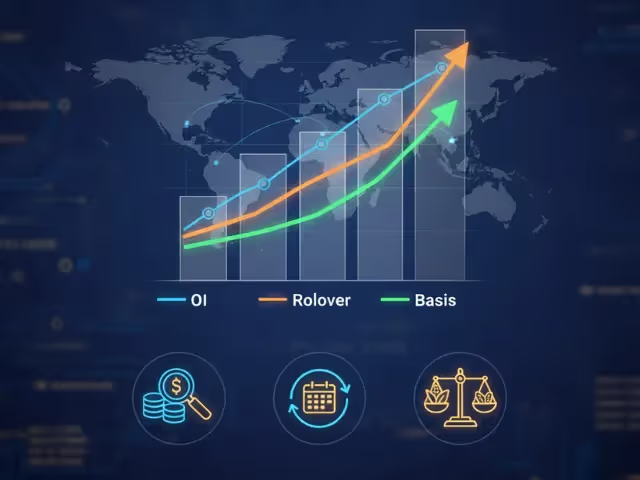
कमोडिटी फ्यूचर्स डेटा कैसे पढ़ें | OI, Rollover और बेसिक्स को समझें
Key Takeaways
- OI (Open Interest) बताता है कि कितने कॉन्ट्रैक्ट्स मार्केट में एक्टिव हैं।
- Rollover दिखाता है कि ट्रेडर्स अपनी पोजीशन अगले महीने तक ले जा रहे हैं या नहीं।
- Futures डेटा से मार्केट की दिशा और सेंटिमेंट समझा जा सकता है।
- OI और प्राइस का रिश्ता ट्रेंड की पुष्टि करता है।
- Swastika Investmart के एनालिटिक्स टूल्स से ये डेटा आसानी से पढ़ा जा सकता है।
🌾 कमोडिटी फ्यूचर्स क्या होते हैं?
कमोडिटी फ्यूचर्स एक ऐसा डेरिवेटिव कॉन्ट्रैक्ट होता है, जिसमें आप किसी कमोडिटी (जैसे गोल्ड, क्रूड ऑयल, सिल्वर, या कॉपर) को भविष्य की तारीख पर तय कीमत पर खरीदने या बेचने का समझौता करते हैं।
उदाहरण के तौर पर —
अगर आप मानते हैं कि क्रूड ऑयल की कीमत बढ़ेगी, तो आप उसका फ्यूचर कॉन्ट्रैक्ट खरीदते हैं।
अगर कीमत बढ़ती है, तो आपको मुनाफा होता है; अगर गिरती है, तो नुकसान।
📘 फ्यूचर्स डेटा को पढ़ना क्यों ज़रूरी है?
कमोडिटी ट्रेडिंग में सिर्फ कीमतें देखना पर्याप्त नहीं है।
डेटा एनालिसिस (OI, Volume, Rollover) से आप यह समझ सकते हैं कि —
- बड़े खिलाड़ी (institutions) किस दिशा में पोजीशन बना रहे हैं
- क्या मार्केट में नया ट्रेंड शुरू हो रहा है या पुराना खत्म
- ट्रेंड “Strong” है या “Weak”
इसलिए एक समझदार ट्रेडर के लिए फ्यूचर्स डेटा पढ़ना उतना ही ज़रूरी है जितना चार्ट देखना।
🔍 Open Interest (OI) क्या है?
Open Interest (OI) बताता है कि किसी खास कमोडिटी फ्यूचर में कितने ओपन कॉन्ट्रैक्ट्स अभी तक क्लोज़ नहीं हुए हैं।
यह ट्रेंड की मजबूती और भागीदारी को दर्शाता है।
OI को समझने का सरल तरीका:
उदाहरण:
अगर गोल्ड फ्यूचर्स की कीमत ₹72,000 से ₹73,200 तक बढ़ती है और OI भी बढ़ता है,
तो यह दर्शाता है कि नए खरीदार मार्केट में प्रवेश कर रहे हैं — यानी ट्रेंड मज़बूत Bullish है।
🔁 Rollover क्या है और यह क्यों मायने रखता है?
हर फ्यूचर कॉन्ट्रैक्ट की एक एक्सपायरी डेट होती है (आमतौर पर महीने के आखिरी सप्ताह में)।
अगर ट्रेडर अपनी पोजीशन को अगले महीने के कॉन्ट्रैक्ट में शिफ्ट करता है, तो इसे Rollover कहा जाता है।
Rollover डेटा से क्या पता चलता है?
- उच्च Rollover (%): ट्रेडर्स अपने पोजीशन पर भरोसा कर रहे हैं।
- कम Rollover: ट्रेडर्स एक्सपायरी के बाद निकलना चाह रहे हैं।
- Rollover कॉस्ट: यह बताता है कि अगले महीने में ट्रेडिंग की दिशा कैसी रह सकती है।
उदाहरण:
अगर सिल्वर में 85% Rollover दिख रहा है, तो इसका मतलब है कि ज़्यादातर ट्रेडर्स ने अपनी लंबी पोजीशन को अगले महीने तक बढ़ा लिया है — यानी सकारात्मक सेंटिमेंट जारी है।
🧮 Volume, OI और Price — तीनों का रिश्ता
ट्रेडिंग में सही निर्णय लेने के लिए आपको तीनों डेटा को एक साथ पढ़ना चाहिए।स्मार्ट ट्रेडिंग टिप:
सिर्फ प्राइस देखकर ट्रेड न करें — OI और Volume की पुष्टि ज़रूर करें।
📊 कैसे पढ़ें यह डेटा (Using Broker Tools)
अधिकांश ब्रोकर्स जैसे Swastika Investmart अपने ग्राहकों को Futures Analytics Tools प्रदान करते हैं।
इनसे आप रियल-टाइम OI, Rollover और Volume डेटा देख सकते हैं।
Swastika Investmart के प्लेटफॉर्म पर:
- Multi-commodity OI analysis
- Historical trend comparison
- Sector-wise OI ranking
- Auto rollover tracking
👉 यहाँ क्लिक करें और डेटा देखें
📈 भारत में कमोडिटी मार्केट का संदर्भ
भारत का कमोडिटी डेरिवेटिव मार्केट (MCX, NCDEX) विश्व के सबसे तेज़ी से बढ़ते बाजारों में से एक है।
यहाँ गोल्ड, सिल्वर, क्रूड, कॉपर, और एग्री-कमोडिटीज़ में रोज़ाना अरबों रुपये का कारोबार होता है।
सरकार और SEBI के सख्त नियामक ढाँचे के कारण यह मार्केट अब पहले से कहीं ज़्यादा पारदर्शी और निवेशक-अनुकूल बन गया है।
💡 Swastika Investmart क्यों?
Swastika Investmart एक SEBI-registered broker है, जो कमोडिटी, इक्विटी और डेरिवेटिव ट्रेडिंग में
अपने रिसर्च-बेस्ड एनालिटिक्स टूल्स और ग्राहक समर्थन के लिए प्रसिद्ध है।
Swastika के साथ आपको मिलता है:
- Advanced OI & Rollover Analysis
- Multi-Asset Research Reports
- Personalized Market Alerts
- Fast & Secure Trading Platform
- Dedicated Commodity Research Desk
👉 अभी खाता खोलें और डेटा-ड्रिवन ट्रेडिंग शुरू करें।
❓ अक्सर पूछे जाने वाले प्रश्न (FAQs)
1️⃣ OI क्या दर्शाता है?
OI दिखाता है कि मार्केट में कितने ओपन कॉन्ट्रैक्ट्स हैं — यह भागीदारी और ट्रेंड की मजबूती बताता है।
2️⃣ Rollover कैसे समझें?
अगर ज़्यादातर ट्रेडर्स अपनी पोजीशन अगले महीने ले जा रहे हैं, तो Rollover हाई होता है — इसका मतलब है कि ट्रेंड में विश्वास बना हुआ है।
3️⃣ क्या OI डेटा रोज़ बदलता है?
हाँ, हर दिन जब भी नए कॉन्ट्रैक्ट्स जुड़ते या खत्म होते हैं, OI डेटा अपडेट होता है।
4️⃣ Futures Trading में यह डेटा क्यों ज़रूरी है?
क्योंकि यह बताता है कि “पैसा कहाँ जा रहा है” — यानी स्मार्ट मनी किस दिशा में ट्रेड कर रही है।
5️⃣ क्या मैं Swastika पर यह डेटा लाइव देख सकता हूँ?
हाँ, Swastika के डैशबोर्ड में रियल-टाइम OI, Volume और Rollover डेटा उपलब्ध है।
🔚 निष्कर्ष
कमोडिटी फ्यूचर्स डेटा को समझना हर निवेशक और ट्रेडर के लिए एक महत्वपूर्ण स्किल है।
OI और Rollover से आप सिर्फ ट्रेंड नहीं, बल्कि मार्केट की गहराई और मूड समझ सकते हैं।
अगर आप डेटा-आधारित ट्रेडिंग सीखना चाहते हैं और बेहतर निर्णय लेना चाहते हैं — Swastika Investmart के साथ जुड़ें
👉 Open your account with Swastika Investmart today
%20(2)%20(5).avif)
Sudeep Pharma IPO Review: Should You Apply Between 21–25 Nov? Complete Analysis Inside!
Key Takeaways
- Sudeep Pharma IPO opens 21–25 Nov 2025 with a price band of ₹563–593.
- Strong FY25 metrics: ₹501.9 cr revenue, 27.88% RONW, and high EBITDA margins.
- Valuation is aggressive at 45–48x P/E, limiting short-term listing gains.
- Dominant presence in pharma excipients with global certifications and stable clients.
- Suitable mainly for long-term (2–5 years) investors seeking exposure to specialty pharma ingredients.
The Sudeep Pharma IPO is among the most talked-about offerings this month, thanks to its strong financial performance and leadership position in pharma-grade minerals and excipients. With subscription dates 21–25 November 2025, investors are evaluating whether the steep valuation is justified by the company’s growth story.
This detailed analysis covers the company’s fundamentals, market position, valuations, strengths, risks, and whether retail investors should consider applying.
Understanding Sudeep Pharma: A 35+ Year Legacy in Excipients
Founded in 1989, Sudeep Pharma has grown into one of India’s key manufacturers of pharmaceutical excipients and specialty chemicals, supplying more than 200+ products across pharma, food, and nutrition sectors. The company operates six manufacturing facilities with a combined capacity of 50,000 MT and serves several global blue-chip clients.
Their product portfolio includes:
- Pharmaceutical, Food & Nutrition ingredients
- Specialty mineral-based ingredients
- Triturates (ready-to-use blends used in tablets & nutraceutical formulations)
Importantly, Sudeep Pharma holds prestigious global certifications such as US FDA, WHO-GMP, EXCiPACT, ISO 9001, FSSC 22000, HACCP, Kosher, and Halal, positioning the company as a trusted supplier in regulated markets.
In 2025, the company also acquired a European premix manufacturer (NSS), strengthening its foothold in the nutrition business.
IPO Details at a Glance
Detail Information
Issue Size- ₹895 cr
Fresh Issue- ₹95 cr
OFS- ₹800 cr
Price Band- ₹563–593
Market Lot- 25 shares
Issue Dates- 21–25 Nov 2025
Post-issue Market Cap- ₹6,697.85 cr
Listing- BSE & NSE
The IPO consists largely of an Offer for Sale, meaning most proceeds go to existing shareholders, not the company. Only the fresh issue will fund capex for machinery at the Nandesari facility and general corporate expenses.
This is an impressive trend—both revenue and profitability have shown robust improvement. A near-40% EBITDA margin places Sudeep among the better-performing players in India’s specialty chemicals space.
What’s driving growth?
- Higher demand from global pharma clients
- Product diversification
- Increased contribution from nutrition and specialty ingredients
- High-entry-barrier mineral-based excipient industry
Valuation: Is the IPO Expensive?
Based on FY25 financials:
- Pre-IPO EPS: 12.46
- P/E at the price band: 45–48x
This valuation is on the higher side, even for high-quality pharma ingredient companies. The IPO note itself categorizes the issue as “aggressively priced”, indicating that most near-term growth is already factored into the pricing.
Does this leave room for listing gains?
Not significantly. The valuation restricts the short-term upside. Investors looking for 10–20% short-term gains may find the risk-reward unfavourable.
Long-term view (2–5 years)
If the company continues delivering:
- 35–40% EBITDA margins
- Strong RONW
- Successful integration of NSS
- Further expansion in specialty minerals
then the valuation could still be justified over a multi-year horizon.
Key Strengths of Sudeep Pharma
1. Leadership in High-Entry-Barrier Ingredients
Manufacturing mineral-based excipients requires high R&D expertise, compliance systems, and technical know-how—creating strong entry barriers.
Sudeep Pharma Ltd. IPO note (1)
2. Deeply Integrated Global Supply Chain
Sudeep serves several Fortune 500 and global blue-chip clients. Long-term contracts and consistent quality make the business sticky.
3. Strong Certifications & Compliance
Regulated market approvals (e.g., US FDA, EXCiPACT) give the company a competitive advantage, especially in the pharma excipients space.
4. Consistent R&D Focus
Multiple in-house labs, pilot plants, and a team dedicated to mineral salts innovation drive product development.
Key Risks You Should Be Aware Of
Even strong companies carry risks. For Sudeep Pharma, key concerns include:
1. Revenue Concentration
- Top 10 customers contribute over 35% of revenues.
- One business segment accounts for 60%+ of total revenues.
This increases vulnerability to client or segment-level slowdowns.
2. Regional Operational Dependence
All manufacturing facilities are located in Gujarat, exposing operations to regional disruptions.
3. Quality & Audit Compliance Risk
Failure to pass audits from global pharma clients could lead to immediate order loss.
4. M&A Integration Risk
Integrating NSS or future acquisitions may strain resources or fail to deliver expected synergies.
Should You Apply for the Sudeep Pharma IPO?
Best for Long-term, Not Listing Gains
The fundamentals are strong: high margins, diversified products, global certifications, and solid financial growth. However, valuation is steep, reducing the probability of short-term listing gains.
Recommended For:
- Long-term investors (2–5 years horizon)
- Those seeking exposure to India’s rising pharma ingredients and specialty minerals industry
- Investors comfortable with premium valuations for quality businesses
Avoid If:
- You’re looking for short-term returns
- You have low-risk tolerance
- Valuation discipline is your priority
FAQs
1. What are the Sudeep Pharma IPO dates?
The IPO opens on 21 November 2025 and closes on 25 November 2025.
2. What is the price band for the IPO?
The price band is ₹563–593 per share.
3. Is the Sudeep Pharma IPO good for listing gains?
The IPO is aggressively priced, leaving limited room for short-term gains. Suitable mainly for long-term investors.
4. What will the funds be used for?
Primarily for capex—procurement of machinery for the Nandesari facility—and general corporate purposes.
5. Does Sudeep Pharma have listed peers?
No direct listed peers exist in India in the same line of business.
Conclusion: A High-Quality Company, But at a High Price
- The company delivers robust performance with rising revenues, high EBITDA margins, and an impressive FY25 RONW of 27.88%.
- It operates as a preferred partner for critical pharma-grade ingredients, serving a solid roster of marquee global customers.
- The issue is considered "aggressively priced" at a P/E of 45–48x, fully capturing its current stable profitability.
- This steep valuation leaves very little room for immediate listing gains or short-term "pops."
- Agressive Investors are advised to apply only if they have a holding horizon of 2–5 years.
Invest in upcoming IPOs, equities, and mutual funds with a trusted SEBI-registered broker. Swastika Investmart offers powerful research tools, strong customer support, and a seamless tech-enabled platform.
👉 Open your account with Swastika Investmart today
%20(12).avif)
भारत में (Joint) Demat खाता कैसे खोलें
मुख्य बातें (TL;DR)
- एक Joint Demat Account में अधिकतम 3 व्यक्ति शामिल हो सकते हैं।
- सभी धारकों का KYC और PAN आवश्यक है।
- सभी ट्रांज़ैक्शन primary holder के नाम से होते हैं।
- संयुक्त खाता परिवार या बिज़नेस पार्टनर के साथ खोला जा सकता है।
- Swastika Investmart के साथ यह प्रक्रिया पूरी तरह ऑनलाइन और तेज़ है।
Demat Account क्या होता है?
Demat Account (Dematerialized Account) वह खाता होता है जिसमें आपके शेयर, म्यूचुअल फंड और बॉन्ड्स इलेक्ट्रॉनिक रूप में रखे जाते हैं।
यह बैंक खाते की तरह काम करता है — बस फर्क इतना है कि इसमें पैसे की जगह शेयर होते हैं।
अगर आप किसी और के साथ मिलकर निवेश करना चाहते हैं, तो आप एक Joint Demat Account खोल सकते हैं।
Joint Demat Account क्या है?
Joint Demat Account में दो या तीन व्यक्ति मिलकर एक ही Demat खाता खोल सकते हैं।
इसमें एक व्यक्ति को Primary Holder (मुख्य धारक) कहा जाता है और बाकी को Joint Holder(s)।
उदाहरण के तौर पर:
मान लीजिए, आप अपने जीवनसाथी या भाई के साथ मिलकर शेयर निवेश करना चाहते हैं।
ऐसे में आप दोनों एक Joint Demat Account खोल सकते हैं, ताकि शेयर और लाभ साझा रूप से रखे जा सकें।
Joint Demat Account खोलने की प्रक्रिया (Step-by-Step Guide)
1. ब्रोकर या DP (Depository Participant) चुनें
भारत में दो प्रमुख Depositories हैं — NSDL और CDSL।
आपको इनके अधिकृत DP जैसे Swastika Investmart के माध्यम से खाता खोलना होगा।
👉 Swastika Investmart पर ऑनलाइन खाता खोलें
2. आवश्यक दस्तावेज़ तैयार रखें
सभी धारकों को नीचे दिए गए दस्तावेज़ जमा करने होंगे:
- PAN Card
- Aadhaar Card (या अन्य पहचान प्रमाण)
- Address Proof (Electricity Bill, Passport आदि)
- Passport-size Photo
- Bank Account Proof (Cancelled Cheque या Passbook)
3. KYC और e-Sign प्रक्रिया पूरी करें
सभी applicants को KYC (Know Your Customer) पूरी करनी होती है।
अगर आप ऑनलाइन प्रक्रिया चुनते हैं, तो Aadhaar आधारित e-KYC और e-Sign से पूरा हो जाता है।
4. Nominee जोड़ें (वैकल्पिक)
आप अपने Joint Demat Account में Nominee जोड़ सकते हैं।
Nominee केवल Primary Holder द्वारा तय किया जा सकता है, लेकिन भविष्य में इसे बदला जा सकता है।
5. Account Activation और Login
सभी दस्तावेज़ सत्यापित होने के बाद, DP द्वारा खाता सक्रिय किया जाता है।
आपको Login credentials मिलेंगे जिससे आप अपने होल्डिंग्स और ट्रांज़ैक्शन्स देख सकते हैं।
Joint Demat Account के प्रकार
Joint Mode- सभी धारकों के हस्ताक्षर हर ट्रांज़ैक्शन के लिए आवश्यक होते हैं।
Either or Survivor Mode- किसी भी एक धारक के सिग्नेचर से ट्रांज़ैक्शन संभव है (अक्सर पति-पत्नी के खातों में)।
Joint Demat Account के फायदे
✅ साझा निवेश नियंत्रण – परिवार या पार्टनर के साथ निवेश प्रबंधन आसान।
✅ उत्तराधिकार में सरलता – मृत्यु की स्थिति में दूसरे धारक को स्वामित्व मिल जाता है।
✅ पारदर्शिता – सभी धारक समान रूप से लेनदेन देख सकते हैं।
✅ सुविधाजनक रिकॉर्ड कीपिंग – एक ही खाता, एकीकृत पोर्टफोलियो ट्रैकिंग।
महत्वपूर्ण नियम और सावधानियाँ
- सभी धारकों का PAN और KYC अनिवार्य है।
- एक Joint Demat Account को Trading Account से लिंक करने के लिए सभी के सिग्नेचर आवश्यक हैं।
- एक बार Primary Holder तय हो जाने पर उसे बदला नहीं जा सकता।
- Death के मामले में खाता “Survivor” के नाम पर ट्रांसफर किया जा सकता है।
Swastika Investmart क्यों चुनें?
Swastika Investmart एक SEBI-registered, NSDL/CDSL depository participant है,
जो निवेशकों को भरोसेमंद और तकनीक-सक्षम अनुभव देता है।
Swastika के साथ आपको मिलता है:
- Paperless Online Account Opening
- Real-time Portfolio Tracking
- Dedicated Relationship Manager
- Research-backed Investment Insights
- Investor Education Programs
👉 अभी खाता खोलें और परिवार के साथ समझदारी से निवेश शुरू करें।
अक्सर पूछे जाने वाले प्रश्न (FAQs)
1️⃣ क्या मैं अपने माता-पिता या जीवनसाथी के साथ Joint Demat Account खोल सकता हूँ?
हाँ, आप किसी भी वयस्क भारतीय निवासी के साथ संयुक्त खाता खोल सकते हैं।
2️⃣ क्या NRI संयुक्त धारक बन सकता है?
हाँ, लेकिन उसे FEMA और RBI दिशा-निर्देशों का पालन करना होगा।
3️⃣ क्या सभी धारकों को KYC देना होता है?
हाँ, प्रत्येक धारक को अलग-अलग KYC और PAN कार्ड की आवश्यकता होती है।
4️⃣ अगर एक धारक की मृत्यु हो जाए तो क्या होगा?
ऐसी स्थिति में खाता Survivor के नाम पर ट्रांसफर किया जा सकता है।
5️⃣ क्या Swastika Investmart में यह प्रक्रिया ऑनलाइन है?
हाँ, पूरी प्रक्रिया e-KYC और e-Sign के माध्यम से ऑनलाइन पूरी की जा सकती है।
निष्कर्ष
एक Joint Demat Account आपको अपने परिवार या पार्टनर के साथ निवेश की जिम्मेदारी साझा करने की सुविधा देता है।
यह पारदर्शिता, सुरक्षा और आसान उत्तराधिकार की दृष्टि से एक समझदार विकल्प है।
अगर आप अपने निवेश सफर की शुरुआत भरोसेमंद पार्टनर के साथ करना चाहते हैं — 👉 Swastika Investmart पर खाता खोलें - जहाँ आपको मिलेगा आसान ऑनबोर्डिंग, बेहतर रिसर्च और 24×7 सपोर्ट।
Excelsoft Technologies Ltd. IPO: Detailed Analysis, Valuation & Verdict
Key Takeaways
- Excelsoft Technologies’ ₹500 crore IPO includes ₹180 crore fresh issue + ₹320 crore OFS.
- Price band: ₹114–₹120, lot size 125 shares, market cap approx. ₹1,381 crore.
- The company is a global vertical SaaS player in the EdTech learning & assessment space.
- Strong FY25 performance: PAT up ~172%, stable margins, ROCE at 16.11%.
- Key risks include heavy reliance on Pearson (≈59% revenue) and compliance & cybersecurity exposure.
- Verdict: Neutral—growth potential strong, but valuation looks stretched.
Excelsoft Technologies Limited is gearing up for its public debut, and the IPO has already drawn attention because of its niche positioning in the vertical SaaS EdTech market. The company provides AI-enabled learning, assessment, and digital content solutions to global clients — a space that has seen rapid adoption across corporate, academic, and certification ecosystems.
With Swastika Investmart’s in-depth research backing the IPO note, this article breaks down the business fundamentals, valuation, risks, and whether investors should apply.
A Closer Look at Excelsoft Technologies
Excelsoft Technologies is a global vertical SaaS company specializing in the learning, assessment, and education technology ecosystem. Their products are used by academic institutions, corporates, government bodies, and certification agencies across multiple geographies.
Key Product Segments
- Assessment & Proctoring
- SARAS e-Assessments
- EasyProctor
- Learning & Student Success Platforms
- SARAS Learning Solutions
- OpenPage Digital Books
- EnablED LXP
- CollegeSparc
- LearnActiv (K-12 focus)
Business Model in One Line
A recurring-revenue, SaaS-driven platform model catering to global education and training markets — with long-term sticky clients.
IPO Details at a Glance
IPO Size: ₹500 crore
Fresh Issue: ₹180 crore
OFS: ₹320 crore
Price Band: ₹114–₹120
Market Lot: 125 shares
Face Value: ₹10
Listing: BSE, NSE
Market Cap at Upper Band: ₹1,381.01 crore
Issue Opens: 19 Nov 2025
Issue Closes: 21 Nov 2025
Listing Date26 Nov 2025
Objects of the Issue
Funds will be used for:
- Land purchase & new building construction (Mysore)
- External electrical upgrades
- IT upgrades (software, hardware, networking)
- General corporate purposes
This signals expansion capacity and infrastructure strengthening — key for SaaS scale-ups.
Highlights
- PAT growth of ~172% YoY in FY25 — excellent turnaround.
- EBITDA margin stable and healthy (31.4%).
- ROCE at 16.11%, respectable for a SaaS firm investing in expansion.
The company is clearly moving toward improving profitability while scaling.
Strengths of Excelsoft Technologies
1. Focus on a High-Growth Vertical SaaS Segment
EdTech, assessments, and learning automation are gaining traction globally — especially post-digital transformation.
2. Strong Global Client Base
76 clients across multiple continents.
Long-term contracts promote predictable recurring revenue.
3. Leadership & Product Depth
Experienced team and mature product suite — SARAS, OpenPage, EnablED — built on agile and flexible technology.
4. High Demand for Assessment Tech
AI-enabled proctoring, remote assessment, and digital exams are now standard for institutions and certification bodies.
Key Concerns & Risks
1. Heavy Dependency on Pearson (≈59% revenue)
This is the biggest red flag.
Any renegotiation or loss of this client can materially impact revenue.
2. Compliance & Global Regulations
Operating across countries brings complex regulatory exposure.
3. Cybersecurity Risks
Given sensitive student data and assessment records, any cyber breach can hurt trust & revenue.
4. SaaS Transition Impacts Cash Flow
Subscription-based revenue shifts can delay recognition.
5. No Long-Term Contracts
Renewal risks remain — despite repeat business.
Valuation: Is the IPO Fairly Priced?
- EPS (Pre-IPO): ₹3.47
- P/E at upper band: ~34.62×
- Sector peers trade between 22× to 42×, but most have diversified client bases.
Conclusion:
The pricing looks aggressive, considering the:
- Client concentration risk
- Contingent liabilities
- Scale vs competitors
- Size of the addressable market
Verdict: Should You Apply for Excelsoft Technologies IPO?
Overall Verdict: Neutral
- Focuses on the high-growth Vertical SaaS segment, specifically in the EdTech learning and assessment market.
- Serves 76 global clients (including Pearson Group), ensuring predictable, recurring revenue via long-term contracts.
- Demonstrated significant financial health, highlighted by a ~172% PAT surge in FY25.
- Client Concentration: Highly reliant on the Pearson Education Group (~59% of revenue), posing a significant disruption risk.
- Valuation & Rating: Appears aggressively priced (P/E ~ 35), leading to a neutral rating with an expectation of only a minor listing gain.
Frequently Asked Questions
1. What is the size of Excelsoft Technologies’ IPO?
Total size is ₹500 crore including ₹180 crore fresh issue + ₹320 crore OFS.
2. What are the key strengths of the company?
Strong global SaaS presence, long-term client relationships, AI-enabled products, and a healthy financial profile.
3. What is the biggest risk of investing in this IPO?
Excelsoft depends heavily on one client — Pearson — contributing ~59% of revenue.
4. Is the IPO fairly priced?
At P/E ~35×, it appears on the expensive side relative to risk factors.
5. What is Swastika Investmart’s view?
A Neutral rating, indicating moderate prospects and valuation concerns.
👉 Open your account with Swastika Investmart today
.avif)
Emcure Pharma Block Deal Impact: Will This Shake Investor Confidence?
Key Takeaways
- Bain Capital to sell ~2.4% stake in Emcure Pharma via a block deal worth about ₹551 crore.
- The floor price is ~₹1,279.80/share, slightly below recent closing prices, triggering some investor caution.
- Despite the block deal, Emcure delivered a strong Q1 FY26: ₹2,101 cr revenue and ~41% YoY PAT growth.
- The deal raises questions about promoter confidence, but fundamentals remain solid given Emcure’s global reach and pipeline.
- For investors, this could be both a liquidity event risk and a potential entry point, especially for long-term plays using a trusted broker.
What Happened: Bain Capital Cuts Emcure Stake
Reports indicate that BC Investments IV, a Bain Capital–affiliated entity, plans to offload about 2.4% of its stake in Emcure Pharma via a block deal. The transaction is pegged at around ₹551 crore, with a floor price of ₹1,279.80 per share. As per regulatory filings, the shares sold will come with a 90-day lock-in.
The deal is being managed by Kotak Securities, which is acting as the lead manager. As of March 2025, BC Investments IV held around 8.68% of Emcure.
Market Reaction: Why Investors Are Nervous
The news of a large investor reducing its position tends to trigger two broad reactions:
1. Short-term sell-off:
Some shareholders may view the block deal as profit-taking, leading to short-term selling pressure. Reports suggest that Emcure’s stock dipped modestly after the news broke.
2. Questioning long-term commitment:
Even though Bain Capital isn’t exiting fully, reducing exposure could make investors wonder about its confidence in Emcure’s mid-to-long term trajectory.
At the same time, this might be a liquidity window for other investors — a chance to buy into a well-performing company at a slightly lower price.
Under the Hood: Emcure’s Strong Operating Performance
While the block deal grabs headlines, Emcure’s business momentum remains robust.
- In Q1 FY26, Emcure reported ₹2,101 crore in revenue, a 15.7% YoY increase.
- PAT surged ~41% to ₹215 crore, with EBITDA margins improving.
- Growth was broad-based: domestic business rose ~9.4%, while the international segment (especially in newer markets) also saw strong gains.
- Emcure is also consolidating its structure: it plans to acquire the remaining 20.42% stake in its subsidiary Zuventus, making it a fully owned unit.
- The company’s pipeline remains healthy, and its partnerships (e.g., with Sanofi for its metabolic portfolio) could fuel future growth.
These results suggest that operationally, Emcure is not weakened by the block-deal event.
Regulatory Angle: Block-Deal Norms Evolving in India
It’s important to view this block deal in light of recent regulatory changes. SEBI, India’s markets regulator, has updated rules for block deals: the minimum size has been increased, and new price-window norms have been introduced.
These reforms aim to bring more structure and transparency to large-volume trades. For institutional sellers like Bain Capital, it also means more disciplined exit mechanisms, which may mitigate investor overreaction.
Possible Implications for Investor Confidence
Here’s how this block deal could influence investor sentiment going forward:
- Trust disruption: Some retail or institutional investors may worry that a large stakeholder scaling down indicates potential headwinds.
- Buying opportunity: For value-focused long-term investors, a block-deal–driven dip could represent a chance to get in at a lower cost.
- Volatility risk: Short-term volatility may rise as the market digests the deal, particularly around lock-in expiry.
- Strategic clarity: If Emcure continues to deliver on its growth targets and pipeline, the deal may be seen as a financial move rather than a strategic retreat.
Frequently Asked Questions
Q: Why is Bain Capital selling a part of its stake in Emcure Pharma?
A: The block deal could be driven by profit booking or portfolio rebalancing. It does not necessarily signal a lack of faith in Emcure’s growth.
Q: Is Emcure's business under pressure?
A: Not based on its latest financials — in Q1 FY26, Emcure reported strong revenue and PAT growth, both domestically and internationally.
Q: Could the block deal lead to a long-term drop in share price?
A: It depends. While large stake sales can increase volatility, Emcure’s fundamentals are still strong. Long-term investors might view the dip as a buying opportunity; short-term traders could be cautious.
Q: How do SEBI’s new block deal rules affect such transactions?
A: SEBI has raised the minimum size for block deals and introduced stricter pricing windows and transparency measures, which could curb speculative or disorderly trades.
Q: How can retail investors take advantage of this situation?
A: Retail investors can use a reliable, SEBI-registered platform like Swastika Investmart, which offers research tools, educational resources, and real-time data to analyze such developments and make informed decisions.
Conclusion
The Emcure Pharma block deal — with Bain Capital offloading around 2.4% of its stake — is a notable event for the stock. But while it raises some eyebrow-raising questions about promoter intent, the company’s strong Q1 performance, healthy international growth, and strategic consolidation suggest that its core story remains intact.
For long-term investors, this could be a window of opportunity, provided you're comfortable with potential short-term volatility. And if you’re looking for a trusted partner to navigate such market moments, Swastika Investmart stands out — SEBI-registered, backed by quality research tools, and committed to investor education.
👉 Open your account with Swastika Investmart today

Mphasis Block Deal Breakdown: Market Reaction & Impact on Future Growth
Key Takeaways
- Blackstone is selling a ~9.5% stake in Mphasis via a ~₹4,600 crore block deal.
- The shares traded at a ~4–5% discount, sparking a ~2–5% drop in Mphasis’s stock.
- The deal may reflect profit-taking but also raises questions on long-term promoter commitment.
- Mphasis continues to deliver on AI-led deal wins and a strong pipeline, supporting its growth story.
- For investors, this block deal could present both risk (increased volatility) and opportunity (entry point), especially via reliable platforms like Swastika Investmart.
Mphasis Block Deal Breakdown: Market Reaction & Impact on Future Growth
What’s Happened: Blackstone Sells Big Stake
Private equity heavyweight Blackstone, which holds a large stake in Mphasis, is offloading up to 9.5% of its equity in a block deal estimated to be worth around ₹4,600 crore. The floor price is set at ₹2,570 per share, which is about 4–4.4% lower than Mphasis’s previous closing price.
This isn’t the first time: earlier, Blackstone sold ~15% of its holdings in a deal worth ₹6,700–7,000+ crore, reducing its stake to just over 40%. Post-deal, those remaining shares are subject to a 180-day lock-in, per the term sheet.
Market Reaction: Why the Stock Fell
The immediate fallout was sharp: Mphasis shares slid 2–5%, reflecting investor concerns over such a major promoter exit. Trade volumes spiked significantly.
This can be interpreted in a few ways:
- Profit booking: Blackstone may simply be locking in gains after successfully scaling its stake over years.
- Sentiment check: Investors might worry about the future involvement of a major backer.
- Risk vs opportunity: For some, such block deals provide a chance to buy in at a discount, but with higher volatility.
Why It Matters: Implications for Mphasis’s Growth Story
1. Promoter Confidence & Ownership Dynamics
Blackstone’s reduction—while still holding a substantial stake (post-deal) of ~40%—could be viewed through two lenses:
- Neutral: It’s a financial decision, not a strategic pull-out.
- Cautious: Large sales by promoters sometimes hint at liquidity or reallocation.
However, since Blackstone isn’t exiting entirely, it suggests continued alignment with Mphasis’s long-term growth.
2. Financial Strength Supported by AI Deals
Despite the block deal noise, Mphasis’s underlying business continues to perform well:
- In Q1 FY26, the company recorded $760 million in Total Contract Value (TCV), with 68% of these deals being AI-led.
- In Q4 FY25, 59% of Mphasis’s large deal wins came from AI-driven engagements.
- In Q2 FY26, the company posted ₹3,901.9 crore in revenue and a PAT of ₹469.1 crore, reaffirming its execution capability.
These numbers suggest that Mphasis is not just riding the block deal headline — its core business remains healthy, especially in high-growth AI and digital transformation areas.
3. Regulatory Context: SEBI’s Changing Block Deal Norms
It’s also timely to note that SEBI recently revised block deal regulations:
- The minimum deal size for a block deal has been raised to ₹250 million (from ₹100 million).
- New pricing norms allow block deals to be placed 3% above or below last traded price, and trades will be conducted in morning and afternoon windows.
These changes may influence how future block deals are structured and could impact liquidity and sentiment.
Real-World Implications for Investors (Especially in India)
- Short-term traders might see this as a volatility event — block deal news + sharp volume = trading opportunity.
- Long-term investors could interpret the dip as a chance to enter: Mphasis has strong fundamentals, especially given its AI-led TCV pipeline.
- Institutional investors may watch how Blackstone redeploys the capital and whether more deals follow once the 180-day lock-in lifts.
- For those invested or planning to invest via Swastika Investmart, it’s reassuring to have a SEBI-registered broker with robust research tools — helping parse such complex events.
FAQs
Q: Why does a block deal cause a stock to drop?
A: Because a large-volume sale by a major promoter often raises concerns about future strategy, even if the underlying business is healthy. Also, block deals are usually priced at a discount, which can drag the share price.
Q: Is Blackstone exiting Mphasis entirely?
A: No. After this deal, Blackstone will still remain the largest shareholder, but its stake will be significantly reduced, and it is subject to a 180-day lock-in for the remaining shares.
Q: How does this deal affect Mphasis’s growth prospects?
A: While this is a liquidity event, Mphasis’s core business continues to grow — especially its AI-led contract wins, which support long-term revenue potential.
Q: What role does SEBI regulation play in block deals now?
A: SEBI has raised the minimum block deal size to ₹250 million and allowed trades within ±3% of the last traded price, in two windows (morning and afternoon).
Q: How can retail investors act on this news?
A: Retail investors can assess whether the dip presents a long-term buy opportunity. Using a trusted, SEBI-registered broker like Swastika Investmart can help by offering strong research support and an educational framework.
Conclusion & Next Steps
The recent Mphasis block deal, with Blackstone selling a ~9.5% stake, has understandably caught the market’s attention. While the immediate reaction was negative — with the stock price dipping and volumes spiking — a deeper look reveals that Mphasis’s core business remains strong, especially with its AI-led deal pipeline.
For many investors, this is not just a headline event — it may be a potential entry point into a fundamentally solid company. And this is where Swastika Investmart can play a valuable role: as a SEBI-regulated broker, it offers robust research tools, educational support, and customer-centric service to help you make informed investment decisions.
👉 Open your account with Swastika Investmart today
.avif)
Paytm Block Deal at 4% Discount — Opportunity or Red Flag for Investors?
Key Takeaways
- Ant Group (Antfin) is selling ~4 % of Paytm at a ~5–6.5% discount via a block deal.
- The deal, worth over ₹2,000 crore, was managed by Goldman Sachs India and Citigroup.
- Paytm’s stock fell ~4–5% after the news — signaling mixed investor sentiment.
- Regulatory changes (SEBI) tighten block-deal rules, potentially impacting future large-share trades.
- For long-term investors, it's a chance to assess whether this is a clean exit or a warning sign — especially in the context of Paytm’s evolving business and ownership.
Paytm Block Deal at 4% Discount — Opportunity or Red Flag for Investors?
In May 2025, Ant Group’s affiliate Antfin initiated a block deal, selling around 4% stake in Paytm (One97 Communications) at a significant discount to the market price. This move has stirred debate in Indian markets — is this a strategic exit by a major investor, or should retail and institutional investors be wary of potential red flags? Let’s unpack the implications.
What Happened: Understanding the Block Deal
Antfin offloaded approximately 25.5 million shares (about 4% of Paytm) through a block trade valued around ₹2,066 crore. The floor price for this deal was fixed at ₹809.75 per share, which implied a hefty 6.5% discount relative to Paytm’s closing price prior to the announcement. According to reporting, this transaction was managed by Goldman Sachs India Securities and Citigroup Global Markets India.
Notably, after this block deal was announced, Paytm’s share price tumbled by around 4–5% in early trading sessions.
Later, it became clear that this was part of a larger plan: Antfin is reportedly planning to fully exit Paytm, selling its remaining ~5.84% stake in a subsequent block trade worth ~₹3,800 crore. The “clean-up trade” reportedly has no lock-in requirement post-sale.
Why the Discount — Interpreting the Motivation
1. Strategic Exit
This could simply be Antfin’s planned wind-down of its exposure to Paytm: over the past few years, it has been gradually reducing its shareholding. An exit via block deals is a common route for large institutional investors who want to exit quietly and efficiently, particularly when they hold a significant stake.
2. Regulatory Considerations
Antfin’s divestment may have regulatory undertones. Chinese-origin investments in Indian fintech have drawn regulatory scrutiny, and reducing the stake could be part of a broader strategy to comply with evolving norms.
3. Market Sentiment & Valuation
The discount may reflect some pressure: block buyers may demand a lower entry price for such a large, immediate chunk. For Antfin, trading liquidity, timing, and risk all play a role. Also, Paytm’s valuation is under continuous scrutiny given its path to profitability and recent financials.
Risks and Red Flags for Investors
Stock Pressure & Volatility
A large block deal by a major shareholder can spook the market. The ~5% fall post-deal shows how sensitive investor sentiment is to big exits.
Ownership Risk
As Antfin exits, the ownership structure of Paytm will change significantly. That may affect governance, strategy, and future funding. If Antfin was seen as a strategic long-term investor, its departure could be concerning.
Discount Signals
The steep discount may imply that block deal buyers are not confident in the near-term upside. For retail investors, this could mean lower conviction from institutional players.
Regulatory Landscape
SEBI recently tightened the rules for block deals — raising the minimum order size and narrowing price bands. Such regulatory shifts could make future exits or entries more challenging or costly.
Why It Could Be an Opportunity
Reallocation by Smart Money
If the stake is being sold by Antfin (a long-term investor) but picked up by other institutional buyers, this could be a reallocation rather than a complete loss of faith in Paytm. Smart buyers could view this as a discount entry point.
Leadership Confidence
Despite the sell-off, Paytm has reported signs of operational improvement. For long-term investors focused on Paytm’s fintech, payments, and merchant ecosystem, this could be a chance to accumulate.
Regulatory Clarity & Maturity
As Paytm matures and consolidates, the block deal may help reset its shareholder base, potentially paving the way for more stable, long-term ownership.
Block Deal Landscape — A Regulatory Context
Block deals are large, negotiated trades executed outside the normal order book to minimize market impact. In India, SEBI provides specific block-deal windows to facilitate this.
However, as of October 2025, SEBI introduced tighter regulations: the minimum block deal size has been raised, and pricing bands have been narrowed to ±3% around a reference price. These changes aim to improve transparency and reduce manipulation risk — a meaningful backdrop when evaluating large shareholder exits.
Real-World Context: What This Means for Indian Markets
- Investor Sentiment: A marquee investor like Antfin exiting raises eyebrows. It could trigger more scrutiny on Paytm’s fundamentals and governance.
- Fintech Ecosystem: Paytm has been a flagship fintech in India. How it weathers such exits will be closely watched by other fintech players, investors, and regulators.
- Listing & Ownership Trends: If Antfin’s full exit goes through, it may signal a shift: from early large backers to a wider, perhaps more strategically aligned investor base.
Frequently Asked Questions (FAQ)
Q1: What exactly is a block deal?
A block deal is a large-volume transaction (often by institutional investors) executed through a special trading window to avoid disrupting the market.
Q2: Why was Paytm being sold at a discount?
Block deal floor prices are often set lower to attract buyers willing to absorb large volumes. In this case, Antfin may have accepted a discount to facilitate a clean exit.
Q3: Is Antfin’s exit a bad sign for Paytm’s future?
Not necessarily. While it raises governance and ownership questions, it's also possible this is simply a strategic reallocation. Other long-term buyers may step in.
Q4: How does SEBI’s new block-deal regulation affect this?
SEBI tightened block-deal rules in 2025, increasing minimum deal sizes and limiting price ranges — this could make future large trades more disciplined and transparent.
Q5: Should retail investors react to this block deal?
Retail investors should view this as one piece of the puzzle. While a large exit is significant, it must be weighed alongside Paytm’s financials, growth strategy, and market position.
Conclusion: Is This a Window or a Warning?
Antfin’s 4% block deal in Paytm — sold at a meaningful discount — is clearly more than just a routine transaction. It reflects a strategic exit by a major investor, but it also introduces short-term volatility and long-term questions about Paytm’s ownership and direction.
For long-term investors, this could be an opportunity: a rare discounted entry into a company with deep fintech reach. But it’s not without risks — and not all of them are trivial.
👉 Open your account with Swastika Investmart today
.avif)
Groww’s Market Cap Hits ₹1.10 Lakh Crore — Investor Implications
Key Takeaways
- Groww’s parent, Billionbrains Garage Ventures, has crossed a market cap of ~₹1.10 lakh crore amid heavy post-IPO rally.
- Surge driven by strong retail investor enthusiasm, profitability, and Groww’s dominant position in India’s brokerage space.
- The milestone underscores the growth of India’s digital investing ecosystem and increasing fintech adoption.
- High valuation also brings risks: tight competition, regulatory scrutiny, and execution pressure.
- Swastika Investmart offers a regulated, research-driven platform for investors who want to participate thoughtfully in fintech growth.
Groww’s Market Cap Breaks New Records — What It Means for Investors
Groww, one of India’s most popular digital brokerages, has recently reached a remarkable milestone. Its parent company, Billionbrains Garage Ventures, saw its market capitalization cross approximately ₹1.10 lakh crore, reflecting massive investor confidence. For many, this isn’t just a fintech success story — it’s a powerful signal about how India’s retail investing wave is maturing. But what should individual and institutional investors read into this valuation?
Here’s a detailed look at what this new market cap milestone means, why it’s happening, and the risks and opportunities investors should consider.
Why Groww’s Valuation Is Soaring
Explosive Retail Participation
Groww has built a massive base of retail investors. Its app, known for ease of use and transparent onboarding, has become a go-to for first-time investors. The soaring valuation reflects how deeply Groww is embedded in India’s retail equity and mutual fund investing trends. The platform’s success is very much tied to the democratization of capital markets in India.
Profitable Growth Story
Unlike many fintech startups, Groww is already making solid profits. In FY 25, the company reported a net profit of ₹1,819 crore and revenue of ₹4,056 crore, marking a strong year-on-year increase. The New Indian Express+2Outlook Business+2
Profitability at this scale makes Groww more than just a growth play — it’s a tech business with healthy structural earnings.
Strong IPO Performance & Investor Demand
Groww’s IPO received strong demand. The Financial Express+2Business Standard+2
When it listed, shares jumped significantly (for example, Business Standard reported a 30% surge on debut) Business Standard, and the company’s valuation was re-rated upward quickly. This momentum was fueled by both retail and institutional investors who see Groww as a long-term play on India’s investing economy.
A Diversifying Business Model
Groww isn’t just about equities – it is expanding aggressively into wealth management, margin trading, commodities, and more. Reuters+1
Its DRHP outlines ambitions to tap into India’s booming wealth market, projected to grow substantially over the coming years. Fortune India
This diversification helps justify a premium valuation because Groww is not reliant solely on one product line.
What This Means for the Indian Financial Market
Digital Broking Is Now Mainstream
Groww’s valuation milestone validates the shift of retail investing into app-based platforms. It signals that digital-first brokerages are no longer niche—they’re central to India's market structure. Increasingly, retail investors are entering equity markets, SIPs, and other financial products via these platforms.
Fintech Competition Will Intensify
With Groww achieving such market cap, other brokerages and wealth-tech firms will feel the pressure to scale faster or innovate more. This could lead to better services, more competitive pricing, and richer product offerings. However, higher valuations also raise the bar: execution risk is now more critical than ever.
Regulatory Spotlight May Increase
Regulators like SEBI are likely to keep a close eye as brokerages scale. Issues like risk disclosure, customer protection, margin lending, and platform stability may come under sharper scrutiny. Groww’s success could shape future regulatory decisions.
A Proxy for Retail Wealth Creation
For many investors, Groww’s growth is not just about its business — it’s a reflection of India’s retail investing future. Its rise could be interpreted as a call to action: more Indians are participating in markets, and wealth creation is becoming more democratized.
Risks & Considerations for Investors
Valuation Premium Risks
While Groww’s market cap is impressive, some analysts believe the valuation might be stretching ahead of fundamentals. Outlook Business If growth slows or monetization underperforms, there could be significant corrections.
Execution Risks in Diversification
Groww’s bets on wealth management, margin trading, and commodities make sense, but each of these lines comes with its own risk. Scaling these businesses while maintaining profitability is challenging.
Intense Competitive Pressure
Groww competes with legacy brokers and new-age platforms like Zerodha, Angel One, and Upstox. Competition on pricing, customer retention, and product innovation will remain fierce.
Regulatory Uncertainty
SEBI rules may evolve, particularly regarding margin trading, client disclosures, and platform risk management. Any adverse regulatory move could affect Groww’s long-term business model.
How Investors Can Interpret This Milestone
- Long-Term Investors: This could be a structural growth play — if you believe in the democratization of investing in India, Groww may serve as a proxy for retail adoption.
- Fintech-Focused Investors: For those placing bets on technology-led financial platforms, Groww’s scale and profitability make it a viable target.
- Risk-Averse Investors: The high valuation calls for caution. Monitoring quarterly results, cash flow, and execution on new business lines will be important before making a large commitment.
- Stock Market Participants: Even if you're not investing in Groww directly, this development matters — it signals how brokerages are evolving, and how retail participation may shape market liquidity and behaviour.
Why Swastika Investmart is a Strong Option in This Landscape
Amid the fintech boom, Swastika Investmart stands out by offering investors a balanced, research-led, and trustworthy platform. Here’s how:
- SEBI-Registered & Regulated: Full compliance ensures investor protection and transparency.
- Deep Research Infrastructure: Analysts provide in-depth reports, valuation models, and sector insights — helping clients understand both fintech opportunities and risks.
- Reliable Customer Support: Human-led support helps with account setup, order execution, and platform queries.
- Cutting-Edge Technology: Real-time charts, advanced order types, and seamless execution make it easy to act on fintech and broker-sector trends.
- Investor Education: Webinars, tutorials, and our learning centre focus on building financial literacy — especially helpful when navigating high-growth fintech names.
If Groww’s new valuation is making you think about fintech exposure, Swastika Investmart provides a disciplined, research-oriented way to participate.
Frequently Asked Questions
Q1. How did Groww reach a market cap of ₹1.10 lakh crore so quickly?
A: The valuation surge is driven by strong retail participation, robust profitability, and investor enthusiasm following its IPO listing. Business Standard+2Business Standard+2
Q2. Is Groww’s high valuation justified?
A: There are compelling reasons — profitability, scale, and diversification. But there are concerns too: execution risk, competition, and regulatory changes could challenge the premium valuation.
Q3. What are Groww’s key growth areas beyond broking?
A: Groww is expanding into wealth management, margin trading, and commodities — aiming to tap multiple revenue streams. Reuters
Q4. Does Groww’s success mean digital investing is here to stay?
A: Very likely. Groww’s rally reflects broader trends: rising financial literacy, mobile-first investing culture, and deepening retail participation in India’s capital markets.
Q5. How can I invest in fintech growth while managing risk?
A: Platforms like Swastika Investmart provide access to such opportunities plus research, guidance, and a regulated framework to help you invest responsibly.
Conclusion
Groww’s market cap breaking past ₹1.10 lakh crore is more than a fintech milestone — it is a testament to how deeply India’s investing culture is evolving. It symbolizes the rise of retail participation, technology-led broking, and fintech-driven wealth creation.
For investors, this moment presents a powerful opportunity — but not without risks. If you want to engage with these trends in a disciplined, research-backed manner, Swastika Investmart offers the clarity, regulation, and support to navigate this new chapter.👉 Open your account with Swastika Investmart today
%20(4)%20(4).avif)
Gold–Silver Correction: Short-Term Dip or Long-Term Opportunity?
Key Takeaways
- Gold and silver prices have corrected after months of strong gains due to global rate expectations and profit-booking.
- Analysts see the dip as healthy, supported by long-term demand, central bank buying, and industrial use of silver.
- Geopolitics, US Fed rate decisions, and the dollar index continue to influence price swings.
- For Indian investors, MCX prices remain sensitive to both global prices and INR movement.
- Swastika Investmart offers research-backed guidance, tools, and a SEBI-regulated platform to help you invest wisely in precious metals.
Gold–Silver Correction: Short-Term Dip or Long-Term Opportunity?
Precious metals have always occupied a special place in Indian households and portfolios. After a powerful rally earlier this year, both gold and silver have recently entered a correction phase. This has sparked a major question among investors: Is this just a temporary dip driven by global cues, or are we looking at a deeper shift in the commodity cycle?
In this blog, we break down the factors behind the correction, evaluate long-term prospects, and help you understand whether this phase could be an attractive opportunity.
What Triggered the Recent Correction?
Softening Rate Cut Expectations
Gold and silver prices are highly sensitive to US Federal Reserve policy. When the Fed signals delayed rate cuts or a tighter stance, bond yields rise. That makes non–yielding assets like gold less attractive in the short run. The recent correction is largely linked to shifting expectations around these rate movements.
Dollar Index Strength
A stronger dollar makes precious metals costlier for non-US buyers. Over the past few weeks, the dollar index has shown upward momentum, reducing global appetite for gold and silver and pushing prices down on international exchanges.
Profit-Booking by Traders
After touching fresh highs earlier in the year, many traders and funds booked profits. This is a common market behavior, especially after a strong upward stretch, leading to short-term pullbacks.
Impact on MCX Prices in India
In India, MCX gold and silver are influenced by both global prices and rupee fluctuations. Even when global prices stabilize, a stronger rupee can bring domestic corrections — something Indian investors must keep an eye on.
Is This Dip Temporary? The Bullish Case for Gold & Silver
Central Bank Buying Remains Strong
Global central banks continue to accumulate gold as part of their reserves. This long-term structural demand supports gold prices even during periods of short-term correction. India’s RBI has also added to its gold reserves in recent years, reflecting confidence in the metal’s stability.
Geopolitical Tensions Support Safe-Haven Demand
Any flare-up in geopolitical tensions — whether in the Middle East, Europe, or the Asia-Pacific — tends to push gold higher as global investors seek safe-haven assets. Precious metals have historically benefited during periods of uncertainty.
Silver’s Dual Advantage: Precious + Industrial
Silver is not just a precious metal; it also plays a vital role in industries like:
- Solar panel manufacturing
- Electric vehicles
- 5G chips
- Medical devices
This industrial demand provides long-term support, especially as countries accelerate clean energy transitions. Short-term corrections often fail to dent this structural growth trend.
Inflation Hedge Over Long Horizons
Gold has long been viewed as a hedge against inflation. India’s inflation remains in the RBI’s comfort zone, but global inflation prints still influence safe-haven buying. Whenever inflation uncertainties rise, gold tends to recover quickly.
When Could Prices Recover?
Watch the US Fed
The moment the Fed signals clear rate cut timelines, both gold and silver could resume upward movement. Historically, metals have rallied strongly in easing cycles.
Seasonal Demand in India
Indian wedding season and festive periods like Akshaya Tritiya often boost domestic demand. A correction ahead of peak buying season can offer attractive entry points.
Potential Weakening of the Dollar
If global growth slows or rate cuts begin, the dollar could weaken — a positive tailwind for precious metals.
Real-World Scenarios: How Investors Respond
- Scenario 1: A young investor diversifies their portfolio with gold ETFs or digital gold to hedge against equity volatility. The current dip allows them to accumulate at lower prices.
- Scenario 2: Silver’s industrial story attracts a long-term investor looking for growth themes tied to the renewable economy. The correction provides a favourable entry point.
- Scenario 3: A trader uses MCX futures for short-term positions, taking advantage of price swings driven by global announcements and domestic rupee movements.
These examples show that both short-term and long-term investors can benefit from volatility — if they understand the drivers behind it.
Risks Investors Should Consider
Short-Term Volatility
Gold and silver can see sharp moves in response to policy announcements and global events. Short-term traders face higher risks.
Currency Fluctuation
MCX prices depend heavily on INR–USD movement. Even if global prices remain stable, a strengthening rupee may pressure Indian prices.
Commodity-Specific Risks
Silver’s industrial exposure means prices can soften during global slowdowns or manufacturing disruptions.
Being aware of these risks helps investors take balanced decisions.
How Swastika Investmart Helps You Navigate Precious Metal Investing
Swastika Investmart stands out as a trusted partner, especially in volatile commodity cycles:
- SEBI-Registered Platform: Offers secure and transparent trading in gold and silver instruments, including commodity futures.
- Strong Research Tools: Tailored reports, market outlooks, and price trend analysis help investors plan smarter.
- Dedicated Customer Support: Assistance across trading, account setup, commodity queries, and market guidance.
- Tech-Enabled Investing: A robust mobile app and web platform provide seamless access to live charts, indicators, and advanced tools.
- Investor Education: Regular webinars, tutorials, and articles to help both beginners and advanced traders understand commodity markets deeply.
For investors evaluating whether this correction is an opportunity, Swastika provides the right ecosystem to analyse and act.
Frequently Asked Questions
1. Why are gold and silver prices falling now?
The correction is mainly due to stronger dollar trends, shifting expectations around US rate cuts, and profit-booking after a sharp rally.
2. Is this a good time to buy gold and silver?
Many analysts view the dip as healthy and long-term supportive factors remain intact. Investors with a long horizon often use such corrections to accumulate.
3. Do MCX gold and international gold prices move together?
Broadly yes, but Indian prices also depend on the INR–USD exchange rate, import duties, and domestic demand patterns.
4. Is silver riskier than gold?
Silver is more volatile because it has significant industrial demand. However, this also means higher upside potential in growth cycles.
5. How can I invest in gold and silver through Swastika Investmart?
You can access MCX derivatives, gold ETFs, and other market instruments through Swastika’s SEBI-regulated, research-driven trading platform.
Conclusion
The current gold–silver correction may feel unsettling, but the underlying fundamentals remain strong. With central bank buying, industrial demand, global uncertainties, and structural inflation trends, precious metals continue to be an essential part of diversified portfolios.
Whether this dip becomes a turning point or just a pause in a long-term uptrend, informed investors stand to benefit the most. With Swastika Investmart’s comprehensive research, trusted platform, and investor-focused tools, you can navigate the precious metals market confidently.
%20(11).avif)
The Banking Index Leadership: How PSU Banks Are Outperforming Nifty 50 and Nifty Bank
Key Takeaways
- PSU banks, via the Nifty PSU Bank index, have outperformed both Nifty 50 and Nifty Bank recently.
- Strong balance sheets, lower NPAs, and better credit growth are powering this comeback.
- Institutional inflows and reforms, including capital raises, are fueling investor confidence.
- Yet, some PSU names remain volatile—selective exposure is key.
- Swastika Investmart offers SEBI-regulated, research-backed access to this opportunity, with educational tools to help investors ride the PSU banking wave.
Introduction
In recent times, public sector banks (PSUs) in India have made a remarkable turnaround. The Nifty PSU Bank index has not only regained momentum but has overtaken major benchmarks like the Nifty 50 and Bank Nifty. This isn’t just a short-term rally—it’s a structural shift reflecting improved fundamentals, policy tailwinds, and renewed investor faith. In this analysis, we unpack why PSU banks are leading, what’s driving their strength, and how this resurgence shapes the broader Indian financial markets.
Why PSU Banks Are Leading the Charge
Strong Earnings & Asset Quality Recovery
A key driver behind this outperformance is PSU banks’ improved profitability and lower stress. In FY25, public sector banks collectively recorded a record net profit of ₹1.78 lakh crore, a surge of 26% over the prior year. The Times of India
Simultaneously, many PSU banks have brought down their non-performing assets (NPAs), strengthening their balance sheets and building trust among investors. Business Standard
This recovery bolsters confidence and supports a strong valuation base.
The Structural Edge: Credit Growth & Capital Strength
Lending Gains & Market Share
PSU banks have clocked notable credit growth. After years of playing catch-up, they are now gaining ground, especially in retail, MSME, and agriculture segments. Business Standard+2mint+2
Remarkably, in FY25, PSU banks outpaced private peers in year-on-year loan growth—something that had not happened for more than a decade. The Economic Times
This strong loan momentum, combined with a stable deposit base, gives them more headroom to expand.
Capital Raises & Free Float Gains
Many PSU banks have raised fresh capital via QIPs (qualified institutional placements), reducing government shareholding and increasing float. TradingView+1
More float improves liquidity, makes shares more accessible to investors, and boosts index weight, which in turn amplifies gains when PSU banks rally.
Market Dynamics: Weightage & Valuation
Rising Index Weight
The weight of PSU banks in both Nifty 50 and Nifty Bank has grown meaningfully. Moneycontrol+1
This reflects not just improved performance but also a re-rating by the market—PSU bank stocks are no longer sidelined as niche or risky plays.
Attractive Valuations
Despite the rally, some analysts still view PSU bank stocks as reasonably valued. TradingView+1
Their valuations are being supported by improving fundamentals (margins, credit, capital), giving long-term and tactical investors a compelling entry point.
Real-World Impact on Indian Markets
Impact on Nifty 50 & Bank Nifty
Over a recent two-month stretch, the Nifty PSU Bank index surged roughly 20%, compared to a gain of about 6% in the Nifty 50. Business Standard
This divergent movement highlights how PSU banks are now contributing disproportionately to the broader market rally. For the Bank Nifty too, PSU weight has grown, influencing its dynamics. Moneycontrol
Regulatory & Policy Tailwinds
Initiatives such as potential higher FDI limits in state-run banks (reports suggest allowing up to 49% foreign ownership) have also fueled optimism. Business Standard
On the credit quality front, reforms and tighter risk management have helped improve coverage ratios, which resonates well with long-term investors and regulators alike.
Risks & Considerations
- Selective Exposure: Not all PSU banks are rallying uniformly. For instance, while Indian Bank and Canara Bank have seen strong gains (as much as ~41% in FY26 so far), others like Punjab & Sind Bank and UCO Bank remain under pressure. The Economic Times+1
- Valuation Risk: As the rally gains steam, valuations could get stretched, especially for those laggards catching up quickly.
- Macro Sensitivity: PSU banks are still exposed to interest rate risks, liquidity cycles, and macroeconomic shocks.
- Policy Uncertainty: While reforms are supportive, policy changes (e.g., FDI caps or regulatory shifts) could swing sentiment both ways.
Why Swastika Investmart Is Well Positioned for This Trend
- SEBI Registration: Fully regulated and trustworthy platform to buy PSU bank stocks or related ETFs.
- Robust Research Tools: Swastika Investmart’s research team and tools provide deep-dive analyst reports, valuation models, and sector-level insights — ideal for navigating the PSU bank revival.
- Tech-Enabled Investing: With an easy-to-use app, real-time market data, and advisory support, you can track PSU bank exposure and rebalance as needed.
- Investor Education: For those new to PSU banking plays, Swastika offers educational content—webinars, articles, and tutorials—to help you understand risk-reward and build a well-informed portfolio.
FAQ
Q1: Why are PSU banks rallying now compared to private banks?
A: The rally is powered by a mix of strong credit growth, improving asset quality, fresh capital raises, and attractive valuations. While private banks remain competitive, PSUs are benefiting from a structural turnaround that investors are recognizing now. Business Standard+1
Q2: Has the Nifty PSU Bank index really outperformed Nifty 50?
A: Yes — in recent months, the PSU Bank index surged ~20% in about two months, whereas Nifty 50 gained only about 6% in the same period. Business Standard
Q3: Are all PSU banks part of this rally?
A: No. While some banks (e.g., Indian Bank, Canara Bank) are leading, others like Punjab & Sind Bank and UCO Bank are lagging. Selective stock picking is therefore key. The Economic Times+1
Q4: What are the risks of investing in PSU banks now?
A: Key risks include policy shifts, rate sensitivity, macro volatility, and the possibility that valuations could overshoot fundamentals. Exposure should be managed thoughtfully.
Q5: How can Swastika Investmart help me invest in PSU bank themes?
A: Swastika Investmart offers a SEBI-registered platform, strong research, user-friendly technology, and investor education. Together, these help you invest in PSU bank stocks or ETFs with confidence.
Conclusion
The resurgence of PSU banks in India is more than just a cyclical bounce — it's a structural revival backed by real earnings, capital strength, and policy tailwinds. Their outperformance over Nifty 50 and Bank Nifty is signaling a re-rating in how markets value this once-underestimated sector.
If you're looking to tap into this PSU banking momentum, Swastika Investmart offers a trusted, research-driven, and tech-powered platform to position yourself with clarity and conviction.
%20(2)%20(4).avif)
Wedding Season 2025: कौन-से Indian Stocks होंगे सबसे ज़्यादा फायदे में?
Key Takeaways
- भारत के शादी-सीज़न में गहनों, ट्रैवल, होटलों और कपड़ों पर खर्च भारी बढ़ता है।
- Titan, Vedant Fashions, IndiGo, Lemon Tree और Indian Hotels जैसे स्टॉक्स इस थीम का लाभ उठा सकते हैं।
- ये सभी कंपनियाँ शादी-इकोसिस्टम के अलग-अलग हिस्सों में काम करती हैं — ज्वेलरी, एथनिक वियर, यात्रा और हॉस्पिटैलिटी।
- लेकिन सिर्फ मौसमी बढ़त पर भरोसा करना सही नहीं है — बेसिक्स जैसे वैल्यूएशन और फंडामेंटल्स को देखना जरूरी है।
- Swastika Investmart के SEBI-रजिस्टर्ड प्लेटफार्म, रिसर्च टूल्स और इन्वेस्टर एजुकेशन इसे समझने और इन विचारों पर कार्रवाई करने में मदद करते हैं।
शादी-सीज़न क्यों मायने रखता है बाजार के लिए
भारत में शादी सीज़न सिर्फ पारिवारिक जश्न नहीं होता — यह डिस्क्रीशनरी खर्च (गिफ्टिंग, ज्वेलरी, होटेल बुकिंग, यात्रा) का भी बड़ा ड्राइवर होता है। जब लाखों जोड़े एक साथ शादी करते हैं, तो ज्वेलरी शॉप्स, एथनिक कपड़ों की दुकानों, होटलों और ट्रैवल एजेंसियों में बूम आता है। Swastika Investmart की रिसर्च में यह साफ दिखता है कि यह मौसमी ट्रेंड कुछ चुनिंदा लिस्टेड कंपनियों को लाभ पहुंचा सकता है।
कौन-कौन से स्टॉक्स हो सकते हैं बेनिफिशियरी?
Titan – ज्वेलरी और लाइफस्टाइल का नेता
Titan की ब्रांडेड ज्वेलरी (जैसे Tanishq) शादी के मौसम में बहुत लोकप्रिय होती है क्योंकि लोग भरोसेमंद नाम चुनते हैं। नॉन-ब्रांडेड ज्वेलरी के मुकाबले, ब्रांडेड ज्वेलरी में मार्जिन बेहतर हो सकता है क्योंकि खपत अधिक प्रीमियम होती है।
Vedant Fashions – एथनिक वियर मार्केट प्लेयर
Vedant Fashions (Manyavar) ब्राइडल और ग्रूम वियर में अच्छी पकड़ रखता है। जैसे ही शादी-सीज़न आता है, एथनिक कपड़ों की मांग बढ़ती है, और यह कंपनी फ्रेंचाइजी विस्तार और नए फैशन सेगमेंट के जरिए इस अवसर का फायदा उठा सकती है।
IndiGo – डेस्टिनेशन वेडिंग्स और ट्रैवल ट्रेंड
वर्तमान में डेस्टिनेशन वेडिंग्स बहुत ट्रेंड में हैं। IndiGo को शादी-मौसमी ट्रैवल का फायदा मिल सकता है क्योंकि लोग शादी के लिए यात्रा करते हैं — प्यासा यात्री वॉल्यूम और बेहतर लोड फैक्टर से एयरलाइन की आय में इजाफा हो सकता है।
Lemon Tree Hotels – मिड-मार्केट होटल्स का प्ले
मध्यम स्तर के होटलों में बैंक्वेट हॉल और कमरे की मांग शादी सीज़न में खासतौर पर बढ़ जाती है। Lemon Tree के पास भारत भर में मौजूदगी है और वो लागत नियंत्रण और इवेंट-सेगमेंट (जैसे शादी) के ज़रिए इस बढ़ी हुई मांग से मार्जिन बढ़ा सकते हैं।
Indian Hotels (Taj) – हाई-एंड और डेस्टिनेशन वेडिंग्स
लक्ज़री होटल, खासकर Taj-लीडेड प्रॉपर्टीज़, बड़े समारोहों और डेस्टिनेशन वेडिंग्स में भारी बुकिंग हासिल कर सकते हैं। ये इवेंट्स अक्सर पूरे होटल को बुक कर देते हैं, जिससे रेवेन्यू और इवेंट-मार्जिन दोनों बढ़ सकते हैं।
निवेश रणनीति: ट्रेडिंग और लॉन्ग-टर्म दोनों में विचार
- शॉर्ट-टर्म (ट्रेडिंग): शादी सीज़न से पहले या उसके दौरान मौसमी ट्रेंड का फायदा लेने की योजना बनाई जा सकती है। ट्रेडर्स स्टॉप-लॉस का उपयोग करके संभावित उतार-चढ़ाव को मैनेज कर सकते हैं।
- लॉन्ग-टर्म (इन्वेस्टमेंट): सिर्फ सीज़नल मोटर पर पोजिशन लेना जोखिम भरा हो सकता है। इसलिए कंपनियों की बैलेंस शीट, रिटर्न रैशियो और स्केलेबिलिटी देखना ज़रूरी है ताकि शादी-इफेक्ट लंबे समय तक टिक सके।
किन बातों पर ध्यान देना चाहिए निवेश से पहले
- वैल्यूएशन: शेयर की कीमत पहले से ही शादी-सीज़न की उम्मीदों को छू चुकी है या नहीं?
- मर्जिन & इन्वेंटरी: रिटेलर्स (जैसे एपेरल) की इन्वेंटरी क्या बहुत ज़्यादा है — क्या वो हर मौसमी पिक को मुनाफे में कन्वर्ट कर पाएंगे?
- लिवरेज: एयरलाइन्स और होटलों का कर्ज अधिक हो सकता है, जिससे लागत-शॉक से मार्जिन प्रभावित हो सकते हैं।
- गवर्नेंस और अनुपालन: SEBI डेटा, कंपनी की रिपोर्टिंग और कॉर्पोरेट गवर्नेंस क्यों मायने रखते हैं — क्योंकि अच्छे नियम और ट्रांसपेरेंसी निवेशकों की सुरक्षा बढ़ाते हैं।
भारतीय बाज़ार संदर्भ और नियामक दृष्टिकोण
- शादी-सीज़न की मांग सिर्फ कंपनियों तक ही सीमित नहीं रहती — यह पूरा आर्थिक इकोसिस्टम प्रभावित करता है, जैसे जीएसटी कलेक्शन (रिटेल + होटल) में उछाल, ट्रैवल बुकिंग और उपभोक्ता खर्च में बढ़ोतरी।
- SEBI-नियमित ब्रोकर्स जैसे Swastika Investmart, जो रिसर्च रिपोर्ट, इन्वेस्टर एजुकेशन और टूल्स (मोबाइल ऐप, अलर्ट सिस्टम) प्रदान करते हैं, निवेशकों को मौसमी थीम पर अच्छी तरह से नेविगेट करने में मदद करते हैं।
- Swastika Investmart SEBI रजिस्टर्ड है और इसके पास टेक-इनेबल्ड प्लेटफार्म और मजबूत कस्टमर सपोर्ट है, जिससे आपको भरोसेमंद इनपुट मिलते हैं।
अक्सर पूछे जाने वाले सवाल (FAQ)
Q1: क्या शादी-सीज़न वाले स्टॉक्स हमेशा फलते-फूलते हैं?
नहीं। मौसमी मांग जरूर बढ़ सकती है, लेकिन स्टॉक्स की रुझान पूरी तरह से बेसिक्स (जैसे वैल्यूएशन और भविष्य की वृद्धि) पर निर्भर करती है।
Q2: शादी थीम वाले स्टॉक्स में निवेश करने का सबसे अच्छा तरीका क्या है?
आप एक डाइवर्सिफाइड बास्केट बना सकते हैं — जैसे ज्वेलरी, होटल और ट्रैवल कंपनियों का मिश्रण — और साथ ही फंडामेंटल्स को ध्यान में रखते हुए निवेश करना चाहिए।
Q3: Swastika Investmart इस रणनीति में कैसे मदद करता है?
Swastika SEBI-रजिस्टर्ड ब्रोकिंग फर्म है, जिसमें रिसर्च एनालिसिस, टेक प्लेटफॉर्म, और इन्वेस्टर एजुकेशन शामिल है — जिससे आप शादी-थीम स्टॉक्स का बेहतर आकलन कर सकते हैं और स्मार्ट निवेश निर्णय ले सकते हैं।
निष्कर्ष
शादी का सीज़न सिर्फ पारिवारिक खुशी का समय नहीं — यह Dalal Street पर एक मौसमी थीम इन्वेस्टमेंट मौका भी पेश करता है। लेकिन सिर्फ थीम पर भरोसा करना पर्याप्त नहीं है। मजबूत रिसर्च, कंपनी के फंडामेंटल्स और वैल्यूएशन की पड़ताल बहुत मायने रखती है।
Swastika Investmart एक SEBI-रजिस्टर्ड और टेक-फर्स्ट ब्रोकिंग प्लेटफॉर्म है, जहाँ आपको गहराई से रिसर्च रिपोर्ट्स, रियल टाइम ट्रेडिंग टूल्स और समर्पित कस्टमर सपोर्ट मिलता है।
अगर आप इन शादी-थीम स्टॉक्स पर ध्यान देना चाहते हैं और भरोसेमंद माध्यम से निवेश करना चाहते हैं, तो यहाँ क्लिक करके
%20(2)%20(3).avif)
From ₹100 to ₹150+: Why Groww’s Listing Electrified the Market
Key Takeaways
- Groww’s IPO listed at ₹150+, up nearly 50% over its issue price of ₹100.
- The strong debut reflected investor confidence in India’s fintech story.
- Robust user growth and brand recall played a key role in driving sentiment.
- Market analysts see the rally as a vote of confidence in digital investing platforms.
- Swastika Investmart’s take: A great milestone for India’s fintech ecosystem, but valuations now demand caution and selective participation.
India’s Fintech Moment: Groww’s Explosive Market Debut
The Indian stock market witnessed a new-age milestone as Groww, one of India’s leading online investment platforms, made a blockbuster debut on the bourses.
Listed at over ₹150 per share against the issue price of ₹100, the stock delivered an impressive 50% premium on listing day — instantly creating a buzz across Dalal Street and retail investor communities.
Groww’s success symbolizes not just a strong IPO performance, but a broader shift in how Indian investors are embracing technology-driven finance.
Why Did Groww’s IPO Succeed So Dramatically?
Several factors aligned to make this one of the most talked-about listings of 2025.
1. Massive Retail Participation
Retail investors showed tremendous enthusiasm, with the retail portion oversubscribed more than 20 times. The low entry price and Groww’s high brand visibility made it a crowd favorite.
2. Strong Fintech Tailwinds
India’s fintech sector is riding a digital wave. With nearly 12 crore demat accounts and increasing mobile-based participation, investors see Groww as a beneficiary of the long-term digital investing trend.
3. Rapid User Growth and Brand Loyalty
Groww’s easy-to-use app, strong marketing, and focus on millennials have helped it attract over 8 crore registered users. Its simple UI and educational approach made first-time investing accessible to millions.
4. Improving Profitability Outlook
While earlier loss-making, Groww has shown signs of operational profitability due to rising transaction volumes, higher SIP registrations, and expansion into mutual funds, futures & options, and insurance.
5. Market Sentiment and Liquidity Support
The timing of the IPO — amid a bullish equity market and falling inflation — also helped attract strong institutional demand.
What the Listing Means for the Broader Fintech Landscape
Groww’s performance signals that India’s fintech opportunity is far from saturated. It highlights how investors value not just profitability today, but scalability and user acquisition potential tomorrow.
However, analysts also caution that valuation discipline is key. With high expectations baked in, any slowdown in growth could lead to sharp corrections.
Swastika Investmart’s View:
“Groww’s listing success is a reflection of strong retail participation and optimism around fintech scalability. But at these valuations, investors must focus on execution, product diversification, and revenue consistency before making long-term bets.”
Investor Sentiment and Market Reaction
Post listing, Groww’s stock witnessed heavy trading volumes, especially from retail and HNI investors. Analysts believe the stock’s performance also reignited interest in upcoming digital IPOs such as Zerodha, Navi Technologies, and PhonePe (rumoured).
The broader Nifty Fintech Index rose nearly 2.8% on listing day, indicating a sector-wide confidence boost.
However, experts urge caution: short-term listing gains may not always translate into long-term returns. Investors should evaluate valuation metrics, competitive positioning, and regulatory stability before entering at elevated levels.
Regulatory and Market Context
The success of Groww’s listing also reinforces India’s SEBI-driven vision of democratizing investment access. The regulator’s push for transparency, investor protection, and digital KYC systems has helped fintech platforms scale rapidly.
With RBI’s focus on digital finance supervision and SEBI’s tighter compliance frameworks, the ecosystem is maturing — benefitting both investors and platforms.
What Should Investors Do Now?
If you received allotment, congratulations — booking partial profit while retaining a core holding could be a balanced approach.
If you missed out, don’t chase momentum blindly. Wait for price stabilization and quarterly earnings clarity before taking new positions.
For future IPO opportunities like this, using a platform with strong research insights, seamless tech, and transparent processes — like Swastika Investmart — can make all the difference.
Swastika offers:
- SEBI-registered advisory and research team
- Real-time IPO analysis & alerts
- User-friendly online trading tools
- Investor education resources to help new investors make informed choices
FAQs
Q1. Why did Groww’s share price jump 50% on listing day?
Because of strong demand, high retail participation, positive market sentiment, and optimism around India’s fintech growth potential.
Q2. Is Groww profitable now?
The company is approaching operational profitability, aided by its growing user base and diversification into multiple investment products.
Q3. Should investors buy Groww shares post-listing?
Investors should exercise caution. While the company’s fundamentals are strong, valuations are high. A long-term SIP-style approach may be more prudent.
Q4. What does Groww’s success mean for Indian fintech?
It signals investor confidence in India’s digital transformation and strengthens the case for more fintech IPOs in the coming years.
Q5. How can I stay updated on upcoming IPOs and listings?
You can follow market insights and IPO reviews through Swastika Investmart’s research portal and open an account to access expert analysis.
Conclusion
Groww’s stellar listing is not just a financial event — it’s a symbol of India’s evolving investment culture. It reflects how technology, simplicity, and trust can redefine finance for a new generation of investors.
But as with every growth story, discipline and valuation awareness matter. For those who want to capitalize on such opportunities with data-driven insights, Swastika Investmart offers a comprehensive suite of tools, research, and investor education to help you make smarter financial decisions.
%20(4)%20(3).avif)
India’s CPI Plunges to 0.25%: What This Record Drop Means for the RBI and Your Investments
Key Takeaways
- CPI inflation drops to 0.25% in October 2025 — the lowest since the 2012 base series began.
- Food deflation and base effects are key drivers behind the fall.
- Economists expect a 25 bps repo rate cut at the RBI’s December MPC meeting.
- Markets have rallied on the news, anticipating easier liquidity and lower borrowing costs.
- But the RBI may still hold off if growth momentum or core inflation remain uncertain.
India’s Record-Low CPI Explained
India’s consumer price index (CPI) inflation tumbled to 0.25% year-on-year in October 2025, marking a historic low since the current series began in 2012. This dramatic decline has surprised both economists and policymakers.
The primary driver? A steep fall in food prices — vegetable and pulses prices dropped by more than 25% year-on-year, while edible oils and cereals saw broad moderation. The government’s supply-side interventions, better monsoon output, and easing global commodity prices all contributed to this cooling trend.
At the same time, core inflation (excluding food and fuel) held around 4.2–4.4%, indicating that services and housing costs remain sticky. This divergence makes the RBI’s next move more complex than the headline number might suggest.
Why the RBI’s Next Move Is Crucial
The Reserve Bank of India (RBI) has maintained its repo rate at 5.50% since June 2024, adopting a “wait and watch” stance as inflation steadily declined from its 4–6% corridor.
Now, with CPI far below the RBI’s lower tolerance limit (2%), the pressure is mounting for a rate cut in the upcoming December 2025 Monetary Policy Committee (MPC) meeting.
Why the RBI Might Cut the Repo Rate
- Inflation well below target: At 0.25%, inflation is not just low — it’s dangerously close to deflation. The RBI may want to preempt a slowdown.
- Boost to growth: Lower borrowing costs could help support private investment and credit demand.
- Fiscal-monetary coordination: With the government pushing infrastructure and consumption growth, an accommodative stance complements fiscal policy.
- Global context: The US Fed and other central banks have already shifted toward easing; India may follow suit.
Why the RBI Might Still Wait
- Base effect distortion: The low print could be temporary, influenced by last year’s high base and one-off declines in perishables.
- Sticky core inflation: Non-food prices remain elevated, suggesting domestic demand is still strong.
- Imported inflation risk: Any rebound in crude oil or global commodity prices could quickly reverse the trend.
- Financial stability: The RBI may prefer to confirm the disinflation trend before loosening policy too soon.
So, while the probability of a rate cut is high, it’s not guaranteed.
Impact on Indian Markets and Your Investments
The markets have already started reacting to the inflation surprise. Let’s break down how different asset classes might behave if the RBI does move to ease policy.
1. Equity Markets
Low inflation and potential rate cuts generally support stock valuations, as lower interest rates reduce the cost of capital.
- Rate-sensitive sectors like banking, real estate, and auto are likely to see renewed investor interest.
- Exporters may also benefit if a rate cut weakens the rupee slightly, improving competitiveness.
However, if inflation stays too low due to weak demand, earnings growth could be under pressure — so investors should stay selective.
2. Debt Markets
Bond yields have already started falling in anticipation of a rate cut. A 25–50 bps repo rate reduction could boost long-duration bond prices significantly.
Investors with exposure to gilt funds or long-term debt funds may gain in the near term.
3. Currency Outlook
A softer interest-rate environment could lead to a mild rupee depreciation, especially if global investors chase higher yields elsewhere. However, strong foreign inflows into Indian equities might offset this effect.
4. Households and Borrowers
If the repo rate is cut, EMIs on home, auto, and personal loans could decline marginally, boosting disposable income. Lower borrowing costs could also reignite demand in consumer goods and real estate.
Real-World Context: Lessons from the Past
This isn’t the first time India has faced ultra-low inflation. In 2018, CPI briefly dipped below 3%, prompting an accommodative shift by the RBI in early 2019. However, that easing cycle was short-lived when food and fuel inflation resurfaced.
The takeaway? One low print doesn’t make a trend. Investors should track inflation momentum over the next 2–3 months before making aggressive portfolio changes.
Moreover, this CPI crash also reflects a base effect and food deflation, not necessarily a structural moderation in core prices. Hence, the central bank will aim to ensure that inflation remains sustainably within its 4% midpoint target before loosening too much.
The Broader Economic Picture
India’s GDP growth remains robust at around 6.8% (FY25 projection), supported by strong infrastructure spending and recovering private consumption. Yet, rural demand and export performance are uneven.
Thus, if the RBI does choose to cut rates, it would likely be a calibrated move—aimed at supporting growth while ensuring inflation expectations stay anchored.
Globally, too, the monetary landscape is shifting. The US Federal Reserve and European Central Bank have both paused rate hikes, with markets betting on cuts in early 2026. India’s moderation aligns with this global trend, potentially enhancing capital inflows.
What Should Investors Do Now?
- Stay diversified: Balance exposure across equities, debt, and gold to manage macro volatility.
- Reassess fixed income: This may be a good time to consider long-duration bond funds or gilt funds as yields fall.
- Focus on fundamentals: In equities, prefer companies with strong earnings visibility, low leverage, and pricing power.
- Use expert guidance: Macro shifts like these can be tricky. Partnering with research-backed platforms like Swastika Investmart, a SEBI-registered broker, can help you interpret data and take timely action.
- Don’t chase short-term momentum: Wait for the December MPC clarity before making aggressive portfolio moves.
FAQs
Q1. Why did India’s CPI inflation fall to 0.25%?
Mainly due to a steep fall in food prices and favourable base effects from last year’s high inflation readings.
Q2. Will the RBI definitely cut rates in December?
Not necessarily. While odds of a rate cut are high, the RBI will evaluate growth data, core inflation, and global developments before deciding.
Q3. How does low inflation impact investors?
It generally boosts equity and bond markets by reducing borrowing costs, but may also signal weak demand if sustained too long.
Q4. Which sectors benefit most from a rate cut?
Banks, autos, real estate, and capital-intensive sectors tend to gain from lower rates.
Q5. How can I prepare my portfolio for this changing environment?
Diversify investments, focus on quality stocks, and consider fixed-income exposure. Consulting with Swastika Investmart’s research team can help tailor your strategy.
Conclusion
India’s CPI falling to 0.25% is a landmark moment — one that could reshape the country’s monetary outlook. The dramatic disinflation gives the RBI breathing room to support growth, but the December MPC decision is not a foregone conclusion.
For investors, this environment presents both opportunity and caution. Lower rates could buoy markets, yet sustained disinflation might also signal slower demand.
Whether you’re a seasoned investor or just starting out, staying informed and strategic is key.
.avif)
Should You Subscribe to Capillary Technologies IPO? – Full Analysis & Review
Key Takeaways
- IPO Dates: Opens Nov 14, closes Nov 18, 2025
- Price Band: ₹549–₹577 per share | Lot Size: 25 shares
- Issue Size: ₹877.5 Cr (₹345 Cr fresh issue, ₹532.5 Cr OFS)
- Valuation: Aggressive at ~299× P/E | Rating: Avoid
- Swastika Verdict: Overvalued despite recent turnaround in profits
Capillary Technologies IPO Overview
Capillary Technologies India Ltd, a Bengaluru-based SaaS company, is tapping the primary market with its IPO worth ₹877.5 crore. The issue comprises a fresh issue of ₹345 crore and an offer for sale (OFS) of ₹532.5 crore by existing shareholders.
The IPO will open for subscription on November 14, 2025, and close on November 18, 2025. Shares are proposed to be listed on both BSE and NSE.
Key IPO Details
Particular Details:
Price Band: ₹549 – ₹577
Issue Size: ₹877.5 Cr
Fresh Issue: ₹345 Cr
Offer for Sale (OFS): ₹532.5 Cr
Lot Size: 25 shares
Face Value: ₹2
Listing Date: November 21, 2025
Market Cap (Post-Issue): ₹4,576.09 Cr
Swastika Rating: Avoid
About Capillary Technologies India Ltd
Founded in India, Capillary Technologies is a global SaaS player specializing in AI-based loyalty and customer engagement solutions. Its product suite includes:
- Loyalty+ – advanced loyalty management
- Engage+ – connected customer engagement
- Insights+ – predictive analytics for retention
- Rewards+ – reward management system
- Customer Data Platform (CDP) – unified insights
The company serves over 410 brands across 47 countries, particularly in retail, BFSI, and hospitality sectors.
After two years of losses, Capillary turned profitable in FY25, posting a net profit of ₹14.15 crore. However, profitability remains modest, and the company’s valuation at nearly 299× P/E raises red flags for conservative investors.
Key Strengths
✅ Market Leadership in Loyalty SaaS: Among Asia’s top loyalty and engagement solution providers.
✅ AI-Driven Personalization: Strong analytics capabilities improve brand–customer relationships.
✅ Global Reach: Presence in over 47 countries, with focus on retail and BFSI.
✅ Experienced Management: Deep domain expertise in enterprise technology and SaaS scalability.
Key Risks and Concerns
⚠️ Aggressive Valuation: At nearly 299× earnings, the IPO appears significantly overvalued versus global peers like Salesforce (P/E ~40) and Adobe (P/E ~29).
⚠️ High OFS Component: Over 60% of the issue is Offer for Sale, meaning limited fresh capital infusion for business growth.
⚠️ Client Concentration: Heavy dependence on a few large enterprise clients could impact revenue stability.
⚠️ Tech Disruption Risk: Operating in a fast-evolving SaaS space demands continuous innovation and R&D spending.
⚠️ Global Competition: Faces stiff competition from Salesforce, Adobe, HubSpot, and others in international markets.
Valuation & Outlook
While Capillary Technologies has achieved a turnaround by reporting profits in FY25, the valuation premium is difficult to justify. With a modest 2.76% ROCE and limited domestic comparables, the IPO is priced much higher than global peers with stronger margins and balance sheets.
Swastika Investmart’s Outlook:
Given the aggressive pricing, high OFS component, and limited profitability track record, Swastika recommends Avoid for long-term investors. Short-term listing gains, if any, could be limited due to stretched valuations.
Market Context
The IPO arrives at a time when India’s SaaS sector is gaining momentum globally, driven by demand for digital transformation and loyalty solutions. While this offers a long-term structural tailwind, investor appetite remains selective—focusing on companies with consistent profitability and scalable margins.
For instance, past SaaS listings like Freshworks witnessed post-listing volatility despite global brand presence—highlighting how profitability remains the key valuation driver.
Should You Apply for the Capillary Technologies IPO?
If you are a risk-averse or conservative investor, this IPO might not fit your profile. The company’s profitability turnaround is still nascent, and with a major OFS, the proceeds largely benefit existing shareholders.
However, if you have a high-risk appetite and long-term faith in India’s SaaS growth, you may consider tracking the stock post-listing for potential entry opportunities at lower valuations.
FAQs
Q1. What are the Capillary Technologies IPO dates?
The IPO opens on November 14, 2025, and closes on November 18, 2025.
Q2. What is the IPO price band and lot size?
The price band is ₹549–₹577 per share, and the lot size is 25 shares.
Q3. What is Swastika Investmart’s recommendation on the Capillary Technologies IPO?
Swastika has rated the IPO as Avoid due to its high valuation and limited profit history.
Q4. How does Capillary compare with global peers like Salesforce or Adobe?
Capillary’s P/E ratio (~299×) is far higher than global SaaS leaders like Salesforce (40×) or Adobe (29×), making it relatively overvalued.
Q5. What will Capillary use its IPO proceeds for?
Funds will go toward product R&D, cloud infrastructure, and system upgrades.
Conclusion
Capillary Technologies has demonstrated operational turnaround and solid market positioning in the loyalty SaaS segment. However, valuation comfort remains a concern, making the IPO suitable only for investors with high-risk tolerance.
For investors seeking balanced and research-driven decisions, Swastika Investmart offers SEBI-registered advisory, advanced research tools, and 24×7 support to help you navigate India’s IPO and equity landscape confidently.

2 Big IPOs This Week! Tenneco Clean Air vs Fujiyama Power Systems | Analyst View & Verdict
Key Takeaways
- Fujiyama Power Systems and Tenneco Clean Air India IPOs open this week.
- Fujiyama is a fast-growing solar and EV components firm; Tenneco specializes in auto emission control systems.
- Fujiyama IPO: ₹828 cr issue (₹600 cr fresh, ₹228 cr OFS), price band ₹216–₹228.
- Tenneco IPO: Backed by a global clean-air giant, strong in automotive OEM supply.
- Swastika Investmart assigns a Neutral rating on Fujiyama due to full valuations despite strong growth.
The IPO market is heating up again with two buzzing issues — Tenneco Clean Air India and Fujiyama Power Systems Limited. Both cater to India’s clean-tech evolution but in distinct ways: one ensures cleaner automobile emissions, while the other powers homes and EVs through renewable energy.
For investors deciding where to park funds this week, here’s an expert comparison backed by Swastika Investmart’s research insights.
Fujiyama Power Systems IPO — Solar and EV Synergy in Action
Fujiyama Power Systems Ltd., part of the UTL Group, manufactures solar panels, inverters, lithium-ion batteries, and hybrid rooftop systems. With operations spanning Greater Noida, Parwanoo, Bawal, and Dadri, the company has built a strong domestic and export presence.
IPO Details
- Issue Size: ₹828 crore (₹600 crore fresh + ₹228 crore OFS)
- Price Band: ₹216 – ₹228 per share
- Face Value: ₹1
- Market Lot: 65 shares
- Issue Opens: 13 Nov 2025 | Closes: 17 Nov 2025
- Listing: BSE & NSE on 20 Nov 2025
- Market Cap (Post-Issue): ₹6,986 crore
- Allocation: QIB 50% | NII 35% | Retail 15%
- Rating: Neutral – Swastika Investmart View
Objects of the Issue
- Part-financing a new manufacturing facility at Ratlam (M.P.)
- Repayment of borrowings
- General corporate purposes
Business Strengths
- Over 522 SKUs across solar and battery products — a one-stop clean energy shop.
- 725 distributors, 5,546 dealers, 1,100 exclusive outlets, and 600+ service engineers.
- Exports to the USA, Bangladesh, and UAE.
- ISO-certified facilities with high manufacturing efficiency.
Key Risks
- Heavy dependence on North India plants.
- High raw-material imports from China expose supply-chain risk.
- Price volatility in solar components.
- Competitive industry pressure on margins.
Analyst View:
Fujiyama’s growth trajectory is impressive, supported by a strong brand network and rising solar adoption. However, at a P/E of ~40×, the issue appears fully priced. While long-term investors may find value in its clean-energy positioning, listing-gain seekers should temper expectations.
Tenneco Clean Air India IPO — A Global Emission Leader Hits Dalal Street
Tenneco Clean Air India, a subsidiary of the US-based Tenneco Inc., is a leading manufacturer of automotive emission control and after-treatment systems. It supplies to OEMs like Tata Motors, Ashok Leyland, and Hyundai.
Highlights (as per industry sources)
- Focused on clean-air and catalytic converter systems that meet BS-VI and Euro standards.
- Benefits from India’s push toward low-emission mobility.
- Backed by global R&D capabilities and technical collaboration from Tenneco’s network.
Analyst Outlook:
Tenneco Clean Air offers steady growth and technological credibility in the auto component space. While its OFS-based IPO won’t fund new projects, investors seeking stability and diversified auto exposure may find it appealing.
Analyst Verdict
Both IPOs reflect India’s transition toward clean and sustainable technologies.
- Tenneco Clean Air India offers stability through global parentage and consistent earnings.
- Fujiyama Power Systems brings aggressive growth from the EV and solar boom but is priced to perfection.
Swastika Investmart’s Verdict: Neutral on Fujiyama; Positive on Tenneco for long-term holders.
Investor Takeaway
As markets continue to reward quality IPOs, investors should evaluate sectoral trends, fundamentals, and valuation comfort before subscribing. Platforms like Swastika Investmart offer registered research, AI-enabled screeners, and dedicated support to help you make informed decisions.
FAQs
1. What is the Fujiyama Power Systems IPO price band and size?
It is priced at ₹216 – ₹228 per share with a total issue size of ₹828 crore (₹600 crore fresh + ₹228 crore OFS).
2. What is Swastika Investmart’s rating for the Fujiyama IPO?
Swastika Investmart has assigned a Neutral rating, citing robust growth but fully priced valuations.
3. What is the listing date for Fujiyama Power Systems?
The shares are scheduled to list on 20 November 2025 on BSE and NSE.
4. Which IPO is better — Fujiyama or Tenneco?
Tenneco offers steady auto sector exposure; Fujiyama offers high growth in clean energy with higher risk. Choice depends on your investment horizon and risk profile.
5. How can investors apply for these IPOs?
You can apply through your Swastika Investmart trading account online using UPI or net-banking.
%20(10).avif)
Donald Trump's remarks on H-1B visas triggers another day of gains for Indian IT
Key Takeaways
- Donald Trump hints at a favorable H-1B visa stance, igniting a rally in Indian IT stocks.
- Infosys, TCS, Wipro, and HCL Tech saw 2–4% gains in early trade.
- Analysts see potential long-term benefits for the Indian tech workforce.
- Swastika Investmart notes strong sectoral sentiment amid global hiring trends.
- Investors should stay alert for US election-linked volatility in IT counters.
Donald Trump's H-1B Visa Remarks Trigger Another Day of Gains for Indian IT
The Indian IT sector woke up to yet another bullish day on Dalal Street, thanks to a surprising — yet market-moving — comment from former US President Donald Trump. His latest statement on H-1B visas, often a politically charged topic in US elections, struck an unexpectedly positive tone, driving optimism across Indian technology stocks.
For investors tracking global cues, this development is more than just a one-day headline. It reflects the deep-rooted link between India’s IT talent pool and US immigration policy — a connection that can move billions in market capitalization within hours.
Why the H-1B Visa Matters So Much to Indian IT
The H-1B visa program allows US employers to hire skilled foreign workers, especially in fields like technology, engineering, and data science. Over 70% of all H-1B visas are issued to Indians, primarily employed by giants such as Infosys, TCS, Wipro, and HCL Technologies.
Historically, every shift in US visa policy has had a direct impact on the valuation of Indian IT companies. A pro-immigration comment from a potential US leader signals easier access to skilled labor and project continuity — both crucial for maintaining margins and overseas client trust.
Trump’s recent comments, perceived as more "pro-skilled-worker", have therefore come as a relief to an industry that thrives on cross-border collaboration.
Market Reaction: Bulls Take Charge
Following Trump’s remarks, the Nifty IT Index surged over 2%, with Infosys leading the pack, rising nearly 3.5% intraday. TCS, Wipro, and Tech Mahindra also traded with strong momentum.
This rally comes after a few subdued weeks marked by global macro uncertainties and weak discretionary IT spending. Traders and long-term investors alike cheered the prospect of smoother visa policies — a potential catalyst for stronger earnings visibility in FY26.
“A positive H-1B narrative ahead of the US elections can significantly reduce operational bottlenecks for Indian IT majors,” noted a Swastika Investmart research analyst. “This sentiment-driven upmove could sustain if backed by solid quarterly performance and hiring recovery.”
The Bigger Picture: US Elections and the Indian IT Playbook
Every US election season brings volatility to Indian IT counters — but this time, markets appear more optimistic. With AI-led transformation, cloud migration, and cybersecurity spending rising, Indian firms are better positioned than ever to leverage global digital demand.
If Trump’s tone on H-1B visas remains consistent, analysts expect a multi-quarter re-rating in the IT space. Sectors like staffing, consulting, and tech services catering to US clients could see improved billing rates and contract stability.
However, investors should remain cautious. Political rhetoric often shifts post-election, and visa reforms can take years to materialize. Regulatory frameworks from both the US Department of Labor and USCIS continue to evolve, impacting project mobility.
Investor Takeaways: What It Means for Your Portfolio
Here’s how Indian investors can interpret this trend:
- Short-term momentum play: Large-cap IT stocks may continue to attract traders as sentiment remains upbeat.
- Mid-term outlook: Favorable visa talk could translate into improved onsite deployment, benefiting revenue growth in FY26.
- Long-term structural benefit: India’s tech dominance and skilled workforce make it indispensable for US corporates, irrespective of political outcomes.
For investors looking to build or rebalance their portfolios, this could be an opportune time to evaluate IT sector exposure. Swastika Investmart’s in-house sectoral research tools and AI-driven analysis dashboards can help identify undervalued opportunities and manage entry-exit timing effectively.
Case in Point: Infosys and TCS Lead the Charge
- Infosys Ltd: The stock rebounded sharply amid renewed optimism around global deal wins and H-1B visa easing hopes. Analysts expect stable margins ahead.
- TCS Ltd: With its heavy US client base, TCS is often viewed as a barometer for visa-related developments. The counter gained nearly 2% after Trump’s statement.
- Wipro and HCL Tech: Both stocks showed improved trading volumes, reflecting broader investor confidence in the sector’s near-term stability.
This rally underlines how policy-sensitive the Indian IT landscape remains — and how quickly sentiment can shift when global cues turn favorable.
FAQs
1. Why did Indian IT stocks rise after Donald Trump’s H-1B visa comments?
Because Trump’s statement hinted at a more positive stance on skilled immigration, which directly benefits Indian IT companies reliant on US-based projects.
2. What is the H-1B visa, and why is it important for India?
It’s a US visa category allowing companies to employ foreign professionals in specialty occupations — with Indians making up the largest share of recipients.
3. Will this rally in IT stocks sustain?
Sustainability depends on upcoming quarterly results, US election outcomes, and clarity on visa reforms. Investors should track both macro and company-specific developments.
4. How can Indian investors benefit from this trend?
By analyzing IT sector fundamentals and diversifying holdings with expert guidance, such as that available on Swastika Investmart’s platform.
5. What risks remain despite Trump’s positive remarks?
US political uncertainty, fluctuating visa quotas, and macroeconomic slowdown could still weigh on sentiment in the medium term.
Conclusion: Optimism Returns, But Stay Grounded
Trump’s unexpected pivot on the H-1B visa issue has once again highlighted how global politics can move Indian markets — especially IT stocks. While optimism is warranted, prudent investing remains key.
With Swastika Investmart, investors can access comprehensive research reports, AI-powered screening tools, and expert guidance to make informed portfolio decisions in fast-changing markets.
Tenneco Clean Air India IPO Review: Valuation, Financials & Analyst Outlook
Key Takeaways
- IPO Size: ₹3,600 crore (entirely Offer for Sale)
- Price Band: ₹378–₹397 per share
- Open/Close Dates: Nov 12–14, 2025; Listing on Nov 19, 2025
- Financials: FY25 revenue ₹4,890.4 cr; EBITDA margin improved to 16.67%
- Swastika’s View: Neutral rating – strong fundamentals, but no fresh issue limits upside.
About the Company
Tenneco Clean Air India Ltd. is the Indian subsidiary of Tenneco Inc., a US-based global leader in automotive clean air and powertrain solutions.
The company designs and manufactures emission-control systems used in passenger vehicles (PVs), commercial trucks (CVs), off-highway vehicles (OHVs), and industrial applications.
It forms part of Tenneco’s Clean Air division, which focuses on helping global OEMs meet evolving BS-VI and emission-compliance norms—a growing regulatory priority in India’s auto ecosystem.
With manufacturing facilities spread strategically across India, Tenneco Clean Air India supplies to top OEMs and is becoming an export hub for the parent’s global operations.
The IPO is entirely an Offer for Sale, so the company won’t receive fresh capital; proceeds go to selling shareholders.
Despite a slight revenue dip in FY25, profitability strengthened sharply—EBITDA margin rose by over 550 bps YoY, signaling improved cost management and product-mix optimization.
The company’s return on capital employed (ROCE) of 56.78% underscores efficient asset utilization—a clear positive compared with several peers in the auto-component space.
At a P/E of ~29× (pre-IPO), the valuation appears moderate—lower than premium peers like Bosch or Timken, but higher than Sharda Motor Industries. Considering consistent profit growth and strong balance sheet, the pricing seems fair but not deeply undervalued.
Key Strengths
✅ Strong R&D and Technology Edge – backed by the global Tenneco Group’s expertise in emission-control systems.
✅ Established Client Base – top OEMs in PV, CV, and OHV categories; longstanding relationships ensure revenue visibility.
✅ Operational Efficiency – strategically located plants enable cost-effective manufacturing and logistics.
✅ Consistent Profitability – steady growth in net profit and cash flows over FY23–FY25.
✅ “Make in India” Advantage – positioning as an export hub enhances competitiveness and localization benefits.
Key Risks & Concerns
⚠️ High Customer Concentration: Top 10 clients contribute ~80% of total sales.
⚠️ Dependence on Auto Sector Cyclicality: Heavy reliance on PV & CV segments (~80% of revenue).
⚠️ Transition to EVs: Could reduce long-term demand for traditional exhaust systems.
⚠️ No Fresh Issue: Being a pure OFS, company won’t gain new funds for expansion or debt reduction.
Analyst Outlook
Swastika Investmart assigns a “Neutral” rating to the IPO.
- The company is fundamentally strong, with impressive margin expansion and ROCE.
- However, absence of fresh capital inflow limits near-term growth catalysts.
- Investors seeking long-term exposure to clean-air technologies within auto components may consider it, but listing-day gains may be limited.
Overall, the IPO looks moderately priced with a balanced risk-reward profile.
Market Context
India’s push toward cleaner mobility and stricter BS-VI emission norms is reshaping the auto-component landscape.
Global Tier-I suppliers like Tenneco are expected to benefit as OEMs transition toward hybrid and low-emission vehicles, creating sustained demand for advanced exhaust after-treatment systems.
However, the accelerating EV adoption curve means that over the long term, companies like Tenneco will need to diversify into EV-compatible thermal and filtration systems to maintain growth momentum.
FAQs
1️⃣ What is the Tenneco Clean Air India IPO price band?
₹378–₹397 per share.
2️⃣ Is there a fresh issue component?
No, the IPO is entirely an Offer for Sale by existing shareholders.
3️⃣ When will the shares list?
Listing is expected on Nov 19, 2025 on both BSE and NSE.
4️⃣ What is Swastika’s recommendation?
Swastika Investmart gives a Neutral rating—strong fundamentals but limited near-term upside.
5️⃣ How can I apply for this IPO easily?
You can apply online via your broker or Demat account; alternatively, open an account with Swastika Investmart for seamless IPO investing.
Conclusion
Tenneco Clean Air India Ltd. brings to the market a solid automotive legacy, backed by global technology and Indian operational strength. While profitability has improved, investors should weigh the lack of fresh capital and auto-sector cyclicality before subscribing.
If you’re an investor seeking diversified exposure to India’s manufacturing and clean-tech auto themes, it’s worth tracking—but allocate selectively.
💼 Invest smart with Swastika Investmart – a SEBI-registered broker known for robust research, reliable support, and tech-driven platforms for IPOs, mutual funds, and stock trading.
.avif)
Emmvee Photovoltaic IPO Review: Bright Future or Overheated Valuation?
Key Takeaways
- IPO Dates: November 11–13, 2025
- Price Band: ₹206–₹217 per share
- Issue Size: ₹2,900 crore (Fresh ₹2,143.86 cr + OFS ₹756.14 cr)
- Swastika Rating: SUBSCRIBE – Strong growth and sector tailwinds
- Listing: BSE & NSE on November 18, 2025
Introduction: India’s Solar Push Gets a New Contender
As India accelerates its renewable energy mission, Emmvee Photovoltaic Power Ltd. (EPPL) is shining bright on investor radars.
Founded in Bengaluru, the company has evolved into one of India’s largest integrated solar PV module and cell manufacturers, contributing to the nation’s clean energy ambitions.
Now, with its IPO opening on November 11, 2025, Emmvee Photovoltaic is looking to raise capital to strengthen its balance sheet and fuel expansion. The big question — is this IPO a golden opportunity or just another overheated offer?
Let’s break it down.
Company Overview: From Panels to Powering India’s Future
Emmvee Photovoltaic Power Ltd. is an integrated solar energy manufacturer involved in:
- Solar module & cell manufacturing
- Engineering, Procurement & Construction (EPC) services
As of May 2025, the company operates with:
- 7.8 GW solar PV module capacity
- 2.94 GW solar cell capacity
- Four manufacturing facilities spread across 22.44 acres in Karnataka
- A workforce of 611 full-time employees
Emmvee serves both domestic and international clients, contributing to India’s solar export ecosystem.
Objects of the Issue:
- Repayment of borrowings & interest
- General corporate purposes
Revenue has tripled in two years, while margins have expanded impressively from 9.1% to 30.9%.
This performance highlights strong execution and benefits from India’s booming solar manufacturing ecosystem under PLI (Production-Linked Incentive) and “Make in India” schemes.
Valuation and Outlook
At a P/E of 34.9× and EPS of ₹6.22, Emmvee’s valuation is moderately priced compared with listed peers like Websol Energy (33.8×) and Saatvik Green Energy (27.5×).
Swastika Investmart’s outlook remains positive, citing:
- Strong growth momentum
- Rising profitability
- Solid industry tailwinds from India’s renewable drive
However, it’s worth noting that the company is heavily reliant on IPO proceeds for debt reduction and capacity expansion. Any delay in scaling operations to its targeted 16.3 GW module capacity by FY28 could affect margins.
Key Strengths
✅ Second-largest integrated solar PV manufacturer in India
✅ Early mover in TOPCon cell technology
✅ Rapid revenue and profit growth trajectory
✅ Advanced, automated manufacturing facilities
✅ Backed by strong promoter-led management and a large order book
Key Risks
⚠️ Dependence on government incentives and policies (solar subsidies, PLI)
⚠️ Execution risk in scaling up manufacturing capacity
⚠️ Heavy reliance on IPO proceeds for debt repayment
⚠️ Global competition from Chinese solar giants
⚠️ Possible margin pressures amid volatile raw material prices
Industry Context: India’s Solar Revolution
India is targeting 500 GW of renewable capacity by 2030, and solar power will contribute more than half.
Government initiatives such as PLI Scheme, ALMM compliance, and import duty on Chinese modules are providing a tailwind to domestic players like Emmvee.
In this context, Emmvee stands at the right intersection of policy support and market demand, giving it an edge for long-term investors looking at green energy portfolios.
Expert View: Should You Subscribe?
Swastika Investmart has rated Emmvee Photovoltaic Power Ltd. as SUBSCRIBE, given its strong fundamentals and sector potential.
Why Subscribe:
- Consistent revenue growth and margin expansion
- Clear roadmap for capacity expansion
- Strategic alignment with India’s renewable energy policies
Caution:
Valuation is slightly elevated, and performance will hinge on successful execution of capacity targets.
FAQs
1. What is the Emmvee Photovoltaic IPO price band?
The price band is ₹206–₹217 per share.
2. What are the IPO dates?
The IPO opens on November 11, 2025, and closes on November 13, 2025.
3. When will the shares list?
Listing is expected on November 18, 2025, on BSE and NSE.
4. What is the IPO size?
The total issue size is ₹2,900 crore, comprising both a fresh issue and OFS.
5. Should investors apply for this IPO?
Yes, according to Swastika Investmart, this IPO is a “SUBSCRIBE” for medium to long-term investors.
6. How will the IPO funds be used?
Funds will primarily go towards debt repayment and general corporate purposes.
Conclusion: A Bright Solar Bet with Reasonable Valuation
Emmvee Photovoltaic Power Ltd. combines strong fundamentals, robust demand, and a clear growth strategy in one of India’s fastest-growing sectors.
While valuations are slightly stretched, the company’s profitability trajectory and industry momentum justify optimism.
Investor Verdict: A promising long-term play in India’s renewable energy future.

Should You Invest in PhysicsWallah IPO? Full Review, Valuation & Long-Term Outlook
Key Takeaways
- IPO Date: Opens Nov 11 and closes Nov 13, 2025
- Price Band: ₹103–₹109 per share
- Issue Size: ₹3,480 crore (Fresh Issue ₹380 crore + OFS ₹3,100 crore)
- Market Cap: ₹31,526.73 crore (post-issue)
- Swastika Rating: AVOID – High valuation and continued losses
Introduction: A Unicorn Steps Into the Stock Market
India’s popular edtech unicorn PhysicsWallah (PW), founded by Alakh Pandey in 2020, has been a household name for JEE and NEET aspirants. Known for democratizing education through affordable online learning, PW has expanded aggressively into offline hybrid centers, test prep, and upskilling segments.
Now, with its Initial Public Offering (IPO) hitting the markets from November 11–13, 2025, investors are keen to know whether this high-profile listing is a good bet.
Let’s break down the financials, valuation, risks, and long-term outlook to see if you should invest in the PhysicsWallah IPO.
Company Overview: From YouTube Channel to Edtech Empire
PhysicsWallah began as an educational YouTube channel and quickly evolved into a full-fledged edtech platform. Today, the company caters to:
- Students from Classes 6–12
- Aspirants for competitive exams like JEE, NEET, UPSC, SSC, and Banking
- Professionals seeking upskilling courses in data science, software development, and finance
As of June 2025, PhysicsWallah has:
- 4.46 million paid users (CAGR of 59.19% since FY23)
- 4.13 million unique online transacting users
- 0.33 million students in offline centers
- 303 centers, 6,267 faculty, and 18,028 employees across India
- Published 4,382 books in FY25
This scale makes PhysicsWallah a strong brand in the competitive education market.
Objects of the Issue:
- Setting up new offline and hybrid centers
- Lease payments for existing facilities
- Acquisition of additional stake in Utkarsh Classes & Edutech Pvt. Ltd
Despite strong revenue growth, PhysicsWallah remains loss-making, reporting a net loss of ₹243 crore in FY25.
Its EV/EBITDA multiple of 145.4× and negative EPS (-0.93) reflect overvaluation and limited near-term profitability visibility.
Valuation & Outlook: Caution Advised
Swastika Investmart has assigned the IPO an “AVOID” rating.
Here’s why:
- High valuation: EV/Sales multiple far exceeds industry benchmarks.
- Loss-making: The company has been consistently in red despite revenue growth.
- Uncertain profitability timeline: With heavy investments in offline expansion, breakeven could take several years.
- No listed peers for valuation comparison in India’s pure edtech space.
While PhysicsWallah’s brand equity is strong and its hybrid model promising, the valuation doesn’t justify the underlying financials yet.
Key Strengths
- Rapid user growth with a robust hybrid learning model
- Proprietary tech stack improving user experience
- Strong faculty and diversified content base
- Deep brand recall among students across Tier 2 and Tier 3 cities
Key Risks
- High dependence on a few star educators
- Fierce competition from BYJU’s, Unacademy, Vedantu, and offline coaching leaders
- Regulatory uncertainty around education content and data privacy
- Cost pressure from expanding offline centers
- Reputation risk from exam-related controversies
Market Context: Edtech’s Second Wave
The Indian edtech sector is witnessing a transition from pure-play online learning to blended offline models. Post-pandemic, students increasingly prefer physical classrooms backed by digital tools — the very model PW is betting on.
However, with funding challenges, regulatory scrutiny, and rising operational costs, only players with sustainable profit models will survive.
For retail investors, PhysicsWallah’s IPO serves as a case study of brand strength vs. balance sheet weakness.
Expert View: Should You Apply?
Conservative investors should wait for profitability visibility before entering.
Short-term listing gains appear limited given the high issue price and negative P/E ratio.
However, if the company manages to turn profitable over the next few years, it could emerge as a leader in India’s edtech 2.0 era.
FAQs
1. What is the PhysicsWallah IPO price band?
The IPO is priced between ₹103–₹109 per share.
2. When will PhysicsWallah shares list on the stock exchange?
Shares are expected to list on November 18, 2025, on BSE and NSE.
3. Is PhysicsWallah profitable?
No, the company has reported losses for the last three years, including a net loss of ₹243 crore in FY25.
4. Should retail investors apply?
According to Swastika Investmart’s analysis, investors should avoid the IPO for now due to high valuation and limited profitability visibility.
5. What is the use of IPO proceeds?
Funds will be used for expansion of offline centers, lease payments, and acquisition of stake in Utkarsh Classes.
Conclusion: Wait and Watch
Physics Wallah’s IPO is an important milestone for India’s edtech story. The company has strong fundamentals in user growth and brand visibility but lacks profitability. With the “AVOID” recommendation from Swastika Investmart, investors are advised to wait for future performance clarity before investing.
If you wish to explore well-researched IPOs and investment opportunities with expert guidance —

.avif)
.avif)

.avif)