Information


Q3 Earnings Expectations: Are Corporate Profits Showing Signs of Slowdown?
.webp)

Quick Takeaways
- Early Q3 results show mixed earnings momentum across sectors
- Margin pressure visible despite revenue growth in many firms
- Global interest rate outlook is influencing investor sentiment
- Select sectors like auto and infra remain resilient
- Stock specific strategy is outperforming index investing
A Mixed Start to the Earnings Season
Q3 earnings expectations are drawing intense attention from investors as results start to reveal the real health of corporate India. While benchmark indices recently ended slightly lower after a three day gaining streak, the broader trend suggests markets are becoming more selective.
The Sensex slipped roughly 100 points while the Nifty closed near 25,943. Losses in heavyweights such as HDFC Bank and Infosys offset gains in State Bank of India and Reliance Industries. Interestingly, thirteen of fifteen sector indices still ended higher, led by a 1.3 percent rise in the auto index. The IT index, however, dropped 1.8 percent and emerged as the weakest link.
Market breadth also leaned negative with about 2,247 stocks declining versus 1,975 advancing. This divergence signals that investors are increasingly rewarding earnings visibility rather than broad market momentum.
What Early Q3 Results Are Indicating
Revenue Growth Is Holding Up
Several companies reported solid top line expansion. For instance:
- Kirloskar Oil Engines posted revenue growth of 29.2 percent and profit growth of 56.2 percent year on year
- Fiem Industries reported revenue up 16.4 percent and net profit up 34.8 percent
- TBO Tek recorded a sharp 85.8 percent revenue jump
These numbers indicate that demand conditions remain stable in many sectors despite global uncertainty.
Margins Tell a Different Story
While revenues are rising, margins are not always keeping pace. Rising input costs, currency fluctuations, and wage pressures are affecting profitability.
Examples include:
- Patanjali Foods saw revenue grow 16.5 percent but EBITDA declined 22.1 percent
- Godrej Industries posted revenue growth but margins dropped 160 basis points
- Concord Biotech reported revenue up 13.7 percent yet margins fell 450 basis points
This divergence between sales growth and margin compression is one of the clearest signals shaping Q3 earnings expectations.
Sector Wise Trends Investors Should Track
Capital Goods and Industrial Firms
Infrastructure linked companies are showing resilience. IRCON International posted revenue decline but improved margins and higher profits, reflecting cost control efficiency. Capacite Infraprojects also delivered margin expansion despite modest revenue growth.
This trend suggests that government spending and order books are still supporting industrial earnings.
Consumption and Retail
Consumer facing businesses are showing varied performance. Lenskart’s revenue rose 38.3 percent with EBITDA margin expanding sharply to 20.1 percent. In contrast, Dollar Industries reported modest revenue growth and declining profits, indicating uneven demand recovery across price segments.
Pharma and Specialty Chemicals
Healthcare companies are experiencing mixed outcomes. AstraZeneca Pharma India reported strong revenue growth of nearly 39 percent but margin contraction. Neogen Chemicals saw revenue rise but profit drop sharply.
Such patterns show that pricing pressure and cost structures continue to shape sector profitability.
Technology and Financials
Technology stocks have been under pressure due to global cues and interest rate concerns. Financial stocks are more stable but face margin sensitivity to rate cycles.
Global Factors Influencing Corporate Profits
Q3 earnings expectations cannot be viewed in isolation. Global macro indicators are playing a major role.
A stronger than expected US jobs report triggered a selloff in Treasuries, pushing two year yields near 3.5 percent. Traders now expect the Federal Reserve’s next rate cut closer to July instead of June. Higher rates typically reduce equity valuations, especially for growth oriented sectors.
Meanwhile, Asian markets have been outperforming US equities this year. The MSCI Asia Pacific Index has gained about 13 percent year to date and recently hit a record high. Strong regional growth momentum is supporting earnings outlook for export driven Indian companies.
Commodity prices are also shaping profitability. Gold prices slipped after strong US employment data reduced hopes of rapid rate cuts. Oil prices rose for a second straight session amid geopolitical tensions involving the US and Iran. Brent crude remains above 69 dollars, which could increase input costs for Indian companies dependent on imports.
Key Events That Could Shape Earnings Outlook
Investors are closely watching upcoming macro triggers such as inflation data. January CPI numbers will influence interest rate expectations and liquidity flows.
If inflation remains controlled, corporate margins could stabilize. If inflation rises, companies may struggle to maintain profitability despite revenue growth.
In India, regulatory oversight from institutions like SEBI continues to strengthen disclosure standards. Transparent reporting helps investors assess earnings quality rather than just headline growth.
Are Corporate Profits Actually Slowing?
The answer is nuanced. Corporate profits are not broadly collapsing, but they are becoming uneven.
Three clear trends are emerging:
- Earnings growth is shifting from broad based to sector specific
- Margin pressure is increasing due to costs and global rates
- Markets are rewarding companies that beat expectations rather than those simply growing
For example, Bayer CropScience reported EBITDA growth of nearly 479 percent and profit growth of about 180 percent, showing that strong operational efficiency can still drive exceptional results even in a challenging environment.
Strategy for Investors During Earnings Season
Periods like this often confuse investors because headlines send mixed signals. A practical approach is to focus on fundamentals rather than market noise.
Consider these principles:
- Track margin trends, not just revenue growth
- Compare results with analyst expectations
- Evaluate management guidance for future quarters
- Watch sector rotation trends
Investors who rely on structured research tools and credible analysis often make better decisions than those reacting to daily volatility.
Frequently Asked Questions
What do Q3 earnings expectations indicate about the market?
They show that growth continues but is uneven across sectors, with margins becoming the key differentiator.
Why are margins falling despite revenue growth?
Higher input costs, wage inflation, currency movements, and interest rates are pressuring profitability.
Which sectors look strongest this quarter?
Auto, infrastructure, and select industrial companies are showing stronger earnings resilience.
How do global interest rates affect Indian corporate profits?
Higher global rates increase borrowing costs, reduce liquidity, and lower valuations, especially for growth sectors.
Should investors change strategy during earnings season?
Yes. A stock specific approach focused on earnings quality is generally more effective than broad market exposure.
Final Word
The latest results suggest that corporate India is not slowing uniformly. Instead, earnings momentum is becoming selective, rewarding efficient companies and punishing weak performers. This phase often marks a transition from liquidity driven rallies to fundamentals driven markets.
For investors, this is where the right platform and research support matter. Swastika Investmart, a SEBI registered brokerage, combines advanced technology, reliable customer support, strong analytical tools, and investor education resources to help clients interpret earnings data and make informed decisions.
If you want to navigate earnings season with confidence and clarity, you can begin here:

IT Stocks Under Pressure: 3 Major Factors Dragging Down Infosys, Wipro and Coforge
Quick Summary
- Benchmark indices slipped as technology stocks led losses
- Nifty IT index dropped nearly 5 percent in a single session
- Weak global cues and ADR declines hurt sentiment
- Rising crude prices added macro pressure
- Analysts expect short term consolidation but selective opportunities
Market Snapshot: What Happened Today
Indian markets traded under strong selling pressure in afternoon trade, with benchmark indices extending losses. The Sensex hovered near 83,712, down about 520 points, while the Nifty slipped around 142 points to 25,811.
The broader mood remained cautious as selling intensified across sectors, especially information technology. The Nifty IT index fell nearly 5 percent, and every constituent traded in the red. Losses ranged between 4 percent and 6 percent across major names.
Among the biggest laggards were Coforge, which declined around 6 percent, and LTIMindtree, down roughly 5 percent. Infosys and TCS also dropped close to 5 percent, while Wipro, Persistent Systems, Tech Mahindra, Mphasis and HCLTech saw declines between 4 percent and 5 percent.
So what exactly triggered this sudden fall?
Factor 1: Sharp Selling in Technology Stocks
The primary drag came from heavy selling in IT companies. Investor sentiment weakened due to rising concerns about how artificial intelligence could reshape traditional outsourcing and consulting models.
Many investors fear that rapid AI adoption may reduce demand for conventional services such as manual coding, testing, and support operations. Firms that depend heavily on legacy contracts could face pricing pressure.
For example, global software companies like Salesforce and Intuit dropped more than 4 percent overnight. When global tech leaders correct sharply, it often spills over into Indian IT stocks because of strong revenue linkages with overseas clients.
This trend reflects a structural shift rather than a short term correction. Markets are adjusting valuations to reflect new business risks.
Factor 2: Weak Global Cues and ADR Declines
Another key trigger was weakness in American Depositary Receipts of Indian IT firms in US markets. ADR declines often act as an early signal for domestic sentiment because they reflect global investor appetite.
Recent US jobs data showed the addition of about 130,000 jobs, while unemployment fell to 4.3 percent. Strong employment data reduces the likelihood of near term rate cuts by the US Federal Reserve. Higher rates typically hurt technology stocks because future earnings get discounted more heavily.
Market strategists also point out that India’s rate cutting cycle may have peaked as growth remains steady and inflation is expected to move toward the Reserve Bank of India’s long term target by FY27. In such an environment, sectors with strong earnings visibility like automobiles, hotels, telecom and financials may attract more capital than IT.
This rotation explains why some non tech stocks rallied even as technology shares fell.
Factor 3: Rising Crude Oil Prices Add Pressure
Oil prices climbed about 0.5 percent to near USD 69.72 per barrel amid geopolitical tensions between the United States and Iran. Higher crude prices are negative for India because the country imports most of its oil.
When oil rises:
- The trade deficit can widen
- Inflation risk increases
- The rupee may weaken
All three factors reduce foreign investor appetite for equities, especially export driven sectors that rely on stable global demand.
Sectoral Impact Beyond IT
Selling was not limited to technology. FMCG, media, and real estate stocks also traded lower, while the Nifty Oil and Gas index declined about 1 percent.
Still, IT remained the biggest drag on indices. Since technology stocks carry significant weight in benchmark indices, even moderate declines can pull markets down sharply.
For example, if heavyweights like Infosys or TCS fall 5 percent in a day, they can wipe out gains from several midcap stocks combined.
What Analysts Are Saying
Market experts believe that support for equities will now depend more on earnings growth than liquidity.
Recent trends show foreign institutional investors have turned buyers in six of the last seven sessions. This suggests that sustained selling pressure may be fading, even if volatility continues.
Analysts also note that markets are rewarding companies that deliver better than expected results. Stocks like Eicher Motors, Titan, and Apollo Hospitals have rallied after strong earnings announcements. This indicates a shift toward selective stock picking rather than broad based rallies.
What This Means for Investors
Short term traders should prepare for volatility. Technology stocks may remain under pressure until clarity emerges on three fronts:
- Global interest rate outlook
- Demand trends in the US and Europe
- AI driven business transformation
Long term investors, however, should not panic. Corrections in high quality IT companies often create opportunities to accumulate fundamentally strong stocks at better valuations.
A practical approach is diversification. Instead of concentrating only on IT, investors can spread exposure across sectors such as banking, capital goods, healthcare and consumption.
Strategic Takeaway for the Indian Market
The recent decline shows that markets are entering a more mature phase. Liquidity driven rallies are giving way to earnings driven performance. This is healthy for long term stability.
Indian regulators such as SEBI continue to strengthen disclosure norms and governance standards, which improves transparency for investors. Such measures enhance confidence during volatile phases.
Frequently Asked Questions
Why are IT stocks falling today?
They declined due to global tech weakness, ADR losses, interest rate concerns, and fears about AI disrupting traditional revenue models.
Is this a short term correction or long term trend?
It appears to be a mix of both. Near term sentiment is weak, but long term demand for digital services remains strong.
Which sectors look stronger now?
Analysts see better momentum in automobiles, telecom, hotels, financials, and select capital goods companies.
Should investors buy IT stocks now?
Gradual buying during dips may suit long term investors, but short term traders should wait for stability.
Do global markets affect Indian IT stocks?
Yes. Since most revenue comes from overseas clients, global cues strongly influence valuations.
Final Thoughts
The current phase shows that markets are becoming more selective. Instead of chasing momentum, investors should focus on fundamentals, earnings visibility, and sector rotation trends.
Having the right research platform and advisory support can make a big difference during volatile phases. Swastika Investmart, a SEBI registered brokerage, offers robust research tools, dedicated customer support, technology driven investing platforms, and strong investor education resources that help investors make informed decisions.
If you are planning to navigate market volatility with confidence, you can start here:
%20(3).avif)
FII FPI & DII Trading Activity on 11 February 2026 | What It Signals for Indian Markets
FII FPI & DII Trading Activity on 11 February 2026 – What It Signals for Indian Markets
Institutional money movement remains the strongest real-time indicator of market direction. On 11 February 2026, trading data from the NSE capital market segment showed a mixed picture — Foreign Institutional Investors (FIIs/FPIs) turned net buyers, while Domestic Institutional Investors (DIIs) booked moderate profits. Such divergence often sets the tone for near-term volatility and sector rotation.
Market Snapshot – 11 February 2026
- FIIs/FPIs recorded net buying of ₹819.63 crore on NSE
- DIIs posted net selling of ₹442.98 crore on NSE
- Combined data across NSE, BSE & MSEI showed stronger FPI buying at ₹943.81 crore
- Domestic institutions remained marginal sellers at ₹125.36 crore on the combined segment
- Banking, auto and select large-caps saw better institutional interest
What FII & DII Activity Means for Markets
Foreign Investors Back in Risk Mode
After weeks of cautious positioning, FIIs returning as buyers on 11 February 2026 signals improving risk appetite. Global cues around US inflation stability and softer crude prices helped emerging markets, including India. Historically, even two to three sessions of consistent FPI buying have led to short-covering rallies in Nifty and Bank Nifty.
Why DIIs Chose to Book Profits
Domestic funds have been the backbone of Indian markets for the last two years. The mild selling seen today is not necessarily bearish. DIIs often rebalance portfolios after sharp moves and deploy cash gradually through SIP flows. Profit booking near resistance levels is a healthy market behaviour.
Sectoral Impact
- Financials: Benefited the most from FPI buying
- IT: Selective accumulation ahead of US deal commentary
- Midcaps: Saw mixed action due to valuation concerns
- PSUs: Light selling by domestic funds
How Should Retail Investors Read This Data?
Institutional flows are not meant to trigger daily trading decisions but to understand the larger trend.
- FPI buying + DII selling – usually indicates near-term optimism
- Both buying – strong bullish confirmation
- Both selling – defensive phase for markets
- High FPI volumes – global factors dominate
- High DII buying – domestic resilience
On 11 February 2026, the structure leans mildly positive as foreign money returned after multiple subdued sessions.
Real Market Context
Over the last quarter, Indian markets have been reacting to three major themes:
- Expectations around India–US trade alignment
- RBI liquidity stance and rate trajectory
- Union Budget follow-through in infrastructure & consumption
Today’s institutional activity fits well into this narrative. FIIs are slowly increasing exposure to rate-sensitive sectors, while DIIs remain valuation conscious.
How Smart Investors Can Position
- Focus on quality large-caps where FPI participation is rising
- Avoid chasing midcaps after one-day flow data
- Track weekly average rather than single session
- Use corrections to accumulate rather than exit in panic
Platforms like Swastika Investmart provide daily institutional flow tracking, research views, and sector heatmaps to help investors interpret such data with discipline.
Frequently Asked Questions
1. Why are FII and DII flows important?
They represent big money decisions. Consistent FII buying often drives momentum, while DII flows provide stability during corrections.
2. Is FII buying on 11 February 2026 a bullish sign?
Yes, it indicates improving sentiment, but confirmation over multiple sessions is necessary before calling a trend reversal.
3. Can retail investors trade only based on FII data?
No. It should be combined with technical levels, earnings outlook, and risk management.
4. Why do DIIs sell when FIIs buy?
DIIs rebalance portfolios and book profits, while FIIs react more to global macro factors.
5. Where can I track daily institutional activity?
SEBI and exchange websites publish data, and brokers like Swastika Investmart offer simplified dashboards.
Final Word
The 11 February 2026 trading session shows foreign investors cautiously returning to Indian equities while domestic institutions consolidate gains. This tug of war is typical in a maturing bull market and often creates selective opportunities rather than broad trends.
For investors, the key is not to react to one day of data but to align with quality businesses and disciplined asset allocation. With research-backed insights, tech-enabled platforms, and SEBI-registered advisory support, Swastika Investmart helps you navigate such market phases with confidence.

Valentine Special Stock Picks 2026: Mother of All Trades, Union Budget 2026, US-India Deal & world Economics
Valentine Picks 2026: Mother of All Trades After Budget & US-India Deal
Markets this February feel very different from the nervous start to the year. The Union Budget, RBI’s growth stance, and fresh momentum in US-India trade discussions have together reset expectations. For investors, this is not just another earnings season—it is a structural turning point.
At Swastika Investmart, our research desk has curated Valentine Picks 2026 – Mother of All Trades, a basket built around three themes: post-Budget beneficiaries, sectors gaining from US-India realignment, and domestic consumption revival. These are not short-term tips but conviction ideas shaped by regulatory changes, liquidity trends, and corporate fundamentals.
What Has Changed After the Budget?
The Budget placed clear bets on infrastructure, manufacturing, and middle-class consumption. Higher capital expenditure, incentives for electronics and defence manufacturing, and rationalisation of personal taxes are expected to lift both demand and corporate margins.
Indian markets historically reward such policy continuity. After the 2021 and 2023 Budgets, infrastructure and capital goods indices outperformed the Nifty by double digits over the next six months. A similar playbook seems to be unfolding again.
RBI, GDP and Liquidity Signals
RBI’s commentary around balanced growth and inflation comfort has eased fears of aggressive tightening. GDP estimates hovering near the 6.5–6.7% range suggest India remains the fastest growing large economy. Mutual fund SIP flows continue at record levels, cushioning FII volatility.
For investors, this means focusing on companies with pricing power, low leverage, and visibility of order books—exactly the filters used in our Valentine Picks.
US-India Trade Deal: The Silent Multiplier
The evolving trade partnership with the US is more than headlines. Electronics, speciality chemicals, defence components and IT services are seeing tangible order enquiries. As supply chains diversify away from China and Russia faces prolonged restrictions, India is becoming a preferred alternative.
Companies linked to:
- electronics EMS and semiconductors
- defence indigenisation
- agro exports
- niche IT services
are likely to witness re-rating. Our research basket aligns portfolios to this geopolitical shift while managing valuation risks.
Sector Themes in Valentine Picks
1) Capital Goods & Infrastructure
Budget allocation to roads, rail and urban housing directly benefits engineering majors and EPC players. Order books are at multi-year highs while commodity prices remain stable. We prefer firms with strong execution history rather than speculative names.
2) Financials: The Credit Revival
Retail credit growth remains healthy despite tighter norms. Well-capitalised private banks and select NBFCs with granular loan books are positioned to gain. Regulatory discipline from SEBI and RBI has improved transparency, reducing past asset-quality surprises.
3) Consumption & New India
Tax relief for the middle class and rural income support are positives for consumer discretionary, QSR, and travel. Brands with digital distribution and regional presence score higher in our model.
4) Export Beneficiaries
Speciality chemicals, auto ancillaries and EMS players stand to gain from the US-India corridor. Currency stability adds to earnings visibility.
How Should Investors Approach This Market?
- Avoid event chasing. Budget rallies often fade; quality leadership sustains.
- Blend growth with defence. Mix cyclicals with high-ROE compounders.
- Use SIP and staggered entry. Volatility around global cues will continue.
- Track governance. SEBI disclosures and pledge levels matter more than stories.
Swastika Investmart’s screening framework combines technical strength with fundamental hygiene—cash flows, promoter behaviour, and sector tailwinds. This discipline helps separate real opportunities from social-media noise.
Real-World Illustration
Consider an auto-ancillary exporting precision components to the US. After the trade discussions, enquiries rose 18% while raw material costs stayed benign. With a debt-free balance sheet and 22% ROE, such a company fits perfectly in our Valentine basket. Similar logic applies to a mid-tier bank gaining CASA share after digital onboarding initiatives supported by regulatory reforms.
Why Research Matters More Than Ever
Indian markets today are influenced by global yields, crude, elections abroad, and domestic reforms simultaneously. Retail investors often react late. A structured research partner helps convert these macro moves into actionable portfolios.
Swastika Investmart brings:
- SEBI-registered advisory processes
- experienced research analysts across equity, derivatives and commodities
- tech-enabled platforms for tracking and rebalancing
- strong customer support and investor education initiatives
Our Valentine Picks are monitored continuously with exit rules, position sizing, and risk alerts.
What Could Go Wrong?
No strategy is immune to risks. Escalation in Russia-Ukraine dynamics, delay in US rate cuts, or sudden FII outflows may trigger corrections. That is why our portfolio avoids over-concentration and focuses on companies with cash buffers and domestic demand cushions.
Getting Started
If you want exposure to the post-Budget opportunity without guessing, explore our curated basket and research notes. The objective is simple—participate in India’s growth while protecting capital from headline shocks.
Frequently Asked Questions
Is this strategy only for short-term traders?
No. The basket is designed for 6–12 month horizons with staggered entries, suitable for investors seeking wealth creation rather than intraday speculation.
How does the US-India trade shift help Indian stocks?
Diversifying supply chains toward India boosts electronics, defence, chemicals and IT services, improving revenue visibility and valuations.
What role does RBI policy play?
Stable rates and adequate liquidity support credit growth and consumption, key drivers for financials and consumer sectors.
Are these recommendations SEBI compliant?
Yes. Swastika Investmart follows SEBI-registered research processes with proper risk disclosures and monitoring.
Can beginners participate?
Absolutely. Our platform offers educational resources, portfolio tracking and support to help first-time investors invest responsibly.
Closing Note
Indian markets are entering a phase where policy, geopolitics and domestic demand are aligning. Valentine Picks 2026 captures this rare confluence—the true Mother of All Trades after the Budget. Partner with Swastika Investmart to invest with research, discipline and confidence.
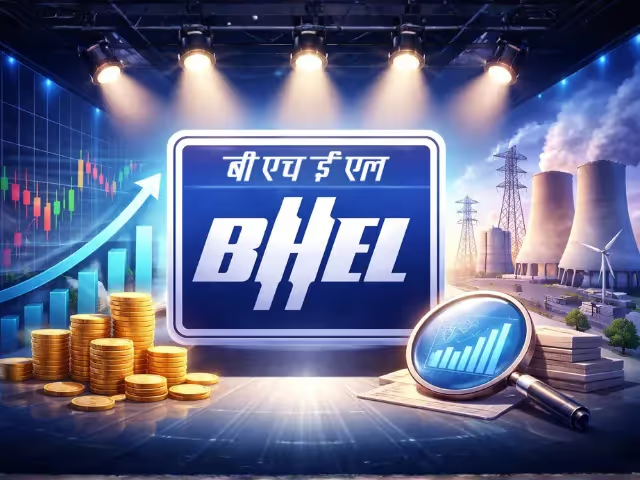
BHEL in Spotlight: Strong Business Execution but OFS Dilution — Key Levels to Watch
Meta Title: BHEL in Spotlight: OFS vs Order Boost
Meta Description: BHEL shares fall on OFS despite ₹2,800 crore order win. Key levels, outlook, and what investors should watch now.
Quick Take
- BHEL shares fell 5.41 percent to ₹260.80 after the government announced a 3 percent OFS with a 2 percent green shoe option.
- The OFS floor price of ₹254 created short term price pressure.
- Fundamentally, BHEL secured a ₹2,800 crore syngas plant order from BCGCL.
- Liquidity may improve post dilution, but key technical levels will guide near term direction.
BHEL in Spotlight: Strong Business Execution but OFS Dilution, Key Levels to Watch
BHEL in Spotlight is not just a headline. It reflects a classic market situation where strong business momentum meets short term supply pressure.
On February 11, 2026, Bharat Heavy Electricals Limited shares declined 5.41 percent to close at ₹260.80. The fall was triggered by the government’s Offer for Sale announcement to divest up to a 5 percent stake. At the same time, BHEL secured a fresh ₹2,800 crore order from Bharat Coal Gasification and Chemicals Limited, reinforcing its execution strength.
So what matters more for investors right now, dilution or business growth? Let us decode.
Government OFS: Why Did BHEL Shares Fall?
The Centre, through the Department of Investment and Public Asset Management, launched an Offer for Sale to dilute a 3 percent equity stake in BHEL, with an additional 2 percent available under a green shoe option.
The floor price was fixed at ₹254 per share, nearly 8 percent lower than the previous closing price. This discount naturally created immediate selling pressure in the secondary market.
Key Details of the OFS
- 3 percent base stake sale
- 2 percent additional green shoe option
- Floor price at ₹254
- Open on February 11 for non retail investors
- Retail investors allowed to bid on T plus 1 basis
The government’s objective is clear. Increase public shareholding, improve market liquidity, and align with its broader disinvestment roadmap.
Under SEBI regulations, the OFS mechanism ensures transparent price discovery and fair participation for institutional and retail investors.
In the short term, however, such stake sales increase supply in the market. When supply rises at a discounted price, stock prices often adjust lower.
Strong Business Execution: ₹2,800 Crore Order Win
While the OFS grabbed headlines, the operational update is equally important.
BHEL received a Letter of Acceptance from Bharat Coal Gasification and Chemicals Limited for the LSTK 2 syngas purification plant package. The order value is approximately ₹2,800 crore, excluding GST and customs duty.
BCGCL is a joint venture between Coal India Limited, which holds 51 percent, and BHEL, which owns 49 percent.
Project Highlights
- Coal to 2,000 tonnes per day ammonium nitrate project
- Location: Lakhanpur, Jharsuguda district, Odisha
- Scope includes design, engineering, supply, civil works, erection, commissioning, and operations and maintenance
- Commissioning timeline of 42 months
- O and M services for 60 months post acceptance
This project strengthens BHEL’s presence in coal gasification and downstream value added infrastructure. It also aligns with India’s push for energy security and import substitution.
For long term investors, a healthy order book is a core fundamental driver in capital goods companies.
Business Momentum vs Dilution: Which Matters More?
Markets often react first to supply events like OFS. But over time, earnings visibility and execution determine valuation.
BHEL plays a strategic role in India’s power and infrastructure sectors under the Ministry of Heavy Industries. With increasing capital expenditure in thermal, renewable, and industrial projects, order inflows remain crucial.
If BHEL continues to secure large EPC contracts and improve execution, earnings growth could offset short term dilution concerns.
Liquidity improvement post OFS can also attract institutional participation, which may reduce volatility in the long run.
Key Levels to Watch in BHEL Shares
From a technical perspective, price action around the OFS floor price becomes critical.
- Immediate support zone: ₹254 to ₹260
- Strong support: ₹240 to ₹245 range
- Immediate resistance: ₹276 to ₹280
- Breakout zone: Above ₹285 with volume
If the stock sustains above the OFS floor price after allotment, it may signal absorption of supply. On the other hand, a breakdown below ₹254 could trigger further correction.
Traders should track volume patterns and delivery data closely during and after the OFS window.
Impact on Indian Markets
Government disinvestment in public sector undertakings is part of India’s broader fiscal strategy. Such moves can:
- Boost market liquidity
- Improve public float
- Enhance institutional participation
- Support fiscal deficit management
For the broader capital goods and infrastructure sector, strong order inflows reflect steady project activity across power, chemicals, and industrial segments.
BHEL’s performance also acts as a sentiment indicator for other public sector enterprises.
How Should Investors Approach BHEL Now?
There are two clear lenses to evaluate BHEL in Spotlight:
For Short Term Traders
- Monitor price action near ₹254
- Watch subscription data of OFS
- Track volume spikes
For Long Term Investors
- Assess order book growth
- Monitor execution timelines
- Evaluate margin stability
- Track government capex trends
Capital goods stocks often reward patience when backed by a strong order pipeline and improving balance sheet strength.
Investors should also consider portfolio allocation and risk profile before taking fresh exposure.
Why Research Support Matters
Events like OFS announcements can create confusion. Is it a negative signal or just a liquidity event?
Swastika Investmart, a SEBI registered stock broker, offers structured research insights, technical analysis tools, and real time updates to help investors navigate such situations.
With tech enabled trading platforms, dedicated customer support, and investor education initiatives, Swastika Investmart ensures informed decision making rather than emotional reactions.
Frequently Asked Questions
Why did BHEL shares fall despite a large order win?
The decline was primarily due to the government’s OFS at a discounted floor price, which created short term selling pressure.
What is the purpose of the BHEL OFS?
The OFS aims to dilute government stake, improve liquidity, widen public shareholding, and support the broader disinvestment strategy.
Is the ₹2,800 crore order significant for BHEL?
Yes, it strengthens the company’s order book and reinforces its position in coal gasification and industrial infrastructure projects.
What are the key technical levels to watch?
₹254 is a crucial support level, while ₹276 to ₹280 acts as immediate resistance. Sustained movement beyond these levels may define the next trend.
Should long term investors worry about dilution?
Dilution increases supply in the short term, but long term performance depends on earnings growth, execution capability, and sector demand.
Conclusion
BHEL in Spotlight represents a balancing act between short term dilution pressure and long term business execution.
While the OFS created immediate volatility, the ₹2,800 crore order underscores operational strength. Investors should avoid reacting solely to headline driven moves and instead focus on fundamentals, technical levels, and risk management.
If you want access to detailed research, timely alerts, and advanced trading tools, consider opening an account with Swastika Investmart:

Q3 Earnings to Watch Today: Key Companies That Could Move the Market
TL;DR
- Q3 Earnings to Watch Today span autos, jewellery, FMCG, banking, energy, and healthcare.
- Margin expansion is the key theme across several companies.
- Select stocks reported strong profit growth despite mixed revenue trends.
- Earnings surprises may drive sector specific rallies in Indian markets.
Q3 Earnings to Watch Today: Key Companies That Could Move the Market
Q3 Earnings to Watch Today are crucial for traders and long term investors alike. With benchmark indices near record levels and global volatility in play, quarterly numbers can trigger sharp stock moves.
This earnings season reflects India’s evolving consumption story, margin recovery in select sectors, and cost pressures in others. Let us break down the key results and what they mean for the broader market.
Consumption and Retail: Strong Demand Signals
Titan Company
Titan reported revenue growth of 43 percent YoY to Rs 25,416 crore. EBITDA rose 62 percent to Rs 2,713 crore, while net profit climbed 61 percent to Rs 1,684 crore.
Margin expansion of 123 basis points reflects strong pricing power and festive demand. For the broader market, this reinforces the resilience of urban consumption and organised jewellery retail.
Jubilant FoodWorks
Revenue grew 13 percent to Rs 2,437 crore. EBITDA increased nearly 20 percent with margin expansion of 109 basis points. Net profit jumped 65 percent.
Improving profitability in quick service restaurants signals stable discretionary spending, a positive read for the consumer sector.
Britannia Industries
Revenue rose 8 percent while EBITDA increased 16 percent. Margins expanded to 19.7 percent. This suggests effective cost control despite commodity price fluctuations.
Automobiles and Auto Ancillaries: Margin Improvement Theme
Eicher Motors
Revenue surged 23 percent to Rs 6,114 crore. EBITDA grew nearly 30 percent, with margin improvement of 130 basis points. Net profit rose 21 percent.
Strong operating leverage indicates steady demand in the premium motorcycle segment.
ZF Commercial Vehicle Control Systems India
Revenue increased 11.6 percent, while EBITDA rose 12.4 percent. Margins remained stable above 18 percent. Consistent growth in the CV space may reflect stable freight activity.
Kirloskar Ferrous Industries
Revenue growth was modest, but margins improved slightly. Profit growth remained muted, suggesting selective strength in the auto components space.
Power and Energy: Mixed Signals
Torrent Power
Revenue grew 4 percent, but EBITDA jumped 26 percent. Margin expansion of 359 basis points indicates improved efficiency and tariff realization.
Oil India
Revenue remained flat sequentially. EBITDA improved, but net profit declined 16 percent QoQ. Volatility in crude prices and realizations continue to impact profitability.
Energy results remain closely linked to global commodity prices and government policy on fuel pricing.
Healthcare and Hospitals: Stable Growth
Apollo Hospitals Enterprise
Revenue rose 17 percent, EBITDA increased 26 percent, and net profit climbed 35 percent.
Strong performance here indicates steady healthcare demand, which remains less cyclical compared to other sectors.
Banking and Financials: Asset Quality Focus
Karnataka Bank
Net interest income remained flat, but net profit improved 2.5 percent. Gross NPA and net NPA ratios showed marginal improvement.
Stable asset quality supports sentiment in the mid cap banking space, though growth remains moderate.
Infrastructure and Capital Goods
Grasim Industries
Revenue increased 25 percent and EBITDA grew 38 percent. Net profit rose 26 percent, reflecting strength in diversified operations.
Techno Electric and Engineering
Revenue grew 37 percent with strong EBITDA expansion. Margin improvement suggests healthy execution in the power infrastructure segment.
Afcons Infrastructure
Revenue declined, but EBITDA margins improved. However, net profit fell sharply, indicating cost pressures.
Infrastructure players often react sharply to order book commentary during earnings calls.
Real Estate and Housing
Ashiana Housing
Revenue surged 172 percent, EBITDA rose nearly 300 percent, and net profit jumped over 400 percent.
This sharp growth may reflect project completions and strong housing demand.
Arvind SmartSpaces
Revenue and profit declined, indicating uneven performance within the real estate space.
Specialty Chemicals and Manufacturing
HEG
Revenue grew 37 percent while EBITDA surged 78 percent. Net profit jumped 148 percent, supported by strong margin expansion.
Huhtamaki India
Revenue remained stable, but EBITDA doubled and net profit rose 159 percent. Operational efficiency seems to be improving.
Alcohol and Beverages
United Breweries
Revenue rose 3.6 percent, but EBITDA increased nearly 60 percent. Net profit more than doubled.
Som Distilleries
Revenue and profit declined sharply, showing mixed demand conditions across the alcoholic beverage segment.
What This Means for Indian Markets
Q3 Earnings to Watch Today highlight three key trends:
- Margin expansion is emerging in several sectors due to cost control and operating leverage.
- Urban consumption remains strong, as seen in jewellery, QSR, and branded FMCG.
- Sector divergence is increasing. Not all companies are benefiting equally from economic growth.
For investors, earnings season often triggers stock specific rallies rather than broad based index moves. Strong beats can push stocks to new highs, while misses may result in sharp corrections.
As per SEBI disclosure norms, listed companies must provide transparent financial reporting, helping investors make informed decisions. Analyzing EBITDA margins, revenue growth, and profit trends is critical during this period.
How Should Investors Approach Earnings Season
Instead of reacting emotionally, investors should:
- Compare growth with sector peers
- Study margin trends over multiple quarters
- Assess debt levels and cash flows
- Track management guidance
Platforms like Swastika Investmart, a SEBI registered stock broker, provide research tools, detailed earnings analysis, technical insights, and responsive customer support to help investors navigate volatility confidently.
Their tech enabled investing platform and investor education initiatives ensure informed participation in the markets.
Frequently Asked Questions
Why are Q3 earnings important for markets?
Q3 results capture festive demand and often set the tone for full year performance. Strong or weak numbers can significantly impact stock prices.
Which sectors are showing strong momentum this quarter?
Consumption, select auto companies, healthcare, and parts of capital goods have shown strong margin expansion.
How do margin changes affect stock prices?
Improving EBITDA margins indicate better cost control and profitability, which can lead to higher valuations.
Should investors trade during earnings season?
Short term traders may benefit from volatility, but long term investors should focus on consistent growth and fundamentals.
Conclusion
Q3 Earnings to Watch Today reveal a market driven by selective strength. While consumption and margin recovery stand out, sector specific divergence remains high.
In such an environment, disciplined research and data driven decisions matter more than ever. Swastika Investmart combines regulatory credibility, strong research capabilities, advanced trading tools, and investor education support to help you act with clarity.
If you want to participate confidently in earnings driven opportunities, you can open your account here:

Titan Q3 Results: Strong Margin Beat — Is This the Start of a Fresh Rally?
Key Takeaways:
- Titan Q3 Results show 61 percent YoY jump in net profit to Rs 1,684 crore.
- Revenue rose 43 percent to Rs 25,416 crore, led by jewellery demand.
- Strong festive sales and exchange programs boosted margins despite high gold prices.
- Titan shares hit a 52 week high, raising hopes of a fresh rally.
Titan Q3 Results: Strong Margin Beat. Is This the Start of a Fresh Rally?
Titan Q3 Results have caught the market’s attention for all the right reasons. The Tata Group company delivered a sharp earnings beat in the October to December quarter, reporting a 61 percent year on year rise in consolidated net profit to Rs 1,684 crore. Revenue from operations surged 43 percent to Rs 25,416 crore.
What makes this quarter stand out is not just growth, but margin resilience in a period when gold prices were elevated. With Titan shares touching a fresh 52 week high, investors are asking a key question. Is this the beginning of another strong rally?
Let us decode the numbers and the bigger picture.
A Snapshot of Titan Q3 Results
Titan’s performance this quarter reflects strong consumer demand, effective pricing strategies, and operational strength.
Profit and Revenue Growth
- Net profit rose 61 percent YoY to Rs 1,684 crore from Rs 1,047 crore.
- Revenue increased 43 percent YoY to Rs 25,416 crore from Rs 17,740 crore.
Such growth at this scale signals not just festive momentum but sustained brand strength.
The company noted that the India domestic business recorded one of its highest ever quarterly growth performances outside Covid impacted periods. This shows structural demand rather than a one off spike.
Jewellery Business Drives the Show
The jewellery segment continues to be Titan’s backbone.
Strong Growth Despite High Gold Prices
The jewellery portfolio grew 42 percent YoY to Rs 22,517 crore excluding bullion and digi gold sales. Tanishq, Mia, and Zoya together reported 40 percent growth to Rs 19,921 crore. Titan’s India jewellery business alone grew 41 percent YoY to Rs 21,458 crore.
This performance is significant because spot gold prices rose nearly 12 percent during the quarter. Historically, high gold prices tend to dampen demand. However, Titan’s exchange programs, festive collections, wedding sales, and coin offers helped offset this challenge.
Store Expansion and International Push
Titan added 49 net new stores in Q3 FY26. Of these, 47 were added in India across Caratlane, Mia, Tanishq, Zoya, and beYon. Tanishq also expanded in the US with new stores in Boston and Orlando.
Expansion during a strong demand cycle improves operating leverage and long term earnings visibility.
Watches Segment Shows Stability
Titan’s watches portfolio grew 14 percent to Rs 1,295 crore.
The analog category remained the main growth driver, with 20 percent growth in consumer sales. Premium brands like Titan, Fastrack, and Sonata delivered healthy double digit growth.
Smart watches saw volume moderation with a 27 percent YoY decline. This suggests a shift in consumer preference towards classic and premium timepieces rather than aggressive discount driven smart watch sales.
Other Consumer Businesses Add Depth
Titan’s EyeCare segment reported steady volume growth and mid single digit improvement in average selling prices. Lenses and sunglasses achieved double digit growth.
The fragrances business grew 24 percent, led by Skinn and Fastrack perfumes. Women’s bags recorded strong double digit growth in both volume and pricing, while Taneira posted 7 percent growth supported by higher ASP and same store sales growth.
This diversification reduces reliance on a single segment and supports margin sustainability.
What Management Said
Managing Director Ajoy Chawla described Q3 as a stellar quarter marked by broad based growth across portfolios. He emphasized strong buyer engagement driven by exchange programs and festive collections.
Management reiterated its focus on brand equity, customer engagement, and innovation driven growth.
Such commentary reinforces confidence in long term strategy.
Titan Share Price Reaction
Titan shares closed near Rs 4,293.80 and touched a fresh 52 week high of Rs 4,329.60 ahead of the results announcement.
When a stock hits new highs on strong earnings, it often signals institutional accumulation. However, short term volatility is possible as traders book profits.
From a broader market perspective, Titan’s performance boosts sentiment in consumer discretionary and retail segments. Strong festive demand also reflects healthy urban consumption trends in India.
Is This the Start of a Fresh Rally?
To answer this, investors must assess three factors.
Earnings Momentum
A 61 percent profit jump and 43 percent revenue growth provide strong earnings visibility. If margin strength sustains in coming quarters, valuations may remain justified.
Gold Price Trend
Gold prices rose sharply during the quarter. If gold remains elevated, Titan’s pricing strategy and exchange initiatives will be tested again. So far, the company has demonstrated resilience.
Valuation and Market Sentiment
Titan typically trades at a premium valuation due to brand strength and consistent growth. A fresh rally will depend on earnings upgrades and broader market conditions.
For long term investors, Titan remains a structural consumption story linked to rising incomes, formalization of jewellery retail, and brand trust.
What Should Investors Do?
Investors should avoid making decisions based solely on one quarter. Instead, consider:
- Long term growth trajectory
- Store expansion plans
- Market share gains
- Competitive positioning
- Overall portfolio allocation
Tracking quarterly commentary and margin trends will be key.
Using research driven platforms such as Swastika Investmart can help investors interpret earnings data, valuation metrics, and technical trends effectively. As a SEBI registered stock broker, Swastika Investmart offers strong research tools, tech enabled investing, responsive customer support, and investor education initiatives that empower informed decision making.
Frequently Asked Questions
What were Titan Q3 Results for FY26?
Titan reported a 61 percent YoY rise in net profit to Rs 1,684 crore and a 43 percent increase in revenue to Rs 25,416 crore.
How did the jewellery segment perform?
The jewellery portfolio grew 42 percent YoY despite high gold prices, driven by festive demand and exchange programs.
Did Titan shares react positively?
Yes. Titan shares touched a fresh 52 week high around Rs 4,329.60 ahead of the results.
Is Titan a long term investment?
Titan is often viewed as a long term consumption play, but investors should evaluate valuations, growth prospects, and portfolio fit.
Conclusion
Titan Q3 Results highlight strong execution, brand power, and consumer resilience even in a high gold price environment. The sharp profit growth and margin strength have revived optimism around the stock.
Whether this leads to a sustained rally will depend on earnings consistency and market conditions. For investors seeking disciplined research, timely insights, and technology backed investing solutions, Swastika Investmart provides a reliable platform to navigate such opportunities.
If you are looking to participate in India’s growth story through informed investing, you can open your account here:

Decoding the Macro Link: Why Gold Rises When US Yields Fall: Understanding the Global Link Impacting Indian Investors
TL;DR
- Gold often rises when US bond yields fall because lower yields reduce the opportunity cost of holding gold.
- Falling yields usually signal slowing growth or rate cuts, boosting safe haven demand.
- Indian investors respond through gold ETFs, SIPs, and portfolio diversification.
- The trend impacts inflation expectations, rupee movement, and Indian equity markets.
Decoding the Macro Link: Why Gold Rises When US Yields Fall and Its Impact on Indian Investors
Gold has always held a special place in Indian portfolios. From wedding jewelry to digital gold and ETFs, the metal is more than an asset. It is a hedge, a tradition, and a safety net. But in global markets, gold follows macro signals. One of the strongest relationships investors track is this: why gold rises when US yields fall.
Understanding this connection can help Indian investors make better decisions, especially during volatile market phases.
The Core Concept: Why Gold Rises When US Yields Fall
Gold does not pay interest or dividends. It simply sits in your portfolio. That means its attractiveness depends on what other assets are offering.
When US Treasury yields are high, investors can earn attractive fixed returns from government bonds. In such periods, gold becomes less appealing because it offers no yield.
However, when US yields fall, the opportunity cost of holding gold declines. Investors are no longer giving up strong interest income by owning gold. As a result, demand for gold increases and prices often rise.
This is the fundamental reason why gold rises when US yields fall.
Understanding US Bond Yields in Simple Terms
US Treasury bonds are considered among the safest investments globally. Their yields reflect:
- Expectations about US interest rates
- Inflation outlook
- Economic growth prospects
- Risk sentiment in global markets
When yields decline, it often signals:
- Expectations of Federal Reserve rate cuts
- Slower economic growth
- Rising recession concerns
- Increased demand for safe assets
In such environments, gold tends to benefit.
The Opportunity Cost Effect Explained with an Example
Imagine two scenarios.
Scenario 1: US 10 year bond yields are at 5 percent. Investors earn steady returns with low risk. Gold becomes less attractive.
Scenario 2: US 10 year bond yields fall to 3 percent due to growth concerns. Suddenly, bonds offer lower returns. Investors shift to gold for capital protection and diversification.
This shift in capital is one of the key drivers behind gold rallies when yields drop.
The Role of Inflation and Real Yields
Another crucial factor is real yield. Real yield is the bond yield adjusted for inflation.
If inflation is high and yields are falling, real yields can turn negative. When real yields are negative, gold becomes even more attractive because:
- Bonds lose purchasing power
- Gold acts as a store of value
This dynamic has played out multiple times in recent years, especially during global crises.
How This Global Link Impacts Indian Investors
Even though US yields are a global variable, their movement directly impacts Indian markets.
Impact on Gold Prices in India
Gold prices in India are influenced by:
- International gold prices
- Rupee dollar exchange rate
- Import duties and regulatory policies
When US yields fall and global gold prices rise, Indian gold prices usually move higher as well. If the rupee weakens at the same time, the price rise can be sharper.
This is why we often see record high gold rates in India during periods of global uncertainty.
Surge in Gold ETFs and SIP Investments
In recent years, Indian investors have increasingly shifted to gold ETFs and gold mutual funds. According to AMFI data trends, gold ETF assets under management have seen strong inflows during risk off phases.
Falling US yields often coincide with:
- Equity market volatility
- Rising geopolitical tensions
- Defensive asset allocation
Investors respond by increasing allocation to gold ETFs through systematic investment plans.
Impact on Indian Equity Markets
The link does not stop at gold.
When US yields fall sharply, it can mean:
- Global risk aversion
- Foreign institutional investor outflows or cautious positioning
- Pressure on emerging markets
However, if yields fall due to rate cut expectations and liquidity support, equity markets may also benefit.
For Indian investors, this means tracking US yields can provide early signals about:
- FII flows
- Currency trends
- Sector rotation
- Defensive versus cyclical positioning
Regulatory Context in India
Gold ETFs and mutual funds in India operate under SEBI regulations. These instruments provide a transparent and efficient way to gain exposure to gold without the risks of physical storage.
Investors must evaluate:
- Expense ratios
- Tracking error
- Liquidity
- Tax treatment
Understanding macro trends such as why gold rises when US yields fall helps investors align their strategy within the regulatory framework.
Real World Case Study
During periods when the US Federal Reserve signaled rate cuts, US Treasury yields declined significantly. In such phases:
- Gold rallied globally
- Indian gold ETF inflows surged
- Defensive sectors gained attention
- The rupee saw volatility
This pattern highlights how interconnected global and Indian markets are.
Portfolio Strategy for Indian Investors
Gold should not replace equities or fixed income. Instead, it works best as a diversification tool.
Financial planners often suggest allocating 5 to 15 percent of a portfolio to gold depending on risk profile.
In times of falling US yields and macro uncertainty, investors may:
- Increase gold exposure gradually
- Use SIPs in gold ETFs
- Balance equity risk with defensive assets
A disciplined approach works better than emotional decisions.
Frequently Asked Questions
Why does gold rise when US yields fall?
Because lower yields reduce the opportunity cost of holding non interest bearing assets like gold, increasing its demand.
Do US yields directly affect Indian gold prices?
Yes. Global gold prices are dollar denominated. Movements in US yields influence global prices, which then impact Indian rates.
Should investors buy gold every time yields fall?
Not necessarily. Investors should consider broader macro trends, portfolio allocation, and long term goals.
How can Indian investors invest in gold?
Through gold ETFs, gold mutual funds, sovereign gold bonds, or physical gold. SEBI regulated ETFs offer transparency and liquidity.
Conclusion
The relationship between US bond yields and gold prices is one of the most powerful macro linkages in global markets. When yields fall, gold often rises due to lower opportunity costs, inflation expectations, and safe haven demand.
For Indian investors, understanding this connection is essential. It helps in managing risk, timing allocation shifts, and building a resilient portfolio.
At Swastika Investmart, a SEBI registered stock broker, we combine macro insights, research driven strategies, and technology enabled investing tools to help investors navigate global signals with confidence. Our customer support and investor education initiatives ensure you make informed decisions rather than reactive ones.
If you are looking to diversify your portfolio and invest smartly across asset classes, you can start your journey here:

February Market Outlook 2026 India: Budget, RBI, GDP, and Global Trade Crossroads

Click to View Report
Quick Summary
- Union Budget 2026 reshaped taxation and capex priorities, causing short-term volatility.
- RBI policy and liquidity stance will decide the next leg for Nifty and Bank Nifty.
- India–US trade deal improved export visibility for several sectors.
- Global axis of Russia–China and energy prices remain key risks.
- Stock selection and disciplined SIPs remain safer than momentum chasing.
The Mother of All Market Themes in February
February 2026 is not just another month for Dalal Street. It is the intersection of domestic policy, global trade realignment, and monetary strategy. Investors are processing four large events at once: the Union Budget, upcoming RBI policy direction, fresh GDP estimates, and the landmark India–US trade agreement.
Unlike routine market phases, this period is shaping the economic narrative for the next few years. Every portfolio decision must now be seen through a wider lens rather than short-term index movement.
Budget 2026: From Shock to Strategy
The initial reaction to the Budget was emotional. Higher taxation on derivatives and changes in buyback rules hit sentiment. Yet the same document delivered the largest ever capital expenditure plan focused on infrastructure, defence, railways, and semiconductors.
For long-term investors, this signals a shift from consumption-led growth to investment-led growth. Companies connected to roads, power, logistics, and domestic manufacturing are likely to see multi-year order visibility. The Budget also maintained fiscal discipline, keeping India attractive in the eyes of global rating agencies.
RBI Policy and Liquidity: The Next Trigger
Markets now look toward the Reserve Bank of India. Inflation has moderated but food prices and imported energy remain sticky. The RBI faces a delicate balance between supporting growth and protecting the rupee.
Any signal on rate cuts or liquidity easing could directly influence housing finance, banks, and rate-sensitive sectors. A stable monetary stance will also encourage foreign funds to return to Indian bonds and equities.
GDP Outlook: Growth With Guardrails
Early estimates suggest India continues to be the fastest-growing large economy. Manufacturing revival, digital adoption, and formalisation are supporting tax collections. Rural demand is recovering after a better monsoon cycle.
However, urban consumption shows selective fatigue, and job creation must accelerate to sustain high GDP momentum. Investors should prefer businesses aligned with domestic capex and export competitiveness rather than pure discretionary stories.
India–US Trade Deal: A Structural Positive
The reduction in tariffs has changed the conversation around Indian exports. Textile hubs, auto component clusters, speciality chemical makers, and engineering goods now have better access to the US market.
This deal also carries geopolitical meaning. It positions India as a reliable supply chain partner at a time when global companies want alternatives to overdependence on China.
Russia–China Axis and Global Risks
Energy prices remain the biggest external variable. The Russia–China partnership influences crude flows, logistics costs, and currency movements. Any escalation can quickly impact Indian inflation and the RBI stance.
Investors should therefore keep exposure to quality energy consumers, avoid excessive leverage, and maintain diversification across sectors.
Market Flows: FII vs DII Reality
Foreign investors reduced positions earlier due to a strong dollar and valuation concerns. Domestic institutions filled the gap through steady SIP inflows. This new structure has made Indian markets more resilient than in previous cycles.
The message is clear. Long-term money is overpowering short-term speculation, and corrections are becoming opportunities rather than disasters.
Sector Roadmap After Budget
Infrastructure and Capital Goods
Beneficiaries of government spending with visible order books and healthier margins.
Export-Oriented Manufacturing
Textiles, chemicals, pharma, and auto ancillaries gain from the trade deal and China-plus-one strategy.
Financials
Banks and NBFCs benefit from credit growth, while policy direction from RBI will be decisive.
Energy and Commodities
Sensitive to Russia–China developments and global demand trends.
Practical Playbook for Investors
- Prefer staggered investing through SIPs and STPs.
- Focus on earnings visibility over story stocks.
- Keep a mix of largecaps for stability and selective midcaps for growth.
- Avoid excessive derivative speculation after new tax changes.
Choosing a credible intermediary with strong research and compliance matters more than ever. Swastika Investmart, a SEBI-registered platform, combines technology-driven investing with human advisory, regular education, and transparent risk management to help investors navigate complex markets.
Frequently Asked Questions
How will the Budget shape markets in 2026?
The Budget supports investment-led growth. Short-term volatility may continue, but infrastructure and manufacturing should gain over the medium term.
Can RBI policy trigger a fresh rally?
Yes, any hint of rate easing or improved liquidity could boost banks, real estate, and consumption-oriented sectors.
What does the India–US trade deal mean for investors?
It improves revenue visibility for exporters and reduces geopolitical uncertainty, supporting valuations.
Are Russia–China developments relevant to Indian stocks?
They affect crude prices, inflation, and currency, which directly influence RBI decisions and corporate margins.
Is this a good time to start investing?
For long-term goals, disciplined investing during volatile phases has historically delivered better outcomes than waiting for perfect clarity.
Closing Perspective
February 2026 stands as a defining chapter for Indian markets where Budget reforms, RBI strategy, GDP momentum, and global trade are converging. Volatility is the price investors pay for opportunity. With informed decisions and a trusted partner, this phase can lay the foundation for long-term wealth creation.
.avif)
Stocks in News 11 February 2026 : What Investors Should Track Today Tata Motors, BHEL, Eicher Motors, Sonata Software
Quick Takeaways
• Tata Motors secures large vehicle supply order from Indonesia
• BHEL wins major order worth about Rs.2,800 crore
• Eicher Motors to expand annual production capacity
• Sonata Software achieves AWS Premier Tier status
Stocks in News 11 February 2026: Key Corporate Triggers for Today
The Stocks in News 11 February 2026 list highlights important corporate developments that may shape market sentiment in the coming sessions. Company specific news often drives sectoral momentum even when broader indices remain range bound. For retail investors, tracking such updates helps in understanding where smart money could move.
Indian markets have recently been reacting more to earnings and order announcements than to global headlines. The latest set of announcements from Tata Motors, BHEL, Eicher Motors, and Sonata Software brings opportunities across automobile, capital goods, and IT sectors.
Tata Motors Expands Global Footprint
Tata Motors has entered into an agreement for the supply of 70,000 vehicles for deployment in Indonesia. This is a meaningful development for the company’s international business. Indonesia is one of the fastest growing automobile markets in Southeast Asia, and such a large order strengthens Tata Motors’ export pipeline.
For investors, this news signals two positive aspects. First, the company is diversifying revenue beyond the domestic market. Second, large fleet orders generally improve capacity utilisation at manufacturing plants, which can support operating margins.
The automobile sector in India has been witnessing steady demand recovery. If Tata Motors continues to win similar contracts, it could encourage other Indian auto manufacturers to explore global opportunities as well.
BHEL Bags Rs.2,800 Crore Order
Another major highlight in the Stocks in News 11 February 2026 update is Bharat Heavy Electricals Limited receiving a Letter of Award from BCGCL for the LSTK 2 syngas purification plant package worth approximately Rs.2,800 crore.
This order is important because BHEL has been focusing on strengthening its presence in the energy and infrastructure space. Large EPC contracts improve revenue visibility for several years. Capital goods companies in India often witness rerating when order inflow remains strong.
From a broader market perspective, such orders indicate that government and private sector capex plans are progressing. This supports allied industries like steel, engineering services, and logistics.
Eicher Motors Plans Capacity Expansion
Eicher Motors announced expansion of its production capacity from 14.6 lakh units to 20 lakh units per year with an investment of about Rs.958 crore. This reflects management confidence in future demand for two wheelers and commercial vehicles.
Capacity expansion usually precedes a growth cycle. When companies commit fresh capital, it shows that they expect sustained sales momentum. For long term investors, such announcements provide insight into the strategic direction of the business.
The auto segment contributes significantly to India’s manufacturing GDP. Higher production can create employment and boost the auto ancillary ecosystem. Therefore, this update has relevance beyond a single company.
Sonata Software Achieves AWS Premier Tier Status
In the IT space, Sonata Software announced that it has achieved AWS Premier Tier Services Partner status in the AWS Partner Network. This recognition is granted only to companies with strong cloud expertise and proven customer success.
Cloud migration and digital transformation remain high priority for global enterprises. Sonata’s new status can help it win larger deals and improve margins. Indian IT firms are increasingly focusing on specialised cloud capabilities rather than only traditional services.
For investors, such certifications act as qualitative indicators of a company’s technological strength and future readiness.
How These Updates Can Influence Indian Markets
The Stocks in News 11 February 2026 mix represents three important themes: export driven growth, domestic capex revival, and digital transformation. When companies from different sectors announce positive triggers on the same day, market breadth usually improves.
For example, a trader tracking Tata Motors may also look at other auto stocks like M&M or Ashok Leyland for sympathy moves. Similarly, BHEL’s order could bring attention to peers in power equipment and infrastructure.
However, investors should avoid reacting only to headlines. It is essential to study valuations, balance sheet strength, and overall market trend before taking positions.
Practical Approach for Retail Investors
A balanced strategy works best on news driven days. Short term traders can focus on price levels and volume confirmation. Long term investors may use dips to accumulate fundamentally strong names.
Imagine an investor who already holds Eicher Motors for the long term. The capacity expansion news reassures him about growth visibility, so he may decide to continue holding instead of booking early profits. Such rational decisions create wealth over time.
Access to credible research makes this process easier. Swastika Investmart, a SEBI registered broker, provides market insights, technical tools, and investor education that help individuals understand the real impact behind daily news.
Frequently Asked Questions
What is the most important update in Stocks in News 11 February 2026?
The major highlights are Tata Motors’ 70,000 vehicle supply agreement and BHEL’s order worth about Rs.2,800 crore, both of which can influence sector sentiment.
Does capacity expansion by Eicher Motors benefit investors?
Yes, higher capacity indicates management confidence in demand and can support long term revenue growth.
Why is Sonata Software’s AWS status significant?
AWS Premier Tier recognition improves credibility in cloud services and may help the company win larger digital transformation projects.
Should investors buy stocks only based on news?
No, news should be combined with valuation, financial health, and market trend before making investment decisions.
Closing Note
The Stocks in News 11 February 2026 updates show how individual corporate actions can shape daily market direction. Staying informed and analysing news with a long term perspective helps investors avoid emotional decisions.
If you want a reliable platform with strong research support, investor education, and seamless trading technology, Swastika Investmart can be a trusted partner for your market journey.
.avif)
Market Set Up 11 February 2026: Reading Today’s Market Mood
Quick Takeaways
• Global cues positive with Dow futures up and Asian markets firm
• FIIs turned buyers in cash while DIIs showed strong support
• Nifty holding above 25,500 keeps short term trend bullish
• Bank Nifty sustaining over 60,000 signals strength in financials
Market Set Up 11 February 2026: Reading Today’s Market Mood
The Market Set Up 11 February 2026 shows a constructive start for Indian equities. Global markets ended mixed but with a positive bias, and early signals from GIFT Nifty indicate a firm opening. For retail investors and traders, such days often create opportunities in quality large caps and momentum driven sectors.
US markets closed with mild gains led by the Dow Jones, while Dow futures are trading higher by more than 100 points. Asian markets are also reflecting optimism. These external cues matter because Indian markets are currently sensitive to global liquidity flows and risk sentiment.
Domestic data from institutional participants adds more colour to the picture. Foreign Institutional Investors have shown renewed buying interest in the cash segment, while Domestic Institutional Investors continued their consistent support. This combination generally strengthens near term confidence.
What FII and DII Activity Is Signalling
One of the most important aspects of the Market Set Up 11 February 2026 is the behaviour of institutional money. FIIs bought close to 69 crore in the cash market, while DIIs infused over 1,100 crore, taking the net figure above 1,200 crore.
For new investors, this is significant because sustained DII buying often cushions the market during global volatility. Mutual funds, insurance companies, and pension funds fall under this category, and their long term approach brings stability.
In the derivatives space, the PCR has improved compared to the previous session. Option data indicates major positions around the 25,900 and 27,500 strikes. However, weekly expiry dynamics can distort option figures, so traders should rely more on price action than only on open interest changes.
Nifty Outlook: Levels That Matter Today
Nifty continues to display bullish momentum after defending the 25,500 zone. This level has now become a crucial demand area. As long as the index trades above it, the short term structure favours buyers.
Immediate resistance is visible near 26,000 followed by 26,100. A decisive close above these zones can trigger fresh momentum towards higher targets. On the downside, 25,780 and 25,700 are important supports where dip buying interest may emerge.
For example, in the last few sessions, every decline towards 25,800 attracted buying from quality stocks in banking, auto, and capital goods. This behaviour shows that investors are not rushing to exit but are using corrections to accumulate.
Bank Nifty Showing Leadership
Bank Nifty remains the stronger index in the Market Set Up 11 February 2026. It is trading comfortably above the psychological 60,000 mark, which reflects confidence in frontline banks.
Resistance is placed around 61,000 and 61,500. If these levels are crossed with volume, the index could lead the next leg of the rally. Supports are seen near 60,500 and 60,000.
Private banks have been driving this strength, supported by healthy credit growth and stable asset quality. PSU banks are also participating selectively, especially those with improving return ratios.
How Retail Investors Should Approach Today
A practical approach on such days is to follow a level based strategy rather than chasing early spikes. Investors can focus on sectors showing relative strength such as banking, infrastructure, and select IT names.
Suppose a retail trader buys a Nifty stock near 25,850 with a stop near 25,700. The risk remains defined while the upside opens towards 26,100. This kind of disciplined plan works better than emotional trading.
Long term investors should continue systematic investments. Market set ups like today often reward those who stay invested through volatility instead of trying to time every move.
Impact on the Indian Markets
The broader impact of the Market Set Up 11 February 2026 is positive for sentiment. Strong DII participation shows domestic confidence in economic growth. With inflation moderating and earnings season largely stable, risk appetite is improving.
From a regulatory perspective, SEBI’s continuous focus on transparency in derivatives and risk management has helped reduce excessive speculation. This creates a healthier environment for genuine investors.
If global cues remain supportive, India could attract fresh foreign flows in coming weeks. Sectors linked to domestic consumption and infrastructure may benefit the most.
Why the Right Platform Matters
In fast moving markets, access to reliable research and technology becomes critical. Swastika Investmart, a SEBI registered broker, offers structured market insights, easy to use trading platforms, and dedicated customer support. For many investors, timely alerts and educational resources make decision making simpler.
Whether someone is a beginner learning about option PCR or an experienced trader tracking FII data, having a trusted partner adds confidence.
Frequently Asked Questions
What does Market Set Up 11 February 2026 indicate for Nifty?
It indicates a bullish bias as Nifty is holding above 25,500 with positive global cues and supportive institutional flows.
Which levels are crucial for Bank Nifty today?
The key resistance lies at 61,000 and 61,500, while 60,500 and 60,000 are important support zones.
How important is FII and DII data?
These flows show the conviction of large investors. When both participate on the buy side, markets usually remain stable.
Should beginners trade on such days?
Beginners should prefer limited risk strategies or observe the market rather than taking aggressive leveraged positions.
Final Thoughts
The Market Set Up 11 February 2026 presents a constructive picture for Indian equities with support from global markets and domestic institutions. Staying focused on quality stocks, respecting risk levels, and avoiding emotional decisions remain the keys to success.
If you want to trade with a SEBI registered platform backed by strong research tools and investor education, open your account with Swastika Investmart and experience tech enabled investing.
FII FPI & DII Trading Activity 10 February 2026 – What It Means for Indian Markets
Summary
- Domestic institutions remained strong net buyers while FIIs showed mild selling pressure.
- DII buying crossed ₹1,500 crore on NSE cash segment, supporting market stability.
- FIIs turned net sellers by around ₹350 crore, indicating cautious global stance.
- Mixed flows suggest stock-specific action rather than broad market weakness.
- Banking, large-caps and defensive sectors continue to attract domestic money.
Understanding Today’s Institutional Flow Picture
Institutional participation is the heartbeat of Indian equity markets. The buying and selling behaviour of Foreign Institutional Investors (FIIs/FPIs) and Domestic Institutional Investors (DIIs) often sets the short-term direction for indices like Nifty 50 and Sensex.
On 10 February 2026, the data revealed an interesting tug of war. Domestic institutions once again played the role of shock absorbers, while foreign investors remained slightly on the back foot.
- DII Activity on NSE Cash:
- Buy Value: ₹14,179.70 crore
- Sell Value: ₹12,641.07 crore
- Net: +₹1,538.63 crore
- FII/FPI Activity on NSE Cash:
- Buy Value: ₹15,156.63 crore
- Sell Value: ₹15,509.18 crore
- Net: –₹352.55 crore
When exchange-combined data of NSE, BSE and MSEI is considered, DIIs remained net buyers by over ₹1,174 crore, while FIIs showed marginal positive flows of ₹69 crore. This divergence highlights how domestic money is increasingly driving Indian markets.
Why Institutional Flows Matter More Than Ever
Indian markets in recent years have matured beyond being completely dependent on foreign capital. Systematic Investment Plans, insurance inflows and pension funds have created a powerful domestic liquidity engine.
However, FII behaviour still impacts:
- Short-term volatility
- Currency movement
- Sector rotation
- Valuation comfort for large caps
A day of FII selling does not automatically signal a bearish trend. What matters is the consistency of flows. The current pattern shows selective profit booking by FIIs rather than an exit.
What DII Buying Tells Us
The strong DII numbers reflect confidence among mutual funds, banks and insurance companies. Several factors are supporting domestic participation:
- Steady SIP Inflows: Retail investors continue to invest through monthly plans, creating automatic buying power.
- Earnings Visibility: Corporate results have shown resilience, especially in banking and infrastructure.
- India Growth Narrative: Compared with other emerging markets, India remains a preferred long-term destination.
This domestic cushion often prevents sharp corrections even when global cues are weak.
Possible Reasons Behind FII Caution
Foreign investors evaluate India alongside global opportunities. A few triggers may explain the mild selling bias:
- Movement in US bond yields and dollar index
- Valuation premium of Indian equities
- Sector-specific profit booking
- Geopolitical risk assessment
Importantly, the selling was not aggressive, which suggests FIIs are in observation mode rather than panic mode.
Impact on Retail Investors
For individual traders and investors, such mixed institutional data calls for a balanced approach.
- Avoid reacting to single-day flows
- Focus on fundamentally strong stocks
- Use volatility to accumulate quality names
- Track sector leadership rather than index noise
Markets tend to reward discipline more than prediction.
How Indian Regulations Strengthen Confidence
SEBI’s stringent disclosure norms for FPIs and mutual funds ensure transparency in reporting daily flows. Real-time availability of this data on exchanges helps investors make informed decisions.
India’s robust settlement systems, T+1 cycle and improved risk management have further increased trust among global participants.
Strategy for the Week Ahead
- Watch whether DII buying continues above the ₹1,000 crore mark.
- Monitor FII positions in index futures for directional clues.
- Banking and large-cap IT remain key sectors to track.
- Any reversal in global cues could quickly bring FIIs back as buyers.
How Swastika Investmart Helps You Navigate Flows
At Swastika Investmart, investors get access to:
- SEBI-registered research backed insights
- Institutional flow tracking tools
- Tech-enabled trading platforms
- Dedicated customer support
- Investor education initiatives
Understanding FII/DII data becomes actionable when combined with strong research and timely execution.
👉Start your investing journey today
Frequently Asked Questions
1. What is the difference between FII and DII?
FIIs are overseas institutions investing in Indian markets, while DIIs include domestic mutual funds, insurance companies and banks investing within India.
2. Does FII selling always crash the market?
No. If DIIs absorb the selling and fundamentals remain strong, markets can stay stable or even rise.
3. Where can I check daily FII DII data?
Exchanges like NSE and BSE publish official figures after market hours for complete transparency.
4. Which segment is considered for this data?
The figures refer to the Capital Market cash segment across NSE, BSE and MSEI.
5. How should beginners use this information?
Use it as a sentiment indicator, not as the sole reason to buy or sell a stock.
Final Thoughts
The trading activity of 10 February 2026 clearly shows the growing strength of domestic investors in India. While FIIs remain important, the market is no longer hostage to their decisions alone.
For long-term investors, such phases create opportunities to focus on quality businesses rather than daily noise. With the right research partner and disciplined approach, institutional data can become a powerful edge.
Invest smart, stay informed, and let Swastika Investmart be your guide in India’s growth story.

Fractal Analytics vs Aye Finance IPO India : First AI Company IPO Explained | Watch Full Video

India’s primary market is witnessing a landmark moment. Fractal Analytics IPO is being called India’s first pure-play Artificial Intelligence company IPO, while Aye Finance IPO represents the fast-growing MSME credit ecosystem. Both belong to completely different industries, yet they reflect where India’s economy is heading – technology-led intelligence and Bharat-focused financial inclusion.
🎥 We have also explained this topic in a detailed video with financial numbers, GMP trends and application strategy – click to watch the full video.
Summary
- Fractal Analytics brings a global AI & analytics business to Indian markets
- Aye Finance focuses on small business lending using data-driven underwriting
- Fractal is a tech growth story; Aye Finance is a financial services play
- Risk factors differ – client concentration vs credit quality
- Long-term potential matters more than listing-day gains
What Exactly Does Fractal Analytics Do?
Fractal Analytics works with Fortune 500 companies to help them take decisions using AI models, machine learning, and advanced analytics. Its revenue comes from enterprise consulting, proprietary platforms and long-term digital transformation contracts.
Why Investors Are Excited
- Exposure to the global AI boom from India
- High-margin intellectual property-led services
- Multi-year sticky relationships with large clients
- Strong presence in the US and Europe
Key Things to Watch
- Dependence on top clients for revenue
- Competition from global AI and IT majors
- Need for continuous investment in talent and R&D
If listed at reasonable valuations, Fractal could become a benchmark for how Indian markets value deep-tech companies, unlike traditional IT services firms.
Understanding Aye Finance IPO
Aye Finance operates in the NBFC segment, providing loans to micro and small entrepreneurs such as shopkeepers, small manufacturers and service providers. The company uses cash-flow based assessment instead of pure collateral to serve underserved borrowers.
Positives
- Huge untapped MSME credit market
- Technology-driven underwriting
- Diversified geographic presence
- Alignment with India’s financial inclusion theme
Risks
- Asset quality during economic slowdown
- Regulatory changes for NBFCs
- Higher cost of operations than banks
Fractal vs Aye Finance – Apples and Oranges
These IPOs should not be compared only on subscription numbers or grey market premium.
- Fractal Analytics = Global AI + enterprise tech play
- Aye Finance = Domestic lending + Bharat growth play
- One depends on tech spending; the other on credit cycles
- Risk-reward profile is completely different
Indian markets are maturing where investors can now choose between new-age AI innovation and traditional financial growth within the same IPO season.
What This Means for Indian Markets
Fractal’s entry could open doors for more AI, SaaS and product companies to list in India. SEBI’s evolving framework for new-age businesses, better disclosures and governance standards are encouraging such companies to choose Indian exchanges over foreign listings.
Aye Finance highlights the continuing opportunity in MSME formalisation, digital payments adoption and data-led lending – segments strongly supported by RBI and government initiatives.
How Should Retail Investors Decide?
- Don’t invest only because it is “India’s first AI IPO”
- Read the RHP for profitability and cash flows
- Avoid overexposure based on GMP hype
- Match the IPO with your risk profile
- Think long term, not just listing gains
At Swastika Investmart, our SEBI-registered research team evaluates IPOs on fundamentals, governance and valuation so investors can take informed decisions backed by credible insights.
Frequently Asked Questions
Is Fractal Analytics really India’s first AI IPO?
Yes, it is the first major public issue where AI and analytics are the core revenue drivers rather than support services.
Which IPO is better – Fractal or Aye Finance?
There is no direct answer. Fractal suits tech-growth investors, while Aye Finance fits those who prefer financial sector exposure.
Are these IPOs risky?
All IPOs carry risk. Fractal faces client and valuation risk; Aye Finance faces credit and regulatory risk.
Can beginners apply?
Yes, but allocation should be based on financial goals and risk appetite, not social media trends.
What should I track after listing?
For Fractal – client addition and margins.
For Aye Finance – asset quality and collection efficiency.
Final Thoughts
The Fractal Analytics vs Aye Finance IPO debate is not about choosing one winner. It is about understanding two powerful themes shaping India – Artificial Intelligence and MSME growth. Investors should look beyond excitement and focus on business quality, valuation and long-term potential.
Begin your investment journey with research-backed guidance and a trusted SEBI-registered broker.

Fractal Analytics IPO Review: Can an AI Story Fit Your Portfolio? Muted Response, Invest or Avoid?
Summary
- Fractal Analytics IPO is priced between ₹857 and ₹900 per share.
- The company is a global AI and analytics services provider with marquee clients.
- Early subscription trends show gradual retail interest with cautious institutional participation.
- Business is linked to enterprise technology spending and global demand cycles.
- Best suited for investors with understanding of technology sector volatility.
Why Fractal Analytics Is in the Spotlight
Artificial intelligence has moved from being a buzzword to a core part of business strategy. Banks use it to detect fraud, retailers rely on it to predict demand, and hospitals deploy it to improve patient outcomes. Fractal Analytics operates at this intersection of data, AI and decision making. The company helps large global enterprises convert raw data into practical actions.
The IPO offers Indian investors a chance to participate in a technology services firm that earns most of its revenue from overseas markets. Unlike traditional IT outsourcing, Fractal positions itself as a high-end analytics partner. This difference makes the issue interesting, but also demands a deeper look at business fundamentals.
Issue Snapshot
- Price Band: ₹857 to ₹900
- Business Segment: Enterprise AI and advanced analytics
- Client Base: Global Fortune 500 companies across BFSI, retail and healthcare
- Use of Proceeds: Growth initiatives and general corporate purposes
- Listing: Mainboard on BSE and NSE
Subscription during the first days has been steady rather than spectacular. Retail investors have shown better participation compared to other categories, while institutional demand is building gradually. Such patterns are common in technology offerings where investors take time to evaluate growth visibility.
What the Company Actually Does
Fractal Analytics does not build consumer apps. Its work happens behind the scenes of large organizations. For example, a bank may use Fractal’s models to identify which customers are likely to need a home loan. A retailer may rely on its algorithms to decide how many units of a product should be stocked in each store.
Revenue largely comes from long-term contracts. This provides a degree of stability, yet the business remains dependent on corporate technology budgets. When global companies tighten spending, analytics projects can slow down.
Strengths That Stand Out
Global Delivery Model
The company serves clients in North America, Europe and Asia. Diversified geography reduces dependence on any single market.
Specialized Expertise
Instead of competing with broad IT service providers, Fractal focuses on high-value analytics and AI consulting. This niche positioning helps in commanding better pricing.
Long Client Relationships
Many customers have worked with the firm for years. Repeat business forms a major share of revenue, which is a positive sign for continuity.
Growing AI Adoption
Enterprises across the world are investing in automation and data-led decisions. This structural trend supports long-term demand.
Risks Investors Should Not Ignore
Dependence on Global Tech Spending
If the US or European economies slow down, clients may postpone analytics projects. Revenue visibility can fluctuate with macro conditions.
Talent Costs
AI specialists are expensive and in short supply. Rising employee costs can impact margins.
Competitive Space
Large IT companies and global consulting firms are also expanding in analytics. Differentiation must remain sharp.
Currency Movements
A significant portion of income is in foreign currency, exposing the business to exchange rate swings.
What This Means for Indian Markets
The listing of a pure analytics player broadens the technology segment on Indian exchanges. Until now, the market has been dominated by traditional IT services firms. Fractal brings exposure to the next phase of digital transformation where data science drives decision making.
For Indian investors, this IPO offers a way to participate in global AI growth without investing in overseas stocks. At the same time, it introduces technology sector risks such as client concentration and rapid change in tools.
How to Judge the Valuation
Technology companies are valued differently from manufacturing or banking businesses. Investors generally look at revenue growth, quality of clients, and scalability of platforms. Profitability is important, but high growth firms often prioritize expansion.
Comparing Fractal with listed IT majors may not give a perfect picture because its service mix is more specialized. A practical approach is to assess whether the company can sustain double-digit growth while protecting margins.
Who May Consider Applying
- Investors comfortable with global technology exposure.
- Those who understand that earnings can be uneven across quarters.
- Portfolios seeking diversification beyond traditional sectors.
Conservative investors who prefer predictable cash flows may want to allocate cautiously. The IPO suits participants who can hold for several years and ride business cycles.
Learning From Real-World Examples
During the pandemic, many retailers accelerated online sales and needed analytics to manage inventory. Companies like Fractal benefited from such digital shifts. On the other hand, in periods of economic uncertainty, some clients delayed new projects, showing how revenue can move with sentiment.
This pattern is typical for knowledge-driven businesses. Returns are created over time through innovation and deeper client relationships rather than one-time events.
Choosing the Right Platform Matters
Applying to an IPO is not only about filling a form. Investors need access to research, clear risk explanations and reliable execution. Swastika Investmart, a SEBI-registered broker, offers detailed IPO notes, easy application through digital platforms, and responsive customer support. Education initiatives and tech-enabled tools help investors take decisions based on facts instead of market noise.
Open Your Account
Begin your investing journey with a trusted partner
Frequently Asked Questions
1. What is the price band of the Fractal Analytics IPO?
The shares are offered in the range of ₹857 to ₹900 each.
2. What type of business does Fractal Analytics run?
The company provides artificial intelligence and advanced analytics solutions to large global enterprises in sectors like banking, retail and healthcare.
3. How does the company earn revenue?
Income mainly comes from long-term service contracts where Fractal builds data models, platforms and consulting solutions for clients.
4. What are the main risks in this IPO?
Key risks include dependence on global technology spending, competition from large IT firms, rising talent costs and currency fluctuations.
5. Who can apply for this IPO?
Retail investors, high net-worth individuals and institutional investors can apply through their stock broker or online trading platform.
Conclusion
Fractal Analytics IPO represents India’s growing connection with the global AI economy. The business operates in a promising field, yet outcomes will depend on execution, client budgets and innovation pace. Investors should view the issue as a long-term technology play rather than a quick opportunity.
With the right research support and a disciplined approach, IPO investing can become a meaningful part of wealth creation. Swastika Investmart stands beside investors with credible guidance, robust platforms and a commitment to informed participation in India’s capital markets.
US OFAC Allegations on Adani Group: What the Request for Information Means for Investors
US OFAC Allegations on Adani Group: What the Request for Information Means for Investors
TL;DR
- US OFAC has sought information related to certain Adani Group entities, triggering market attention
- An information request is not the same as sanctions or a guilty finding
- Indian regulators continue to oversee disclosures and compliance
- Market volatility may persist, but long-term fundamentals remain key
- Investors should focus on verified facts rather than speculation
Understanding the US OFAC Action and Why It Matters
News around the Adani Group once again grabbed investor attention after reports that the US Office of Foreign Assets Control, commonly known as OFAC, sought information related to certain group entities. Headlines moved fast, social media reacted faster, and markets did what they usually do in such moments, price in uncertainty.
For investors, especially in India, it is important to pause and understand what an OFAC information request actually means and what it does not. Regulatory processes often involve preliminary fact finding, and not every request results in punitive action.
OFAC operates under the US Department of the Treasury and is primarily responsible for administering economic and trade sanctions. Its jurisdiction usually applies to US persons, entities operating in the US, or transactions involving the US financial system.
What Is an OFAC Request for Information
An OFAC request for information is essentially a formal query seeking clarification or documentation related to transactions, counterparties, or compliance processes. It does not automatically imply wrongdoing.
Such requests are often part of routine screening, enhanced due diligence, or third party reporting. Global conglomerates with international exposure frequently face these checks due to their scale, geographic reach, and involvement in cross border trade or financing.
For Indian investors, this distinction is critical. A request for information is not a sanction, not an indictment, and not a final regulatory conclusion.
Adani Group’s Global Exposure and Why Scrutiny Exists
The Adani Group has expanded aggressively across ports, power, renewables, airports, and infrastructure. Many of these businesses involve international lenders, suppliers, and contracts, bringing them within the visibility of overseas regulators.
Large infrastructure projects often require foreign currency borrowing, offshore subsidiaries, and global counterparties. This naturally increases regulatory touchpoints across jurisdictions, including the US financial system.
In past cases across global markets, similar regulatory inquiries have been seen with multinational corporations without necessarily leading to adverse outcomes.
Immediate Market Reaction and Indian Investor Sentiment
Indian equity markets tend to react swiftly to global regulatory headlines, particularly when they involve prominent business groups. Following reports of the OFAC query, select Adani stocks witnessed intraday volatility as traders reassessed risk.
However, broader market indices remained relatively stable, indicating that investors viewed the development as company specific rather than systemic.
Domestic institutional investors and long term retail participants generally focus on cash flows, project execution, and regulatory clarity from Indian authorities such as SEBI and stock exchanges.
Role of Indian Regulators and Disclosure Framework
In India, listed companies operate under strict disclosure norms governed by SEBI and stock exchange regulations. Any material development that could impact investor decision making must be disclosed in a timely manner.
Indian regulators also maintain oversight on foreign exposure, related party transactions, and debt structures through periodic filings. This layered regulatory environment provides an added level of transparency for domestic investors.
From an investor protection standpoint, this ensures that information asymmetry is limited and market participants can make informed decisions.
How Should Investors Interpret This Development
For investors, the key lies in separating facts from speculation. Regulatory inquiries, especially from overseas agencies, often evolve over time. Markets dislike uncertainty, but they also correct exaggerated fears once clarity emerges.
Short term traders may witness heightened volatility, while long term investors may focus on fundamentals such as asset quality, revenue visibility, and balance sheet strength.
This episode also reinforces the importance of diversification and risk management, particularly when investing in large conglomerates with complex structures.
Using Research and Tools to Navigate Volatile News
In times of regulatory headlines, access to credible research becomes invaluable. SEBI registered platforms like Swastika Investmart provide structured analysis, verified updates, and risk focused insights that help investors move beyond noise.
Strong research tools, responsive customer support, and tech enabled investing platforms allow investors to track developments objectively rather than reacting emotionally to headlines.
Investor education initiatives also play a role in helping market participants understand how global regulatory frameworks interact with Indian markets.
Key Takeaways for Indian Investors
Regulatory scrutiny is not uncommon for global businesses operating across borders. While headlines can cause short term discomfort, long term investment decisions should rest on fundamentals, governance disclosures, and regulatory outcomes rather than speculation.
Staying informed through reliable sources and maintaining a disciplined approach remains the best defence against uncertainty driven volatility.
Frequently Asked Questions
What is the US OFAC and what does it do
OFAC is a US Treasury body that enforces economic and trade sanctions and monitors compliance related to international transactions involving the US financial system.
Does an OFAC information request mean sanctions are coming
No, an information request is a preliminary step and does not automatically lead to sanctions or penalties.
Will this impact Indian stock markets broadly
Such developments are usually company specific and do not typically affect the broader Indian market unless systemic risks emerge.
Should retail investors exit Adani stocks immediately
Investment decisions should be based on individual risk tolerance, investment horizon, and fundamentals rather than short term news flow.
How can investors track verified updates on such developments
Following stock exchange disclosures, SEBI filings, and trusted research platforms helps investors stay informed with accurate information.
Conclusion and Investor Perspective
Regulatory inquiries can test market sentiment, but they also underline the importance of transparency and compliance in global business. For Indian investors, the focus should remain on verified disclosures, regulatory clarity, and long term business fundamentals.
If you are looking to navigate market volatility with confidence, having access to reliable research and a SEBI registered platform makes a meaningful difference.
Explore smarter investing and stay informed by opening an account with Swastika Investmart today.

Q3 Earnings Preview: Which Companies Are Reporting Results
Q3 Earnings Preview: Which Companies Are Reporting Results Today and Why It Matters
India’s Q3 earnings season continues to shape market sentiment, with several heavyweight names and mid-cap companies announcing their December quarter results today. From pharmaceuticals and chemicals to stock exchanges and textiles, today’s earnings slate offers valuable insights into sector trends, margin pressures, and management confidence amid a changing macro environment.
For investors, earnings are not just about headline profit numbers. They help decode demand conditions, cost pressures, regulatory impact, and future growth visibility. Let’s take a closer look at the companies reporting Q3FY26 results today, what their numbers indicate, and how the Indian markets could respond.
Why Today’s Q3 Earnings Are Important for Markets
Quarterly results play a crucial role in short-term stock movements and long-term investment decisions. As India navigates stable interest rates, moderating inflation, and global uncertainty, Q3 results are offering clarity on how businesses are adapting.
Sectors such as pharmaceuticals and specialty chemicals are seeing renewed investor interest due to export demand, regulatory approvals, and margin recovery. Meanwhile, infrastructure-linked plays and financial market intermediaries continue to benefit from higher market participation and volumes.
Today’s earnings announcements will help investors assess whether earnings momentum is broad-based or selective.
Companies Reporting Q3 Results Today: Key Highlights
Pfizer India: Steady Growth in Profit and Revenue
Pfizer reported a healthy improvement in its December quarter performance. Net profit rose to ₹141.8 crore in Q3FY26 from ₹127.6 crore a year ago. Revenue from operations increased to ₹645 crore compared with ₹538 crore in the corresponding quarter last year.
The numbers reflect steady demand for chronic therapies and strong execution in the domestic pharmaceutical market. Investors will closely track commentary on pricing pressures, new product launches, and regulatory compliance going forward.
Aurobindo Pharma: Profit Growth and Strategic Expansion
Aurobindo Pharma posted a solid performance with net profit rising to ₹910 crore in Q3FY26 from ₹846 crore in the year-ago period. Revenue grew to ₹8,646 crore from ₹7,979 crore, supported by stable formulations business and export traction.
Beyond earnings, the company announced plans to acquire a 26 per cent stake in Garuda Renewables Private Limited, indicating a strategic push towards sustainability-linked initiatives. It also received approval from the NCLT Hyderabad to merge Curateq Biologics and Auro Vaccines, a move expected to streamline operations and unlock efficiencies.
BSE: Strong Earnings Driven by Market Activity
BSE delivered an impressive set of numbers in Q3FY26. Net profit surged to ₹601.8 crore from ₹219.7 crore in the same quarter last year, while revenue rose to ₹1,244.1 crore compared with ₹768.1 crore.
The sharp rise was driven by higher transaction charges, increased derivatives activity, and improved operating leverage. With retail participation in capital markets remaining strong, earnings visibility for market infrastructure institutions continues to improve.
Navin Fluorine International: Sharp Rise in Profitability
Navin Fluorine reported a significant jump in earnings, with net profit climbing to ₹185.4 crore in Q3FY26 from ₹83.6 crore a year ago. Revenue increased to ₹892.4 crore from ₹606.2 crore.
The performance highlights strong demand for specialty chemicals and fluorochemicals, supported by long-term contracts and global supply chain realignment. Management guidance on capex and margin sustainability will be key for investor sentiment.
Trident: Profit Declines Amid Sector Challenges
Trident reported net profit of ₹44.2 crore in Q3FY26, down from ₹79.7 crore in the same quarter last year. The decline reflects margin pressure and subdued demand conditions in the textile sector.
While near-term challenges persist, investors will watch for recovery signals, cost-control measures, and export demand trends as global consumption stabilises.
Market Impact: What Investors Should Watch
Earnings announced today may influence stock-specific movements, but they also offer broader cues for the Indian equity market.
Pharmaceutical stocks remain in focus due to stable domestic demand and improving export prospects. Specialty chemicals continue to attract long-term investors given China-plus-one opportunities. Meanwhile, BSE’s results reinforce the theme of rising financialisation of savings in India.
Investors should track management commentary on input costs, regulatory risks, currency impact, and demand outlook rather than focusing only on quarterly profit numbers.
How Swastika Investmart Helps Investors Navigate Earnings Season
Tracking earnings season can be overwhelming, especially with multiple companies reporting every day. Swastika Investmart, a SEBI-registered stockbroker, supports investors with in-depth research, earnings analysis, and sector insights.
With robust research tools, tech-enabled trading platforms, and dedicated customer support, Swastika Investmart empowers investors to make informed decisions during volatile market phases. Its focus on investor education ensures clients understand not just what the numbers say, but what they mean.
Frequently Asked Questions
What is Q3 earnings season in India
Q3 earnings season refers to the period when listed companies announce their financial results for the October to December quarter of the financial year.
Why do stock prices react sharply to quarterly results
Stock prices react based on how results compare with market expectations, future guidance, and changes in business outlook.
Which sectors are closely watched during Q3 results
Pharmaceuticals, banking, chemicals, infrastructure, and capital market-related stocks usually attract high investor attention.
Are strong Q3 results enough to invest in a stock
While strong results are positive, investors should also evaluate valuation, growth sustainability, and long-term fundamentals.
How can retail investors track earnings efficiently
Using research platforms and expert analysis from registered brokers like Swastika Investmart helps simplify earnings tracking.
Final Thoughts
Today’s Q3 earnings announcements underline the mixed but resilient nature of India Inc. While sectors like pharmaceuticals, chemicals, and capital markets continue to show strength, others are navigating short-term pressures.
For investors, this is a reminder that disciplined analysis and sectoral understanding matter more than headline numbers.
If you are looking to track earnings trends, analyse stocks, and invest with confidence, consider opening an account with Swastika Investmart and access professional research and seamless trading tools.

Gold Prices Retreat After Historic Market Rout: Is the Safe-Haven Losing Shine?
Gold Prices Retreat After Historic Market Rout: Is the Safe-Haven Losing Shine?
TL;DR
- Gold prices retreated despite sharp volatility across global markets
- Profit booking and liquidity needs drove short-term selling pressure
- Long-term fundamentals for gold remain intact amid macro uncertainty
- Indian investors continue to view gold as a portfolio stabiliser
Why Gold Fell When Markets Turned Risky
Gold has long been considered the ultimate safe-haven asset. Historically, whenever equity markets witness sharp corrections, investors flock to gold to protect capital. However, the recent market rout delivered an unexpected twist. Instead of rallying, gold prices retreated, leaving investors puzzled.
This decline did not signal a loss of confidence in gold itself. Rather, it reflected short-term market mechanics. During intense sell-offs, investors often liquidate profitable assets, including gold, to cover margin calls or raise cash. This temporary selling pressure can push gold prices lower even when risk aversion is high.
In past crises as well, gold has shown similar behaviour before regaining momentum once panic subsides.
Liquidity Crunch and Profit Booking Explained
One of the biggest drivers behind gold’s retreat was the need for liquidity. With equities, commodities, and even some bond markets under stress, investors sought immediate cash. Gold, being highly liquid, became an easy source of funds.
Additionally, gold had rallied strongly in the months leading up to the correction. This created room for profit booking, especially among institutional investors who lock in gains during volatile phases.
For Indian investors, this is not unusual. Domestic gold prices often mirror global trends but are also influenced by the rupee movement. A softer rupee can partially cushion global price declines, reducing the overall impact on local gold rates.
Is Gold Losing Its Safe-Haven Status?
Despite the recent dip, gold’s role as a safe-haven remains intact. Its value lies not in short-term price moves but in its ability to preserve wealth over market cycles.
Gold continues to offer protection against inflation, currency depreciation, and geopolitical uncertainty. Central banks globally, including emerging market economies, have steadily increased their gold reserves over recent years. This structural demand reinforces gold’s long-term relevance.
For Indian households, gold remains deeply embedded in financial planning, serving both cultural and investment purposes. Regulatory frameworks around gold ETFs, sovereign gold bonds, and digital gold have further strengthened access and transparency for investors.
What This Means for Indian Markets
From an Indian market perspective, the gold correction comes at a time when equity volatility is elevated and global cues remain mixed. For portfolio construction, this reinforces the importance of diversification rather than timing individual asset classes.
Gold’s temporary retreat could even be seen as an opportunity for long-term investors to rebalance portfolios. Financial advisors often recommend allocating a portion of investments to gold to reduce overall portfolio risk.
Regulators such as SEBI continue to promote transparent gold investment avenues, enabling investors to participate without the risks associated with physical storage.
How Smart Investors Are Positioning Now
Seasoned investors understand that gold performs best when uncertainty persists over time, not during sudden spikes in panic. Many are maintaining steady exposure rather than exiting positions based on short-term price movements.
This is where disciplined research and advisory support play a role. Platforms like Swastika Investmart provide access to market insights, research tools, and educational resources that help investors navigate volatile phases with clarity rather than emotion.
By focusing on asset allocation and long-term goals, investors can avoid reactive decisions that often hurt returns.
FAQs
Why did gold prices fall despite market volatility?
Gold fell mainly due to profit booking and liquidity needs as investors sold liquid assets to raise cash during the market rout.
Is gold still a safe-haven investment?
Yes, gold remains a reliable safe-haven over the long term, offering protection against inflation, currency risks, and global uncertainty.
Should Indian investors reduce gold exposure now?
Not necessarily. Short-term price movements should not dictate long-term allocation decisions, especially for diversification.
How does the rupee impact gold prices in India?
A weaker rupee can offset global gold price declines, limiting the fall in domestic gold prices.
What are the best ways to invest in gold today?
Gold ETFs, sovereign gold bonds, and digital gold offer regulated and transparent investment options for Indian investors.
Final Thoughts
Gold’s recent retreat may look unsettling at first glance, but it does not undermine its long-standing role in portfolio stability. Market corrections often test investor patience, and gold’s performance should be judged across cycles, not days.
For investors seeking balanced exposure and informed guidance, Swastika Investmart offers SEBI-registered credibility, strong research capabilities, and investor-friendly platforms that support smarter decision-making.
Ready to invest with confidence?

BSE Shares in Focus After Q3 Earnings: What Strong Market Internals Signal for Investors
BSE Shares in Focus After Q3 Earnings: What Strong Market Internals Signal for Investors
TL;DR
- BSE delivered sharp YoY growth in profit and revenue in Q3, driven by higher transaction charges
- Strong derivatives volumes highlight improving market depth
- EBITDA margins expanded significantly, reflecting operating leverage
- BSE shares have rallied sharply over the past year, keeping investors focused on sustainability
Why BSE’s Q3 Earnings Matter for Market Participants
Shares of BSE Ltd, Asia’s oldest stock exchange, moved into focus after the company reported a standout performance for the December quarter. In an environment where market participants closely track trading volumes, derivatives activity and pricing power, BSE’s Q3 earnings offered valuable signals about the health of India’s capital markets.
The exchange reported strong growth across key financial metrics, reinforcing the view that structural improvements in market participation and product diversification are beginning to reflect meaningfully on the balance sheet.
For investors, BSE’s results are not just about headline profit growth. They offer insights into how exchanges monetise rising participation, manage costs and build long-term revenue streams in a competitive regulatory environment overseen by SEBI.
A Snapshot of BSE’s Q3 Financial Performance
BSE posted a sharp improvement in profitability during the quarter.
Standalone net profit rose 104 percent year-on-year to ₹220 crore, while revenue from operations surged 108 percent to ₹773 crore. Operating EBITDA more than doubled to ₹236 crore, with margins expanding to 31 percent, highlighting operating leverage from higher volumes.
On a consolidated basis, the performance was even stronger. Net profit jumped 174 percent year-on-year to ₹603 crore, while revenue climbed 62 percent to ₹1,244 crore. Sequentially, profits improved by 12 percent compared with the September quarter, pointing to consistency rather than a one-off spike.
This performance has contributed to strong stock momentum, with BSE shares rising over 125 percent in the past year.
Transaction Charges Take Centre Stage
A key driver behind BSE’s Q3 numbers was the sharp rise in transaction charges.
Transaction charge revenue surged to ₹952 crore during the quarter, up from ₹511 crore in the same period last year and ₹794 crore in the previous quarter. This jump reflects higher trading activity, improved product acceptance and better monetisation of volumes.
For exchanges, transaction charges are closely linked to market sentiment and participation. When retail and institutional activity picks up, revenues scale rapidly, while fixed costs remain relatively stable. This dynamic played out clearly in BSE’s Q3 earnings.
Equity Derivatives Show Structural Strength
One of the most closely watched segments this quarter was equity derivatives.
BSE reported strong traction in its derivatives business, with options average daily notional turnover rising to ₹210 lakh crore in Q3FY26. This compares with ₹105 lakh crore in the same quarter last year and ₹164 lakh crore in the September quarter.
Options premium average daily turnover also grew nearly 30 percent quarter-on-quarter to ₹194 lakh crore. Total options revenue surged 122 percent year-on-year to ₹784 crore.
These numbers indicate that BSE is gaining ground in a segment that has historically been dominated by a single player. Rising derivatives activity improves revenue visibility and enhances the exchange’s relevance in an evolving trading ecosystem.
EBITDA Expansion Reflects Operating Leverage
Operating efficiency stood out as another positive in the quarter.
Operating EBITDA, including Core SGF, rose sharply to ₹732 crore from ₹235 crore in the year-ago period. EBITDA margins expanded to 59 percent, compared with 31 percent last year.
Such margin expansion reflects the scalable nature of exchange businesses. As volumes increase, incremental revenue largely flows through to profits. For investors, this highlights why exchanges are often viewed as long-term structural plays on capital market growth.
What This Means for Indian Markets
BSE’s Q3 performance aligns with broader trends in Indian markets.
Higher retail participation, deeper derivatives activity and improved price discovery are strengthening the overall market ecosystem. Exchanges benefit directly from this expansion while also playing a crucial role in maintaining transparency and orderly trading under SEBI’s regulatory framework.
The results also reinforce confidence in India’s market infrastructure at a time when global investors are selectively allocating capital to emerging markets with strong domestic participation.
Where Swastika Investmart Fits In
For investors tracking exchange stocks or broader market trends, having access to reliable research and execution platforms is critical.
Swastika Investmart, a SEBI-registered brokerage, supports investors with in-depth equity research, real-time market insights and tech-enabled trading tools. Its focus on investor education and responsive customer support helps clients navigate earnings-driven volatility with greater clarity.
As markets evolve and new opportunities emerge across sectors like financial services and capital market infrastructure, informed decision-making becomes a key differentiator.
Frequently Asked Questions
What drove BSE’s strong Q3 profit growth?
The sharp rise in transaction charges, higher derivatives volumes and operating leverage were the main contributors to profit growth.
Why are transaction charges important for stock exchanges?
Transaction charges form a core revenue stream and scale directly with trading activity, making them a key indicator of market participation.
How did BSE’s derivatives segment perform in Q3?
Equity derivatives saw strong growth, with options turnover and premium volumes rising significantly year-on-year and quarter-on-quarter.
Are BSE shares a proxy for Indian market activity?
To a large extent, yes. Exchange earnings often reflect broader trends in trading volumes, participation and investor sentiment.
What role does SEBI play in exchange operations?
SEBI regulates exchanges to ensure transparency, fair practices and market stability, shaping how exchanges price products and manage risk.
Final Takeaway
BSE’s Q3 earnings underline the strength of India’s capital market infrastructure. Rising transaction volumes, expanding derivatives activity and improving margins signal a business model benefiting from structural tailwinds rather than short-term spikes.
For investors, these results reinforce the importance of tracking market internals alongside headline numbers. As participation deepens and products diversify, exchanges remain central to India’s financial growth story.
If you are looking to participate in such opportunities with the backing of strong research and a trusted platform, consider opening an account with Swastika Investmart today.

Aye Finance IPO Review: Muted Response, Invest or Avoid?
Summary
- Aye Finance IPO price band is ₹122 to ₹129 with a lot size of 116 shares.
- The company provides loans to micro and small businesses across India.
- Funds will be used mainly to expand lending operations.
- Anchor investors have participated while retail demand is gradual.
- Suitable for investors with a medium to long-term outlook on MSME credit growth.
Understanding the Aye Finance IPO Story
India’s micro and small enterprises form the backbone of the economy but often struggle to obtain formal credit. Aye Finance Limited was created to serve this exact segment by offering customized business loans to small shop owners, manufacturers, and service providers who are typically underserved by banks.
The public issue consists of a fresh issue and an offer for sale by existing shareholders. Money raised through the fresh portion will strengthen the capital base and support future lending. This is essential for any non-banking financial company that plans to grow its loan book responsibly.
For investors, the decision revolves around the quality of the business, the opportunity size in MSME lending, and the valuation offered through the IPO.
Aye Finance IPO Details at a Glance
- Price Band: ₹122 to ₹129
- Lot Size: 116 shares
- Issue Size: Around ₹1,010 crore
- Business Focus: Credit solutions for micro and small enterprises
- Listing Venue: BSE and NSE mainboard
The pricing is positioned in line with comparable lending businesses. However, NBFC investments should always be evaluated on parameters like asset quality, collection efficiency, and growth sustainability rather than only on issue price.
Business Strengths You Should Know
Focused MSME Approach
Aye Finance works closely with small entrepreneurs such as kirana store owners, local manufacturers, and traders. By assessing cash flows instead of relying only on collateral, the company reaches customers ignored by traditional banks.
Blend of Technology and Field Expertise
The lender uses digital tools for underwriting while maintaining on-ground verification and collections. This hybrid model has helped build discipline and customer connect in smaller towns.
Strong Institutional Backing
Reputed global and domestic investors are part of the shareholding structure, reflecting governance comfort and long-term commitment.
Expanding Presence
The loan book and branch network have grown steadily, indicating acceptance of its products in multiple states.
Key Risks to Consider
Economic Sensitivity
Borrowers in the micro segment can be affected by local disruptions, inflation, and demand slowdowns, which may influence repayment behaviour.
Interest Rate Environment
NBFC margins depend on the cost of borrowing. Prolonged high interest rates can impact profitability.
Competitive Landscape
Banks, fintech lenders, and other NBFCs are increasingly targeting the same customer base with faster approvals and attractive pricing.
Execution Challenges
Maintaining asset quality while growing aggressively is a constant balancing act for any MSME-focused lender.
Impact on Indian Markets
This IPO highlights the ongoing formalization of credit to small businesses. With rising digital payments, GST adoption, and account aggregator frameworks, lenders now have better tools to assess informal enterprises. The issue aligns with RBI’s broader objective of expanding regulated credit and financial inclusion.
For the primary market, the listing will indicate investor appetite for traditional lending models after a phase dominated by new-age tech issues. A stable performance would reinforce confidence in fundamentally driven IPOs.
Who Should Consider Applying?
- Investors seeking exposure to India’s MSME growth theme.
- Those comfortable with the risk profile of NBFC businesses.
- Applicants looking at five to seven year wealth creation rather than quick trades.
Short-term oriented traders may want to be cautious, while long-term investors can evaluate the company based on fundamentals and sector potential.
How to Approach the Decision
Before applying, read the offer document carefully, review asset quality trends, and compare with listed peers on return ratios and growth metrics. An IPO should fit into your overall financial plan and risk appetite.
Choosing a broker with strong research and transparent processes makes the journey easier. Swastika Investmart, a SEBI-registered broker, supports investors with in-depth IPO research, tech-enabled platforms, and responsive customer assistance so that decisions are driven by data rather than emotion.
Open Your Account
Apply to IPOs seamlessly with Swastika Investmart
Frequently Asked Questions
1. What is the price band of Aye Finance IPO?
The issue is priced between ₹122 and ₹129 per share with a minimum lot size of 116 shares.
2. What will the IPO proceeds be used for?
Funds from the fresh issue will primarily support future lending and strengthen the company’s capital base.
3. Is Aye Finance a bank?
No, it is a non-banking financial company focused on lending to micro and small enterprises.
4. Who can apply in this IPO?
Retail investors, HNIs, and institutional investors can apply through their trading accounts.
5. Is this IPO suitable for long-term investors?
Investors with belief in MSME credit growth and tolerance for NBFC risks may consider it from a long-term perspective.
👉 Open your trading account today
Stay informed, stay disciplined, and let market data guide your investment decisions.
Market Opening Updates for 10 February 2026: Nifty 50 and Bank Nifty Start Strong
Quick Market Snapshot
- Nifty 50 opened at 25,922.65, gaining 0.21 percent
- Bank Nifty opened at 60,740.80, up 0.12 percent
- Early gains reflect positive global cues and steady institutional flows
- Banking and index heavyweights lead the opening momentum
Market Opening Updates for 10 February 2026: Nifty 50 and Bank Nifty Start Strong
The Market Opening Updates for 10 February 2026 indicate a firm start for Indian equities, with benchmark indices opening on a positive note. Both Nifty 50 and Bank Nifty began the session higher, reflecting supportive global cues, steady institutional participation, and continued confidence in domestic fundamentals.
For investors and traders, market openings provide valuable insight into sentiment, risk appetite, and potential intraday direction. Today’s opening signals suggest cautious optimism, especially in index heavyweights and banking stocks.
How the Indian Market Opened Today
At the opening bell, the Nifty 50 opened at 25,922.65, registering a gain of 0.21 percent. The index showed strength across select large-cap stocks, indicating buying interest at higher levels.
Meanwhile, Bank Nifty opened at 60,740.80, up 0.12 percent. The banking index continues to trade above the crucial 60,000 mark, reinforcing its role as a key driver of broader market sentiment.
Such opening moves often set the tone for the session, especially when they align with overnight global trends and pre-market indicators like GIFT Nifty.
Global Cues Supporting the Opening Momentum
Global markets played a supportive role in today’s opening. Asian indices traded with a positive bias, while stability in U.S. markets helped sustain risk appetite. Although global cues were not aggressively bullish, they were strong enough to encourage early buying in Indian equities.
In real market scenarios, Indian markets tend to respond positively when Asian peers trade firm and global volatility remains contained. This environment allows investors to focus more on domestic factors such as earnings, sector rotation, and institutional flows.
Banking Stocks Lead the Early Trade
The early strength in Bank Nifty highlights continued confidence in the financial sector. Banking stocks often set the direction for the broader market, as they reflect credit growth expectations, liquidity conditions, and economic activity.
Public and private sector banks have benefited from improving asset quality, steady loan growth, and controlled interest rate expectations. When Bank Nifty holds above key psychological levels like 60,000, it usually supports broader market stability.
For traders, banking stocks remain an important space to watch for intraday momentum and positional opportunities.
What the Opening Signals for Traders and Investors
The Market Opening Updates for 10 February 2026 suggest a market that is optimistic but selective. Early gains do not necessarily guarantee a strong trending day, especially when indices are near important resistance levels.
Short-term traders may look for:
- Sustained buying above opening levels
- Volume confirmation in index heavyweights
- Strength in banking and financial stocks
Long-term investors, on the other hand, can use such openings to assess broader sentiment rather than react to short-term price moves. Consistency in openings above key supports often reflects healthy market structure.
Key Levels to Track During the Session
For Nifty 50, the immediate support zone lies near the 25,800 region. As long as the index holds above this level, the broader trend remains constructive. On the upside, the 26,000 mark continues to act as a crucial psychological resistance.
Bank Nifty has support near 60,500, followed by the 60,000 zone. Resistance is seen closer to 61,000. A sustained move above this level could strengthen bullish sentiment further.
These levels become especially important on days when markets open higher, as profit booking can emerge near resistance zones.
Institutional Activity and Market Confidence
Institutional participation remains a key pillar supporting Indian markets. Foreign institutional investors have shown selective buying interest, while domestic institutions continue to provide stability during intraday dips.
Such participation reflects confidence in India’s economic outlook, corporate earnings visibility, and regulatory environment. The Securities and Exchange Board of India plays a vital role in maintaining transparency, fair disclosures, and investor protection, which strengthens long-term market trust.
How Retail Investors Can Approach the Day
Retail investors should avoid chasing prices immediately after a positive opening. Instead, it is often wiser to wait for confirmation, observe sector leadership, and assess whether gains are broad-based or limited to a few stocks.
For example, if banking and IT stocks continue to attract buying throughout the session, it may indicate a stronger underlying trend. If gains narrow quickly, consolidation or range-bound movement may follow.
Disciplined investing and informed decision-making remain crucial, especially during volatile or event-driven sessions.
Frequently Asked Questions
What do Market Opening Updates indicate?
They provide early insight into market sentiment, global influence, and potential intraday direction.
Is a positive opening always bullish?
Not necessarily. Markets can open higher and still trade sideways or face profit booking later in the session.
Why is Bank Nifty important at market open?
Bank Nifty reflects financial sector strength and often sets the tone for overall market movement.
Should long-term investors react to opening moves?
Long-term investors should focus more on fundamentals and trends rather than short-term openings.
How do regulations support market stability?
SEBI regulations ensure transparency, fair trading practices, and investor protection, enhancing market confidence.
Conclusion
The Market Opening Updates for 10 February 2026 show Indian markets beginning the day on a firm footing, with both Nifty 50 and Bank Nifty opening higher. Supportive global cues, steady institutional participation, and strength in banking stocks have contributed to the positive start.
For investors seeking reliable research, market insights, and a seamless trading experience, Swastika Investmart offers SEBI-registered expertise, advanced research tools, tech-enabled platforms, and dedicated customer support to help you navigate markets with confidence.
👉 Open your trading account today
Stay informed, stay disciplined, and let market data guide your investment decisions.

.avif)
.avif)

.avif)