Information
.avif)

IT Stocks Under Pressure: Is the AI Boom Turning Into a Near-Term Risk?
.webp)

Quick Snapshot
- IT stocks under pressure as global tech weakness and AI concerns weigh on sentiment.
- The Nifty IT Index has declined sharply in recent weeks and over the past year.
- Analysts fear AI could disrupt traditional outsourcing models in the near term.
- Long term outlook remains constructive if companies adapt quickly.
IT Stocks Under Pressure: Is the AI Boom Turning Into a Near Term Risk?


4
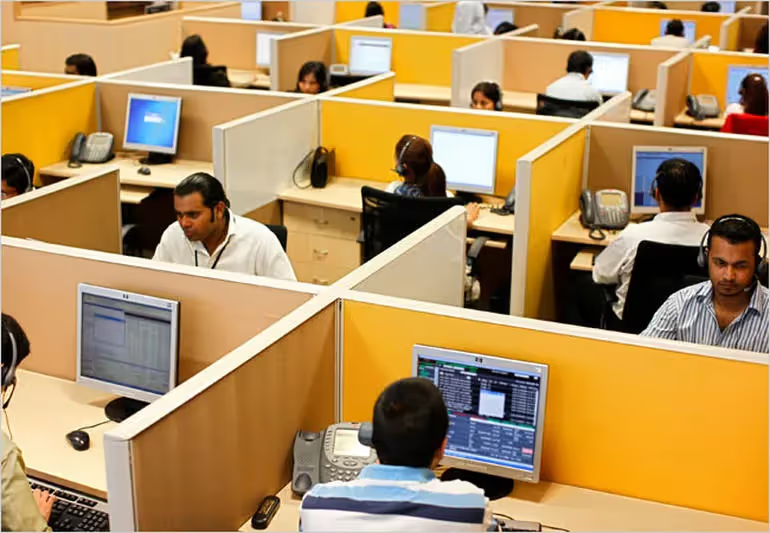
Indian IT stocks are back under pressure. After a brief rebound, technology shares slipped again on February 18 as weakness in global tech stocks spilled into domestic markets. The decline has raised a crucial question for investors. Is the artificial intelligence boom becoming a short term threat for traditional IT companies?
The answer is not straightforward. While AI promises massive long term growth, markets are worried about immediate disruptions to revenue models, hiring trends, and deal pipelines.
Why IT Stocks Are Falling Again
The sell off is not happening in isolation. Multiple triggers have converged at the same time, creating a cautious environment.
Global Tech Weakness
Overnight declines in US technology stocks often influence Indian IT shares because the sector earns a large portion of revenue from overseas clients. Weak sentiment abroad typically results in lower risk appetite domestically.
Sector Wide Selling
The Nifty IT Index dropped about 1.5 percent intraday with all constituents trading lower. Stocks such as Infosys, TCS, and Wipro declined alongside midcap peers, showing that selling pressure was broad based rather than company specific.
Recent Performance Trends
The sector index has fallen roughly 21 percent over the past year and about 17 percent in the last month alone. Such sharp declines often reflect both valuation compression and changing growth expectations.
The Real Concern: AI Disruption
According to analysts at Motilal Oswal Financial Services, artificial intelligence could render portions of legacy software and testing services redundant. This is not the first time the industry has faced disruption.
Earlier cycles saw infrastructure management services challenged by hyperscale cloud providers, and business process outsourcing faced automation pressures. The fear now is that AI tools could accelerate that pattern.
Why This Matters for Revenue Models
Indian IT companies traditionally rely on large teams billing clients for long term projects. If AI tools can automate coding, testing, and support tasks, companies may need fewer engineers for the same work. That could reduce billing size unless firms shift to value based pricing.
Client Decision Delays
Another near term risk is hesitation among global clients. Companies evaluating AI adoption may delay signing large outsourcing deals until they fully understand how automation will reshape their technology budgets.
Signs of Opportunity Amid the Fear
Despite the pessimism, not all signals are negative.
Strategic Partnerships
One major positive development was the collaboration between Infosys and Anthropic to deploy enterprise AI solutions using advanced models. Such partnerships show that Indian IT firms are not ignoring disruption. They are actively investing in next generation capabilities.
Industry Messaging
At global technology conferences, leaders have increasingly emphasized collaboration between humans and AI rather than replacement. The message is that AI will augment productivity rather than eliminate the need for service providers.
Market Behavior
The sector briefly rebounded earlier this week when investors bought the dip after a sharp market wide correction wiped out nearly ₹4.86 lakh crore in equity value over nine sessions. This indicates that long term investors still see value at lower levels.
Near Term Outlook for IT Stocks
Analysts remain cautious in the short run. Several factors will determine whether the sell off continues or stabilizes.
Deal Flow Commentary
Quarterly earnings calls and management guidance about new contracts will be closely tracked. Strong deal wins could quickly restore confidence.
Currency Movements
A weaker rupee typically benefits IT companies because revenues are dollar denominated. Currency trends can therefore offset global slowdown concerns.
Hiring Trends
If companies slow hiring or reduce workforce targets, markets may interpret it as a sign of demand weakness. On the other hand, selective hiring for AI roles may be seen as a strategic shift.
Impact on Indian Markets
The IT sector is a major weight in benchmark indices. When technology stocks decline, they often drag the broader market lower. This is why investors track IT performance as a leading indicator of institutional sentiment.
Regulatory oversight by the Securities and Exchange Board of India ensures transparency in disclosures, which helps investors assess whether AI investments are translating into real business growth.
Real World Scenario Investors Can Relate To
Consider a global bank evaluating outsourcing contracts. Earlier, it might have signed a five year software maintenance deal with a large IT vendor. Today, it may first test AI driven automation tools to reduce manual work. During this evaluation period, it postpones signing new contracts.
That delay directly affects revenue visibility for IT firms, which is why markets react quickly to even small shifts in client behavior.
Investment Strategy in the Current Phase
Short Term Approach
Traders should expect volatility and sharp swings. Sector sentiment is fragile, and price moves may be driven more by global cues than domestic fundamentals.
Long Term Approach
Long horizon investors should track how effectively companies integrate AI into their services. Firms that adapt quickly could emerge stronger and capture larger global market share.
Frequently Asked Questions
Why are IT stocks falling now
Weak global tech sentiment and fears that AI may disrupt traditional outsourcing models have triggered selling.
Is AI bad for IT companies
Not necessarily. AI creates disruption in the short term but also opens new revenue streams for companies that adapt.
Which factor matters most for IT stock recovery
Large deal wins and strong management guidance are the biggest triggers for sentiment improvement.
Are current levels attractive for investment
Long term investors may find value if they believe in the sector’s structural growth story, though volatility may persist.
What should investors monitor next
Watch earnings commentary, hiring trends, AI investments, and global tech market movements.
Final Takeaway
IT stocks under pressure do not automatically signal structural decline. Markets are reacting to uncertainty, not necessarily deterioration. Artificial intelligence is reshaping the technology landscape, but history shows that sectors capable of adapting often emerge stronger after disruption cycles.
For investors seeking reliable research insights, advanced analytics, responsive support, and a platform built for modern markets, Swastika Investmart offers a technology driven investing experience backed by strong compliance standards and investor education.

After the Big Drop, Where Are Silver Prices Headed in the Near Term?
Key Takeaways
- Silver prices have fallen about 46 percent from recent highs, entering a consolidation phase.
- Macro factors like interest rate outlook and liquidity are driving short term volatility.
- Structural demand from industry and investors still supports long term prices.
- March could be a decisive month for the next directional move.
After the Big Drop, Where Are Silver Prices Headed in the Near Term?


4
Silver prices shocked the commodities market earlier this year with a sharp rally, only to retreat just as quickly. After touching an all time high of ₹4,20,000 per kg on the Multi Commodity Exchange on January 29, the metal has corrected nearly 46 percent. This steep fall has left traders wondering whether the rally is over or simply paused before the next move.
Market experts believe the current phase is not a collapse but a consolidation. Price action over the next few weeks may determine whether silver resumes its long term uptrend or continues correcting.
Why Silver Prices Fell So Sharply
Profit Booking After Record Highs
Whenever an asset rallies rapidly, investors tend to lock in profits. Silver’s surge attracted speculative positions, and once momentum slowed, traders rushed to exit. This created selling pressure that accelerated the fall.
Interest Rate Uncertainty
Precious metals are highly sensitive to interest rate expectations. Investors closely watch signals from the US Federal Reserve because higher rates make non yielding assets like silver less attractive. Uncertainty around policy timing has kept markets volatile.
Traders now expect rate cuts to begin around June 2026, with two reductions priced in for the year. Such expectations influence currency movements and commodity flows globally.
Dollar Movement Matters
Silver is priced internationally in dollars. When the US Dollar Index weakens, metals often rise because they become cheaper for foreign buyers. Recently, the index slipped below the key 97 level, showing signs of losing momentum. However, lack of clarity has prevented a strong rebound in silver.
Short Term Triggers That Could Decide Direction
Upcoming Economic Data
Markets are waiting for signals from the FOMC Minutes and PMI data releases. These indicators influence expectations about inflation, growth, and rate policy. Any surprise could trigger sharp moves in metals.
Seasonal Market Patterns
Analysts note that the Chinese New Year period typically brings lighter institutional trading and temporary volatility. During such phases, prices often move in narrow ranges rather than strong trends.
Geopolitical Developments
Safe haven demand tends to rise when geopolitical tensions increase. For example, recent tensions between the United States and Iran briefly supported precious metals. But without sustained risk events, rallies have struggled to hold.
Strong Fundamentals Still Support Silver
Despite the sharp correction, silver’s long term story remains intact. Unlike gold, silver has dual demand drivers. It is both a precious metal and an industrial commodity.
Industrial Demand
Silver is widely used in solar panels, electric vehicles, semiconductors, and electronics. As clean energy adoption grows, demand for silver in photovoltaic cells continues rising. This structural demand acts as a price cushion during market downturns.
Supply Constraints
Mining output growth has been limited for years. Supply deficits have persisted because new mining projects take time to develop. Tight supply combined with rising industrial consumption creates a supportive backdrop.
Investment Demand
Retail investors and ETFs have steadily increased silver allocations. During periods of inflation uncertainty, many investors treat silver as a hedge, similar to gold but with higher volatility.
What March Could Mean for Silver Prices
Analysts suggest that March may become a turning point. By then, liquidity conditions may improve and clarity on monetary policy could emerge. If macro pressures ease, silver could regain upward momentum.
On the other hand, if economic data strengthens and interest rate cuts get delayed, metals could remain under pressure. In such scenarios, prices may move sideways rather than trend strongly.
Impact on Indian Markets and Traders
For Indian investors, silver is not just a global commodity. It is also a popular trading instrument and a traditional store of value. Movements on international exchanges quickly reflect in domestic prices.
Higher volatility often leads to increased trading volumes on commodity platforms. Short term traders look for momentum opportunities, while long term investors track fundamental signals.
Regulatory oversight from the Securities and Exchange Board of India ensures transparency and safeguards market participants. This strengthens confidence in commodity derivatives trading in India.
Practical Example for Investors
Consider a trader who bought silver near peak levels expecting continued momentum. The sharp correction would have triggered margin pressure and forced decisions. However, a long term investor focused on structural demand might see the same fall as a buying opportunity.
This difference highlights why understanding market cycles is crucial. Commodities often move in phases of expansion, correction, and consolidation rather than straight lines.
Investor Strategy for the Near Term
For Short Term Traders
- Expect volatility until macro clarity emerges
- Watch currency movements and global bond yields
- Use strict risk management and stop losses
For Long Term Investors
- Focus on demand supply trends
- Monitor industrial growth indicators
- Accumulate gradually instead of timing exact bottoms
Frequently Asked Questions
Is the recent fall in silver prices unusual
No. Commodities often experience sharp corrections after strong rallies due to profit booking and macro shifts.
What is the biggest factor affecting silver right now
Interest rate expectations and currency movements are currently the most influential drivers.
Can silver recover soon
It can, especially if liquidity improves and rate cut expectations strengthen, though timing depends on economic data.
Is silver a good hedge against inflation
Yes, historically silver has acted as a partial hedge, particularly during periods of currency weakness.
Should beginners invest in silver now
Beginners should start with small allocations and understand volatility before increasing exposure.
Final Thoughts
Silver’s recent drop may look alarming, but corrections are a natural part of commodity cycles. The metal still enjoys strong structural support from industrial demand, supply constraints, and investor interest. The coming weeks will likely decide whether prices stabilize or prepare for another upward leg.
For investors who want reliable research insights, advanced tools, and responsive support while tracking commodities and markets, Swastika Investmart provides a technology driven platform backed by regulatory compliance and investor education.

Eternal–OpenAI Partnership: How AI Could Transform Zomato and Blinkit Ecosystems
TL;DR
- Eternal’s collaboration with OpenAI may accelerate AI adoption across food delivery and quick commerce platforms.
- Smarter logistics, demand prediction, and hyper-personalization could improve margins for Zomato and Blinkit.
- AI integration may influence India’s internet sector valuations and investor sentiment.
- Regulatory oversight and data compliance will be key factors to monitor.
Eternal–OpenAI Partnership: How AI Could Transform Zomato and Blinkit Ecosystems
Artificial intelligence is rapidly becoming the backbone of digital platforms. The proposed partnership between Eternal and OpenAI has sparked discussions across India’s tech and investment circles. Market participants are closely watching how this collaboration could reshape platforms like Zomato and Blinkit, both of which rely heavily on data, logistics efficiency, and customer engagement.
For investors, the bigger question is not just about technology. It is about profitability, scalability, and long term competitive advantage in India’s fast evolving digital economy.
Understanding the Strategic Context
AI partnerships today are not simply about automation. They are about intelligence layers that sit on top of existing platforms. Eternal’s potential collaboration signals a shift toward predictive decision making, adaptive logistics, and conversational interfaces.
In practical terms, this means platforms could move from reactive operations to proactive systems that anticipate user needs before orders are placed. For companies operating on thin margins, even small efficiency gains can significantly improve profitability.
Zomato and Blinkit: Why AI Matters Now

Smarter Demand Forecasting
Food delivery and quick commerce businesses struggle with demand volatility. Rain, cricket matches, or festivals can cause sudden spikes. AI models can analyze historical order patterns, weather data, and local events to predict demand accurately. This allows better staffing, optimized delivery routes, and reduced idle time for riders.
Dynamic Pricing and Offers
AI driven pricing algorithms can adjust delivery fees, discounts, or surge charges in real time. Airlines and ride hailing apps already use similar systems. For Zomato and Blinkit, such tools could increase order volumes during slow periods while maximizing revenue during peak hours.
Inventory Optimization for Quick Commerce
Blinkit operates dark stores that must stock the right products at the right time. AI can predict which items will sell faster in each locality. This reduces wastage of perishables and improves inventory turnover ratios, a key metric investors track in quick commerce.
Personalization as a Growth Engine
Personalization is where AI could deliver the biggest impact.
Imagine opening a food delivery app and seeing exactly what you want to eat before you even search. AI can analyze past orders, dietary preferences, time of day, and even mood signals from browsing behavior. Such hyper personalization increases conversion rates and customer retention.
For Blinkit, personalized grocery lists and automated reordering reminders could turn occasional users into daily customers. Subscription models powered by predictive analytics may emerge as a new revenue stream.
Operational Efficiency and Margin Expansion
Investors often worry about profitability in India’s internet sector. AI driven automation could address this concern.
- Route optimization reduces fuel costs and delivery time.
- AI chatbots handle customer queries, lowering support expenses.
- Fraud detection algorithms minimize refund abuse and fake orders.
Even a 2 to 3 percent improvement in operational efficiency can materially improve EBITDA margins for high volume platforms.
Market Impact on Indian Tech Stocks
The Indian equity market tends to reward companies that demonstrate scalable technology advantages. When firms integrate advanced AI systems, analysts often upgrade growth projections due to improved unit economics.
If Zomato and Blinkit successfully deploy AI across logistics, marketing, and operations, it could influence sector wide valuations. Comparable platform companies may face pressure to accelerate their own AI investments, potentially triggering an industry wide innovation cycle.
Institutional investors usually interpret such partnerships as signals of future readiness. This can attract long term capital flows, especially from global funds seeking exposure to India’s digital consumption story.
Regulatory and Data Governance Considerations
Any AI integration involving user data must comply with India’s digital regulations. The Securities and Exchange Board of India monitors disclosures and corporate governance for listed entities, while data protection rules govern how platforms handle customer information.
Companies deploying AI must ensure transparency, user consent, and algorithmic accountability. Failure to do so could lead to regulatory scrutiny or reputational risk, which investors should factor into risk assessment.
Real World Scenario: What This Could Look Like
Consider a Friday evening in Mumbai. AI predicts heavy rain and increased food delivery demand. The system automatically:
- Prepositions delivery partners in high demand zones
- Suggests rain friendly dishes to users
- Adjusts delivery fees based on real time rider availability
- Notifies restaurants to prepare for order surges
This level of predictive orchestration can dramatically improve customer experience while reducing operational chaos.
Investor Perspective: Opportunities and Risks
Potential Upsides
- Higher margins through automation
- Stronger customer retention via personalization
- Competitive moat through proprietary AI models
Possible Risks
- High initial investment in AI infrastructure
- Dependence on external technology partners
- Regulatory compliance costs
Smart investors evaluate both sides before making decisions.
Frequently Asked Questions
1. What is the Eternal–OpenAI partnership about
It refers to a collaboration focused on deploying advanced AI tools to enhance platform intelligence, automation, and user experience.
2. How could this affect Zomato’s profitability
AI driven logistics and demand prediction could reduce costs and improve margins over time.
3. Why is Blinkit likely to benefit from AI
Quick commerce relies on accurate inventory and delivery speed. AI improves both, making operations more efficient.
4. Will this impact stock prices immediately
Not necessarily. Markets typically wait for measurable results before re rating valuations.
5. What should investors monitor
Track earnings commentary, AI investment disclosures, and operational metrics such as delivery time and cost per order.
Conclusion
The Eternal–OpenAI collaboration signals a broader shift toward AI first business models in India’s digital economy. For platforms like Zomato and Blinkit, the real opportunity lies not just in adopting AI but in embedding it deeply into operations, logistics, and customer engagement. If executed well, this transformation could reshape profitability trajectories and strengthen their competitive positioning.
For investors seeking to track such emerging opportunities with reliable research, analytics tools, and dedicated support, Swastika Investmart offers a technology driven investing platform backed by strong compliance standards and investor education resources.

Next Week’s Mainboard IPO Lineup: Complete Guide to Price Band, Lot Size and Dates.
Next Week’s Mainboard IPO Lineup: Complete Guide to Price Band, Lot Size and Dates
Quick Snapshot
- Four mainboard IPOs open next week across sectors from healthcare to energy.
- Price bands range from ₹75 to ₹1053, catering to both retail and HNI investors.
- Issue sizes vary widely from ₹110 crore to ₹3,100 crore.
- IPO activity signals improving primary market sentiment in India.
Why next week’s mainboard IPO lineup matters
India’s primary market is showing renewed momentum, and the next week’s mainboard IPO lineup reflects growing investor appetite for new listings. When multiple IPOs open within a short window, it usually indicates strong institutional interest and healthy liquidity conditions.
For retail investors, such clusters create opportunities to diversify applications across sectors. For the market as a whole, active IPO calendars often signal confidence in valuations and macro stability.
Full list of upcoming IPOs next week
Here is a detailed breakdown of the companies hitting the primary market along with price band, investment requirement, and key dates.
Healthcare sector offering
Gaudium IVF & Women Health
- Open: 20 Feb
- Close: 24 Feb
- Price band: ₹75 to ₹79
- Minimum investment: ₹14,931
- Issue size: ₹165 crore
- Tentative allotment: 25 Feb 2026
- Tentative listing: 27 Feb 2026
Healthcare IPOs often attract long term investors because the sector benefits from structural demand driven by demographics and rising healthcare awareness.
Textile manufacturing play
Shree Ram Twisters
- Open: 23 Feb
- Close: 25 Feb
- Price band: ₹95 to ₹104
- Minimum investment: ₹14,976
- Issue size: ₹110 crore
- Tentative allotment: 26 Feb 2026
- Tentative listing: 2 Mar 2026
Textile companies tend to perform well when export demand strengthens and raw material costs stabilize. Investors usually track margins and order book visibility before applying.
Jewellery sector listing
PNGS Reva Diamond Jewellery
- Open: 24 Feb
- Close: 26 Feb
- Price band: ₹367 to ₹386
- Minimum investment: ₹12,352
- Issue size: ₹380 crore
- Tentative allotment: 27 Feb 2026
- Tentative listing: 4 Mar 2026
Jewellery IPOs often benefit from strong brand recall and retail expansion strategies. Investors typically examine store growth plans and inventory management efficiency.
Large energy sector issue
Clean Max Enviro Energy Solutions
- Open: 23 Feb
- Close: 25 Feb
- Price band: ₹1000 to ₹1053
- Minimum investment: ₹14,742
- Issue size: ₹3,100 crore
- Tentative allotment: 26 Feb 2026
- Tentative listing: 2 Mar 2026
This is the largest IPO among the upcoming offerings. Large issue sizes usually attract strong institutional participation, which can influence listing day sentiment.
What makes this IPO batch interesting
Wide price range for different investors
With price bands starting from ₹75 and going above ₹1000, the lineup accommodates different investment capacities. Small investors can participate in lower ticket issues, while high conviction investors may choose larger offerings.
Sector diversification
The upcoming IPO calendar includes companies from healthcare, textiles, jewellery, and renewable energy. Such sector diversity helps investors spread risk rather than concentrating exposure in a single industry.
Strong primary market sentiment
When companies from unrelated sectors launch IPOs simultaneously, it typically means merchant bankers and promoters believe market conditions are favorable. This is often linked to:
- Stable interest rates
- Strong secondary market performance
- Healthy liquidity
Real world example of IPO clustering impact
In past years, whenever IPO launches were tightly packed within weeks, listing gains were often influenced by liquidity distribution. If too many IPOs compete for funds, subscription levels may vary widely.
For example, if investors apply aggressively in a large issue, smaller IPOs in the same week might see lower oversubscription. This does not necessarily reflect company quality but rather capital allocation decisions.
Regulatory safeguards investors should know
In India, IPOs are regulated by the Securities and Exchange Board of India, which mandates detailed disclosures in prospectuses. Investors should always review:
- Risk factors section
- Financial statements
- Promoter shareholding
- Use of proceeds
These disclosures help investors evaluate whether valuations are justified.
How to evaluate which IPO to apply for
Before applying, investors should assess:
Valuation relative to peers
Compare price to earnings ratio or price to sales with listed competitors.
Growth visibility
Look at revenue trajectory, order book, and expansion plans.
Industry outlook
Even strong companies may underperform if their sector faces headwinds.
Subscription demand
High institutional demand often signals confidence, though it does not guarantee listing gains.
Market impact of active IPO weeks
Busy IPO calendars often coincide with bullish market phases. They can influence the secondary market in three ways:
- Liquidity rotation from stocks to IPOs
- Increased retail participation
- Higher trading volumes post listing
However, excessive supply of new listings can temporarily divert funds from existing equities.
Practical strategy for retail investors
Many experienced investors follow a staggered application strategy. Instead of applying for every IPO, they shortlist offerings based on fundamentals and valuation comfort.
For instance, an investor bullish on renewable energy may prioritize Clean Max Enviro Energy Solutions, while another focusing on consumer demand may prefer the jewellery company issue.
Frequently Asked Questions
How many IPOs are opening next week
Four mainboard IPOs are scheduled to open across different sectors.
Which IPO has the largest issue size
Clean Max Enviro Energy Solutions has the largest issue size at ₹3,100 crore.
What is the lowest minimum investment among them
PNGS Reva Diamond Jewellery requires the lowest minimum investment of ₹12,352.
Do IPO clusters affect listing gains
Yes. When multiple IPOs launch together, investor funds get divided, which can influence subscription levels and listing performance.
Should beginners apply to all IPOs
Not necessarily. It is better to select IPOs based on financial strength, sector outlook, and valuation.
Final thoughts
The next week’s mainboard IPO lineup highlights a vibrant primary market phase in India. With companies from diverse sectors seeking capital, investors have multiple opportunities to participate in early stage growth stories. The key lies in analyzing fundamentals rather than chasing hype.
For investors who want reliable research insights, advanced tools, and smooth application support, Swastika Investmart provides a strong investing platform backed by SEBI registration, smart analytics, dedicated support, and educational resources designed for informed decision making.

Cochin Shipyard Bags ₹5,000 Crore Navy Order: What It Means for the Stock
Cochin Shipyard Bags ₹5,000 Crore Navy Order: What It Means for the Stock
Key Highlights
- Major ₹5,000 crore defence contract strengthens order book visibility.
- Signals strong government push toward domestic shipbuilding.
- Improves long term revenue predictability and margin stability.
- Defence contracts often act as re rating triggers for PSU stocks.
A Landmark Defence Contract for Cochin Shipyard
Cochin Shipyard Limited has secured a massive ₹5,000 crore order from the Indian Navy, marking one of the largest defence wins for the company in recent years. For investors tracking India’s defence manufacturing theme, this development is more than just a contract. It is a signal that domestic shipyards are becoming central to national strategic infrastructure.
Large government orders tend to provide multi year revenue visibility. Unlike commercial shipbuilding, defence projects usually come with milestone based payments, strict timelines, and strong policy backing. This reduces business uncertainty and improves financial predictability.
Why This Order Is Strategically Important
Strengthening India’s Self Reliance Push
The order aligns with India’s broader defence manufacturing strategy that prioritizes domestic production under policy initiatives encouraging local sourcing. Defence shipbuilding contracts awarded to Indian yards help reduce dependence on foreign suppliers while boosting domestic industry capabilities.
For Cochin Shipyard, this strengthens its positioning as a strategic asset in India’s maritime defence ecosystem.
Long Term Revenue Visibility
Shipbuilding contracts of this scale typically span several years. Revenue is recognized progressively as construction milestones are completed. This ensures:
- Stable cash flow inflows
- Lower earnings volatility
- Better planning for capital expenditure
Investors often assign premium valuations to companies with predictable earnings pipelines, especially in capital intensive industries.
Margin Stability Compared With Commercial Orders
Commercial shipbuilding projects can be cyclical because they depend on global shipping demand. Defence contracts, however, are driven by national security budgets, which tend to remain stable even during economic slowdowns.
This structural difference makes defence order books highly valuable for listed shipbuilders.
Market Reaction and Investor Sentiment
When companies announce large defence deals, markets usually react quickly because such contracts validate business capabilities. In many cases, defence wins trigger short term stock rallies as traders anticipate improved earnings visibility.
Historically, Indian defence PSU stocks have shown strong momentum after order inflows due to three reasons:
- Higher revenue certainty
- Strong government backing
- Limited competition
If execution remains on schedule, this contract could act as a sentiment booster for Cochin Shipyard’s stock over the medium term.
Real World Example: How Order Books Influence Stock Performance
Consider infrastructure companies. When a construction firm wins a large highway contract, analysts immediately revise revenue projections upward. The same principle applies here.
In shipbuilding, the order book is the single most important metric. A growing backlog signals future revenue already locked in. Investors often compare order book size to annual revenue to judge business visibility.
For instance, if a company with ₹4,000 crore annual revenue secures a ₹5,000 crore contract, it effectively adds more than a year of assured business.
Broader Impact on Indian Markets
Large defence orders do not affect just one company. They can influence the broader capital markets in several ways:
Sectoral Re Rating
Strong order inflows often lift valuations across the defence sector because investors anticipate rising government spending. This can create momentum across related stocks such as equipment suppliers, component manufacturers, and engineering contractors.
Boost to Manufacturing Theme
India’s equity markets have increasingly favored manufacturing led growth stories. Defence shipbuilding fits neatly into this narrative because it combines industrial production, technology development, and export potential.
Policy Driven Growth Visibility
Government defence procurement follows structured tender processes and long term strategic planning. This reduces uncertainty for investors compared to sectors driven purely by consumer demand.
Competitive Landscape
While India has multiple shipyards, only a handful have the technical capability and infrastructure to execute complex defence projects. This creates high entry barriers and limits competition.
Cochin Shipyard’s advantages include:
- Large dry dock capacity
- Proven track record in naval projects
- Government ownership backing
- Integrated ship repair facilities
These strengths help the company compete effectively for future contracts.
Risks Investors Should Watch
Even strong order wins do not eliminate risks. Investors should track:
Execution Timelines
Delays in shipbuilding projects can increase costs and affect profitability.
Input Cost Fluctuations
Steel prices and specialized equipment costs can influence margins.
Policy Changes
Government procurement policies and budget allocations can affect future order inflows.
Monitoring quarterly results and management commentary helps investors assess whether execution remains on track.
Financial Market Perspective
From a valuation standpoint, defence contracts often support price to earnings expansion because they reduce earnings uncertainty. Analysts typically revise target prices when:
- Order book visibility improves
- Margins stabilize
- Return ratios strengthen
If Cochin Shipyard continues to secure similar high value projects, it could strengthen investor confidence and attract institutional interest.
What This Means for Long Term Investors
Long term investors generally look for companies with structural growth drivers rather than short term catalysts. This contract supports several such drivers:
- Rising defence spending
- Localization of manufacturing
- Technological capability development
- Export opportunities
These themes suggest that the order may not just be a one time boost but part of a broader multi year growth trajectory.
Frequently Asked Questions
Why is the ₹5,000 crore Navy order important for Cochin Shipyard
It increases revenue visibility, strengthens the order book, and signals strong government support for domestic shipbuilding.
Will the contract immediately increase profits
Not instantly. Revenue will be recognized gradually as project milestones are completed over several years.
Does this affect the defence sector overall
Yes. Large contracts often improve sentiment across defence stocks because they indicate strong government spending trends.
Is Cochin Shipyard a cyclical stock
Partly. Commercial shipbuilding is cyclical, but defence orders provide stability and reduce volatility.
What should investors track next
Execution progress, quarterly earnings, margin trends, and future order announcements.
Final Takeaway
The ₹5,000 crore naval contract positions Cochin Shipyard as a key beneficiary of India’s expanding defence manufacturing ecosystem. While short term market reactions may fluctuate, the long term story depends on execution, order inflows, and industry tailwinds.
For investors seeking reliable insights, advanced analytics, and seamless investing tools, Swastika Investmart offers a strong platform backed by SEBI registration, robust research systems, responsive support, and investor education resources.

Infosys Signs Pact With Anthropic To Collaborate On AI Using Claude
Quick Takeaways
- Infosys partners with Anthropic to deploy Claude AI for enterprise clients.
- Focus begins with telecom and expands to finance, manufacturing, and software.
- Stock jumped over 3 percent after announcement, leading market gainers.
- Agentic AI solutions could reshape outsourcing and consulting revenue.
Why the Infosys Anthropic AI partnership matters
The announcement that Infosys has signed a strategic agreement with Anthropic marks a major step in enterprise artificial intelligence adoption. The collaboration centers on integrating Anthropic’s Claude family of AI models into Infosys’ enterprise ecosystem to automate complex business operations and accelerate digital transformation.
For investors, this is not just a technology update. It signals a structural shift in how Indian IT companies position themselves in a rapidly evolving AI driven global services market.
Shares of Infosys surged more than 3 percent after the announcement, making it one of the top performers in the Nifty 50 during that trading session. Market reaction suggests that investors view the partnership as a growth catalyst rather than a disruption risk.
Strategic goals behind the collaboration
Enterprise grade AI deployment
The primary objective is to combine Infosys’ domain expertise with Anthropic’s advanced language models such as Claude. This integration will allow enterprises to automate processes that traditionally required manual intervention.
Examples include:
- Telecom network optimization
- Customer lifecycle management
- Compliance monitoring
- Software testing and code generation
This type of deployment differs from basic chatbot usage. It focuses on real business outcomes, not experimental use cases.
Dedicated AI Centre of Excellence
The companies will jointly establish a specialized innovation hub focused initially on telecommunications. This center will build tailored AI agents designed for industry specific operations.
Over time, the solutions will expand to sectors such as:
- Financial services
- Manufacturing
- Enterprise software
Such centers often become long term revenue drivers because they generate repeat consulting, integration, and support contracts.
Rise of agentic AI
A key highlight of the deal is its emphasis on agentic artificial intelligence. Unlike traditional AI tools that respond to prompts, agentic systems can autonomously execute multi step tasks.
For example, in insurance claims processing, an AI agent could:
- Review documentation
- Validate policy rules
- Detect fraud patterns
- Generate approval reports
All without human intervention unless exceptions occur.
This evolution has major implications for IT services. Instead of billing hours for manual work, firms may earn from platform subscriptions and outcome based pricing.
Leadership commentary signals long term ambition
According to Infosys CEO Salil Parekh, the partnership represents a strategic leap toward building intelligent and responsible enterprise systems. His statement underscores a broader industry shift from digital transformation to AI transformation.
Anthropic CEO Dario Amodei highlighted that domain expertise is essential to make AI useful in regulated industries. That is where Infosys brings value through decades of experience in telecom, finance, and manufacturing consulting.
This combination of deep industry knowledge and advanced AI models is what analysts believe could differentiate the partnership from generic AI deployments.
Market context: Why investors are paying attention
The global IT services industry has faced volatility because AI tools are improving productivity at unprecedented speed. Investors worry that automation may reduce demand for traditional outsourcing.
However, deals like this indicate a different narrative. Instead of losing business, IT companies may shift toward higher value services such as:
- AI architecture consulting
- Workflow automation design
- Governance and compliance frameworks
This transition mirrors earlier technology cycles. Cloud computing initially raised concerns about revenue cannibalization but ultimately created massive new opportunities for service providers.
Real world business impact scenarios
To understand practical implications, consider a telecom company managing millions of subscribers. With integrated AI agents powered by Anthropic models and Infosys platforms, the operator could:
- Predict network congestion before it happens
- Automates customer support queries
- Detect anomalies in billing systems
This reduces costs, improves service quality, and enhances customer satisfaction.
Such measurable outcomes are exactly what enterprise clients seek when signing long term IT contracts.
Implications for Indian IT stocks
The partnership arrives at a time when Indian technology stocks have been under pressure due to fears of AI disruption. Strategic alliances like this could help restore confidence.
If execution succeeds, the deal could:
- Strengthen Infosys’ deal pipeline
- Support margin expansion through automation
- Improve investor sentiment toward the sector
For the broader market, it reinforces India’s positioning as a global hub for enterprise technology services rather than just outsourcing.
Competitive positioning in the AI race
Global consulting firms and hyperscalers are all investing heavily in enterprise AI. Infosys’ approach focuses on combining proprietary platforms with third party foundation models.
This hybrid strategy allows flexibility. Companies can choose the model that fits regulatory requirements while still leveraging Infosys’ integration expertise.
Such adaptability is crucial for heavily regulated industries where compliance standards vary across jurisdictions.
What investors should monitor next
To evaluate whether the partnership delivers real value, investors should track:
- New enterprise deal wins linked to AI solutions
- Revenue contribution from AI led projects
- Management guidance on margins and costs
- Client adoption metrics across industries
Consistent improvement in these indicators would validate the strategic rationale behind the collaboration.
Frequently Asked Questions
What is the Infosys Anthropic AI partnership about
It is a collaboration to integrate Anthropic’s Claude AI models with Infosys platforms to automate enterprise processes and build industry specific AI solutions.
Why did Infosys stock rise after the announcement
Investors viewed the partnership as a growth driver that could strengthen the company’s position in the fast growing enterprise AI market.
What industries will benefit first
The rollout begins with telecommunications and will later expand to finance, manufacturing, and software services.
What is agentic AI
Agentic AI refers to systems capable of executing multi step tasks autonomously rather than simply responding to prompts.
Is this partnership positive for the Indian IT sector
Yes. Strategic AI alliances show that Indian IT firms are adapting quickly to technological shifts, which can support long term growth and valuations.
Final thoughts
The Infosys Anthropic AI collaboration reflects how quickly the global technology landscape is evolving. Rather than resisting disruption, leading firms are embracing it and building capabilities that align with the next phase of enterprise computing.
For investors navigating such fast moving developments, having access to reliable research, strong analytics tools, and responsive support can make a real difference. Swastika Investmart offers all of this along with SEBI registration, advanced investing technology, and investor education resources designed to help clients make informed decisions.

Infosys AI Day 2026: Can AI Reignite Growth for India’s IT Giant?
Infosys AI Day 2026: Can AI Reignite Growth for India’s IT Giant?
Quick Summary
- Infosys shares rose about 2.5 percent ahead of its AI strategy presentation.
- Investors want clarity on how AI will affect revenue growth and margins.
- Over 500 AI agents and strong client adoption signal early traction.
- AI transformation could drive long-term demand for IT services despite near-term risks.
Why Infosys AI Day Matters for Investors
Infosys will soon outline its artificial intelligence roadmap at its much anticipated AI Day event. This comes at a time when the global IT services sector is under pressure due to rapid advancements in generative AI and automation platforms.
The company’s stock climbed to around Rs 1400 on February 17, up about 2.55 percent intraday, as markets positioned themselves ahead of management commentary. This reaction reflects how closely investors are tracking technology strategy announcements in today’s AI driven environment.
For Indian equity investors, such events often act as sentiment triggers, much like earnings or guidance revisions.
What the Management Is Expected to Reveal
According to CEO Salil Parekh, AI is no longer an experimental initiative for the company. It is now integrated across delivery, consulting, and enterprise transformation solutions.
Key themes expected from the presentation include:
Enterprise AI Adoption Trends
- Over 90 percent of the company’s top 200 clients are already engaged in AI projects.
- More than 500 AI agents are currently deployed across client environments.
- Generative AI has produced over 28 million lines of code internally, a 12 percent sequential rise.
This indicates that clients are not just exploring AI. They are actively deploying it into production environments.
The Shift From Pilot Projects to Scale
A report from Kotak Institutional Equities highlighted that the firm is entering a scale phase starting FY26. This phase focuses on:
- Building AI ready data infrastructure
- Designing automation driven workflows
- Implementing governance and compliance layers
- Integrating AI agents with legacy systems
In simple terms, companies are moving from testing AI tools to embedding them into daily operations.
Why IT Stocks Are Under Pressure
The broader technology sector has seen sharp volatility recently. Concerns rose after new AI tooling developments from Anthropic triggered fears that automation could reduce the need for traditional IT outsourcing.
Between January 19 and February 13, Infosys shares declined more than 18 percent on the NSE. The selloff was driven by worries that AI powered productivity gains could limit revenue growth in the short term, especially if clients demand pricing renegotiations or outcome based contracts.
This is a classic disruption cycle where technology improves efficiency but challenges existing business models.
How Infosys Plans to Turn AI Into Growth
One of the company’s strongest bets is its proprietary AI ecosystem, including Infosys Topaz. These platforms aim to move beyond basic automation and transform entire business workflows.
Strategic Focus Areas
- Workflow level transformation rather than task automation
- Industry specific AI solutions
- Integration of AI agents into legacy enterprise systems
- Responsible AI frameworks aligned with global regulations
The management believes AI adoption will unfold over seven to eight years, meaning IT service providers will remain essential partners in enterprise transformation.
Real World Example: Banking Sector Use Case
Consider a large Indian bank modernizing its digital infrastructure. Traditional outsourcing might involve coding, testing, and deployment services. With AI enabled platforms, Infosys can now:
- Generate code automatically
- Detect vulnerabilities before deployment
- Optimize workflows in real time
Instead of reducing demand, this shifts the nature of services from manual execution to high value consulting and architecture design.
Impact on Indian Markets and IT Sector
The implications extend beyond one company. India’s IT industry contributes significantly to export earnings, employment, and index performance.
If Infosys demonstrates a successful AI transition, it could:
- Improve sentiment across IT stocks
- Support valuations of technology indices
- Reinforce India’s position as a global digital services hub
On the regulatory side, Indian firms must also comply with data privacy and AI governance norms, including global standards such as GDPR and India’s Digital Personal Data Protection Act. Companies that build responsible AI frameworks early could gain a competitive edge.
Bull vs Bear Case for Infosys Stock
Bullish View
- Strong enterprise adoption signals real demand
- Proprietary platforms create differentiation
- AI consulting could boost margins over time
Bearish View
- AI productivity may reduce billing hours
- Pricing pressure from clients
- High investment costs in AI infrastructure
For investors, the key variable is execution. Strategy announcements excite markets, but consistent quarterly delivery ultimately determines stock performance.
What Investors Should Watch After AI Day
Smart investors will track three specific signals after the event:
- Deal pipeline commentary linked to AI projects
- Margin outlook after automation adoption
- Client spending trends for digital transformation
If these indicators show strength, the stock could regain momentum.
Frequently Asked Questions
Is AI a threat or opportunity for Infosys?
Both. AI can reduce traditional outsourcing demand but also opens new consulting and platform revenue streams.
Why did Infosys stock fall recently?
Concerns about AI disrupting IT services pricing and a sequential profit decline triggered selling pressure.
How long will AI transformation take in IT services?
Management estimates a seven to eight year adoption cycle across enterprises.
What should investors focus on now?
Future deal wins, AI led revenue growth, and margin guidance.
Is Infosys still a long term story?
Yes, if it successfully transitions from manpower driven services to AI powered solutions.
Final Thoughts
Infosys AI Day 2026 is more than a corporate presentation. It is a reality check for the entire IT sector. The company stands at a critical turning point where technology disruption can either compress growth or unlock a new phase of innovation driven expansion.
For investors seeking research backed insights, robust tools, and seamless investing experience, Swastika Investmart offers a strong platform backed by SEBI registration, advanced analytics, responsive support, and investor education resources.
.avif)
Market Set Up 17 February 2026: Nifty and Bank Nifty suggests a cautious start | Technical Outlook
Summary
• US markets closed for Presidents Day; Dow futures lower
• GIFT Nifty indicates a weak opening near 88 points down
• FIIs sold Rs 972 crore in cash, DIIs bought Rs 1667 crore
• Nifty support at 25500, resistance at 25690 to 25900
• Bank Nifty shows bullish bias above 60600 support
Market Set Up 17 February 2026: Nifty and Bank Nifty Technical Outlook
The Market Set Up for 17 February 2026 suggests a cautious start for Indian equities. With US markets closed for Presidents Day and Dow futures trading lower, global cues remain slightly negative. GIFT Nifty is indicating a gap down opening of around 88 points, reflecting weak early sentiment.
Let us decode what the data, derivatives positioning, and technical levels are signaling for traders and long term investors.
Global Cues and Their Impact on Indian Markets
Global markets often set the tone for domestic indices such as Nifty 50 and Bank Nifty.
On 17 February 2026:
• US markets were closed due to Presidents Day
• Dow futures traded lower by around 95 points
• Asian markets were mixed
• GIFT Nifty indicated a negative opening bias
When US markets are closed, liquidity remains thin globally. However, futures trading still influences risk sentiment. A negative Dow futures trend typically leads to cautious positioning in emerging markets like India.
For Indian traders, this means volatility during the first hour of trade could be higher than usual.
FII and DII Data Analysis
Institutional flows remain one of the most important drivers of short term market direction.
Cash Market Activity
• FII: Sold Rs 972 crore
• DII: Bought Rs 1667 crore
• Net institutional flow: Positive Rs 695 crore
Despite FII selling pressure, strong DII buying absorbed supply. Domestic institutions such as mutual funds and insurance companies continue to support the market during dips. This pattern has been visible throughout recent months, especially when global funds reduce exposure.
F and O Positioning
Nifty PCR stands at 1.11 compared to 0.65 earlier, indicating increased put writing. India VIX at 13.33 shows volatility remains moderate.
Highest Open Interest for 17 February 2026 expiry:
• 26000 Call
• 25500 Put
Max Pain level stands at 25650.
FII index derivative data shows mixed positioning. There is addition in long futures and heavy activity in call and put segments. Such positioning often signals a range bound market rather than a strong trending day.
For traders, this suggests respecting key levels rather than chasing momentum.
Technical Outlook for Nifty
Nifty bounced sharply from the confluence of 20 day moving average and 200 day moving average. Such a cluster often acts as a strong technical base.
Immediate Resistance Levels
• 25690 to 25770 zone
• 25900 as next hurdle
If Nifty sustains above 25770 with strong volumes, momentum traders may attempt 25900.
Immediate Support Level
• 25500
A decisive break below 25500 could trigger profit booking towards lower levels. However, as long as this level holds, bulls retain short term control.
For swing traders, buying near support with defined stop losses remains a prudent strategy.
Bank Nifty Technical View
Bank Nifty continues to show relative strength compared to broader indices.
It has resumed bullish momentum after taking support near the 20 day moving average.
Resistance Levels
• 61000
• 61500
• 62000
Support Levels
• 60600
• 60000
The banking sector plays a critical role in Nifty’s overall direction because of its heavy weightage. Sustained buying in private and PSU banks could cushion declines in other sectors.
What This Means for Investors
Short term traders should monitor intraday price action around key resistance and support zones. Option writers may prefer strikes near 26000 Call and 25500 Put based on open interest concentration.
Long term investors should not react to a single day’s Market Set Up. Instead, focus on:
• Corporate earnings trends
• Government capital expenditure
• RBI monetary policy stance
• Inflation and liquidity conditions
The Reserve Bank of India continues to balance inflation control with growth support. Stable interest rate expectations often provide comfort to equity markets.
Real World Example
Suppose Nifty opens weak but holds 25500 and gradually recovers. This would indicate strong dip buying by institutions. Traders who panic sell early may miss the recovery.
On the other hand, if 25500 breaks with high volumes, intraday short trades could play out effectively.
Market discipline is about reacting to price confirmation rather than predicting outcomes.
Risk Management Is Key
Markets are influenced by global cues, institutional flows, and derivative positioning. No indicator guarantees direction.
SEBI regulations mandate transparent disclosure of institutional data and derivative positions. Investors should rely on verified exchange data rather than social media speculation.
Using stop losses, proper position sizing, and diversification remains essential.
Why Choose Swastika Investmart
Navigating daily Market Set Up analysis requires timely research and execution support.
Swastika Investmart is a SEBI registered stock broker offering:
• In house technical and fundamental research
• Advanced trading platforms with real time analytics
• Dedicated relationship managers
• Investor education initiatives
• Transparent and compliant operations
Whether you are an intraday trader tracking resistance levels or a long term investor building wealth, access to research backed insights can make a meaningful difference.
You can Open Your Trading Account here
Frequently Asked Questions
What is GIFT Nifty and why is it important
GIFT Nifty is the offshore derivative of Nifty traded at GIFT City. It provides early indications of how Indian markets may open.
Why do FII and DII flows matter
Foreign and domestic institutional investors trade in large volumes. Their buying or selling can influence short term price direction.
What does Max Pain level mean
Max Pain is the strike price where option writers face the least loss at expiry. Markets often gravitate toward this level near expiry.
Is India VIX at 13 considered high
A VIX near 13 indicates moderate volatility. Extreme fear typically appears when VIX rises sharply above 20.
Conclusion
The Market Set Up for 17 February 2026 suggests a cautious start with clearly defined support and resistance levels. Institutional flows remain supportive despite FII selling, and technical structures indicate range bound trade unless key levels are breached.
Stay disciplined. Trade with data, not emotion.
With Swastika Investmart’s research driven insights and technology enabled platforms, you can approach the market with greater clarity and confidence.
.avif)
Stocks in News on 17 Feb 2026: Cochin Shipyard, Lupin, Highway Infra, Delhivery. Key triggers and market impact explained
Summary
• Cochin Shipyard wins Rs 5,000 crore defence order, boosts PSU shipbuilding sentiment
• Lupin signs Canada licensing deal, strengthens specialty pharma portfolio
• Highway Infra secures Rs 155 crore NHAI order, positive for infra space
• Delhivery partners for EV deployment, supports logistics and ESG theme
• Order wins and strategic deals may influence short term price action
Stocks in News Today 17 February 2026: Key Triggers & Market Impact
Indian markets often react sharply to corporate developments such as order wins, strategic partnerships, and global expansion plans. In today’s Stocks in News, four companies are drawing investor attention: Cochin Shipyard, Lupin, Highway Infrastructure, and Delhivery.
Let us break down what these developments mean for investors and how they may impact the broader Indian stock market.
Cochin Shipyard Wins Rs 5,000 Crore Defence Order
Cochin Shipyard Limited has been declared the L1 bidder for a Rs 5,000 crore Ministry of Defence order to manufacture five survey vessels for the Indian Navy.
Why This Matters
Defence contracts are long term, high value projects that provide revenue visibility. Being declared L1 bidder typically means the company quoted the lowest price and is expected to secure the final contract after procedural approvals.
India’s defence manufacturing push under the Atmanirbhar Bharat initiative has significantly strengthened domestic shipyards. With growing geopolitical focus in the Indo Pacific region, naval expansion is becoming a priority.
Market Impact
• Positive sentiment for defence PSUs
• Potential order book expansion
• Improved earnings visibility over multiple years
Investors often track order inflows as a leading indicator of revenue growth. A Rs 5,000 crore project adds strong execution visibility, which may support medium term valuation re rating if margins remain stable.
Lupin Expands Global Footprint with Canada Deal
Lupin Limited has signed a licence and supply agreement with Spektus Pharma to commercialise the novel antidepressant DeslaFlex in Canada.
Strategic Significance
The global pharmaceutical industry is highly competitive. Licensing innovative products in regulated markets such as Canada strengthens a company’s specialty portfolio.
For Indian pharma companies, growth beyond generic drugs into specialty and branded formulations is a major strategic shift. It typically leads to better margins and long term brand positioning.
What Investors Should Watch
• Revenue contribution from the Canadian market
• Regulatory approvals and timelines
• Margin expansion potential
Pharma stocks are sensitive to global regulatory developments, especially approvals from USFDA, Health Canada, and European regulators. Any smooth execution here could support Lupin’s international growth narrative.
Highway Infrastructure Secures NHAI Project
Highway Infrastructure Limited has received a Letter of Award worth Rs 155 crore from NHAI.
Infrastructure Momentum in India
Road construction remains a core focus area under the National Infrastructure Pipeline. Orders from National Highways Authority of India provide steady project pipelines for EPC players.
Although Rs 155 crore may not be very large compared to mega infra projects, consistent order wins indicate execution strength and pipeline visibility.
Broader Market Context
The government’s continued capital expenditure allocation in Union Budgets supports infrastructure stocks. When companies consistently win NHAI orders, it signals strong sectoral momentum.
Investors typically evaluate:
• Order book to revenue ratio
• Debt levels
• Execution track record
A healthy balance sheet and timely project completion are key for sustainable stock performance.
Delhivery Partners for Electric Mobility
Delhivery has entered into a pact with electric mobility startup RIDEV to deploy 150 electric vehicles.
Why This Is Important
Logistics companies face rising fuel costs and ESG pressures. Transitioning to electric vehicles helps reduce operating costs over time and improves sustainability metrics.
India’s EV ecosystem is growing rapidly, supported by government incentives under the FAME scheme. Companies adopting electric fleets early may gain cost advantages and ESG focused investor interest.
Impact on Investors
While 150 vehicles may be a small portion of the total fleet, such initiatives signal long term operational efficiency and sustainability alignment. ESG driven funds increasingly evaluate such transitions before allocating capital.
How These Developments Influence Indian Markets
The Nifty and Sensex often react to stock specific news based on:
• Size of the order
• Margin implications
• Strategic expansion potential
• Regulatory environment
Defence and infrastructure align with government capex themes. Pharma aligns with global healthcare demand. Logistics connects with India’s consumption and ecommerce growth story.
From a regulatory perspective, all listed companies must disclose material developments under SEBI’s Listing Obligations and Disclosure Requirements regulations. Timely and transparent disclosure improves investor confidence.
Practical Example for Investors
Suppose an investor is building a diversified portfolio:
• Defence for long term structural growth
• Pharma for export driven earnings
• Infrastructure for domestic capex theme
• Logistics for consumption growth
News driven volatility can create short term trading opportunities, while long term investors may use dips for systematic accumulation based on fundamentals.
However, it is important not to invest purely on headlines. Evaluate quarterly earnings, debt levels, cash flows, and management commentary before making decisions.
How Swastika Investmart Supports Smarter Investing
Tracking Stocks in News daily requires research, data analysis, and timely execution. Swastika Investmart, a SEBI registered stock broker, provides:
• In house research reports
• Advanced trading platforms
• Real time market updates
• Dedicated relationship managers
• Investor education initiatives
With technology enabled investing and transparent compliance standards, investors can make informed decisions aligned with their financial goals.
If you want to act on market opportunities efficiently, you can Open Your Trading Account here:
Frequently Asked Questions
What does L1 bidder mean in stock market news
L1 bidder refers to the lowest bidder in a government tender. It indicates the company has quoted the lowest price and is likely to win the contract, subject to final approvals.
Do order wins immediately increase stock prices
Not always. Markets assess order size, profitability, and execution risk before reacting. Sometimes the news may already be priced in.
How important are global licensing deals for pharma companies
Very important. They improve geographic diversification, enhance revenue streams, and can boost margins if the product is differentiated.
Is EV adoption by logistics companies financially beneficial
In the long term, yes. Electric vehicles can lower fuel and maintenance costs while improving ESG positioning.
Conclusion
Today’s Stocks in News highlight how defence, pharma, infrastructure, and logistics remain key pillars of India’s growth story. Order wins and strategic partnerships strengthen business fundamentals, but investors must look beyond headlines.
A disciplined approach, supported by strong research and regulatory compliant platforms, makes a real difference. Swastika Investmart combines technology, research expertise, and investor support to help you navigate dynamic market conditions with confidence.
Stay informed. Stay disciplined. Invest wisely.
India AI Impact Summit 2026: Key Announcements Investors Must Track
Key Highlights at a Glance
- India hosts its first global AI summit with leaders from 45 plus countries
- ₹10,372 crore IndiaAI Mission strengthens compute and research ecosystem
- Semiconductor and AI infrastructure announcements signal long term growth
- Global tech CEOs and policymakers push for ethical and inclusive AI
- Indian markets may benefit from AI led innovation and capital inflows
India AI Impact Summit 2026: Key Announcements Investors Must Track
The India AI Impact Summit 2026 has placed the country firmly on the global technology map. Held from February 16 to 20 at Bharat Mandapam, the event marks the first international AI summit hosted in the Global South. For investors, it is more than a diplomatic gathering. It is a signal of where capital, innovation, and policy direction may move over the next decade.
With presidents, prime ministers, technology leaders, and startup founders participating, the summit reflects India’s growing influence in shaping the global artificial intelligence agenda.
Why the Summit Matters for Markets
The summit arrives at a time when AI is reshaping industries from banking to healthcare. Countries that lead in AI infrastructure and policy often attract long term investment flows.
India’s Strategic Positioning
India has already committed ₹10,372 crore to the IndiaAI Mission. The program includes:
- Over 38,000 GPUs onboarded for shared computing access
- Development of 12 indigenous foundation models
- Expansion of AI research and startup funding
Such investments signal that India is not only adopting AI but building it domestically. This reduces reliance on foreign technologies and strengthens digital sovereignty.
Global Participation Signals Confidence
High level attendance underscores the summit’s importance. Leaders such as Narendra Modi, Emmanuel Macron, and Antonio Guterres are participating alongside delegations from more than 45 countries.
This broad representation suggests strong global interest in collaborating with India on AI governance, infrastructure, and innovation.
The United States delegation includes over 120 senior executives and officials focusing on quantum computing, trusted technologies, and advanced computing partnerships. Such participation often precedes joint ventures, technology transfers, and cross border investments.
Policy Announcements Investors Should Watch
Semiconductor Push
India’s first commercial scale semiconductor production is expected to begin soon, with new facilities preparing for launch. Ten projects have already been approved under the national semiconductor mission, with additional plans under Semiconductor Mission 2.0 to design AI focused chips locally.
Domestic chip manufacturing could transform India’s electronics and AI ecosystem, reducing import dependency and boosting local manufacturing stocks.
Affordable Compute Access
Officials revealed that compute capacity is available at roughly ₹65 per GPU hour. Lower compute costs make it easier for startups and enterprises to develop AI solutions, potentially accelerating innovation across sectors.
Digital Infrastructure Expansion
The summit highlights India’s strong digital backbone. With more than 800 million internet users and widespread digital payment adoption, the country offers scale that few markets can match.
The National Payments Corporation of India has even launched a pilot UPI One World wallet for foreign delegates, allowing visitors to make payments without an Indian bank account. This showcases India’s real time payments ecosystem as a global model.
Corporate and Industry Signals
Executives from global technology firms emphasized responsible AI deployment, trust, and inclusive growth. Industry leaders noted that AI adoption remains uneven worldwide, with usage in developed nations nearly double that of developing regions.
India aims to close that gap by focusing on accessibility and citizen participation. Government officials highlighted a Jan Bhagidari approach, meaning citizens are active stakeholders rather than passive users.
This model could create massive demand for AI driven services in education, agriculture, healthcare, and public administration. Companies operating in these sectors may benefit from policy support and funding.
Real World Impact on Indian Sectors
Technology Stocks
AI infrastructure investments often boost companies involved in data centers, cloud computing, and semiconductor design. Firms aligned with government initiatives tend to attract institutional investment.
Manufacturing and MSMEs
Industry leaders stressed that small and medium enterprises must remain central to India’s AI strategy. AI driven automation can improve productivity, reduce costs, and enhance export competitiveness.
Education and Skills
A dedicated pavilion at the summit demonstrates AI powered learning tools and personalized career guidance systems. As workforce skills improve, productivity gains may lift long term economic growth.
Geopolitical Importance of the Summit
The summit is not just about technology. It is also about diplomacy. Bilateral meetings on the sidelines focus on ethical AI, climate applications, and digital infrastructure cooperation.
India is positioning itself as a bridge between developed and developing nations in shaping global AI standards. Experts believe no single country can manage AI risks alone, making international coordination essential.
This role strengthens India’s geopolitical influence and may attract foreign capital into technology and innovation sectors.
Practical Example for Investors
Think of AI like electricity in the early 20th century. Countries that built power grids first saw rapid industrial growth. Today AI infrastructure plays a similar role. Nations investing early often lead innovation cycles for decades.
India’s aggressive push into compute power, chip manufacturing, and policy frameworks suggests it wants to be one of those leaders rather than a follower.
Questions Investors Are Asking
What is the main goal of the India AI Impact Summit 2026
The summit aims to shape a global framework for inclusive, responsible, and collaborative artificial intelligence development.
Why is global participation significant
International attendance signals trust in India’s AI ecosystem and increases chances of cross border partnerships and investment.
How does the summit affect Indian markets
Announcements related to infrastructure, policy incentives, or partnerships can influence technology, semiconductor, and digital platform stocks.
What sectors benefit most from AI expansion
Technology services, manufacturing, healthcare, agriculture, fintech, and education stand to gain from AI adoption.
Is India becoming a global AI hub
Rapid investment in compute, talent, and infrastructure indicates that India is positioning itself as a major global AI innovation center.
Final Thoughts
The India AI Impact Summit 2026 is more than a headline event. It is a strategic milestone showing how India plans to shape the next phase of global technology. From semiconductor manufacturing to affordable compute and inclusive innovation, the announcements reflect a country preparing for long term leadership in artificial intelligence.
For investors, events like these help identify future growth sectors before they fully emerge in market valuations. Platforms such as Swastika Investmart provide research driven insights, advanced tools, and SEBI registered credibility to help investors track such opportunities with confidence.
Open your account here:

Torrent Pharma in Focus: How JB Merger Could Drive Next Phase of Growth .
TL;DR Snapshot
- Torrent Pharma shares rose after solid quarterly earnings and merger progress with JB Chemicals.
- EBITDA, revenue, and profit beat estimates while margins improved.
- The combined entity could double EBITDA by FY30.
- Strong cash flow may fuel future acquisitions and expansion.
- Analysts see synergy benefits unlocking over the next few years.
Torrent Pharma in Focus: How JB Merger Could Drive Next Phase of Growth
India’s pharmaceutical sector is witnessing a new consolidation wave, and Torrent Pharma in Focus: How JB Merger Could Drive Next Phase of Growth has become a major talking point among investors. The recent acquisition of a controlling stake in JB Chemicals & Pharmaceuticals Ltd. by Torrent Pharmaceuticals Ltd. is not just a routine corporate deal. It signals a strategic pivot aimed at scale, efficiency, and global competitiveness.
The market reaction reflects optimism. Shares climbed about 4 percent after the December quarter results, showing investor confidence in both earnings quality and future integration benefits.
Strong Quarterly Performance Sets the Tone
Torrent’s latest earnings showed steady operational execution across geographies.
Key Financial Highlights
- Net profit rose 26.3 percent year on year to ₹635 crore.
- Revenue increased 17.6 percent to ₹3,303 crore.
- EBITDA grew 19 percent to ₹1,088 crore.
- EBITDA margin expanded to 32.9 percent from 32.5 percent.
Revenue, EBITDA, and profit beat Street estimates by 1 percent, 2 percent, and 5 percent respectively. Finance costs declined 21 percent, indicating effective deleveraging and balance sheet discipline.
This combination of growth and margin expansion signals a healthy operating model, which is critical before executing a large merger.
Why the JB Acquisition Matters
Torrent currently owns 48.8 percent of JB Pharma and is awaiting regulatory approval from Securities and Exchange Board of India for the full merger. Completion is expected within 6 to 9 months.
Strategic Advantages
- Portfolio diversification with strong chronic therapy brands.
- Wider domestic distribution network.
- Expanded international presence.
- Improved bargaining power in procurement and manufacturing.
Management expects cost synergies of ₹400 to ₹450 crore over the next two to three years. About 20 percent could be realized in the current year alone. Revenue synergies may follow later as cross selling opportunities emerge.
Global brokerage Jefferies believes integration will meaningfully enhance operating leverage, while Nuvama estimates that the combined entity could double EBITDA between FY25 and FY30.
Geographic Growth Engines Supporting Expansion
Torrent’s growth is not dependent on a single market. Its diversified presence is providing stability.
Regional Performance Trends
- India revenue grew 14 percent to ₹1,798 crore.
- US revenue rose 19 percent to ₹321 crore.
- Brazil jumped 27 percent to ₹371 crore.
- Germany increased 8 percent to ₹304 crore.
- Rest of world surged 32 percent to ₹509 crore.
Germany remained slightly constrained due to supply disruptions at a third party vendor, but management indicated this is temporary.
The company also expects semaglutide related opportunities to support numbers from FY27 onward, positioning it well within the fast growing diabetes and obesity drug segment.
Cash Flow Strength Could Unlock New Opportunities
Analysts estimate the combined Torrent and JB entity could generate ₹6,500 to ₹7,000 crore in cash flow. Net debt to EBITDA could reach around ₹5,000 crore by FY29.
Strong cash flow matters because it enables companies to:
- Invest in R&D pipelines
- Expand manufacturing capacity
- Acquire niche brands or regional players
- Reduce debt and improve valuation multiples
Nuvama values the company at 27 times FY28 estimated EV to EBITDA, projecting EBITDA of ₹7,600 crore in FY28. If execution matches expectations, valuation rerating could follow.
Market Impact and Sectoral Implications
The deal reflects a broader trend in the Indian pharma industry where mid to large players are consolidating to compete globally. Scale is becoming essential due to:
- Rising compliance costs
- Global pricing pressure
- Patent cliffs
- Increasing competition from generics
Torrent’s move mirrors strategies seen globally, where companies acquire strong branded portfolios to strengthen margins and reduce reliance on price sensitive markets.
For investors, such consolidation often signals long term value creation rather than short term trading moves.
What Investors Should Watch Next
Even promising mergers carry execution risk. Key triggers to monitor include:
- Speed of integration post approval
- Realization of cost synergies
- Cross selling success across distribution channels
- Debt levels after consolidation
- Progress in regulated markets
If Torrent manages integration efficiently, it could emerge as one of India’s most profitable pharma companies by the end of the decade.
Real World Perspective
Imagine a hospital chain merging with a diagnostics network. Individually they grow steadily, but together they can cross refer patients, reduce costs, and increase revenue per customer. The Torrent and JB combination works similarly. Manufacturing, sales networks, and product portfolios become stronger when combined, creating economies of scale.
Frequently Asked Questions
Is the JB merger already completed?
No. Torrent has acquired a controlling stake and is awaiting regulatory approval before full merger completion.
How much synergy is expected from the deal?
Management expects ₹400 to ₹450 crore in cost synergies within two to three years.
Will the merger affect Torrent’s debt levels?
Estimates suggest net debt to EBITDA could be around ₹5,000 crore by FY29, supported by strong cash flows.
Why did the stock rise after results?
Earnings beat expectations, margins improved, and investors welcomed the strategic benefits of the acquisition.
Is Torrent Pharma suitable for long term investors?
Analysts see long term potential due to strong growth visibility, but investors should track execution and sector risks.
Final Thoughts
Torrent Pharma appears to be entering a transformational phase. Strong quarterly numbers, declining finance costs, and a strategic acquisition pipeline indicate disciplined management and long term vision. If the integration of JB Chemicals progresses smoothly, the company could significantly scale earnings and strengthen its global footprint.
For investors looking to track such high potential opportunities with research backed insights, Swastika Investmart offers SEBI registered credibility, advanced analytics tools, responsive support, and investor education resources.
Open your account here:
New RBI Norms May Change Market Liquidity — Here’s What You Must Know
Quick summary
- RBI has tightened funding rules for capital market intermediaries
- Banks must now provide fully collateralised credit facilities
- Leverage in the system may reduce, impacting trading volumes
- Long term market stability could improve despite short term pressure
New RBI Norms May Change Market Liquidity. Here’s What You Must Know
India’s financial markets are entering a new regulatory phase. The Reserve Bank of India has introduced tighter norms for bank exposure to capital market intermediaries, and the move could subtly reshape market liquidity over the next few quarters.
While the changes are largely risk focused, they may influence trading activity, broker funding structures and short term market sentiment. For investors and traders, understanding the real impact is essential.
Let us break it down in simple terms.
What Exactly Has RBI Changed
The RBI has mandated that from April 1, 2026, banks must extend credit to capital market intermediaries only on a fully secured basis. This includes brokers, clearing members and other securities market participants.
Key highlights of the new framework include:
- All lending must be backed by eligible collateral
- Banks must apply standardised haircuts on securities
- Continuous collateral monitoring is now mandatory
- Funding for proprietary trading is not allowed
- Exposure caps linked to Tier 1 capital remain in place
In simple words, easy leverage in the system is being tightened.
Why RBI Introduced These Norms
The Indian capital market ecosystem has grown rapidly in recent years, especially with the surge in retail participation, derivatives trading and margin funding.
RBI’s objective is clear:
Strengthen systemic risk management
Higher leverage in the system can amplify volatility during market stress. By enforcing full collateralisation, RBI aims to reduce spillover risks to the banking system.
Align with evolving market practices
With increasing sophistication in trading strategies and funding structures, regulators want tighter oversight.
Prevent misuse of bank funding
The explicit ban on financing proprietary trading ensures that bank credit is not used for speculative risk taking.
Overall, the move is preventive rather than reactive.
How It Can Impact Market Liquidity
This is the question most investors are asking.
The impact is unlikely to be dramatic overnight, but some gradual changes may emerge.
Short term impact: Slight tightening
Because brokers and intermediaries must now maintain higher collateral buffers, effective leverage in the system could reduce.
Possible near term effects include:
- Moderation in aggressive trading activity
- Slight pressure on derivative volumes
- Higher funding costs for some intermediaries
- Increased focus on balance sheet strength
High frequency and prop driven strategies may feel the heat first.
Medium term impact: Better risk discipline
Over time, the market ecosystem typically adjusts. Well capitalised brokers and institutions usually adapt quickly by restructuring funding lines.
In fact, disciplined leverage often leads to:
- Lower systemic risk
- Better quality liquidity
- Reduced probability of sharp dislocations
This is similar to past regulatory tightening phases where markets initially reacted but later stabilised.
Long term impact: Structurally positive
History shows that stronger risk frameworks often support market credibility. Global investors generally prefer markets with robust regulatory oversight.
For India, the long term benefits could include:
- Improved financial stability
- Stronger institutional participation
- Better confidence during volatile phases
So while liquidity may see some recalibration, the broader market structure may actually strengthen.
Which Segments May Feel the Impact First
Not all parts of the market will be affected equally.
Brokers relying heavily on bank funding
Intermediaries with thinner capital buffers may need to adjust their funding mix.
Proprietary trading heavy players
Since bank funding for prop trading is restricted, strategies dependent on leverage could moderate.
Margin trading ecosystem
MTF structures may see tighter monitoring, though retail investors are unlikely to face immediate disruption.
Exchanges and clearing members
Transaction driven businesses may witness marginal volume sensitivity in the adjustment phase.
However, strong and well capitalised players should navigate the transition smoothly.
What Retail Investors Should Do
For most retail investors, the direct impact will be limited. Still, staying aware helps in better decision making.
Here is a practical approach.
Do not panic on short term volatility
Regulatory changes often create temporary noise. Focus on fundamentals rather than headline reactions.
Prefer quality brokers
In a tighter regulatory environment, strong, compliant and well capitalised brokers become even more important.
Watch liquidity sensitive stocks
Stocks heavily dependent on trading volumes, exchanges or brokerage activity may show short term sensitivity.
Stay aligned with long term trends
India’s structural growth story remains intact despite periodic regulatory tightening.
Why Platform Choice Matters More Now
As regulations tighten, investors benefit from working with a broker that combines compliance strength with technology driven execution.
Swastika Investmart stands out with:
- SEBI registered and compliant framework
- Robust research and advisory support
- Advanced trading platforms
- Strong customer service focus
- Continuous investor education initiatives
In an evolving regulatory landscape, having the right partner can make a meaningful difference to your investing journey.
Frequently Asked Questions
Will RBI’s new norms immediately reduce market volumes
Not immediately. Any impact is likely to be gradual as intermediaries adjust their funding structures.
Are retail traders directly affected
Retail traders are largely unaffected. The norms mainly target bank lending to market intermediaries.
Which sector stocks could be sensitive
Brokerage firms, exchanges and prop trading heavy businesses may see short term sentiment impact.
Is this move positive or negative for markets
Short term neutral to mildly negative for liquidity, but structurally positive for market stability.
When do the new rules come into effect
The revised framework becomes effective from April 1, 2026.
Final Thoughts
RBI’s tighter capital market exposure norms are part of a broader effort to future proof India’s fast growing financial ecosystem. While the move may slightly recalibrate leverage and trading activity in the near term, it strengthens the market’s risk foundation for the long run.
For investors, the key is to stay informed, focus on quality and partner with reliable platforms.
If you want research backed insights and a smooth investing experience, consider getting started with Swastika Investmart today.

Results Watch: Top Stocks Reporting Earnings Today — What to Expect
TLDR
• Earnings season shows mixed trends across sectors
• Pharma, renewables, and select industrials show strength
• Margin pressure visible in consumer and chemicals space
• Market reaction likely to remain stock specific
• Quality balance sheets and guidance will drive moves
Results Watch: Top Stocks Reporting Earnings Today — What to Expect
India’s earnings season is in full swing, and today’s results batch offers a broad snapshot of corporate health across sectors. From pharma and infrastructure to renewables and consumer companies, the latest numbers highlight a market that is clearly stock specific rather than broadly directional.
For investors tracking results watch top stocks reporting earnings today, the key takeaway is simple. Revenue growth remains uneven, margins are under pressure in some pockets, and balance sheet strength is becoming more important than ever.
Let us decode the biggest earnings trends and what they could mean for the Indian stock market.
Market Context: Why Today’s Earnings Matter
The current earnings cycle comes at a time when markets are balancing multiple factors. Global demand uncertainty, input cost movements, and domestic consumption trends are all influencing corporate performance.
In India, investors typically focus on three things during results season:
• Revenue growth momentum
• Margin sustainability
• Management commentary and guidance
Today’s results batch reflects exactly this mix, with some companies delivering strong profit growth while others face margin compression.
Sector Wise Highlights from Today’s Earnings
Pharma and Healthcare: Steady but Selective Strength
The pharma space continues to show resilience.
Torrent Pharma reported a strong quarter with revenue up 17.6 percent year on year and net profit rising 26.2 percent. Margins also improved slightly to 32.9 percent. This indicates continued strength in branded formulations and operational discipline.
Akums Drugs also posted healthy growth with revenue up 14.8 percent and EBITDA up 20.9 percent, showing stable demand in the CDMO segment.
However, healthcare was not uniformly strong. Narayana Hrudayalaya saw revenue surge over 60 percent but margins contracted sharply, highlighting cost pressures.
Market read: Pharma remains structurally strong, but margin trends will be closely watched.
Infrastructure and Capital Goods: Mixed Execution
Infrastructure names delivered a mixed set of numbers.
NBCC reported revenue growth of 7.6 percent and a sharp jump in net profit of nearly 39 percent, although EBITDA margins declined. This suggests execution is strong but profitability pressure persists.
Ahluwalia Contracts delivered a steady quarter with both revenue and profit growth in double digits, indicating healthy order book execution.
Patel Engineering, however, saw EBITDA decline more than 21 percent and margins compress, reflecting cost pressures in EPC projects.
Market read: Order books remain healthy but margin discipline is becoming critical.
Renewables and Wind: Clear Bright Spot
The renewable energy ecosystem continues to show strong momentum.
Inox Wind posted robust growth with revenue up 32.5 percent and EBITDA rising 38 percent. Margins also expanded, reflecting operating leverage.
Inox Green also delivered an impressive quarter with revenue up nearly 34 percent and profit jumping sharply.
Market read: Renewables remain one of the strongest structural themes in the market.
Consumer and Retail: Margin Pressure Visible
Consumption plays showed divergent trends.
Lux Industries reported revenue growth of over 21 percent but net profit fell sharply by 59 percent due to margin compression.
Brainbees Solutions, the parent of FirstCry, posted revenue growth but slipped into a deeper loss, indicating profitability challenges in the digital retail space.
KRBL delivered a better set with profit up 28 percent despite revenue decline, thanks to margin expansion.
Market read: Volume growth exists, but profitability is under pressure in several consumer segments.
Chemicals and Specialty Players: Growth with Margin Stress
Anupam Rasayan posted strong revenue growth of over 31 percent and profit jumped 74 percent. However, EBITDA margin declined significantly, showing cost pressures.
Fineotex Chemical and Galaxy Surfactants also reported revenue growth but margin compression.
Market read: Demand is healthy but pricing power remains limited in parts of the chemical sector.
Industrial and Engineering: High Divergence
Precision Wires delivered standout numbers with revenue up 36 percent and profit nearly doubling. This indicates strong demand in the electrical ecosystem.
Azad Engineering also impressed with profit growth of over 44 percent and strong margin expansion.
On the weaker side, EMS and Shakti Pumps reported sharp margin and profit declines.
Market read: Industrial space remains highly stock specific.
Companies Showing Strong Earnings Momentum
Based on today’s results, the following names stand out on operational performance:
• Precision Wires
• Torrent Pharma
• Inox Wind
• Azad Engineering
• National Fertilizers
These companies reported either strong profit growth, margin expansion, or both.
Stocks Showing Pressure Points
Some companies flagged caution due to margin compression or profit decline:
• Lux Industries
• Patel Engineering
• Galaxy Surfactants
• Shakti Pumps
• Jindal Poly Films
Investors may watch management commentary closely in these cases.
What This Means for the Indian Stock Market
The broader message from results watch top stocks reporting earnings today is clear. The market is transitioning into a phase where:
• Stock selection matters more than sector calls
• Margin quality is under scrutiny
• Balance sheet strength is being rewarded
• High growth without profitability is being questioned
This is typical of a maturing earnings cycle.
For traders, expect stock specific volatility. For long term investors, this is a good phase to focus on fundamentally strong companies with pricing power and healthy cash flows.
How Smart Investors Are Tracking Earnings Season
Serious investors are no longer reacting only to headline profit numbers. Instead, they track:
• EBITDA margin trends
• Order book visibility
• Debt levels
• Cash flow quality
• Management guidance
Platforms that provide deep research tools and quick earnings analytics can make a big difference during this period.
Swastika Investmart, a SEBI registered broker, supports investors with robust research coverage, tech enabled investing platforms, and dedicated customer support. Its focus on investor education also helps market participants interpret earnings beyond the headline numbers.
Frequently Asked Questions
Q1. Why do stocks react sharply during earnings season?
Because quarterly results reveal real business performance, which can change earnings expectations and valuations.
Q2. What should investors focus on besides net profit?
Investors should track margins, revenue quality, debt levels, and management guidance for a complete picture.
Q3. Is revenue growth more important than margin growth?
Both matter. Sustainable companies usually show balanced growth in revenue and profitability.
Q4. Which sectors look strong in the current results season?
Renewables, select pharma companies, and niche industrial players are showing relative strength.
Q5. How can beginners track earnings efficiently?
Using research backed platforms and broker tools helps investors quickly interpret results and identify opportunities.
Conclusion
Today’s earnings batch reinforces an important market reality. The Indian market is no longer moving in a broad based manner. Instead, performance is becoming highly company specific.
While sectors like renewables and pharma continue to show strength, margin pressure in consumer and chemicals space is a reminder that growth quality matters more than ever.
For investors, this is the time to stay selective, focus on fundamentals, and use reliable research platforms to navigate volatility. With strong research tools, SEBI registered credibility, and tech enabled investing support, Swastika Investmart continues to empower investors to make informed market decisions.

Marico’s Strategic Shift: From Hair Oil Giant to Digital FMCG Challenger
TL;DR
• Marico is investing ₹714 crore to acquire digital-first brands across snacks, nutrition, and beauty
• Hair oil remains the cash engine, while new brands aim to drive future growth
• The move targets faster-growing premium consumption segments
• Execution metrics like ROCE and foods growth remain strong
• Long-term investors should watch how well Marico scales these new bets
The Big Shift Underway at Marico
For decades, Marico built its reputation on one powerful franchise: coconut oil. Brands like Parachute created strong cash flows, high return ratios, and predictable growth. But consumer markets do not stand still forever.
Marico’s strategic shift marks a clear transition from being a traditional FMCG player to a diversified, digital-first consumer company. Between February 2025 and February 2026, the company deployed around ₹714 crore across three targeted acquisitions. Each deal was small enough to manage but meaningful enough to fill a portfolio gap.
This is not a defensive move. It is proactive capital allocation aimed at keeping growth engines running before legacy categories slow down.
Why Marico Needed a New Growth Engine
Slowing Growth in Legacy Categories
Hair oil remains highly profitable, but the category is mature. Volume growth in staple FMCG segments typically moderates over time as penetration peaks. Even with strong brand equity, sustaining 20 to 25 percent growth in such categories becomes difficult.
Marico’s management appears to have recognized this early. Instead of waiting for growth pressure, the company is investing in adjacencies that benefit from changing consumer behavior.
Premiumisation Is Reshaping FMCG
Indian consumers are steadily moving toward premium, health-focused, and digital-first products. Urban millennials and Gen Z buyers are willing to pay more for:
• Healthy snacking
• Plant-based nutrition
• Premium skincare
• Clean-label products
Traditional FMCG companies that fail to capture this shift risk gradual market share erosion in high-growth segments.
The Three Strategic Bets Explained
4700BC Strengthens the Foods Play
Marico acquired a 93 percent stake in 4700BC, a premium popcorn brand. This move complements the Saffola franchise and strengthens the company’s presence in the healthy snacking space.
The logic is straightforward. India’s packaged snacks market is expanding rapidly, and premium variants are growing faster than mass products. By owning a differentiated brand, Marico can leverage its distribution muscle while preserving the brand’s premium positioning.
Cosmix Taps the Protein Consumption Theme
The acquisition of a 60 percent stake in Cosmix signals Marico’s entry into plant-based nutrition and wellness. Protein consumption in India remains structurally underpenetrated compared with global benchmarks.
With rising fitness awareness and preventive healthcare trends, categories such as plant protein, superfoods, and daily wellness supplements are seeing strong repeat demand. These segments typically enjoy better gross margins than traditional staples.
If executed well, Cosmix could become a meaningful growth contributor over the next five to seven years.
Skinetiq Opens the Beauty and ASEAN Door
Through a 75 percent stake in Skinetiq Vietnam, Marico gains exposure to premium skincare and Southeast Asian markets. Beauty and personal care is one of the fastest-growing global consumer segments, driven by premiumisation and digital discovery.
The Vietnam entry is particularly strategic. Southeast Asia offers higher growth rates than many mature FMCG markets and provides geographic diversification beyond India and Bangladesh.
Financial Health Remains Intact
A key concern whenever FMCG companies diversify is whether core execution suffers. So far, Marico’s numbers suggest stability.
The foods business has already crossed ₹900 crore in revenue, showing traction in newer categories. More importantly, return on capital employed remains around 45 percent, which is among the stronger metrics in the sector.
Revenue growth is also showing signs of acceleration despite ongoing investments. This indicates that the company is balancing growth spending without significantly diluting profitability.
What This Means for the Indian Stock Market
From a broader market perspective, Marico’s strategic shift reflects a larger trend among Indian FMCG companies. Incumbents are increasingly acquiring digital-first brands rather than building everything in-house.
This has several implications.
First, valuations in the premium D2C ecosystem may stay supported as large players continue scouting for acquisitions.
Second, listed FMCG companies with strong balance sheets may pursue similar bolt-on deals to protect growth visibility.
Third, investors may begin valuing traditional FMCG players not just on legacy cash flows but also on their ability to capture emerging consumption themes.
However, execution risk remains real. Integrating digital-native brands into a large corporate structure without diluting agility is never easy.
Risks Investors Should Track
While the strategy looks sensible, investors should monitor a few key factors.
Integration risk is the biggest watchpoint. Digital-first brands often thrive on founder-led agility and community-driven marketing. Over-integration can sometimes slow innovation.
Margin trajectory is another area to watch. Premium categories usually carry strong gross margins but may require higher upfront marketing spends.
Finally, competitive intensity in nutrition and beauty is rising, with both startups and global players expanding aggressively in India.
Where Swastika Investmart Adds Value
For investors tracking evolving FMCG stories like Marico, having the right research support matters. Swastika Investmart, a SEBI-registered investment advisor, offers detailed equity research, advanced trading platforms, and strong customer support designed for both new and experienced investors.
Its tech-enabled investing ecosystem helps investors track sectoral shifts, while its investor education initiatives simplify complex market developments into actionable insights.
If you are looking to participate in India’s evolving consumption story, having access to reliable research tools can make a meaningful difference.
Open your account here

Gold & Silver Volatility Explained: Why Prices Swing Even as Dollar Weakens
Quick Takeaways
- Gold and silver prices remain volatile despite a softer dollar.
- Interest rate expectations drive short term bullion swings.
- Safe haven demand and central bank buying support prices.
- Industrial demand makes silver more volatile than gold.
- Indian markets track global cues plus local demand trends.
Gold & Silver Volatility Explained: Why Prices Swing Even as Dollar Weakens
Gold and silver volatility has puzzled investors recently. Many assume that when the dollar weakens, bullion must rise. In reality, price movements are more complex. Multiple global forces interact at once. Interest rates, economic data, investor positioning, and demand trends all shape price direction.
On February 16, international gold slipped about 0.5 percent to near $5,014 per ounce after strong gains in previous weeks. Silver moved both ways in the same period. This shows that currency movement alone does not decide bullion prices.
Let us break down the real drivers in simple terms.
Why Gold Moves Even When the Dollar Falls
Gold is priced globally in US dollars. A weaker dollar usually makes gold cheaper for other countries. That often supports prices. Yet markets rarely move on one factor.
Interest Rates Matter More Than Currency
When traders expect higher interest rates, gold may fall. That is because bullion does not pay interest. Investors then shift money to bonds or deposits.
Recent US data showed the economy growing near 3 percent annualised in the December quarter. Strong jobs numbers reduced hopes of early rate cuts from the Federal Reserve. This pushed traders to lock profits in gold despite the softer dollar.
Position Unwinding Creates Swings
Large institutional traders often book profits after sharp rallies. This is called position unwinding. Even strong assets can drop quickly when traders close positions.
Gold recently crossed $5,000 on COMEX before correcting. That move was driven by traders securing gains rather than a change in long term outlook.
Why Silver Is More Volatile Than Gold
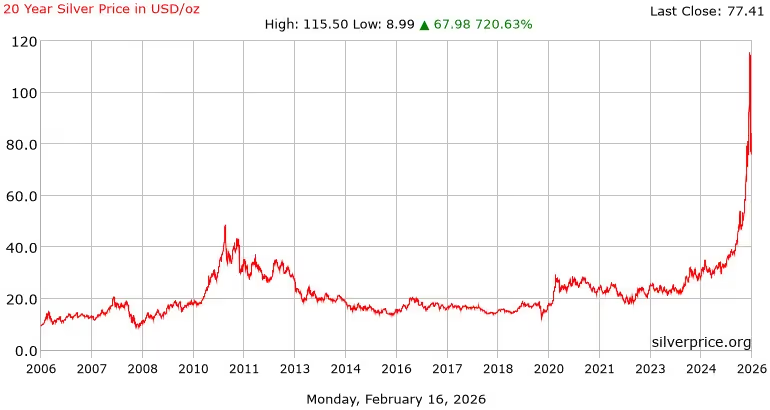


4
Silver behaves differently because it has two demand sources.
Dual Nature of Silver
Gold is mostly a store of value. Silver is both a precious metal and an industrial metal. It is used in electronics, solar panels, and batteries.
If industrial metals weaken, silver often drops even if gold stays strong. That is exactly what happened recently. Weakness in technology stocks and industrial commodities pressured silver.
Investor Sentiment Amplifies Moves
Silver markets are smaller than gold markets. Lower liquidity means prices react faster to large trades. This leads to sharper ups and downs.
Domestic Market Trends in India
Indian bullion prices follow global trends but also depend on local demand and currency movement.
Last week on Multi Commodity Exchange
- Silver futures fell ₹5,532 or 2.2 percent
- Gold rose ₹444 or 0.3 percent
This difference shows how each metal reacts to different forces.
Local Factors That Influence Prices
- Rupee movement against dollar
- Festival and wedding demand
- Import duties and taxes
- Jewellery demand cycles
Jewellers report that high volatility makes buyers cautious. Many customers delay purchases when prices swing widely within days.
Role of Economic Data in Bullion Volatility
Economic indicators often trigger sharp moves.
Key Data Traders Watch
- GDP growth numbers
- Inflation data such as PCE index
- Employment reports
- Central bank commentary
Investors currently await US inflation and growth data for clues about interest rate direction. Analysts at JM Financial Services note that bullion may remain range bound with volatility until clearer signals emerge.
Support Factors Preventing Sharp Declines
Despite short term corrections, several structural factors support bullion.
Central Bank Buying
Many global central banks are increasing gold reserves to diversify away from dollar assets. This steady buying creates a price floor.
Safe Haven Demand
During stock market volatility or geopolitical tension, investors often shift to gold. This demand tends to limit downside.
Bond Yield Trends
Bond yields have eased recently. Lower yields make gold more attractive because the opportunity cost of holding it falls.
Real World Example
Think of gold like real estate in a prime location. Prices may fluctuate weekly due to news or interest rates. But long term value stays strong because demand remains steady. Silver is more like a technology stock. It can rise fast when growth expectations improve and fall quickly when industrial outlook weakens.
What This Means for Investors
Understanding volatility helps investors avoid emotional decisions.
Short term traders focus on data releases and global cues. Long term investors track macro trends such as inflation and central bank policies. Diversifying between gold, silver, and other assets can reduce risk.
For Indian investors, monitoring rupee movement and domestic demand cycles is equally important. Local festivals or import duty changes can move prices even when global markets stay calm.
Frequently Asked Questions
Why do gold prices fall even when the dollar weakens?
Because interest rate expectations and profit booking can outweigh currency effects.
Why is silver more volatile than gold?
Silver depends on industrial demand as well as investment demand, making its price more sensitive to economic cycles.
What data affects bullion prices the most?
Inflation, GDP growth, employment reports, and central bank statements have the biggest impact.
Is volatility bad for investors?
Not always. Volatility creates trading opportunities, but long term investors should focus on trends instead of daily moves.
Do Indian prices always follow global prices?
Mostly yes, but local demand, taxes, and rupee movement can cause differences.
Final Word
Gold and silver volatility is not random. It reflects the tug of war between interest rates, currency trends, economic data, and investor sentiment. While short term swings may continue, structural support from central banks and safe haven demand keeps bullion relevant in diversified portfolios.
Investors who want deeper research insights, smart analytics tools, and reliable guidance often prefer platforms like Swastika Investmart. With SEBI registration, strong customer support, and investor education resources, it helps traders navigate complex markets confidently.
Open your account here:

Q3FY26 Concall Insights: How Bajaj Finance Is Turning AI Into a Revenue Engine
TL;DR
• Q3FY26 concall shows Bajaj Finance using AI to directly generate revenue, not just cut costs
• AI-powered call centers contributed nearly 10 percent of total disbursements
• 800 plus autonomous agents deployed across key business functions
• 47 percent productivity gains in digital development reported
• AI adoption theme is reshaping both NBFCs and power sector plays in India
Q3FY26 Concall Insights: How Bajaj Finance Is Turning AI Into a Revenue Engine
When investors think of the AI trade, they usually think of IT companies. But the Q3FY26 concall insights from Bajaj Finance tell a very different story.
The real AI winners may not be the tool makers. They are the enterprises that industrialize AI at scale. And this quarter, Bajaj Finance demonstrated how AI can evolve from a buzzword into a measurable revenue engine.
At a time when the Indian market is debating valuation pressures in IT and rotating toward power and infrastructure, Bajaj Finance’s AI-led transformation offers a case study in execution.
Bajaj Finance Q3FY26 Concall: From Experiment to Execution
Company Overview: Bajaj Finance


4
Bajaj Finance is one of India’s leading non-banking financial companies, regulated by the Reserve Bank of India as an NBFC. Known for consumer lending, SME finance, and digital lending platforms, the company has consistently invested in technology to strengthen underwriting, cross-selling, and risk management.
In its Q3FY26 concall, management did not just discuss AI adoption. They quantified it.
Voice to Value: Monetising Idle Data
One of the standout revelations from the concall was the scale at which AI is being deployed in customer engagement.
AI systems analyzed over 20 million customer calls. From this data, 100,000 new loan offers were generated.
Earlier, such call recordings would sit idle in servers. Now, they are being converted into actionable credit opportunities. This is not cost optimization. This is revenue generation.
For investors, this signals a shift from digitisation to data monetisation.
Direct Revenue Impact: ₹1,600 Crore Disbursements
AI-powered call centers reportedly drove approximately ₹1,600 crore in disbursements during the quarter. That accounts for nearly 10 percent of total loan volumes.
This is critical. Many companies speak about AI improving efficiency. Bajaj Finance showed that AI can directly influence top-line growth.
In a competitive NBFC environment where margins depend on underwriting quality and cross-selling efficiency, such AI-led lead conversion creates a structural advantage.
Content at Scale: 2.7 Lakh AI Generated Videos
Marketing transformation was another highlight.
Management revealed that 100 percent of banners and videos are now AI generated. Around 2.7 lakh videos were created in just one quarter.
For a retail-focused lender that depends heavily on targeted campaigns across cities and product categories, content velocity matters. AI enables hyper-personalised campaigns without ballooning marketing costs.
This also aligns with the broader shift toward digital customer acquisition in India’s financial ecosystem.
The Agentic Future: 800 Plus Autonomous Agents
Perhaps the most forward-looking insight from the Q3FY26 concall was the deployment of 800 plus autonomous agents across Sales, HR, IT, and Risk functions.
This is not simple chatbot automation. These are task-specific AI systems designed to assist in underwriting checks, HR screening, internal ticket resolution, and workflow optimisation.
In regulated sectors like NBFCs, automation must comply with RBI guidelines on data security and risk governance. Bajaj Finance’s structured deployment suggests a compliance-first approach.
Tech Efficiency: 47 Percent Productivity Gains
Management indicated productivity gains of up to 47 percent in digital development.
For a financial services company constantly upgrading apps, loan management systems, and risk engines, such efficiency gains can shorten product launch cycles and reduce operational bottlenecks.
In a rising interest rate environment or margin pressure cycle, operating leverage becomes crucial. AI-driven productivity can protect return on assets and return on equity over the long term.
The Broader AI Trade: Why Power May Outperform IT
The Q3FY26 concall insights also fit into a larger thematic shift in Indian markets.
The Power Play
AI data centers are energy intensive. India’s data center capacity is projected to cross 9 GW by 2030. As demand for high density computing rises, so does demand for stable power supply.
Power companies are no longer seen as slow moving utilities. They are becoming core infrastructure enablers for the AI economy.
This explains why power stocks are gaining investor attention even as some IT majors face margin pressure.
The IT Reality Check
Traditional IT services operate on time and material billing models. As AI automates coding, testing, and maintenance, revenue growth visibility becomes uncertain.
Valuations in the IT sector are being reassessed in light of automation risks and slower headcount growth.
The investment thesis is evolving. Do not just buy the software. Consider the fuel that runs the hardware.
In this context, Bajaj Finance stands out because it is not selling AI tools. It is embedding AI into its core lending engine.
Impact on Indian Markets
AI adoption by large NBFCs signals a structural shift in financial services.
If AI improves underwriting, reduces NPAs, and enhances cross selling, credit costs could remain stable even during economic slowdowns. That strengthens investor confidence in the sector.
At the index level, financials hold significant weight in Nifty and Sensex. Efficiency gains in leading NBFCs and banks can support earnings growth and market stability.
For retail investors, the takeaway is simple. Earnings quality and technological integration now matter as much as loan book growth.
What Should Investors Watch Next
• Sustainability of AI driven disbursement growth
• Impact on credit cost and asset quality
• Capital adequacy and regulatory compliance
• Competitive response from other NBFCs and banks
Q4FY26 commentary will be crucial in assessing whether AI contribution scales further or stabilises at current levels.
Frequently Asked Questions
1. What were the key highlights from Bajaj Finance Q3FY26 concall?
AI analyzed 20 million calls, generated 100,000 loan offers, drove ₹1,600 crore disbursements, and deployed 800 plus autonomous agents across functions.
2. How does AI improve profitability for NBFCs?
AI enhances underwriting accuracy, improves lead conversion, reduces operational costs, and boosts cross selling efficiency.
3. Why is the AI trade shifting toward power stocks?
AI data centers require large amounts of electricity. Growing data capacity increases demand for stable power infrastructure.
4. Is AI adoption a regulatory risk for financial companies?
NBFCs must comply with RBI guidelines on data security, governance, and risk management. Structured AI deployment with strong oversight reduces regulatory risk.
5. Should investors prefer AI users over AI developers?
Companies that integrate AI into core operations may generate stronger long term returns than firms merely selling AI tools. Execution matters more than hype.
Conclusion
The Q3FY26 concall insights from Bajaj Finance reveal a powerful shift. AI is no longer an experimental tool. It is a revenue engine.
As markets rotate between IT, power, and financials, investors must focus on companies that embed technology into business fundamentals.
At Swastika Investmart, our SEBI registered research team tracks such structural shifts with data driven insights, advanced research tools, and investor education support.
If you want to align your portfolio with emerging themes like AI led financial transformation, open your trading account today:

Today’s Earnings Preview: Key Metrics and What They Mean for Investors
Key Takeaways
• Financials, jewellery and real estate delivered strong growth
• Metals, chemicals and packaging faced margin pressure
• Several companies moved from losses to profits
• Sector rotation likely in Indian markets
• Stock specific action may dominate indices
Post Market Earnings Update: Complete Company Wise Q3 Analysis
The latest Post Market Earnings Update shows clear divergence across sectors. While select financial, jewellery and real estate companies reported strong profit growth, several commodity linked and manufacturing companies faced margin compression.
With quarterly earnings being a key valuation driver in Indian markets, these results could influence near term stock specific moves and sector rotation.
Below is the complete company wise breakdown.
Muthoot Finance
Revenue up 53.6 percent at Rs. 4,467 crore versus Rs. 2,909 crore
Calculated NII up 64.2 percent at Rs. 4,467 crore versus Rs. 2,721 crore
Net Profit up 94.9 percent at Rs. 2,656 crore versus Rs. 1,363 crore
Strong credit demand and higher spreads supported profitability.
Tega Industries
Revenue down 1.2 percent at Rs. 404 crore versus Rs. 409 crore
Ebitda down 49.5 percent at Rs. 46.1 crore versus Rs. 91.2 crore
Ebitda Margin down 1,090 bps at 11.4 percent versus 22.3 percent
Net Profit down 63.7 percent at Rs. 19.7 crore versus Rs. 54.2 crore
Margins contracted sharply despite stable revenue.
Praj Industries
Revenue down 1.3 percent at Rs. 842 crore versus Rs. 853 crore
Ebitda down 34.9 percent at Rs. 47.4 crore versus Rs. 72.8 crore
Ebitda Margin down 290 bps at 5.6 percent versus 8.5 percent
Net Loss at Rs. 12.4 crore versus Profit of Rs. 41.1 crore
Profitability reversed due to margin pressure.
Honasa Consumer
Revenue up 16.2 percent at Rs. 602 crore versus Rs. 518 crore
Ebitda up 150.6 percent at Rs. 65.4 crore versus Rs. 26.1 crore
Ebitda Margin up 590 bps at 10.9 percent versus 5.0 percent
Net Profit up 93.1 percent at Rs. 50.2 crore versus Rs. 26 crore
Operating leverage improved significantly.
Zaggle Prepaid Ocean Services
Revenue up 21.8 percent at Rs. 526 crore versus Rs. 432 crore
EBIT up 15.6 percent at Rs. 42.2 crore versus Rs. 36.5 crore
EBIT Margin down 40 bps at 8.0 percent versus 8.4 percent
Net Profit up 4.0 percent at Rs. 36.3 crore versus Rs. 34.9 crore
Moderate profit growth with slight margin dip.
Indian Hotels
Revenue up 12.2 percent at Rs. 2,842 crore versus Rs. 2,533 crore
Ebitda up 11.9 percent at Rs. 1,076 crore versus Rs. 962 crore
Ebitda Margin down 10 bps at 37.9 percent versus 38.0 percent
Net Profit up 55.1 percent at Rs. 903 crore versus Rs. 582 crore
Travel demand remains resilient.
Engineers India
Revenue up 58.2 percent at Rs. 1,210 crore versus Rs. 765 crore
Ebitda up 259.6 percent at Rs. 352 crore versus Rs. 97.9 crore
Ebitda Margin up 1,630 bps at 29.1 percent versus 12.8 percent
Net Profit at Rs. 347 crore versus Rs. 109 crore
Strong execution and margin expansion.
Fine Organic Industries
Revenue up 7.4 percent at Rs. 555 crore versus Rs. 517 crore
Ebitda down 8.3 percent at Rs. 94.4 crore versus Rs. 103 crore
Ebitda Margin down 290 bps at 17.0 percent versus 19.9 percent
Net Profit down 10.6 percent at Rs. 73.9 crore versus Rs. 82.7 crore
Profit pressure despite revenue growth.
Hindalco Industries
Revenue up 0.7 percent at Rs. 66,521 crore versus Rs. 66,058 crore
Ebitda down 10.8 percent at Rs. 7,994 crore versus Rs. 8,966 crore
Ebitda Margin down 160 bps at 12.0 percent versus 13.6 percent
Net Profit down 56.8 percent at Rs. 2,049 crore versus Rs. 4,741 crore
Margin compression impacted profitability.
Indian Hume Pipe
Revenue down 26.0 percent at Rs. 282 crore versus Rs. 381 crore
Ebitda down 40.8 percent at Rs. 22.1 crore versus Rs. 37.3 crore
Ebitda Margin down 200 bps at 7.8 percent versus 9.8 percent
Net Profit at Rs. 61.5 crore versus Rs. 14.4 crore
Improved bottom line despite lower revenue.
Jagran Prakashan
Revenue down 7.7 percent at Rs. 477 crore versus Rs. 517 crore
Ebitda down 23.6 percent at Rs. 71.4 crore versus Rs. 93.5 crore
Ebitda Margin down 310 bps at 15.0 percent versus 18.1 percent
Net Profit down 13.5 percent at Rs. 54.1 crore versus Rs. 62.6 crore
Media segment remains under pressure.
Schneider Electric Infrastructure
Revenue up 20.0 percent at Rs. 1,029 crore versus Rs. 857.2 crore
Ebitda up 23.6 percent at Rs. 173 crore versus Rs. 140 crore
Ebitda Margin up 40 bps at 16.8 percent versus 16.4 percent
Net Profit down 12.6 percent at Rs. 97 crore versus Rs. 111 crore
Revenue growth but profit decline.
Petronet LNG
Revenue up 1.4 percent at Rs. 11,164 crore versus Rs. 11,009 crore
Ebitda up 7.3 percent at Rs. 1,198 crore versus Rs. 1,117 crore
Ebitda Margin up 60 bps at 10.7 percent versus 10.1 percent
Net Profit up 5.5 percent at Rs. 846 crore versus Rs. 802 crore
Stable utility performance.
IRCTC
Revenue up 18.3 percent at Rs. 1,449 crore versus Rs. 1,225 crore
Ebitda up 11.5 percent at Rs. 465 crore versus Rs. 417 crore
Ebitda Margin down 190 bps at 32.1 percent versus 34.0 percent
Net Profit up 15.5 percent at Rs. 394 crore versus Rs. 341 crore
Railway services show steady growth.
Vedant Fashions
Revenue down 3.7 percent at Rs. 492 crore versus Rs. 511 crore
Ebitda down 9.9 percent at Rs. 218 crore versus Rs. 242 crore
Ebitda Margin down 300 bps at 44.4 percent versus 47.4 percent
Net Profit down 14.6 percent at Rs. 135 crore versus Rs. 158 crore
Discretionary demand softness visible.
MIDHANI
Revenue up 16.0 percent at Rs. 276 crore versus Rs. 238 crore
Ebitda up 4.2 percent at Rs. 54.6 crore versus Rs. 52.4 crore
Ebitda Margin down 220 bps at 19.8 percent versus 22.0 percent
Net Profit up 8.2 percent at Rs. 27.6 crore versus Rs. 25.5 crore
Moderate growth with slight margin dip.
HCC
Revenue down 8.1 percent at Rs. 925 crore versus Rs. 1,007 crore
Ebitda at Rs. 67.2 crore versus Loss of Rs. 30.5 crore
Ebitda Margin at 7.3 percent
Net Profit at Rs. 8.1 crore versus Loss of Rs. 38.9 crore
Turnaround visible.
Ingersoll Rand
Revenue up 19.1 percent at Rs. 455 crore versus Rs. 382 crore
Ebitda up 11.8 percent at Rs. 114 crore versus Rs. 102 crore
Ebitda Margin down 170 bps at 25.1 percent versus 26.8 percent
Net Profit down 7.5 percent at Rs. 71.9 crore versus Rs. 77.7 crore
Revenue strong, profit slightly lower.
Coal India
Revenue down 5.3 percent at Rs. 34,924 crore versus Rs. 36,859 crore
Ebitda down 24.2 percent at Rs. 9,331 crore versus Rs. 12,318 crore
Ebitda Margin down 670 bps at 26.7 percent versus 33.4 percent
Net Profit down 15.9 percent at Rs. 7,157 crore versus Rs. 8,506 crore
Coal realizations impacted margins.
DCX Systems
Revenue down 39.5 percent at Rs. 121 crore versus Rs. 200 crore
Ebitda Loss at Rs. 5.2 crore versus Profit of Rs. 3 crore
Net Loss at Rs. 2.4 crore versus Profit of Rs. 10 crore
Weak quarter.
Indraprastha Gas
Revenue up 1.1 percent at Rs. 4,068 crore versus Rs. 4,023 crore
Ebitda up 6.8 percent at Rs. 471 crore versus Rs. 441 crore
Ebitda Margin up 60 bps at 11.6 percent versus 11.0 percent
Net Profit up 2.1 percent at Rs. 394 crore versus Rs. 386 crore
Steady utility earnings.
PI Industries
Revenue down 27.6 percent at Rs. 1,376 crore versus Rs. 1,901 crore
Ebitda down 41.0 percent at Rs. 302 crore versus Rs. 512 crore
Ebitda Margin down 490 bps at 22.0 percent versus 26.9 percent
Net Profit down 16.5 percent at Rs. 311 crore versus Rs. 373 crore
Global demand slowdown impact visible.
Inox India
Revenue up 28.4 percent at Rs. 429 crore versus Rs. 334 crore
Ebitda up 36.5 percent at Rs. 94.1 crore versus Rs. 68.9 crore
Ebitda Margin up 130 bps at 22.0 percent versus 20.7 percent
Net Profit up 4.0 percent at Rs. 60.7 crore versus Rs. 58.4 crore
Healthy industrial growth.
Biocon
Revenue up 9.2 percent at Rs. 4,173 crore versus Rs. 3,821 crore
Ebitda up 10.9 percent at Rs. 834 crore versus Rs. 752 crore
Ebitda Margin up 30 bps at 20.0 percent versus 19.7 percent
Net Profit at Rs. 144 crore versus Rs. 25 crore
Improved profitability.
Hindware Home Innovation
Revenue up 7.7 percent at Rs. 640 crore versus Rs. 594 crore
Ebitda up 63.6 percent at Rs. 48.1 crore versus Rs. 29.4 crore
Ebitda Margin up 260 bps at 7.5 percent versus 4.9 percent
Net Profit at Rs. 3.6 crore versus Loss of Rs. 17.8 crore
Operational turnaround.
Entero Healthcare Solutions
Revenue up 25.6 percent at Rs. 1,707 crore versus Rs. 1,359 crore
Ebitda up 35.9 percent at Rs. 67.8 crore versus Rs. 49.9 crore
Ebitda Margin up 30 bps at 4.0 percent versus 3.7 percent
Net Profit up 8.7 percent at Rs. 27.6 crore versus Rs. 25.4 crore
Distribution scale improving.
Shaily Engineering Plastics
Revenue up 26.8 percent at Rs. 251 crore versus Rs. 198 crore
Ebitda up 24.8 percent at Rs. 57.3 crore versus Rs. 45.9 crore
Ebitda Margin down 30 bps at 22.9 percent versus 23.2 percent
Net Profit up 48.4 percent at Rs. 37.4 crore versus Rs. 25.2 crore
Profit growth strong.
Deepak Nitrite
Revenue up 3.8 percent at Rs. 1,975 crore versus Rs. 1,903 crore
Ebitda up 25.1 percent at Rs. 211 crore versus Rs. 169 crore
Ebitda Margin up 180 bps at 10.7 percent versus 8.9 percent
Net Profit up 1.7 percent at Rs. 99.8 crore versus Rs. 98.1 crore
Margin recovery visible.
Endurance Technologies
Revenue up 26.2 percent at Rs. 3,608 crore versus Rs. 2,859 crore
Ebitda up 28.1 percent at Rs. 477 crore versus Rs. 373 crore
Ebitda Margin up 20 bps at 13.2 percent versus 13.0 percent
Net Profit up 20.2 percent at Rs. 222 crore versus Rs. 184 crore
Auto ancillary demand stable.
Uflex
Revenue down 3.3 percent at Rs. 3,612 crore versus Rs. 3,735 crore
Ebitda down 3.4 percent at Rs. 439 crore versus Rs. 454 crore
Ebitda Margin down 10 bps at 12.1 percent versus 12.2 percent
Net Profit down 73.6 percent at Rs. 36.2 crore versus Rs. 137 crore
Sharp profit contraction.
Sudarshan Chemical
Revenue at Rs. 2,103 crore versus Rs. 666 crore
Ebitda down 52.0 percent at Rs. 37.9 crore versus Rs. 78.9 crore
Ebitda Margin down 1,000 bps at 1.8 percent versus 11.8 percent
Net Loss at Rs. 115 crore versus Profit of Rs. 50 lakh
Severe margin erosion.
Rupa & Company
Revenue down 0.9 percent at Rs. 314 crore versus Rs. 316 crore
Ebitda down 32.3 percent at Rs. 25.8 crore versus Rs. 38 crore
Ebitda Margin down 380 bps at 8.2 percent versus 12.0 percent
Net Profit down 31.7 percent at Rs. 16.3 crore versus Rs. 23.8 crore
Innerwear demand slowdown.
SpiceJet
Revenue up 13.8 percent at Rs. 1,408 crore versus Rs. 1,237 crore
Ebitda Loss at Rs. 128 crore versus Loss of Rs. 81 crore
EBITDAR up 20.5 percent at Rs. 105 crore versus Rs. 86.8 crore
EBITDAR Margin up 40 bps at 7.4 percent versus 7.0 percent
Net Loss at Rs. 261 crore versus Profit of Rs. 20.4 crore
Aviation sector stress continues.
Conclusion
This Post Market Earnings Update clearly shows that earnings divergence is widening in Indian markets.
Financials, jewellery, infrastructure and select industrials are gaining strength. Metals, chemicals and packaging remain under pressure.
In such an environment, stock specific research becomes critical.
At Swastika Investmart, our SEBI registered research team provides structured earnings analysis, sector insights and technology enabled investing tools to help investors make informed decisions.
Open your trading account here:
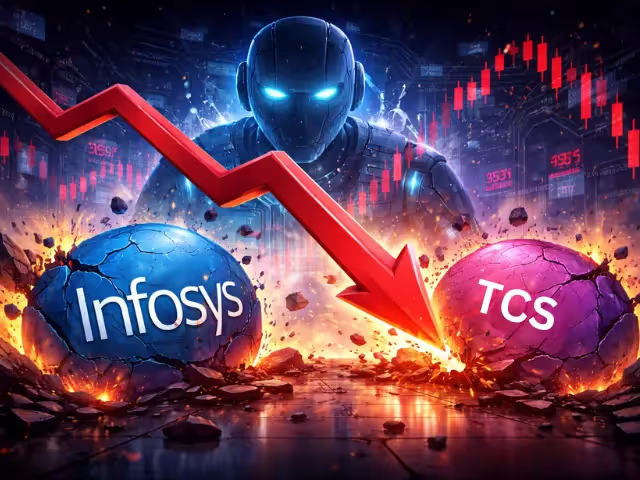
IT Stocks Crash Up to 7%: Is AI Disruption the New Threat to Infosys & TCS?
TL;DR
• IT stocks fell up to 7% amid AI disruption fears and global weakness
• Infosys and TCS face margin pressure as clients cut discretionary spending
• AI may reduce traditional IT services demand but opens new growth avenues
• Indian markets remain resilient, but IT volatility may continue
• Long term investors should focus on fundamentals, not headlines
IT Stocks Crash Up to 7%: Is AI Disruption the New Threat to Infosys & TCS?
Indian IT stocks saw sharp selling pressure this week, with some counters falling up to 7% in a single session. Investors are now asking a serious question: Is AI disruption becoming a structural threat to giants like Infosys and TCS?
The fall was not just a routine correction. It reflected a deeper concern about global demand slowdown, rising automation, and the rapid adoption of artificial intelligence tools that may reduce traditional IT outsourcing needs.
Let’s break down what is happening, what it means for the Indian markets, and how investors should interpret this phase.
Why Did IT Stocks Crash?
The recent decline in IT stocks was triggered by a combination of global and sector specific factors:
1. AI Disruption Concerns
Companies worldwide are rapidly adopting AI models and automation tools. Large language models and AI platforms are now capable of handling coding, testing, data analysis, and customer support functions that were traditionally outsourced to IT service firms.
Investors fear that this could reduce billing hours and pressure revenue growth for companies like Infosys and TCS.
However, the reality is more nuanced. AI can reduce certain low value services, but it also creates demand for AI integration, cloud migration, cybersecurity, and data governance services.
2. Weak Global Demand
Indian IT companies derive a major portion of revenue from the US and Europe. With economic uncertainty and tight corporate budgets, clients are delaying discretionary technology spending.
This has led to cautious management commentary in recent quarters and lower revenue guidance.
3. Margin Pressure
Higher employee costs, visa expenses, and pricing pressure are impacting operating margins. Investors typically react sharply when margins compress, especially in a sector known for high profitability.
Impact on Infosys and TCS
Infosys and TCS remain industry leaders with strong balance sheets and diversified client bases. But short term challenges are visible.
Revenue Mix Risk
A large portion of revenue comes from BFSI and retail sectors. If global banks and retailers slow their tech budgets, revenue growth could moderate.
Automation vs Human Billing
Traditionally, Indian IT firms operated on a time and material model. If AI reduces the need for manpower intensive coding, billing structures may need to evolve.
That said, both companies are heavily investing in AI platforms and proprietary solutions to stay ahead of the curve.
TCS has already embedded AI in several enterprise solutions. Infosys has launched AI driven service offerings to help clients optimize operations.
The transition may be painful in the short term, but it is not necessarily destructive.
Is AI Really a Threat or an Opportunity?
Every technological shift initially looks like a disruption. When cloud computing emerged, similar fears existed. Yet Indian IT adapted quickly and expanded their service portfolios.
AI could follow a similar pattern.
Instead of writing code manually, engineers may supervise AI systems. Instead of pure manpower supply, firms may shift toward outcome based contracts.
The key question is adaptability. Indian IT companies have historically demonstrated strong execution capabilities.
Impact on the Indian Markets
The Nifty IT index plays a significant role in the broader Indian equity markets. Sharp declines in IT stocks can drag benchmark indices lower.
However, the Indian economy remains structurally strong. Domestic sectors such as banking, capital goods, defence, and manufacturing continue to show momentum.
For long term investors, sector rotation is a normal part of market cycles.
It is also important to note that Indian IT companies are regulated under SEBI norms, ensuring high standards of financial disclosure and governance. Transparency reduces systemic risk compared to many global peers.
What Should Investors Do Now?
Market corrections often create anxiety. But panic selling rarely creates wealth.
Here are a few practical steps investors can consider:
Focus on Fundamentals
Check order book growth, deal wins, free cash flow, and management commentary rather than reacting to headlines.
Watch Valuations
After the correction, some IT stocks may trade at more reasonable valuations. Historically, buying quality IT stocks during fear phases has rewarded patient investors.
Diversify
Avoid over concentration in one sector. A balanced portfolio reduces volatility impact.
Track Global Cues
Since Indian IT is export oriented, US interest rates, tech spending trends, and global GDP forecasts matter.
Real World Perspective
Consider the 2008 financial crisis. IT stocks crashed sharply due to global slowdown fears. Yet over the next decade, companies like TCS and Infosys delivered strong returns.
Similarly, during the COVID period, IT demand surged due to digital transformation.
Markets move in cycles. Technology evolves. Companies adapt.
The key for investors is disciplined strategy rather than emotional reaction.
FAQs
Why did IT stocks fall up to 7%?
IT stocks declined due to AI disruption fears, weak global demand, and margin pressure concerns.
Is AI going to replace Indian IT companies?
AI may change service models, but leading firms are investing heavily in AI integration and innovation.
Should I sell Infosys or TCS now?
Investment decisions should depend on your financial goals and risk profile. Long term investors often benefit from staying invested in fundamentally strong companies.
How does IT sector weakness affect Indian markets?
Since IT has significant weight in benchmark indices, sharp falls can temporarily drag the broader market lower.
Is this a good time to invest in IT stocks?
Corrections can offer opportunities, but investors should analyze valuations, earnings outlook, and global trends before investing.
Conclusion
The recent IT stocks crash reflects uncertainty, not collapse. AI disruption is real, but so is innovation. Infosys and TCS are not small startups struggling to survive. They are global technology leaders with deep client relationships and strong financial positions.
Short term volatility is part of equity markets. Long term wealth creation depends on informed decisions backed by research.
At Swastika Investmart, we combine SEBI registered research expertise, advanced trading platforms, and dedicated customer support to help investors navigate such volatile phases confidently. Our research tools and investor education initiatives are designed to empower informed decision making.
If you are looking to build a disciplined, research driven portfolio, you can start your journey here:

Lenskart Results Analysis: Growth Story Intact or Valuations Overstretched?
Quick Insights
- Lenskart shares surged after strong Q3 earnings performance
- Profit jumped multi fold while revenue rose 38 percent
- International business turned profitable with improving margins
- High growth outlook supports optimism but valuations remain a debate
- Investors should balance momentum with fundamentals
Market Reaction to Lenskart Results
Lenskart results analysis has become one of the most discussed topics among investors after the eyewear retailer’s stock jumped nearly 12 percent following its latest quarterly numbers. The rally pushed the stock to a record high since its listing in November, reflecting strong investor confidence.
At mid session on February 12, shares were trading about 8.5 percent higher near Rs 506.55 with trading volume touching over 21 million shares compared to a 30 day average of just 1.5 million. Such a sharp rise in volume often signals institutional participation and renewed market interest.
The trigger behind this surge was a strong earnings report that exceeded expectations across key financial metrics.
Financial Performance Breakdown
Revenue Growth Signals Strong Demand
Lenskart reported revenue of Rs 2,308 crore for the quarter, up 38 percent from Rs 1,669 crore a year earlier. The growth was driven by new customer additions, expanding store presence, and rising demand for prescription eyewear.
India operations grew over 40 percent year on year, while international business recorded growth of about 33 percent. This balanced expansion across geographies suggests that the company’s growth is not dependent on a single market.
A major operational indicator was the company conducting more than 60 lakh eye tests during the quarter, nearly half of which were first time exams. Each new eye test increases the addressable market, making this metric particularly significant for long term growth.
Profitability Improvement Stands Out
The most striking highlight of this Lenskart results analysis is profitability. Net profit surged to about Rs 132.7 crore compared with just Rs 1.8 crore in the same quarter last year. That represents a massive jump driven by margin expansion and operating leverage.
Domestic profit before tax climbed more than threefold to Rs 161 crore. International operations also turned profitable with profit before tax of Rs 32.5 crore versus a loss of Rs 42.4 crore last year.
This shift from loss to profit in overseas markets is a key milestone. It shows that expansion investments are beginning to pay off.
International Business Becomes a Growth Engine
Lenskart’s international segment has emerged as a major growth driver. The division reported operational profitability of about 6.1 percent across nine months with around 705 stores globally.
Interestingly, management highlighted that international markets are achieving profitability faster than India did at a similar stage. This suggests that the company’s business model is scalable and adaptable across geographies.
The strategy relies on replicating its India playbook which includes data driven pricing, centralized manufacturing, and digital customer acquisition. Technology trained on millions of Indian consumers is now helping optimize global operations.
Strong Same Store Sales Momentum
Another key indicator of business health is same store sales growth. Lenskart reported 28 percent same store growth in India along with 36 percent same pincode growth, reflecting higher demand even in existing locations.
Such growth shows that performance is not coming only from expansion but also from improved productivity in existing stores. Investors usually view this positively because it signals sustainable growth rather than temporary spikes.
Market Opportunity Remains Massive
The company estimates India’s eyewear market at around Rs 79,000 crore, while the need based market exceeds Rs 4 lakh crore. More than 500 million people in India require vision correction, highlighting enormous long term potential.
This structural demand story supports the bullish thesis. Unlike discretionary products, vision correction is a necessity. That makes the category relatively resilient even during economic slowdowns.
Risks Investors Should Not Ignore
Despite strong numbers, investors should consider potential risks before assuming that growth alone guarantees stock performance.
Valuation Concerns
Stocks that rally sharply after results often start trading at premium valuations. When expectations become too high, even good results may fail to satisfy markets. Investors must compare valuation multiples with sector peers and growth sustainability.
Overseas Expansion Challenges
Although international markets have turned profitable, the company recently converted loans given to overseas subsidiaries into equity because those entities could not service debt obligations. While not uncommon in expansion phases, it highlights execution risks in global markets.
Competitive Landscape
The eyewear segment is attracting new entrants including global brands and online platforms. Maintaining growth will require continuous innovation, pricing discipline, and customer retention.
What the Market Is Pricing In
The current rally suggests investors are betting on a long runway of growth rather than focusing solely on current earnings. This is typical for consumer technology driven companies that operate in underpenetrated markets.
For instance, technology platforms with strong customer acquisition metrics often command higher valuations because markets price future earnings potential rather than present profits.
Impact on Indian Equity Markets
High growth companies like Lenskart influence broader market sentiment. When recently listed firms deliver strong results, it boosts confidence in IPO markets and encourages new listings. This improves liquidity and widens investment opportunities for retail investors.
Regulatory oversight by SEBI ensures disclosures on financial performance, shareholding patterns, and ESOP issuance. Lenskart announced ESOP plans worth over Rs 1,500 crore combined, which can align employee incentives with shareholder interests when structured effectively.
Practical Example for Investors
Consider two investors evaluating Lenskart after results. One focuses only on the price surge and fears missing out. Another studies revenue growth, margin trends, and expansion strategy before investing gradually.
Historically, the second approach tends to produce better long term outcomes because it balances optimism with analysis. Earnings season often rewards disciplined investors more than impulsive ones.
Frequently Asked Questions
Why did Lenskart shares rise after results?
Shares jumped because the company reported strong revenue growth, a sharp increase in profit, and improving margins across domestic and international markets.
Is Lenskart’s growth sustainable?
Growth appears supported by strong demand, expanding customer base, and a large untapped market, though sustainability depends on execution and competition.
What is driving Lenskart’s international success?
Its global expansion benefits from technology driven operations, centralized manufacturing, and replication of its India business model.
Are valuations a concern for investors?
Yes. Rapid price gains can lead to premium valuations, so investors should compare growth prospects with valuation multiples before investing.
How large is India’s eyewear market opportunity?
The current market is about Rs 79,000 crore, while the need based opportunity exceeds Rs 4 lakh crore due to a large population requiring vision correction.
Final Perspective
This Lenskart results analysis shows a company delivering impressive growth across revenue, profit, and global expansion. The numbers clearly indicate strong operational momentum. However, the market has already rewarded the stock significantly, which means future performance must justify current expectations.
For investors, the key lies in evaluating both growth potential and valuation comfort. Having access to reliable research tools, market insights, and expert guidance can make this process easier. Swastika Investmart, a SEBI registered brokerage, provides advanced analytics, responsive support, technology driven platforms, and investor education resources designed to help investors analyze companies beyond headline numbers.
If you want to evaluate growth stocks with deeper insights, you can begin here:

Why Gold and Silver Slipped After Strong US Jobs Data: Impact of Rising Yields & Dollar Strength
Quick Takeaways
- Early Q3 results show mixed earnings momentum across sectors
- Margin pressure visible despite revenue growth in many firms
- Global interest rate outlook is influencing investor sentiment
- Select sectors like auto and infra remain resilient
- Stock specific strategy is outperforming index investing
A Mixed Start to the Earnings Season
Q3 earnings expectations are drawing intense attention from investors as results start to reveal the real health of corporate India. While benchmark indices recently ended slightly lower after a three day gaining streak, the broader trend suggests markets are becoming more selective.
The Sensex slipped roughly 100 points while the Nifty closed near 25,943. Losses in heavyweights such as HDFC Bank and Infosys offset gains in State Bank of India and Reliance Industries. Interestingly, thirteen of fifteen sector indices still ended higher, led by a 1.3 percent rise in the auto index. The IT index, however, dropped 1.8 percent and emerged as the weakest link.
Market breadth also leaned negative with about 2,247 stocks declining versus 1,975 advancing. This divergence signals that investors are increasingly rewarding earnings visibility rather than broad market momentum.
What Early Q3 Results Are Indicating
Revenue Growth Is Holding Up
Several companies reported solid top line expansion. For instance:
- Kirloskar Oil Engines posted revenue growth of 29.2 percent and profit growth of 56.2 percent year on year
- Fiem Industries reported revenue up 16.4 percent and net profit up 34.8 percent
- TBO Tek recorded a sharp 85.8 percent revenue jump
These numbers indicate that demand conditions remain stable in many sectors despite global uncertainty.
Margins Tell a Different Story
While revenues are rising, margins are not always keeping pace. Rising input costs, currency fluctuations, and wage pressures are affecting profitability.
Examples include:
- Patanjali Foods saw revenue grow 16.5 percent but EBITDA declined 22.1 percent
- Godrej Industries posted revenue growth but margins dropped 160 basis points
- Concord Biotech reported revenue up 13.7 percent yet margins fell 450 basis points
This divergence between sales growth and margin compression is one of the clearest signals shaping Q3 earnings expectations.
Sector Wise Trends Investors Should Track
Capital Goods and Industrial Firms
Infrastructure linked companies are showing resilience. IRCON International posted revenue decline but improved margins and higher profits, reflecting cost control efficiency. Capacite Infraprojects also delivered margin expansion despite modest revenue growth.
This trend suggests that government spending and order books are still supporting industrial earnings.
Consumption and Retail
Consumer facing businesses are showing varied performance. Lenskart’s revenue rose 38.3 percent with EBITDA margin expanding sharply to 20.1 percent. In contrast, Dollar Industries reported modest revenue growth and declining profits, indicating uneven demand recovery across price segments.
Pharma and Specialty Chemicals
Healthcare companies are experiencing mixed outcomes. AstraZeneca Pharma India reported strong revenue growth of nearly 39 percent but margin contraction. Neogen Chemicals saw revenue rise but profit drop sharply.
Such patterns show that pricing pressure and cost structures continue to shape sector profitability.
Technology and Financials
Technology stocks have been under pressure due to global cues and interest rate concerns. Financial stocks are more stable but face margin sensitivity to rate cycles.
Global Factors Influencing Corporate Profits
Q3 earnings expectations cannot be viewed in isolation. Global macro indicators are playing a major role.
A stronger than expected US jobs report triggered a selloff in Treasuries, pushing two year yields near 3.5 percent. Traders now expect the Federal Reserve’s next rate cut closer to July instead of June. Higher rates typically reduce equity valuations, especially for growth oriented sectors.
Meanwhile, Asian markets have been outperforming US equities this year. The MSCI Asia Pacific Index has gained about 13 percent year to date and recently hit a record high. Strong regional growth momentum is supporting earnings outlook for export driven Indian companies.
Commodity prices are also shaping profitability. Gold prices slipped after strong US employment data reduced hopes of rapid rate cuts. Oil prices rose for a second straight session amid geopolitical tensions involving the US and Iran. Brent crude remains above 69 dollars, which could increase input costs for Indian companies dependent on imports.
Key Events That Could Shape Earnings Outlook
Investors are closely watching upcoming macro triggers such as inflation data. January CPI numbers will influence interest rate expectations and liquidity flows.
If inflation remains controlled, corporate margins could stabilize. If inflation rises, companies may struggle to maintain profitability despite revenue growth.
In India, regulatory oversight from institutions like SEBI continues to strengthen disclosure standards. Transparent reporting helps investors assess earnings quality rather than just headline growth.
Are Corporate Profits Actually Slowing?
The answer is nuanced. Corporate profits are not broadly collapsing, but they are becoming uneven.
Three clear trends are emerging:
- Earnings growth is shifting from broad based to sector specific
- Margin pressure is increasing due to costs and global rates
- Markets are rewarding companies that beat expectations rather than those simply growing
For example, Bayer CropScience reported EBITDA growth of nearly 479 percent and profit growth of about 180 percent, showing that strong operational efficiency can still drive exceptional results even in a challenging environment.
Strategy for Investors During Earnings Season
Periods like this often confuse investors because headlines send mixed signals. A practical approach is to focus on fundamentals rather than market noise.
Consider these principles:
- Track margin trends, not just revenue growth
- Compare results with analyst expectations
- Evaluate management guidance for future quarters
- Watch sector rotation trends
Investors who rely on structured research tools and credible analysis often make better decisions than those reacting to daily volatility.
Frequently Asked Questions
What do Q3 earnings expectations indicate about the market?
They show that growth continues but is uneven across sectors, with margins becoming the key differentiator.
Why are margins falling despite revenue growth?
Higher input costs, wage inflation, currency movements, and interest rates are pressuring profitability.
Which sectors look strongest this quarter?
Auto, infrastructure, and select industrial companies are showing stronger earnings resilience.
How do global interest rates affect Indian corporate profits?
Higher global rates increase borrowing costs, reduce liquidity, and lower valuations, especially for growth sectors.
Should investors change strategy during earnings season?
Yes. A stock specific approach focused on earnings quality is generally more effective than broad market exposure.
Final Word
The latest results suggest that corporate India is not slowing uniformly. Instead, earnings momentum is becoming selective, rewarding efficient companies and punishing weak performers. This phase often marks a transition from liquidity driven rallies to fundamentals driven markets.
For investors, this is where the right platform and research support matter. Swastika Investmart, a SEBI registered brokerage, combines advanced technology, reliable customer support, strong analytical tools, and investor education resources to help clients interpret earnings data and make informed decisions.
If you want to navigate earnings season with confidence and clarity, you can begin here:

.avif)
.avif)

.avif)