

Debt Trap Warning Signs: When Loans Start Hurting Your Wealth




Quick Takeaways
• Not all debt is bad, but unmanaged debt can destroy long-term wealth.
• High EMI-to-income ratio is one of the earliest warning signs of a debt trap.
• Credit card rollovers and personal loans often become the biggest financial burden.
• Rising debt affects savings, investments, and financial freedom.
• Smart debt management can protect your wealth and improve financial stability.
When Borrowing Stops Helping and Starts Hurting
Loans are part of modern life.
A home loan helps buy a house.
An education loan builds a career.
A business loan can create income.
Used wisely, debt can be a financial tool.
But there’s a thin line between useful debt and dangerous debt.
And once that line is crossed, loans start eating your wealth instead of building it.
This is called a debt trap.
A debt trap happens when your income is increasingly used to pay existing loans, leaving little room for savings, investments, or emergencies.
In India, rising consumer loans, easy digital credit, and credit card usage have made debt more accessible than ever.
But easy access does not always mean healthy borrowing.
Understanding debt trap warning signs can protect your financial future.
What Is a Debt Trap?
A debt trap begins when a person borrows money and struggles to repay it on time.
To manage one loan, they take another.
Then another.
Slowly, debt repayments become a monthly burden.
The cycle continues.
For example:
Rahul earns ₹60,000 a month.
He pays:
₹20,000 home loan EMI
₹10,000 car loan EMI
₹8,000 personal loan EMI
₹12,000 credit card dues
That’s ₹50,000 already committed.
Only ₹10,000 remains for living expenses.
One emergency can break the system.
That’s how debt traps begin.
Warning Sign 1: Your EMIs Are Taking More Than 40% of Your Income
This is one of the clearest warning signs.
Financial planners often suggest keeping total EMIs below 35% to 40% of monthly income.
If your debt payments are crossing that level, risk rises sharply.
Why?
Because savings suffer.
Investments stop.
Emergency funds disappear.
A job loss or medical issue can create financial stress.
The Reserve Bank of India has also repeatedly highlighted household leverage as an important economic risk.
Warning Sign 2: You’re Using Credit Cards to Pay Bills
Credit cards are useful.
But using them for basic monthly expenses regularly is a red flag.
Worse, paying only the minimum due creates a bigger problem.
Credit card interest rates in India can range from 30% to 45% annually.
That’s expensive debt.
Imagine carrying ₹1 lakh on a credit card.
At 36% annual interest, repayment becomes painful if not cleared quickly.
This kind of debt grows fast.
Warning Sign 3: Taking New Loans to Repay Old Loans
This is classic debt trap behavior.
Borrowing to pay borrowing.
It may feel like relief.
But it only delays the problem.
Many borrowers take personal loans to clear credit cards.
Then use cards again.
Now they have both.
The cycle worsens.
This is where financial damage becomes serious.
Warning Sign 4: No Emergency Fund
Debt becomes dangerous when there is no backup.
Without emergency savings, every unexpected expense becomes borrowed money.
Medical expenses.
Job loss.
Family emergencies.
Without cash reserves, debt rises faster.
Financial experts often recommend at least 6 months of emergency savings.
But many borrowers ignore this.
Warning Sign 5: Your Credit Score Is Falling
A falling credit score is often an early signal.
Missed payments.
High credit utilization.
Loan defaults.
All affect your score.
In India, credit scores from TransUnion CIBIL are critical for future borrowing.
A poor score means:
Higher interest rates
Loan rejection
Lower financial flexibility
This creates more financial pressure.
Good Debt vs Bad Debt: Know the Difference
Not all loans are harmful.
Understanding the difference matters.
Good Debt
Home loans
Education loans
Business loans
These create assets or future income.
Bad Debt
Credit card debt
Personal loans for lifestyle expenses
Buy-now-pay-later misuse
These often fund consumption, not wealth.
That distinction is important.
How Debt Hurts Wealth Creation
Debt affects more than monthly cash flow.
It affects long-term wealth.
For example:
If you invest ₹15,000 monthly in mutual funds for 15 years, compounding can create significant wealth.
But if that ₹15,000 goes into unnecessary EMIs?
That opportunity disappears.
Debt delays wealth creation.
It also creates stress-driven financial decisions.
That hurts investment discipline.
Debt and the Indian Economy
Household borrowing in India has increased significantly.
Retail credit growth remains strong.
Banks and NBFCs continue expanding personal loan books.
That boosts consumption.
But excessive retail debt can create economic risks.
This is why the Reserve Bank of India closely monitors unsecured lending and consumer credit growth.
For investors, rising bad loans can affect banking stocks, NBFCs, and consumption-driven businesses.
Debt is not just personal.
It impacts markets too.
How to Escape a Debt Trap
The good news?
Debt traps can be fixed.
Prioritize High-Interest Debt First
Start with credit cards and personal loans.
These cost the most.
Clear them faster.
Stop Taking New Debt
No fresh loans unless absolutely necessary.
Break the cycle.
Build an Emergency Fund
Even small savings matter.
Start with one month.
Build gradually.
Increase Income If Possible
Freelancing.
Side income.
Skill upgrades.
Extra income accelerates debt reduction.
Create a Debt Repayment Plan
Track every EMI.
Set timelines.
Stay disciplined.
Real-World Lesson: Lifestyle Inflation Is Dangerous
A salary hike often leads to higher spending.
Bigger car.
Bigger house.
More credit.
But income growth does not guarantee wealth growth.
Only controlled spending and disciplined investing do.
Many high earners remain financially stressed because debt rises with income.
That’s lifestyle inflation.
And it’s a silent wealth killer.
Investing While Managing Debt
Should you stop investing?
Not always.
If debt is high-interest, clearing it may offer better returns than investing.
But long-term investing should continue where possible.
Platforms like Swastika Investmart help investors build disciplined wealth strategies through research-backed insights, investor education, and tech-enabled investing solutions.
Managing debt and investing together requires planning.
Final Thoughts: Debt Should Support Wealth, Not Destroy It
Loans are tools.
Not enemies.
But when borrowing becomes habit-driven and uncontrolled, it can damage financial freedom.
The warning signs are often visible early.
High EMIs.
Credit card dependency.
Borrowing to repay debt.
No savings.
Falling credit score.
Recognizing them early can save years of financial stress.
Wealth creation is not just about earning more.
It’s about managing money better.
If you want to build smarter financial habits and start your wealth journey with expert guidance, open your account with Swastika Investmart and take control of your financial future.
Frequently Asked Questions
What is a debt trap?
A debt trap happens when a person keeps borrowing to repay existing debt and struggles to maintain financial stability.
What EMI percentage is considered risky?
If total EMIs exceed 40% of your monthly income, it may indicate financial stress.
Is credit card debt dangerous?
Yes, because credit card interest rates are among the highest forms of borrowing.
How can I improve my credit score?
Pay EMIs on time, reduce credit utilization, and avoid multiple loan applications.
Should I invest or repay debt first?
High-interest debt should usually be cleared first, while maintaining basic long-term investing discipline.
Big Budget




.avif)
.avif)
.avif)
.avif)
.avif)








.avif)
.avif)
.avif)
.avif)
Latest Articles
.avif)
Indian Stock Market Outlook for 27 February 2026: Volatility Near Key Support Zones


Summary
• Global markets remain mixed while GIFT Nifty signals a weak opening
• FIIs continue selling, but strong DII buying supports markets
• Nifty trades between major moving averages, indicating volatility
• Bank Nifty structure remains relatively stronger than benchmark indices
• Traders should watch 25,350 and 25,600 levels closely
Market Overview: Global Signals Set a Cautious Tone
The Indian stock market enters the 27 February 2026 session with mixed global cues. US markets closed marginally positive, with the Dow Jones ending slightly higher. However, Dow futures slipped nearly 250 points overnight, reflecting caution among global investors.
Asian markets are trading on a mixed note, suggesting uncertainty ahead of key macroeconomic triggers. Meanwhile, GIFT Nifty indicates a gap down opening of around 90 points, hinting at early volatility for domestic indices.
Such setups usually lead to range bound trading rather than directional momentum, especially when markets approach strong technical zones.
Institutional Activity: Domestic Investors Provide Stability
Institutional flows continue to shape short term sentiment in Indian equities.
Foreign Institutional Investors remained net sellers with outflows of approximately ₹3,466 crore. Persistent FII selling often creates pressure on large cap stocks, particularly banking and IT names.
On the other hand, Domestic Institutional Investors injected nearly ₹5,032 crore into equities. This resulted in a net positive institutional flow of about ₹1,566 crore.
This divergence highlights an important structural trend in Indian markets. Domestic participation through mutual funds, SIP inflows, and insurance investments continues to absorb global selling pressure.
In recent years, this domestic cushion has helped India outperform several emerging markets during global uncertainty phases.
Derivatives Data Signals Consolidation
Options data suggests traders expect consolidation rather than aggressive upside.
Key observations include:
Options Positioning
• Highest Open Interest seen at 26,000 Call and 24,000 Put
• Maximum Pain level positioned near 25,500
• Nifty Put Call Ratio stands at 0.88
A PCR near 0.88 indicates balanced sentiment. Markets are neither extremely bearish nor overly bullish.
The buildup in both Call and Put positions shows hedging activity rather than speculative bets. Traders appear cautious ahead of directional confirmation.
India VIX declined to around 13.06, signaling controlled volatility despite global uncertainty. Lower volatility typically supports gradual price movements instead of panic selling.
Nifty Technical Outlook: Battle Between Moving Averages
Nifty continues to trade within a technically sensitive zone.
Key Technical Levels
The index is currently fluctuating between:
• 200 Day Moving Average near 25,350
• 100 Day Moving Average around 25,750
This range acts as a decision zone for market participants.
A bounce from the 200 DMA remains possible, as long term investors often accumulate near this level. However, immediate resistance exists near the 20 DMA placed around 25,600.
If Nifty sustains above 25,600, short covering could push the index toward higher resistance levels. Conversely, a decisive breakdown below the 200 DMA may expose the index to the next strong support near 25,110.
From a trader’s perspective, this is typically a wait and watch phase rather than aggressive positioning.
Bank Nifty Outlook: Relative Strength Continues
Compared to Nifty, Bank Nifty maintains a stronger technical structure.
Important Levels to Track
• Immediate support around 60,500 near the 20 DMA
• Resistance zone between 61,500 and 62,000
Banking stocks have shown resilience due to stable credit growth, improving asset quality, and consistent domestic inflows.
If Bank Nifty sustains above support levels, it may act as a stabilizing force for the broader market even during volatile sessions.
Historically, leadership from banking stocks often determines short term market direction in India.
What This Means for Indian Investors
The current setup reflects a classic consolidation phase.
Retail investors often mistake sideways markets for weakness. In reality, consolidation helps markets absorb profit booking and prepares the ground for the next trend.
For example, similar phases during previous earnings seasons saw markets trade within narrow ranges before breaking out once institutional confidence returned.
Key strategies investors may consider:
• Avoid chasing gap openings
• Focus on quality stocks near support levels
• Use staggered buying instead of lump sum entries
• Monitor institutional flow trends closely
Long term investors should remember that India’s structural growth story remains intact, supported by strong domestic demand and regulatory oversight by SEBI.
Role of Research Driven Investing
In volatile environments, access to reliable research becomes critical. Investors increasingly rely on platforms that combine technology with market insights.
Swastika Investmart stands out with its SEBI registered framework, research backed recommendations, advanced trading platforms, and investor education initiatives designed for both beginners and experienced traders.
Rather than reacting emotionally to daily market noise, informed decision making supported by credible analysis helps investors stay aligned with long term goals.
Frequently Asked Questions
Is the market trend bullish or bearish right now?
The trend is neutral with consolidation. Markets are reacting to global uncertainty while holding key domestic support levels.
Why are FIIs selling Indian equities?
Global risk adjustments, currency movements, and portfolio rebalancing often drive FII selling rather than weakness in India’s fundamentals.
What is the importance of the 200 DMA?
The 200 Day Moving Average is widely seen as a long term trend indicator. Holding above it signals structural strength.
Should retail investors trade during volatile sessions?
Only disciplined traders should take short term positions. Investors may prefer gradual accumulation strategies.
Why is Bank Nifty stronger than Nifty?
Banking stocks benefit from domestic economic growth and consistent institutional participation, offering relative stability.
Conclusion: Markets Pause Before the Next Move
The Indian stock market outlook for 27 February 2026 suggests controlled volatility rather than panic. Institutional buying, stable volatility indicators, and strong banking support continue to balance global uncertainty.
Periods like these often reward patient investors more than aggressive traders.
If you are looking to navigate markets with research backed insights, powerful trading tools, and strong customer support, consider starting your investment journey with Swastika Investmart.
.avif)
Stocks in News India Today 27 February 2026: Greaves Cotton, HCLTech, NBCC and Brigade Enterprises
Summary
• Greaves Cotton expands EV business internationally with Nepal entry
• HCLTech strengthens innovation through IIT Kanpur collaboration
• NBCC secures ₹775 crore redevelopment order from DDA
• Brigade Enterprises taps India’s growing senior living opportunity
• These developments highlight infra, IT and EV sector momentum in Indian markets
Stocks in News India Today 27 February 2026
The Indian stock market reacts quickly to company specific developments, especially when announcements signal expansion, new orders, or long term strategic partnerships. Tracking daily updates helps investors understand sectoral momentum and emerging investment opportunities.
In Stocks in News India today, 27 February 2026, companies across electric mobility, IT services, infrastructure, and real estate have made important announcements that may influence market sentiment during upcoming trading sessions.
Let’s break down what these updates actually mean for investors and the broader Indian markets.
Greaves Cotton Expands Electric Mobility Business Internationally
Greaves Cotton announced that its electric mobility division, Greaves Electric Mobility, will expand operations into Nepal as part of its international growth roadmap announced on 27 February 2026.
Why This Development Is Important
India’s EV ecosystem is entering its next growth phase where companies are exploring neighboring international markets.
Nepal offers strong potential due to:
• Supportive EV adoption policies
• Increasing fuel import dependency
• Rising demand for affordable electric mobility
• Geographic and trade advantages with India
This expansion reflects Greaves Cotton’s intent to evolve into a regional electric mobility player rather than remaining India focused.
Market Impact
Investors typically interpret international expansion as a long term growth signal. The EV sector continues to benefit from policy push under India’s sustainability and electrification initiatives.
Successful execution could strengthen revenue diversification and improve growth visibility over the coming years.
HCLTech Signs MoU with IIT Kanpur for Innovation
HCLTech signed a Memorandum of Understanding with Indian Institute of Technology Kanpur on 27 February 2026 to transform advanced academic research into scalable enterprise solutions.
Strategic Context
India’s IT industry is shifting from traditional outsourcing toward innovation led digital transformation.
The collaboration aims to focus on:
• Artificial intelligence research applications
• Enterprise technology pilots
• Global Capability Center innovation
• Industry ready digital solutions
Such initiatives help IT companies strengthen intellectual property driven growth models.
Investor Viewpoint
Although partnerships may not immediately impact quarterly earnings, markets often reward companies investing in innovation ecosystems that improve long term competitiveness in global markets.
NBCC Secures ₹775 Crore Order from DDA
NBCC (India) Limited received a ₹775 crore redevelopment project from the Delhi Development Authority, officially disclosed in market updates dated 27 February 2026.
Infrastructure Momentum Continues
Urban redevelopment projects remain central to India’s infrastructure growth strategy. Government backed contracts provide:
• Stable revenue pipelines
• Execution visibility
• Reduced payment risk
• Long term project continuity
Market Relevance
Strong order inflows typically improve investor confidence in infrastructure PSUs. With India maintaining high capital expenditure spending, construction and redevelopment companies remain closely linked to economic expansion trends.
Brigade Enterprises Enters Senior Living Segment
Brigade Enterprises partnered with Primus Senior Living on 27 February 2026 to launch three senior living communities across South India with an estimated GDV of ₹750 crore.
A Structural Real Estate Opportunity
India’s demographic transition is reshaping housing demand. Senior living communities are emerging as a fast growing niche driven by:
• Increasing life expectancy
• Urban migration trends
• Rising retirement planning awareness
• Demand for assisted lifestyle communities
Developers entering early may gain long term demand advantages.
Investment Outlook
Diversification into specialized residential formats helps real estate companies reduce cyclicality associated with traditional housing demand.
This move positions Brigade Enterprises within a structurally expanding segment of the real estate market.
Market Impact on Indian Equities Today
The Stocks in News India today 27 February 2026 highlights three dominant themes influencing market sentiment:
Global Expansion by Indian Companies
Expansion initiatives signal increasing global competitiveness of Indian firms.
Innovation Led Technology Growth
Corporate academic partnerships strengthen India’s digital leadership positioning.
Government Driven Infrastructure Push
Order wins reinforce confidence in capital expenditure led economic growth.
These developments collectively support broader market sentiment across sectoral indices beyond large cap dominated movements.
Regulatory Perspective for Investors
All listed companies disclose material developments under regulations governed by the Securities and Exchange Board of India.
Investors should remember:
• News based rallies can be temporary
• Execution determines long term stock performance
• Order wins and partnerships require sustained delivery
Combining news tracking with fundamental research remains essential.
Turning Market News into Smart Investment Decisions
Professional investors rarely react instantly to headlines. Instead, they evaluate:
• Earnings visibility impact
• Sector outlook
• Valuation comfort
• Management execution history
A research driven investing approach becomes easier with platforms offering advanced analytics, reliable insights, and investor education.
Swastika Investmart, a SEBI registered stock broker, supports investors through strong research capabilities, technology enabled trading platforms, responsive customer service, and structured investor learning resources.
👉 Open your trading account today
Frequently Asked Questions
What is Stocks in News India today?
It refers to companies making important announcements on a specific trading day that may influence stock price movements.
Does today’s news guarantee stock price movement?
No. Market reaction depends on execution, valuation, and broader market sentiment.
Why are infrastructure orders important?
They provide predictable revenue visibility and strengthen company order books.
Should long term investors track daily news?
Yes. Daily updates help identify emerging sector trends early.
How can beginners interpret market news better?
Using research backed brokerage platforms helps investors understand real impact instead of reacting emotionally.
Conclusion
The Stocks in News India today 27 February 2026 reflects how expansion, innovation partnerships, infrastructure spending, and evolving real estate demand continue shaping India’s growth narrative.
While daily announcements influence short term sentiment, disciplined investors focus on fundamentals and long term execution capability.
With SEBI registration, strong research tools, investor education initiatives, and technology driven investing solutions, Swastika Investmart enables investors to confidently navigate market opportunities and transform information into informed investment decisions.
%20(3).avif)
FII FPI & DII Trading Activity on 26 February 2026 | What It Signals for Indian Markets
Summary
• DIIs were net buyers of ₹5,031.57 crore on 26 February 2026
• FIIs turned net sellers with ₹3,465.99 crore outflow
• Domestic flows helped cushion market volatility
• Institutional activity offers key signals for short term market direction
DII vs FII Data 26 February 2026: What It Means for Indian Markets
Institutional flows often decide the short term mood of Dalal Street. The DII vs FII data 26 February 2026 clearly shows a tug of war between domestic and foreign investors. While Foreign Institutional Investors reduced exposure, Domestic Institutional Investors stepped in with strong buying support.
Understanding this shift is crucial for traders and long term investors alike.
Institutional Activity Snapshot
On 26 February 2026:
- DII Buy Value: ₹19,242.72 crore
- DII Sell Value: ₹14,211.15 crore
- DII Net Value: ₹5,031.57 crore
- FII Buy Value: ₹14,607.90 crore
- FII Sell Value: ₹18,073.89 crore
- FII Net Value: ₹3,465.99 crore outflow
The numbers show a clear domestic cushion against foreign selling pressure.
Why DII Buying Matters
Domestic Institutional Investors include mutual funds, insurance companies, banks, and financial institutions registered under SEBI. Their strong participation often reflects confidence in India’s economic fundamentals.
When DIIs absorb FII selling, markets tend to stay stable. This pattern has been visible multiple times over the past few years, especially during global uncertainty.
For example, during global rate hike cycles, FIIs often pull money from emerging markets. However, growing SIP inflows into Indian mutual funds give DIIs consistent buying power. This structural shift has changed market dynamics.
Why FIIs Sold on 26 February 2026
Foreign investors typically react to global triggers such as:
- US bond yield movements
- Dollar index strength
- Crude oil prices
- Global risk sentiment
Even a small shift in US Federal Reserve commentary can influence FII positioning. Selling of ₹3,465.99 crore indicates cautious sentiment rather than panic.
It is important to note that FII outflows do not always signal a bearish trend. Sometimes, it is sector rotation or profit booking.
Impact on Nifty and Sensex
When DIIs buy aggressively, they provide liquidity support. This can lead to:
- Reduced intraday volatility
- Stronger support near key technical levels
- Better recovery from dips
Retail investors often feel nervous when headlines highlight FII selling. However, data driven investors look at the combined picture.
On days like 26 February 2026, the domestic buying intensity suggests underlying strength.
The Bigger Structural Trend
Over the last few years, India has seen rising domestic participation through:
- SIP investments
- Pension fund allocations
- Insurance investments
- Retail trading accounts
SEBI data shows consistent growth in demat accounts. This broadens the investor base and reduces dependence on foreign capital.
Earlier, heavy FII selling would sharply drag indices lower. Today, DIIs have become a counterbalancing force.
Sector Level Implications
Although aggregate numbers give a broad view, sector wise allocation is equally important.
FIIs often prefer:
- Financials
- IT
- Large cap growth stocks
DIIs typically support:
- Domestic consumption themes
- Banking and financial services
- Capital goods and infrastructure
If FIIs exit large caps while DIIs accumulate, midcaps and domestic focused sectors may outperform.
What Retail Investors Should Do
Institutional flow data should guide perspective, not trigger emotional trading.
Here is a simple framework:
Short Term Traders
- Watch key support and resistance levels
- Monitor global cues overnight
- Track FII index futures positions
Long Term Investors
- Focus on earnings growth
- Continue systematic investments
- Use volatility to accumulate quality stocks
Trying to chase daily FII numbers without context can lead to overtrading.
Regulatory Oversight and Transparency
SEBI ensures daily disclosure of FII and DII trading activity. This transparency helps investors make informed decisions.
Foreign Portfolio Investors operate under defined regulatory norms. Domestic mutual funds follow strict risk management and disclosure guidelines.
Such oversight enhances market trust and reduces systemic risks.
How Swastika Investmart Helps You Decode Institutional Data
Interpreting DII vs FII data 26 February 2026 requires both numbers and context. At Swastika Investmart, investors benefit from:
- SEBI registered research insights
- Technical and fundamental analysis tools
- Real time market alerts
- Dedicated customer support
- Investor education resources
Instead of reacting to headlines, investors can rely on structured research to make informed decisions.
Markets reward discipline more than speed.
If you want access to expert backed strategies and smart tools, you can start here:
Frequently Asked Questions
What is DII vs FII data?
DII vs FII data shows the daily buying and selling activity of Domestic Institutional Investors and Foreign Institutional Investors in Indian stock markets.
Is FII selling always negative for markets?
Not necessarily. If DIIs absorb selling and fundamentals remain strong, markets can remain stable or even rise.
Why are DIIs becoming more powerful in India?
Rising SIP inflows, insurance investments, and pension allocations have increased domestic liquidity in the equity markets.
Where can I check daily institutional flow data?
Daily institutional trading data is available through stock exchanges like NSE and BSE and reported under SEBI guidelines.
Final Thoughts
The DII vs FII data 26 February 2026 highlights a clear shift in market structure. Foreign investors trimmed exposure, but domestic institutions stepped up confidently. This signals resilience in Indian markets.
Institutional flows offer valuable insights, but they are just one piece of the puzzle. Economic growth, earnings momentum, and policy stability matter equally.
With the right research support and disciplined strategy, investors can turn volatility into opportunity.
Swastika Investmart empowers investors with trusted research, strong technology, and responsive support. If you are ready to invest with clarity and confidence, take the next step.

Uber vs Rapido: Inside India’s ₹3,000 Crore Ride-Hailing War
Uber vs Rapido: Inside India’s ₹3,000 Crore Ride-Hailing War
TL;DR
- Uber and Rapido are locked in an intense price and market share battle in India.
- Rapido is disrupting with bike taxis and low-cost rides, while Uber focuses on scale and premium segments.
- The competition is reshaping urban mobility economics and driver earnings.
- For investors, the ride-hailing war signals opportunities in mobility, auto, and digital platforms.
India’s Ride-Hailing Market Heats Up
India’s urban mobility story is entering a new phase. The Uber vs Rapido rivalry is no longer just about ride bookings. It has become a high-stakes battle for market dominance in a sector estimated to be worth over ₹3,000 crore and growing rapidly.
With rising urbanization, increasing smartphone penetration, and improving digital payments infrastructure, ride-hailing platforms are deeply embedded in daily commuting. But the big question is simple. Who is winning the war, and what does it mean for the broader market?
Let’s decode.
The Evolution of India’s Ride-Hailing Ecosystem
A decade ago, app-based cab services were a novelty. Today, they are a necessity in metros and Tier 2 cities.
Key growth drivers
- Rapid urbanization
- Rising disposable income
- Traffic congestion in major cities
- Expansion of digital payment systems like UPI
- Flexible gig economy workforce
Initially dominated by cab aggregators, the market has now fragmented. This is where the Uber vs Rapido contest becomes interesting.
Uber’s Strategy: Scale, Brand, and Premium Push
Uber entered India early and built strong brand recall. Its playbook has been clear.
Strength areas
1. Wide city coverage
Uber operates across most major Indian cities, giving it a strong network effect.
2. Multi-category offerings
From UberGo and Uber Auto to Uber Premier, the company targets multiple customer segments.
3. Global technology backbone
Uber leverages its global algorithms for pricing, routing, and demand prediction.
Challenges Uber faces
- High customer acquisition costs
- Driver dissatisfaction in some regions
- Increasing price sensitivity among Indian users
- Competition from low-cost players like Rapido
Uber’s model works well in premium and airport segments, but India remains a price-sensitive market.
Rapido’s Disruption: The Bike Taxi Advantage
Rapido has changed the game by focusing on affordability and speed. Its bike taxi model solved a real Indian problem: last-mile connectivity at low cost.
Why Rapido is gaining traction
1. Ultra-affordable rides
Bike taxis are often 30 to 50 percent cheaper than cabs.
2. Faster in congested cities
In cities like Bengaluru and Delhi, bikes navigate traffic far better than cars.
3. Strong focus on Tier 2 markets
Rapido expanded aggressively beyond metros.
4. Asset-light expansion
Lower operating costs compared to four-wheeler fleets.
The auto segment pivot
Rapido has recently pushed aggressively into auto rickshaws, directly challenging Uber Auto and other incumbents. This is where the Uber vs Rapido rivalry has intensified the most.
Price Wars and Driver Economics
The biggest battlefield is pricing.
Ride-hailing platforms typically subsidize rides to gain market share. But sustained discounting impacts driver earnings and platform profitability.
Real-world example
In Bengaluru:
- A typical bike ride on Rapido may cost ₹40 to ₹60
- The same short trip via cab could cost ₹120 to ₹180
For daily commuters, the choice becomes obvious.
However, drivers often compare:
- Incentives
- Commission structure
- Ride frequency
- Payment cycles
Driver loyalty is fluid, and both companies continuously tweak incentives to retain supply.
Regulatory Overhang: A Key Risk
India’s ride-hailing sector operates under evolving state transport rules. Several states have already introduced aggregator guidelines.
Key regulatory themes
- Bike taxi legality debates in multiple states
- Surge pricing caps
- Driver welfare norms
- Data localization requirements
For instance, some state transport departments have periodically questioned bike taxi permissions. Any adverse ruling could materially impact Rapido’s core model.
Investors tracking the Uber vs Rapido battle must keep an eye on regulatory developments.
Market Impact: Who Benefits Beyond Ride Platforms
The ripple effects of the ride-hailing war extend beyond mobility apps.
Potential beneficiaries
1. Auto OEMs
Higher fleet demand supports two-wheeler and three-wheeler manufacturers.
2. EV ecosystem
Both players are gradually exploring electric fleets, benefiting EV suppliers.
3. Digital payments companies
UPI and wallet transactions rise with ride volumes.
4. Insurance providers
Commercial vehicle insurance demand increases.
For equity investors, the opportunity may lie in the broader ecosystem rather than the aggregators themselves, especially since major ride-hailing firms are either unlisted or globally listed.
Can Profitability Emerge in India
The million-rupee question remains profitability.
Historically, ride-hailing globally has struggled with margins due to:
- High incentives
- Price competition
- Regulatory compliance costs
- Customer acquisition spending
Rapido’s bike-first model is structurally more cost-efficient, but scaling profitably in India’s hyper-competitive market remains challenging.
Uber, with its global scale, has deeper pockets but must adapt to India’s unique price sensitivity.
What Should Market Participants Watch
For investors and market watchers, a few signals matter most.
- Regulatory clarity on bike taxis
- Driver supply trends
- EV fleet adoption
- Consolidation possibilities
- Path to unit-level profitability
The Uber vs Rapido contest is less about immediate profits and more about long-term platform dominance.
Conclusion: Mobility War with Long-Term Market Signals
India’s ride-hailing space is entering a decisive phase. The Uber vs Rapido battle highlights how price innovation, local execution, and regulatory navigation can reshape entire industries.
While end users enjoy cheaper and faster rides, investors should look deeper into the mobility value chain for sustainable opportunities.
If you want to track such emerging sectors with data-backed insights, strong research tools, and reliable market guidance, Swastika Investmart, a SEBI-registered broker, offers tech-enabled investing, robust analytics, and dedicated customer support designed for serious market participants.
Frequently Asked Questions
Q1. Who is currently leading in the Uber vs Rapido battle in India?
Both platforms lead in different segments. Uber remains strong in cab categories, while Rapido is gaining fast in bike taxis and autos.
Q2. Are bike taxis legal across India?
Not uniformly. Regulations vary by state, and legality remains under policy review in several regions.
Q3. How does the ride-hailing war impact stock market investors?
Indirectly through auto companies, EV players, insurance firms, and digital payment companies that benefit from higher mobility demand.
Q4. Is the Indian ride-hailing market profitable yet?
Profitability remains challenging due to heavy competition and incentive spending, though unit economics are improving gradually.
Q5. Which factors will decide the long-term winner?
Regulatory clarity, driver retention, pricing discipline, and technology efficiency will be the key differentiators.
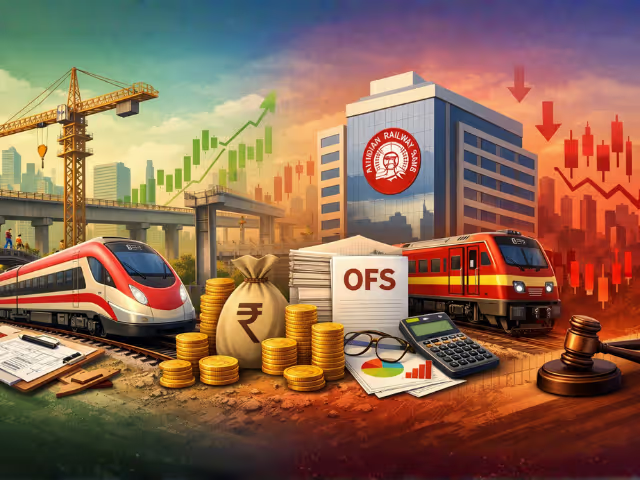
RVNL Secures ₹371 Crore Project While IRFC OFS Hits Market: What Investors Should Know.
Key Takeaways
• RVNL’s new order strengthens its execution visibility
• IRFC OFS may create short term supply pressure on the stock
• Railway sector momentum remains structurally strong
• Government divestment strategy continues to play out
• Investors should focus on order book quality and valuation
RVNL Secures ₹371 Crore Project While IRFC OFS Hits Market
India’s railway ecosystem continues to remain in focus as two important developments have caught investor attention. Rail Vikas Nigam Limited has secured a fresh project worth ₹371.69 crore, while the Government of India has launched an offer for sale in Indian Railway Finance Corporation.
Both developments come at a time when railway stocks have seen strong rerating over the past few years. However, the market impact of these announcements is different in nature.
Let us break down what this means in practical terms for investors.
RVNL Order Win Strengthens Execution Pipeline
Rail Vikas Nigam Limited recently received a Letter of Award from National Mineral Development Corporation for developing a township in Kirandul, Chhattisgarh. The project is valued at approximately ₹371.69 crore.
For infrastructure companies like RVNL, order inflow is the lifeblood of future revenue visibility.
Why this order matters
First, it adds incremental strength to RVNL’s already healthy order book. A strong order pipeline improves revenue predictability over the next few years.
Second, the project comes from a reputed public sector entity, which generally reduces counterparty risk.
Third, township development expands RVNL’s execution exposure beyond core railway EPC work, indicating gradual diversification.
Real world context
In recent years, companies with robust order books such as RVNL, IRCON, and other railway EPC players have witnessed strong market rerating. Investors closely track fresh orders as a leading indicator of future growth.
IRFC OFS Brings Supply Pressure to the Market
On the other hand, Indian Railway Finance Corporation is in the spotlight due to the government’s offer for sale.
The Government of India has decided to sell a 2 percent stake in IRFC via OFS at a floor price of ₹104 per share. Importantly, the government has chosen not to exercise the oversubscription option.
What OFS means in simple terms
An offer for sale is a mechanism through which existing shareholders, often the government in PSU companies, sell their stake to the public through the stock exchange.
It does not bring fresh capital into the company. Instead, it increases the free float in the market.
How IRFC OFS Impacts Investors
The OFS has both short term and long term implications.
Near term impact
In the short run, OFS announcements often create supply overhang. When a large block of shares enters the market, prices can face temporary pressure.
Traders usually watch the discount to market price and subscription response closely.
Long term perspective
From a structural standpoint, higher public shareholding improves liquidity and institutional participation. Over time, this can be positive for valuation stability.
The government’s decision to sell only 2 percent and skip the oversubscription option suggests calibrated divestment rather than aggressive dilution.
Railway Sector Momentum Remains Intact
Despite these mixed developments, the broader railway theme in India remains structurally strong.
The government continues to focus heavily on:
• Rail infrastructure expansion
• Dedicated freight corridors
• Station redevelopment
• Rolling stock modernisation
• Logistics efficiency
Budgetary allocations to railways have seen consistent growth over the past few years, which continues to support order visibility for railway PSUs.
What Should Investors Track in RVNL
While the new order is positive, investors should avoid looking at order wins in isolation.
Key factors to monitor include:
Order book to revenue ratio
A healthy ratio ensures multi year revenue visibility.
Execution track record
Timely completion and margin discipline are critical in EPC businesses.
Working capital cycle
Infrastructure companies often face receivable delays, which can impact cash flows.
Margin sustainability
Investors should watch whether diversification into township projects affects margin profile.
What Should Investors Watch in IRFC
IRFC operates a very different business model compared to EPC players like RVNL.
Key monitorables include:
• Net interest margin stability
• Borrowing cost trends
• Asset quality
• Government policy support
• Dividend sustainability
Since IRFC is primarily a railway financing arm, its growth is closely linked to Indian Railways’ capital expenditure plans.
Market Context and Regulatory Angle
From a regulatory standpoint, OFS transactions in PSU companies are conducted under SEBI’s framework for offer for sale through stock exchange mechanism.
Investors should always review:
• Floor price versus market price
• Subscription data
• Institutional participation
• Post OFS shareholding pattern
These indicators often provide clues about medium term stock behaviour.
How Swastika Investmart Helps Investors Navigate PSU Opportunities
Railway and PSU stocks can move sharply based on policy signals, order wins, and divestment news. Having access to timely research becomes crucial.
Swastika Investmart, a SEBI registered broker, supports investors through:
• Research backed insights on PSU and infrastructure stocks
• Advanced trading platforms
• Responsive customer support
• Strong investor education ecosystem
• Technology driven investing tools
If you want to track opportunities in railway and infrastructure themes, you can start here:
https://trade.swastika.co.in/?UTMsrc=RVNLIRFCUpdate
Conclusion
The latest developments around RVNL and IRFC highlight two different but important market dynamics.
RVNL’s ₹371 crore order strengthens its growth visibility and reinforces the ongoing railway infrastructure momentum. Meanwhile, the IRFC OFS may create short term supply pressure but improves long term market float.
For investors, the railway story remains structurally positive. However, stock selection, valuation discipline, and close tracking of government actions will be key to generating consistent returns in this space.
Frequently Asked Questions
What does RVNL’s new project indicate
It indicates continued order inflow strength and improves future revenue visibility for the company.
Is IRFC OFS negative for the stock
In the short term it can create supply pressure, but in the long term higher float can improve liquidity.
What is the floor price in IRFC OFS
The government has set the OFS floor price at ₹104 per share.
Is the railway sector still a strong theme
Yes, supported by strong government capex and infrastructure push.
Should investors buy railway PSU stocks now
Investors should evaluate valuations, order visibility, and business fundamentals before making any decision.

Reliance Expands Its AI Empire: What the New Step Down Subsidiary Signals for Investors
Key Takeaways
• Reliance is deepening its AI strategy through a new step down subsidiary
• The move signals long term commitment to digital and AI infrastructure
• Investors should watch monetisation and execution closely
• Indian tech ecosystem could see positive spillover effects
• Strategic structuring may improve operational focus
Reliance Expands Its AI Empire
Reliance Industries has taken another calculated step in its technology journey by creating a new step down subsidiary focused on artificial intelligence and digital capabilities. While such corporate structuring may appear routine at first glance, the move carries meaningful strategic signals for investors tracking India’s largest conglomerate.
The formation of a step down subsidiary often reflects sharper business focus, better capital allocation, and preparation for future scale. In Reliance’s case, it reinforces the group’s aggressive push into AI, cloud, and next generation digital services.
For market participants, the key question is simple. What does this move actually mean for future growth and shareholder value?
Understanding the Step Down Subsidiary Structure
Before analysing the impact, it is important to understand what a step down subsidiary is.
A step down subsidiary is essentially a subsidiary of an existing subsidiary. In simple terms, the parent company owns a company, and that company further owns another entity.
Companies usually adopt this structure for:
• Focused business operations
• Regulatory flexibility
• Strategic partnerships
• Future fundraising or listing options
• Risk segregation
In Reliance’s context, the new entity is widely seen as part of its broader AI and digital ecosystem buildout.
Why Reliance Is Doubling Down on AI
Reliance has been steadily transforming from a traditional energy and telecom heavyweight into a technology driven platform company.
Over the past few years, the group has invested heavily in:
• Digital services through Jio
• Cloud and data infrastructure
• Artificial intelligence capabilities
• Enterprise digital solutions
• Retail tech integration
The new step down subsidiary signals that Reliance is moving from experimentation to structured execution in AI.
Globally, companies like Big Tech hyperscalers are pouring billions into AI infrastructure. Reliance appears to be positioning India’s digital ecosystem to capture a share of that opportunity domestically.
Strategic Intent Behind the Move
There are several possible strategic objectives behind this corporate action.
Operational focus
Creating a dedicated entity allows management teams to focus exclusively on AI led initiatives without getting diluted within the larger conglomerate structure.
Capital flexibility
Step down subsidiaries often make it easier to bring in strategic investors, joint venture partners, or private capital in the future.
Technology ecosystem building
Reliance’s long term vision appears to be creating an integrated digital stack spanning connectivity, cloud, AI, and consumer platforms. This new entity may become a key building block.
Risk management
Separating emerging businesses into distinct entities helps ring fence financial risks while allowing aggressive scaling.
What This Means for Investors
From an investor perspective, this development should be viewed through a medium to long term lens rather than expecting immediate earnings impact.
Positive signals
The move reinforces Reliance’s commitment to high growth digital and AI segments. Markets generally reward companies that invest early in structural technology shifts.
It also indicates that the group is preparing its AI business for scale, partnerships, and potential monetisation in the future.
Near term realities
However, investors should remember that new technology verticals typically involve heavy upfront investments. Returns may take time to materialise.
In the near term, the impact on consolidated earnings may remain limited.
Key monitorables
Investors should track:
• Capital allocation toward AI initiatives
• Revenue visibility from digital services
• Partnerships with global tech firms
• Monetisation timelines
• Margin trajectory of new businesses
Impact on Indian Markets and Tech Ecosystem
Reliance’s AI push has broader implications beyond the company itself.
Boost to India’s AI narrative
Large scale investments by domestic giants strengthen India’s positioning in the global AI race. This supports the government’s broader digital and semiconductor ambitions.
Positive sentiment for tech and telecom
Companies linked to cloud, data centers, fiber networks, and enterprise IT services may benefit from the expanding AI ecosystem.
Competitive intensity
While Reliance’s move is strategically positive, it may also increase competition in digital infrastructure and enterprise technology segments.
Regulatory and Governance Perspective
From an Indian regulatory standpoint, such restructuring typically falls under disclosure norms mandated by SEBI and stock exchanges.
Investors should always check:
• Exchange filings for capital commitments
• Related party disclosures
• Segment reporting changes
• Future fundraising plans
Transparent disclosure and disciplined capital allocation remain key comfort factors in evaluating conglomerate expansions.
How Swastika Investmart Supports Investors
Tracking large corporate developments requires more than just headlines. It requires structured research, timely alerts, and disciplined execution.
Swastika Investmart, a SEBI registered broker, empowers investors with:
• Research driven market insights
• Advanced and user friendly trading platforms
• Dedicated customer support
• Strong investor education initiatives
• Technology enabled investing experience
Whether you are analysing mega caps like Reliance or identifying emerging opportunities, having the right partner can significantly improve decision making.
If you are planning to participate in India’s evolving market themes, you can begin here:
https://trade.swastika.co.in/?UTMsrc=RelianceAIExpansion
Conclusion
Reliance’s decision to create a new step down subsidiary focused on AI is a strategic move that signals long term ambition rather than short term earnings impact. It reflects the group’s intent to build a scalable digital and artificial intelligence ecosystem within India.
For investors, the development is structurally positive but requires patience. Execution, monetisation, and capital discipline will ultimately determine value creation.
In a market increasingly driven by technology narratives, staying informed and selective will remain the key to successful investing.
Frequently Asked Questions
What is a step down subsidiary
It is a subsidiary owned by another subsidiary of the parent company, used for operational focus and strategic flexibility.
Why is Reliance investing heavily in AI
Because AI is becoming a core driver of future digital growth across telecom, cloud, retail, and enterprise services.
Will this move immediately boost Reliance earnings
Not necessarily. AI investments typically take time before generating meaningful profits.
How should investors view this development
As a long term strategic positive, while closely monitoring execution and capital allocation.
Does this impact the broader Indian tech sector
Yes. Large investments by Reliance can strengthen India’s digital ecosystem and improve sentiment toward related sectors.


.avif)
.avif)

.avif)




START YOUR INVESTMENT JOURNEY
Get personalized advice from our experts
- Dedicated RM Support
- Smooth and Fast Trading App
