Information
%20(1).avif)

Market Set-Up Today 23 December 2025: Nifty, Bank Nifty & Global Cues
.webp)

The Indian equity markets enter 23 December 2025 on a positive note after a buoyant session on 22 December 2025, as year-end optimism, strong global cues, and renewed foreign investor interest lifted sentiment. With the Christmas week underway, traders and investors are watching key support and resistance levels while monitoring global macro developments for directional clues.
What Happened on 22 December 2025?
Indian indices ended strongly ahead of the holiday-shortened week:
- Nifty 50 closed above 26,170, up nearly 0.8% on the day. The Financial Express
- Sensex surged more than 600 points, signaling broad market participation. The Financial Express
- Bank Nifty also ended higher, supported by financial sector strength. The Financial Express
The rally extended recent upside momentum and reflected selective buying across sectors, including IT, banking, and consumer-oriented stocks. Market breadth was healthy, indicating that the advance wasn’t confined only to a few blue-chips. The Times of India
Global Cues Driving Sentiment
International markets are providing supportive signals:
- Major global indices in the U.S. and Asia closed higher or traded with strength, sustaining investor confidence. Newsmax
- This backdrop combined with expectations of policy easing, attractive valuations globally, and steady foreign flows has contributed to a constructive trading setup. Reuters
For Indian markets, the correlation between global indices and domestic benchmarks remains significant especially during holiday weeks when local participation may thin and global flows take precedence.
Foreign & Institutional Flow Dynamics
One of the subtle drivers behind the recent strength has been foreign portfolio investor (FII) interest. After a period of cautious positioning, FII inflows have returned in measured fashion, particularly into large caps and quality names. Reuters
Domestic Institutional Investors (DIIs) continue to support markets with insurance and mutual fund buying, balancing short-term volatility. Institutional participation often lends credibility to trends, reducing the risk of sharp reversals.
Technical Levels to Watch Today
For traders aligned with technical charts, several reference points are shaping expectations for today:
Nifty 50
- Support Zones: 25,950 – 26,000 range remains key; holds near these levels signal resilience.
- Resistance Levels: Move above 26,200 – 26,300 could trigger further short-covering and momentum.
Bank Nifty
- Support Level: Around 59,000 holding above this zone keeps bullish bias intact.
- Upside Target Range: 59,300 – 60,000+ where psychological hurdles lie.
These technical thresholds are useful for traders and positional investors alike to manage risk in the thin holiday session.
Currency & External Sector Chatter
Another factor closely watched by participants is the Indian Rupee. After strengthening in recent weeks, the rupee saw mild retreat due to increased dollar demand and hedging activity in derivative markets. While this hasn’t derailed market optimism, it underscores the interplay between currency moves and equity flows — especially FIIs evaluating returns in rupee terms. Reuters
Sectoral Outlook: Where Buyers Are Leaning
Banking & Financials
The banking index’s sturdy performance on 22 Dec suggests continued interest in financials heading into 23 Dec. Stability in interest rates and improving credit growth data underpin confidence.
IT & Tech Stocks
Tech majors ended higher, supported by positive global earnings cues and currency-linked earnings expectations, which often benefit when the rupee stabilizes.
Consumer Cyclicals & Industrial Plays
Selective buying in consumer and industrial stocks reflecting festive demand and broader economic resilience adds depth to the current market move.
What This Means for Traders & Investors
For short-term traders, today’s session should focus on intra-day levels with disciplined stop-losses near support zones. A breakout above resistance could fuel short-covering ahead of week’s end.
For longer-term investors, the current backdrop suggests that while data flows may slow due to holidays, structural trends such as foreign allocations to Indian equities and stable macro fundamentals could sustain overall confidence into the new year.
👉 Pro Tip: Use volatility tools and real-time research dashboards (like those offered by Swastika Investmart) to gauge live market sentiment and refine entry points.
Risk & Regulatory Considerations
Investors should always consider guidelines from India’s market regulator, SEBI (Securities and Exchange Board of India), which enforces transparency and trading norms across exchanges. Keeping abreast of SEBI announcements around index composition, corporate disclosures, and derivatives norms can help in making informed decisions.
FAQs Market Outlook 23 Dec 2025
Q1: Will the Nifty continue its rally today?
Market setup suggests a positive bias but rally continuation depends on sustaining above key support zones (25,950–26,000) and strong global cues.
Q2: How important are foreign flows for the Indian markets right now?
FII participation remains a key sentiment driver, especially near year-end, as overseas investors rebalance portfolios and reposition for 2026.
Q3: Can small-caps outperform mid/large caps in holiday weeks?
Small and midcaps often show selective strength but typically lag behind large caps in thin sessions unless specific triggers emerge.
Q4: Should traders worry about rupee volatility?
Rupee moves can influence return expectations, but mild volatility doesn’t necessarily derail equity momentum unless currency stress escalates sharply.
Q5: Where can I track live support and resistance levels?
Use robust research tools and real-time dashboards (like Swastika Investmart’s) to monitor dynamic market levels and adjust trades effectively.
Conclusion
The Indian market outlook for 23 December 2025 shows a cautiously bullish setup shaped by strong 22 December 2025 closes, supportive global dynamics, and renewed investor interest. While holiday-thin volumes could lead to range-bound moves, the broader sentiment remains positive.
If you’re looking to track live prices, technical levels, and real-time research insights open your account with Swastika Investmart today for trusted, SEBI-registered support and advanced investing tools.

This Smallcap Stock Turned 5× in 2025—What Changed?
Key Takeaways
- Cupid Ltd delivered nearly 5x returns in 2025 due to a clear business turnaround
- New promoters shifted the company from dividend-led to growth-focused
- Diversification into FMCG and diagnostics unlocked new revenue streams
- Strong earnings growth, export visibility, and a debt-free balance sheet drove re-rating
- The rally was backed by fundamentals, not speculation
When a Smallcap Story Actually Delivers
Smallcap rallies often come with scepticism. Investors frequently ask whether sharp price moves are driven by speculation or by genuine business change. Cupid Ltd’s near 480 percent rally in 2025 stands out because it was powered by visible, measurable improvements across management, business strategy, and financial performance.
This was not an overnight story. Cupid’s transformation unfolded steadily after a decisive shift in ownership and direction, supported by execution on the ground.
New Promoters Brought a New Playbook
The turning point came in late 2023, when the Universal-Halwasiya Group acquired a controlling stake of 41.84 percent in Cupid Ltd, later increasing it to 43.28 percent.
This was more than a routine promoter change. The new management moved decisively away from the company’s earlier identity as a conservative, dividend-focused exporter. Instead, the focus shifted to scale, brand-building, and long-term growth.
Rising promoter ownership sent a clear signal to the market. The people running the company were increasing their own exposure, reinforcing confidence in the strategy ahead.
From a Single-Product Exporter to a Wellness Platform
Earlier, Cupid was largely dependent on B2B contraceptive exports, especially government and institutional tenders. While this provided stable cash flows, growth visibility was limited and highly dependent on tender cycles.
The new strategy focused on diversification. Cupid expanded into:
- FMCG and personal wellness products targeted at Indian consumers
- Medical diagnostics and in-vitro diagnostic products
This transition reduced dependence on a single product line and opened doors to structurally larger markets. It also allowed the company to balance steady export revenues with faster-growing domestic segments.
FMCG Execution Changed Market Perception
Cupid’s entry into FMCG surprised the market with its pace of execution.
Within the first year:
- FMCG revenues crossed ₹50 crore
- Products reached over 1.2 lakh retail outlets
- A sales force of more than 315 people was deployed across regions
For investors, this was critical. Many companies announce diversification plans, but few execute at scale within such a short period. Cupid’s ability to build distribution and generate meaningful revenue validated the new management’s credibility.
Earnings Growth Confirmed the Turnaround
The most important driver of Cupid’s re-rating was earnings.
Financial performance showed:
- Around 91 percent year-on-year revenue growth
- Nearly 140 percent growth in profits in Q2 FY26
- First-half FY26 profits almost equalling full-year FY25 profits
This indicated strong operating leverage. Fixed costs were absorbed quickly as volumes grew, improving margins and return ratios. The market responded by assigning a higher valuation multiple, reflecting improved growth visibility.
Long-Term Export Visibility Added Stability
While domestic FMCG drove growth, Cupid did not abandon its export strengths. The company secured a five-year national tender in South Africa covering the period from 2025 to 2030.
This contract provides:
- Approximate annual revenue visibility of ₹115 crore
- Coverage of over half of FY25 revenue through long-term orders
Such visibility reduces earnings uncertainty and improves cash flow planning. For investors, this balanced the higher-risk FMCG expansion with predictable export income.
Liquidity Events Helped Broaden Participation
In April 2024, Cupid announced a 1:10 stock split along with a 1:1 bonus issue. While these actions do not change intrinsic value, they improve liquidity and affordability.
As the stock price adjusted lower post-split, retail participation increased. Combined with improving fundamentals, this resulted in higher trading volumes and better price discovery.
Regulatory Moats Strengthened the Business
Cupid enjoys a strong regulatory edge, which is often underestimated in smallcap analysis.
The company holds:
- WHO and UNFPA certifications for male and female condoms
- CE approval under the EU IVDR framework for diagnostic products
These approvals are difficult to obtain and create entry barriers. They also enable participation in global tenders, providing a competitive moat against smaller or unorganised players.
Growth Without Leverage Built Trust
Even while expanding capacity by around 2.5 times, Cupid remained debt-free. Growth was funded through internal accruals rather than aggressive borrowing.
A clean balance sheet reduced financial risk and reassured investors that growth was sustainable. In a market increasingly cautious about leverage, this became a major positive.
From Dividend Stock to Growth Narrative
Perhaps the biggest change was perception. Cupid was no longer viewed as a slow-moving, yield-oriented stock. It was now seen as a high-growth FMCG and healthcare play with global exposure.
As expectations changed, valuation multiples expanded. This combination of earnings growth and re-rating ultimately drove the stock’s 5x move.
Frequently Asked Questions
Why did Cupid Ltd stock rise sharply in 2025?
The rally was driven by promoter change, business diversification, strong earnings growth, and improved growth visibility.
Was Cupid’s rally speculative in nature?
No. The stock price movement was supported by revenue growth, profit expansion, and long-term contracts.
Is Cupid Ltd still dependent on government tenders?
While exports remain important, the company has diversified into FMCG and diagnostics, reducing dependence on tenders.
Does Cupid carry high financial risk?
No. The company remains debt-free and has funded expansion through internal earnings.
Final Takeaway: A Rally Backed by Real Change
Cupid Ltd’s transformation shows how genuine business change can create outsized returns in smallcap stocks. New promoters, diversified revenue streams, fast execution, regulatory advantages, and clean financials came together to create a credible growth story.
For investors, the lesson is clear. Sustainable wealth creation comes from identifying early signs of execution and governance, not from chasing momentum alone.
At Swastika Investmart, our SEBI-registered research, strong fundamental frameworks, and investor education initiatives help identify such inflection-point stories early while managing risk responsibly.

Gold and Silver Are Rising : Should You Track MCX Stock?
Key Takeaways
- Gold and silver prices are rising amid global uncertainty and easing rate expectations
- Precious metals trading volumes tend to increase during such cycles
- MCX plays a critical role in India’s commodity ecosystem
- Higher market participation can support exchange-led businesses
- Investors should evaluate MCX as a proxy to India’s growing commodity market
Why Gold and Silver Are Back in Focus
Gold and silver have regained investor attention after a prolonged period of consolidation. Global cues such as geopolitical tensions, expectations of lower global interest rates, and currency volatility have revived demand for precious metals as a hedge.
In India, the story is even more nuanced. Gold is not just an investment asset but also a cultural store of value. Silver, meanwhile, is gaining prominence due to its industrial use in electronics, solar energy, and electric vehicles. As prices move up, trading activity across bullion markets typically accelerates.
This brings an important question for equity investors: should you track MCX stock when gold and silver prices are rising?
What Is Driving the Rise in Gold and Silver Prices
Global Interest Rate Expectations
One of the biggest drivers of precious metals is interest rate direction. When global central banks signal a pause or potential easing, non-yielding assets like gold become more attractive.
Lower real interest rates reduce the opportunity cost of holding gold and silver, leading to increased investment demand globally.
Geopolitical and Economic Uncertainty
Periods of geopolitical stress and economic uncertainty often push investors toward safe-haven assets. Gold, in particular, benefits during such phases as portfolios seek stability.
Silver tends to follow gold but also draws strength from industrial demand, making its price movement slightly more volatile but potentially more rewarding.
Currency Movements and Inflation Hedging
A softer US dollar and inflation concerns further support precious metal prices. For Indian investors, a stable or strengthening rupee can moderate domestic price swings, but global trends still dominate overall sentiment.
Understanding MCX and Its Role in India’s Commodity Markets
Multi Commodity Exchange of India is the country’s largest commodity derivatives exchange. It provides a regulated platform for trading metals, energy, and agricultural commodities.
MCX earns revenue primarily through transaction fees, which are directly linked to trading volumes rather than commodity prices themselves. This distinction is crucial for equity investors.
When gold and silver prices rise and volatility increases, participation from hedgers, traders, jewellers, and institutional players often picks up. Higher volumes can translate into stronger operating leverage for the exchange.
How Rising Gold and Silver Prices Impact MCX Stock
Volume Led Growth Opportunity
Historically, commodity exchanges tend to benefit during periods of heightened price movement. Rising gold and silver prices attract retail traders, arbitrageurs, and hedgers, leading to higher turnover.
MCX, being the dominant platform in precious metals trading in India, stands to gain from increased activity rather than directional price bets.
Retail Participation and Financialisation
India has seen a steady rise in retail participation in commodities, supported by better digital access, awareness, and regulatory clarity. Gold and silver rallies often act as entry points for first-time commodity investors.
This structural shift supports long-term volume growth for MCX beyond short-term price cycles.
Regulatory Stability and Market Confidence
MCX operates under the regulatory oversight of SEBI, which has strengthened market transparency and risk management over time. Improved governance norms have helped restore confidence among participants after past disruptions.
Stable regulation encourages broader participation, which is critical for exchange-led business models.
What MCX Does Not Depend On
It is important to note that MCX’s performance is not tied to whether gold or silver prices rise or fall. What matters is market activity, volatility, and participation.
Even during price corrections, active hedging and speculative interest can sustain volumes. This makes MCX a relatively unique way to gain exposure to commodity market growth without directly trading commodities.
MCX Stock From an Investor’s Perspective
For equity investors, MCX represents a play on India’s evolving financial markets rather than a pure commodity bet.
Key factors to track include:
- Growth in average daily turnover
- Expansion into new commodity contracts
- Technological upgrades and system stability
- Regulatory developments affecting derivatives markets
Like all market-linked businesses, MCX earnings can be cyclical, but its long-term prospects are aligned with India’s increasing financialisation and risk management needs.
Impact on Indian Markets and Portfolio Strategy
A sustained rally in gold and silver often coincides with cautious equity sentiment globally. In such phases, investors tend to diversify portfolios across asset classes.
Tracking MCX stock during precious metal rallies can offer insight into broader market participation trends, risk appetite, and hedging behaviour. However, stock selection should always be guided by fundamentals and valuation comfort.
Frequently Asked Questions
Why are gold and silver prices rising now?
Gold and silver are rising due to global rate cut expectations, geopolitical uncertainty, and demand for inflation hedging.
Does MCX benefit directly from higher gold and silver prices?
MCX benefits from higher trading volumes and participation, not from the price level of commodities.
Is MCX stock a proxy for gold investment?
No. MCX stock reflects commodity market activity, not gold prices. It is an exchange business, not a commodity producer.
Is MCX regulated in India?
Yes. MCX operates under SEBI regulation, ensuring transparency, risk controls, and investor protection.
Conclusion: Tracking the Trend Without Chasing the Price
The rise in gold and silver prices highlights a broader shift toward diversification and risk management in uncertain times. While direct commodity investing is one route, tracking MCX stock offers a different lens into how India’s commodity markets are evolving.
At Swastika Investmart, our SEBI-registered research, advanced trading tools, and strong investor education framework help you understand such thematic opportunities with clarity and discipline. Whether you are exploring commodities or equities, informed decisions make all the difference.

Why the Indian Rupee Is Gaining Strength and Who Benefits
Key Takeaways
- The Indian rupee is strengthening due to stable macro fundamentals and strong capital inflows
- RBI’s active currency management and forex reserves are supporting rupee stability
- Import-dependent sectors benefit, while exporters may face margin pressure
- A strong rupee reflects investor confidence in India’s growth outlook
- Equity markets often respond positively to sustained currency stability
Understanding the Recent Strength in the Indian Rupee
The Indian rupee has shown notable resilience and strength against the US dollar in recent months, surprising many market participants who were bracing for volatility amid global uncertainties. Currency movements may appear technical, but they have a direct bearing on inflation, corporate earnings, foreign investment, and stock market sentiment.
A strengthening rupee is not a standalone event. It is usually the outcome of multiple economic forces moving in sync. For investors, understanding these forces is crucial to identify which sectors benefit and which face headwinds.
Key Reasons Why the Indian Rupee Is Gaining Strength
Strong Capital Inflows Into Indian Markets
One of the biggest drivers of rupee strength has been consistent foreign capital inflows. India continues to attract foreign portfolio investors and long-term global funds due to its relatively strong growth prospects compared to other emerging economies.
When foreign investors bring dollars into Indian equities and bonds, demand for the rupee rises, naturally pushing the currency higher. This trend is often reinforced during periods when India’s macro stability stands out globally.
Robust Forex Reserves and RBI’s Active Role
India’s foreign exchange reserves remain among the highest globally, giving the Reserve Bank of India a strong buffer against excessive volatility. The RBI regularly intervenes in currency markets to smooth sharp movements rather than targeting a specific exchange rate.
This disciplined approach reassures global investors and prevents panic-driven depreciation, contributing to gradual rupee appreciation during stable periods.
Improving Trade Balance Dynamics
While India remains a net importer, moderation in crude oil prices and steady export performance in services such as IT and pharmaceuticals have helped contain the trade deficit.
A narrower current account deficit reduces pressure on the rupee and improves overall currency sentiment. Services exports, in particular, provide consistent dollar inflows that support rupee stability.
Relative Weakness in the US Dollar
Currency strength is always relative. Periods of easing US inflation expectations, potential rate cuts by the US Federal Reserve, or slowing US growth often weaken the dollar index.
When the dollar softens globally, emerging market currencies like the rupee tend to benefit, especially those backed by strong domestic fundamentals.
Who Benefits From a Stronger Indian Rupee
Import Dependent Industries
Companies that rely heavily on imports gain directly from rupee appreciation. Lower input costs help protect margins and reduce pricing pressure.
Key beneficiaries include:
- Oil marketing companies due to cheaper crude imports
- Aviation firms through reduced fuel and lease costs
- Electronics and capital goods manufacturers dependent on imported components
These sectors often see improved profitability during phases of rupee strength.
Inflation and the Indian Consumer
A stronger rupee helps contain imported inflation. When fuel, fertilisers, edible oils, and electronic goods become cheaper in rupee terms, it indirectly supports household purchasing power.
Lower inflation also gives the RBI greater flexibility in monetary policy, which can be supportive for interest-sensitive sectors like banking, real estate, and automobiles.
Equity Markets and Investor Sentiment
Currency stability is a sign of macroeconomic confidence. A strengthening rupee often boosts overall market sentiment, especially among foreign investors who see lower currency risk.
Historically, periods of rupee stability or appreciation have coincided with steady equity market inflows and reduced volatility.
Who Faces Challenges When the Rupee Strengthens
Export Oriented Sectors
Exporters earn revenues in foreign currency but incur costs largely in rupees. A stronger rupee reduces the value of their dollar earnings when converted back to rupees.
IT services, textiles, and some manufacturing exporters may experience margin pressure if rupee appreciation is sharp or prolonged. However, companies with pricing power or global cost structures are better positioned to absorb this impact.
Remittance Dependent Households
Indian households dependent on overseas remittances may see slightly lower rupee inflows when the domestic currency strengthens, although this impact is usually marginal unless currency moves are extreme.
Impact on Indian Stock Markets and Investment Strategy
Currency trends influence sector rotation within equity markets. During phases of rupee strength, investors often prefer domestically focused sectors such as banking, consumption, infrastructure, and capital goods.
At the same time, selective exporters with strong order books and hedging strategies continue to remain attractive. The key is balance rather than blanket sector calls.
Bond markets also benefit from currency stability, as it encourages foreign participation in Indian debt instruments, improving liquidity and lowering borrowing costs.
Regulatory and Policy Perspective in India
The RBI follows a managed float regime, allowing market forces to determine the rupee’s value while intervening to prevent disorderly movements. This policy balance has earned credibility globally.
India’s focus on fiscal discipline, infrastructure spending, and ease of doing business reforms further strengthens the rupee’s long-term outlook without compromising export competitiveness.
What Investors Should Watch Next
Investors should track global interest rate trends, crude oil prices, and RBI policy commentary closely. Sudden shifts in global risk sentiment can still influence currency movements.
Rather than reacting to short-term fluctuations, investors should assess how currency trends align with broader portfolio goals and sector exposure.
Frequently Asked Questions
Why is the Indian rupee strengthening against the dollar?
The rupee is gaining strength due to strong capital inflows, high forex reserves, controlled inflation, and a relatively weaker US dollar.
Is a strong rupee good for Indian stock markets?
Generally yes. Currency stability improves investor confidence and supports foreign investment inflows into Indian equities.
Which sectors benefit the most from a stronger rupee?
Import-heavy sectors such as oil, aviation, capital goods, and electronics benefit the most from rupee appreciation.
Do exporters lose when the rupee strengthens?
Exporters may face margin pressure, but companies with diversified markets, pricing power, and hedging strategies can manage the impact effectively.
Conclusion: Reading Currency Strength the Right Way
A strengthening Indian rupee is not just a currency story. It reflects confidence in India’s economic fundamentals, policy stability, and long-term growth potential. While some sectors benefit more than others, overall currency stability is a positive signal for markets and investors alike.
At Swastika Investmart, our SEBI-registered research, advanced analytics, and investor education initiatives help you navigate macro trends like currency movements with clarity and confidence. Whether you are positioning for domestic growth or managing global exposure, informed insights make all the difference.
Railway Fare Increase and Its Ripple Effect on the Indian Economy
Key Takeaways
Railway Fare Increase and Its Ripple Effect on the Indian Economy
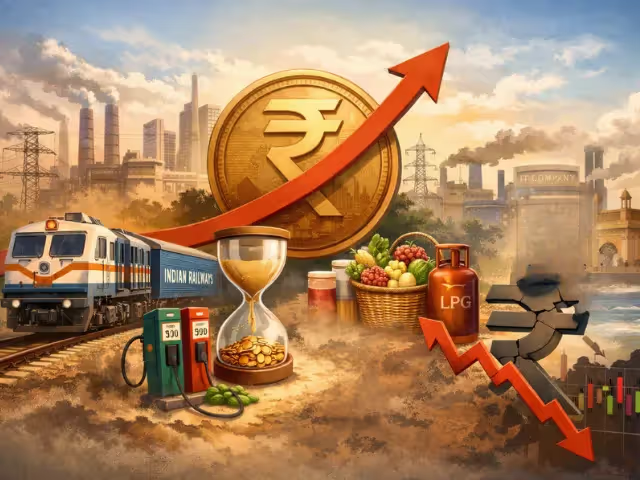
Indian Railways is more than just a transport utility. It is the backbone of India’s economic engine, moving over 20 million passengers and nearly 1.5 billion tonnes of freight annually. Any change in railway fares, even a marginal one, has a cascading impact across households, businesses, and financial markets.
A railway fare increase often sparks public debate, but from an economic and investment lens, it reflects deeper themes such as fiscal discipline, subsidy rationalisation, infrastructure funding, and inflation management. Let’s break down how a railway fare hike travels far beyond ticket counters and into the broader Indian economy.
Why Railway Fare Increases Happen
Indian Railways operates in a complex financial environment. Passenger fares have historically been kept low for social reasons, leading to heavy cross-subsidisation from freight revenues.
Some key reasons behind fare revisions include:
Rising Operational Costs
Fuel prices, employee salaries, maintenance expenses, and safety upgrades continue to rise. Indian Railways is one of the largest employers in the country, and wage revisions under Pay Commissions significantly impact its cost structure.
Capital Expenditure and Modernisation
Projects such as Vande Bharat trains, station redevelopment, dedicated freight corridors, and electrification require sustained capital inflows. Fare hikes help fund these long-term investments.
Reducing Dependence on Budgetary Support
The government has been gradually nudging PSUs, including Indian Railways, toward financial self-reliance. Rationalising fares reduces the fiscal burden on the exchequer.
Impact on Households and Consumers
For millions of middle-class and lower-income families, railways remain the most affordable mode of long-distance travel. Even small fare hikes can affect monthly budgets.
Urban and Migrant Workers
Daily and seasonal commuters feel the immediate pinch, especially those dependent on second-class and sleeper travel. This can reduce discretionary spending in other areas.
Inflationary Spillover
Higher passenger fares indirectly contribute to inflation, especially when combined with rising fuel and food prices. While rail fares have a lower weight in CPI compared to fuel, their indirect impact cannot be ignored.
Ripple Effect on Businesses and Supply Chains
Railways are critical to India’s logistics ecosystem, transporting coal, cement, steel, food grains, and fertilisers.
Higher Freight Costs
If freight charges rise alongside passenger fares, companies may pass on higher logistics costs to consumers. Sectors like FMCG, cement, power, and metals are particularly sensitive.
Margin Pressure on MSMEs
Small manufacturers and traders operating on thin margins may face profitability pressure if transportation costs rise faster than demand growth.
Export Competitiveness
India’s export competitiveness depends partly on efficient inland logistics. Persistent cost escalation can affect pricing power in global markets.
Impact on Indian Stock Markets
Railway fare hikes are closely tracked by equity markets, not because of the fare itself, but for what it signals.
Positive Signal for PSU Discipline
Markets often view fare rationalisation as a sign of improved financial discipline. This can be sentiment-positive for railway-linked PSUs and infrastructure companies.
Beneficiaries in the Long Term
Stocks related to rail manufacturing, EPC, signalling, and rolling stock may benefit if higher revenues translate into stronger capex execution.
Short-Term Consumption Concerns
On the flip side, sectors dependent on mass travel and discretionary spending, such as tourism or budget hospitality, may face near-term demand moderation.
Regulatory and Policy Context in India
Railway fares are influenced by broader policy objectives rather than pure commercial logic.
- Fare decisions are aligned with Union Budget priorities
- Political sensitivity often leads to gradual or selective increases
- Subsidies are increasingly targeted rather than universal
- Emphasis is shifting toward service quality, safety, and speed
This measured approach helps balance social welfare with fiscal sustainability.
What Should Investors Watch Going Forward
For investors, the real story is not the fare hike itself but what follows.
Execution of Capex Plans
Are higher revenues being reinvested into safety, capacity expansion, and efficiency improvements?
Freight Versus Passenger Mix
Sustained improvement in freight efficiency can stabilise railway finances without frequent passenger fare hikes.
Impact on Inflation and RBI Policy
Any meaningful inflationary pressure could influence monetary policy decisions, affecting interest-sensitive sectors.
Allied Industries
Cement, steel, logistics, and PSU banks financing rail projects are key areas to monitor.
Frequently Asked Questions
Does a railway fare increase directly increase inflation?
Not significantly on its own, but combined with higher freight costs, it can contribute indirectly to inflationary pressure.
Are railway fare hikes good or bad for the economy?
In the short term, they can strain consumers. In the long run, if revenues are invested efficiently, they support infrastructure growth and productivity.
Which sectors are most affected by railway fare increases?
Logistics-heavy sectors like FMCG, cement, steel, power, and tourism feel the impact the most.
Do railway fare hikes impact stock markets immediately?
Markets usually react to the broader policy signal rather than the fare hike itself. The impact is often indirect and sector-specific.
Conclusion: Turning Policy Signals Into Investment Opportunities
A railway fare increase may feel like a small change at the ticket window, but its economic footprint is far larger. It touches household budgets, corporate margins, inflation trends, and government finances. For investors, understanding these linkages is essential to making informed decisions rather than reacting to headlines.
At Swastika Investmart, our SEBI-registered research framework, advanced market tools, and investor education initiatives help you decode such macro developments and align them with your portfolio strategy. Whether it’s infrastructure themes, PSU opportunities, or inflation-linked trends, having the right insights at the right time makes all the difference.
Market Set-Up Today 22 December 2025: Nifty, Bank Nifty & Global Cues
Global Market Cues Setting the Tone
Overnight global markets provided a supportive backdrop for Indian equities.
US markets ended higher, with the Dow Jones gaining 183 points, reflecting continued risk appetite among global investors. Dow futures trading higher in early hours further reinforces positive sentiment.
Asian markets are trading on a positive note, indicating broad-based optimism across regions. The strongest indicator for Indian traders, GIFT Nifty, is up by 164 points, suggesting a firm to positive start for domestic benchmarks.
Such alignment between US markets, Asian peers, and GIFT Nifty typically leads to confident market openings unless disrupted by sudden macro news.
Institutional Flow Analysis and Market Impact
Institutional participation remains the backbone of the current market trend.
Foreign Institutional Investors bought shares worth ₹1,831 crore, while Domestic Institutional Investors added ₹5,723 crore. This results in a combined net inflow of ₹7,554 crore into the cash market.
When both FIIs and DIIs are net buyers, it signals strong conviction in market stability. Historically, such sessions often see:
- Reduced downside risk
- Better follow-through on breakouts
- Strength in index heavyweights and banking stocks
This flow data supports a continuation of the prevailing uptrend rather than a reversal.
Derivatives Data and Volatility Outlook
Derivatives indicators point toward a controlled bullish environment.
The Nifty Put Call Ratio has moved up to 1.13 from 0.83, indicating increased put writing activity. This suggests that traders are expecting the market to hold higher levels.
India VIX has cooled off to 9.71, down 1.32 percent. A low volatility environment generally supports trending moves and discourages aggressive short positions.
Together, rising PCR and falling VIX reflect confidence rather than complacency.
FII Positioning in Index Derivatives
FII data in index derivatives further strengthens the positive outlook.
There has been an increase in futures long positions and a reduction in futures shorts. On the options side, significant additions in put positions and reduction in call shorts indicate expectations of market stability with limited downside.
This type of positioning usually aligns with gradual upside moves rather than sharp spikes, making it favorable for positional traders.
Key Option Levels to Watch
Option data highlights important reference levels for today’s session.
The highest call open interest is placed at 26000, while the highest put open interest stands at 25900. The maximum pain level is around 25950.
This creates a crucial zone between 25950 and 26000. A sustained move above 26000 may lead to short covering, while holding above 25950 keeps the structure intact.
Technical Outlook for Nifty
Nifty is likely to open above its 20-day moving average near 26000, indicating a positive bias.
Immediate resistance is seen at 26100. A decisive move above this level can open the door for 26200 and 26300 in the near term.
On the downside, the 26000 to 25950 zone acts as immediate support. Below this, 25840 becomes the next important level to watch.
As long as Nifty holds above 25950, the trend remains favorable for buy-on-dips strategies.
Technical Outlook for Bank Nifty
Bank Nifty continues to outperform, trading above its 20-day moving average near 59275.
On the upside, 59600, 59800, and the psychological 60000 level are key targets. Support is placed at 59000, followed by a stronger base near 58700.
Strength in Bank Nifty often provides stability to the broader market, making it a key index to track during intraday and positional trades.
What This Means for Indian Market Participants
For intraday traders, dips toward support zones may offer buying opportunities with disciplined risk management.
Positional traders can continue to stay aligned with the trend while trailing stops near key support levels.
Long-term investors may use phases of consolidation to accumulate quality stocks, especially in sectors backed by institutional buying.
All market participation should remain aligned with SEBI guidelines and individual risk profiles.
Frequently Asked Questions
Is the market bullish today, 22 December 2025?
Yes, the overall set-up is positive, supported by global cues, institutional buying, and bullish derivatives data.
What are the key Nifty levels to watch today?
Immediate support lies between 25950 and 26000, while resistance is placed at 26100 and above.
Why is Bank Nifty important for today’s trade?
Bank Nifty is showing relative strength and often leads market direction, especially during trending sessions.
Does low India VIX favor traders?
Yes, low volatility supports trend-based strategies and reduces the risk of sharp intraday swings.
Conclusion and Investor Note
The market set-up for 22 December 2025 reflects a stable and confident environment driven by strong global cues, solid institutional flows, and supportive technical indicators. While short-term fluctuations are part of market behavior, the broader structure remains constructive.
For traders and investors looking for disciplined market participation, a research-backed approach is essential. Swastika Investmart, a SEBI-registered stockbroker, offers strong research insights, advanced trading platforms, and dedicated customer support to help investors navigate markets with confidence.

10 Must-Watch Movies and Books Every Stock Market Investor Should Know
Key Takeaways
- Stock market movies and books simplify complex market behaviour
- They teach investor psychology, risk management, and discipline
- Many stories mirror real Indian and global market events
- Learning through stories improves long-term investing mindset
- Combine knowledge with research-backed platforms for better decisions
Why Movies and Books Matter for Investors
Before listing the recommendations, it is important to understand why such content matters. Markets repeat patterns, but investors often do not learn fast enough. Movies and books capture these patterns in a way data cannot.
For Indian investors, especially post events like the Harshad Mehta scam, global financial crises, and recent retail market participation, understanding history and psychology is as important as understanding ratios.
SEBI has consistently emphasized investor education and risk awareness, and these stories complement formal learning by showing consequences of excess leverage, blind optimism, and herd mentality.
Must-Watch Stock Market Movies
The Big Short
This movie explains the 2008 global financial crisis through simple storytelling. It shows how a few investors spotted risks in mortgage-backed securities while the majority ignored warning signs.
Investor takeaway: When everyone believes a story, it is worth questioning it. Indian markets have seen similar optimism during small-cap and IPO booms.
Wall Street
A classic film that introduced the phrase “greed is good.” While fictional, it captures the emotional pull of quick money and insider culture.
Investor takeaway: Short-term gains without ethics or discipline often end badly, a lesson reinforced by several Indian market scams.
Margin Call
Set over 24 hours inside an investment bank, this movie focuses on risk management failures.
Investor takeaway: Risk ignored does not disappear. It compounds. Retail investors using leverage in derivatives can relate closely to this message.
Scam 1992: The Harshad Mehta Story
Though technically a series, it is essential viewing for Indian investors. It shows how loopholes, unchecked optimism, and blind trust can distort markets.
Investor takeaway: Regulation matters. SEBI’s current surveillance systems exist because of such episodes.
Inside Job
A documentary-style film that connects policy failures, rating agencies, and financial institutions.
Investor takeaway: Markets are part of a larger system. Understanding macro forces improves long-term investing decisions.
Must-Read Stock Market and Investing Books
The Intelligent Investor by Benjamin Graham
Often called the investor’s bible, this book focuses on value investing and margin of safety.
Investor takeaway: Price is what you pay, value is what you get. This principle remains relevant in Indian equity markets.
Common Stocks and Uncommon Profits by Philip Fisher
This book emphasizes qualitative analysis, management quality, and long-term growth.
Investor takeaway: Not all value lies in numbers. Many successful Indian companies rewarded investors who understood the business early.
One Up on Wall Street by Peter Lynch
Lynch explains how everyday observations can lead to great investments.
Investor takeaway: Retail investors often have informational advantages in products and services they use daily.
Rich Dad Poor Dad
While not strictly about the stock market, it reshapes how people think about money, assets, and cash flow.
Investor takeaway: Investing is about building assets, not just earning income.
Market Wizards by Jack D. Schwager
A collection of interviews with top traders across markets.
Investor takeaway: There is no single formula for success, but discipline, risk control, and consistency are common traits.
What Indian Investors Can Learn From These Stories
Indian markets today have higher retail participation than ever before. Easy access to trading apps has increased participation but also risk. Stories from movies and books highlight mistakes that repeat across geographies.
Key lessons include:
- Avoid leverage without understanding downside risk
- Do not chase momentum blindly
- Separate noise from fundamentals
- Respect regulations and disclosures
SEBI’s push toward investor awareness aligns closely with these lessons.
Turning Knowledge Into Action
Learning is only useful when applied correctly. Watching movies or reading books builds perspective, but execution requires discipline and reliable support.
This is where platforms like Swastika Investmart stand out. As a SEBI-registered brokerage, it combines:
- Strong research-driven insights
- Tech-enabled trading platforms
- Dedicated customer support
- Ongoing investor education initiatives
Such support systems help investors apply lessons learned from history to real market decisions.
Frequently Asked Questions
Are stock market movies useful for real investors?
Yes. They simplify complex concepts like bubbles, risk, and psychology, making them easier to remember and apply.
Which book should a beginner start with?
The Intelligent Investor is a strong starting point, followed by One Up on Wall Street for practical thinking.
Do these lessons apply to Indian markets?
Absolutely. Human behaviour, greed, and fear remain constant across markets, including India.
Can movies replace financial education?
No. They complement learning but should be combined with research, data, and regulatory awareness.
Final Thoughts
The stock market rewards patience, discipline, and understanding. Movies and books act as mirrors, reflecting mistakes and successes investors have already lived through. Learning from them helps avoid repeating history.
If you are ready to turn knowledge into action with research-backed insights and a trusted platform, consider starting your investing journey with Swastika Investmart.
%20(7)%20(3).avif)
Infosys ADR’s 50% Jump Explained: A Data-Feed Error, Not Fundamentals
Key Takeaways
- Infosys ADRs surged nearly 50% intraday on the NYSE before being halted
- No earnings update, guidance change, or corporate announcement triggered the move
- The spike was linked to a data-feed or pricing anomaly combined with low liquidity
- Indian-listed Infosys shares did not mirror the ADR move in a meaningful way
- The incident highlights why investors must separate price action from fundamentals
What Exactly Happened to Infosys ADR?
Infosys ADRs listed on the NYSE witnessed an unusually sharp intraday spike, at one point showing gains close to 50%. This triggered automatic volatility controls, leading to a temporary trading halt.
Such halts are not uncommon in US markets when price movements exceed predefined thresholds within a short time. What made this event stand out was the absence of any news that could justify such a dramatic re-rating of a large-cap IT stock.
Within hours, reports clarified that the move was not driven by business developments but by a technical anomaly related to market data and liquidity conditions.
Why This Was Not a Fundamentals-Driven Rally
No Corporate or Earnings Trigger
Infosys had not released earnings, revised guidance, announced a large deal, or disclosed any material event. Under Indian regulations, specifically SEBI’s Listing Obligations and Disclosure Requirements, any price-sensitive information must be promptly disclosed to exchanges. No such disclosure was made.
No Change in Sector Outlook
The Indian IT sector has been navigating a phase of cautious global tech spending, margin pressures, and slower deal ramp-ups. While long-term digital demand remains intact, there was no overnight shift that could justify a 50% jump in valuation.
Indian Market Price Action Told a Different Story
If fundamentals were truly at play, the impact would have reflected in Infosys shares on NSE and BSE. Instead, domestic shares remained largely stable, reinforcing that the ADR spike was an isolated overseas event.
Understanding the Real Cause: Data-Feed Error and Liquidity Issues
What Is a Data-Feed Error?
Market data feeds transmit real-time prices, volumes, and quotes to trading platforms. In rare cases, glitches, delayed updates, or erroneous prints can cause abnormal price displays. When combined with automated trading systems, this can exaggerate price moves.
Why ADRs Are More Vulnerable
ADRs often trade with lower volumes compared to their home-market shares. In such cases:
- A few aggressive trades can push prices sharply
- Algorithmic systems may amplify the move
- Bid-ask spreads can widen dramatically
This makes ADRs more susceptible to sudden spikes or drops unrelated to fundamentals.
Role of Volatility Halts
US exchanges use limit-up and limit-down mechanisms to pause trading during extreme moves. The Infosys ADR halt was a risk-control measure, not a confirmation of genuine price discovery.
Does This Impact Indian Investors?
Short-Term Impact on NSE and BSE
There was limited spillover into Indian markets. Professional investors and institutions quickly recognized the anomaly and avoided overreacting. Retail investors who track ADRs should note that overseas price distortions do not always translate to domestic valuations.
Sentiment vs Reality
While such events grab headlines, they rarely alter the intrinsic value of a fundamentally strong company. Infosys continues to be valued in India based on earnings visibility, deal pipeline, margins, and management commentary.
Regulatory Perspective in India
SEBI’s surveillance mechanisms and disclosure norms significantly reduce the chances of such unexplained spikes in Indian markets. This incident indirectly highlights the robustness of domestic market oversight compared to fragmented overseas trading in ADRs.
Key Lessons for Retail Investors
Price Action Is Not Always Information
A sharp move does not automatically mean insiders know something. Technical errors, low liquidity, or algorithmic trading can create noise.
Avoid Chasing Overnight Spikes
Entering trades purely based on unusual price action can expose investors to sharp reversals once normal trading resumes.
Focus on Fundamentals and Disclosures
Earnings quality, balance sheet strength, cash flows, and management guidance remain the real drivers of long-term returns.
How Disciplined Platforms Help Navigate Such Events
Market anomalies reinforce the importance of using research-backed, compliant platforms. Swastika Investmart, a SEBI-registered brokerage, focuses on:
- Strong in-house research across equities and derivatives
- Tech-enabled platforms with reliable market data
- Dedicated customer support during volatile sessions
- Continuous investor education to separate noise from signal
Such strengths help investors stay grounded when markets throw surprises.
Frequently Asked Questions
Was the Infosys ADR rally caused by a short squeeze?
No clear evidence suggests a classic short squeeze. The move was largely attributed to technical and data-related factors combined with thin liquidity.
Will Infosys shares in India eventually catch up to the ADR spike?
Unlikely. Since the move was not fundamentals-driven, Indian prices are expected to reflect business performance, not overseas anomalies.
Can such data-feed errors happen in Indian markets?
They are rare due to robust surveillance and disclosure norms enforced by SEBI, though no market is entirely immune to technical issues.
Should investors track ADR prices regularly?
ADR prices can offer global sentiment cues, but they should never be the sole basis for investment decisions in Indian-listed stocks.
Final Thoughts
The Infosys ADR 50% jump was dramatic but misleading. It serves as a reminder that not every big price move signals opportunity. For Indian investors, discipline, regulatory awareness, and fundamentals remain the best anchors in volatile markets.
If you want to invest with clarity, strong research support, and a platform built for long-term wealth creation, consider opening an account with Swastika Investmart.
%20(3).avif)
FII & DII Trading Activity on 19 December 2025: What It Signals for Indian Markets
Institutional investor activity often sets the tone for Indian stock markets, especially during phases of consolidation or heightened volatility. On 19 December 2025, trading data from NSE, BSE, and MSEI revealed a positive trend as both Foreign Institutional Investors (FIIs) and Domestic Institutional Investors (DIIs) ended the session as net buyers.
For retail investors and market participants, understanding this data goes beyond numbers. It offers insight into institutional confidence, liquidity trends, and potential market direction.
Understanding FII and DII Participation in Indian Markets
Role of Foreign Institutional Investors
FIIs, also referred to as FPIs under SEBI regulations, include global asset managers, pension funds, hedge funds, and sovereign wealth funds. Their investment decisions are influenced by global interest rates, currency movements, geopolitical developments, and relative valuation among emerging markets.
Historically, sustained FII inflows have played a key role in driving medium to long-term market rallies in India.
Role of Domestic Institutional Investors
DIIs consist of Indian mutual funds, insurance companies, banks, and pension funds. Unlike FIIs, DIIs tend to invest with a longer-term domestic outlook, focusing on economic growth, corporate earnings, and policy stability.
In recent years, DIIs have emerged as a stabilising force during periods of FII volatility.
FII & DII Trading Data Snapshot for 19 December 2025
According to official exchange data for 19 December 2025, institutional activity in the capital market segment showed the following trends:
DII Trading Activity on 19 December 2025
- Total Buy Value: ₹23,097.51 crore
- Total Sell Value: ₹17,374.62 crore
- Net Investment: ₹5,722.89 crore
Strong net buying by DIIs highlights sustained confidence in Indian equities and continued inflows from domestic mutual funds and insurance players.
FII Trading Activity on 19 December 2025
- Total Buy Value: ₹27,447.95 crore
- Total Sell Value: ₹25,617.06 crore
- Net Investment: ₹1,830.89 crore
The positive FII net flow, though moderate, signals a shift towards risk-on sentiment after recent cautious positioning.
What This Means for Indian Stock Markets
Domestic Institutions Providing Market Stability
The significant DII buying on 19 December 2025 reflects steady domestic participation. During periods of global uncertainty, domestic funds often step in to absorb selling pressure, helping stabilise benchmark indices such as Nifty 50 and Sensex.
This trend reinforces India’s growing domestic investor base and rising SIP inflows.
Improving Global Sentiment Reflected in FII Flows
While FII buying remained lower than DII inflows, the fact that foreign investors were net buyers is meaningful. It suggests improved confidence in India’s growth prospects amid expectations of stable interest rates and resilient corporate earnings.
Such gradual FII accumulation often precedes broader participation in select sectors.
How Retail Investors Can Use FII and DII Data
Market Timing and Sentiment Analysis
Tracking daily FII and DII activity helps investors gauge short-term market sentiment. When both institutional groups are net buyers, it often indicates a supportive environment for equities.
Sector-Level Opportunities
FIIs typically favour large-cap stocks, banking, IT, and capital-intensive sectors, while DIIs often focus on consumption, financials, and fundamentally strong mid-cap companies.
Understanding these patterns can help investors align their portfolios accordingly.
Regulatory Oversight and Transparency
Institutional trading activity in India is governed by SEBI, ensuring transparency and fair market practices. Daily FII and DII data published by exchanges allows investors to make informed decisions based on verified information.
Platforms like Swastika Investmart, a SEBI-registered broker, enable investors to track these trends using advanced research tools, expert insights, and real-time data.
Why Tracking Institutional Activity Matters More Than Ever
With increasing retail participation and global interconnectedness, institutional flows have become a key market indicator. The data from 19 December 2025 highlights how domestic strength and improving foreign sentiment can work together to support Indian markets.
For investors, the real edge lies in combining this data with strong research, disciplined investing, and the right trading platform.
Frequently Asked Questions
What was the FII net investment on 19 December 2025
FIIs recorded a net buying of ₹1,830.89 crore in the capital market segment.
Why is DII buying important for Indian markets
DII buying provides stability and reduces market volatility, especially during periods of global uncertainty.
Do positive FII flows guarantee a market rally
No. While positive flows indicate confidence, markets also depend on earnings, macroeconomic data, and global cues.
Where can investors track daily FII and DII data
Daily data is published by NSE and BSE and can be analysed using research tools available on platforms like Swastika Investmart.
Conclusion
The FII and DII trading activity on 19 December 2025 reflects a constructive outlook for Indian equities. Strong domestic participation combined with improving foreign sentiment suggests underlying market resilience.
For investors aiming to navigate markets with clarity and confidence, aligning decisions with institutional trends while using reliable research platforms can make a meaningful difference.
If you are looking for a SEBI-registered broker with powerful research tools, responsive customer support, and a technology-driven trading experience, Swastika Investmart offers a comprehensive solution for both new and experienced investors.

MUFG Enters Shriram Finance: What the 20% Stake Deal Means for Investors.
Key Takeaways
- MUFG’s 20% stake in Shriram Finance highlights global confidence in Indian NBFCs
- The deal strengthens Shriram Finance’s capital position, governance, and growth runway
- Foreign strategic investments often improve valuation comfort and long-term stability
- For investors, the focus should be on execution, asset quality, and growth sustainability
Introduction: A Landmark Deal in Indian Financial Markets
When a global banking giant takes a meaningful stake in an Indian financial company, markets pay attention. MUFG Bank’s decision to acquire around a 20% stake in Shriram Finance is one such development that has sparked interest across Dalal Street.
This is not just another foreign investment headline. It reflects growing global confidence in India’s financial system, the non-banking finance company space, and Shriram Finance’s business model. For investors, the key question is simple: what does this deal really mean for future returns and risk?
Understanding the MUFG and Shriram Finance Deal
Mitsubishi UFJ Financial Group, Japan’s largest financial group, is known for its conservative approach and long-term investments. Its entry into Shriram Finance is strategic rather than speculative.
Shriram Finance is a major player in retail lending, with strong exposure to commercial vehicle finance, MSME loans, and rural-focused credit. Over the years, it has built deep distribution networks in semi-urban and rural India.
A 20% stake is significant. It gives MUFG meaningful influence without taking over operational control. This signals partnership, not disruption.
Why This Deal Matters in the Current Market Context
Global Capital Is Becoming Selective
In a high interest rate and volatile global environment, foreign institutions are cautious. Capital flows into emerging markets are increasingly selective, favoring companies with strong governance, scalable models, and consistent asset quality.
MUFG’s entry suggests Shriram Finance meets these criteria.
Confidence in India’s NBFC Sector
Indian NBFCs went through a tough phase after liquidity stress and tighter regulations. Over time, stronger players adapted by improving balance sheets, tightening credit underwriting, and aligning closely with RBI norms.
This deal reinforces the view that the sector has matured.
What MUFG Brings to the Table
Stronger Capital and Funding Stability
A global partner improves funding confidence. It can help Shriram Finance diversify borrowing sources and potentially reduce long-term funding costs.
Lower funding costs, even marginally, can support net interest margins in a competitive lending environment.
Governance and Risk Management
Global banks operate under strict regulatory and risk frameworks. MUFG’s presence can strengthen internal controls, risk monitoring, and compliance processes.
For long-term investors, this reduces tail risks rather than boosting short-term profits.
Long-Term Growth Alignment
MUFG has deep experience in Asia-focused financial services. This alignment supports sustainable growth rather than aggressive expansion, which markets increasingly reward.
Market Reaction and Investor Sentiment
Historically, Indian stocks that attract strategic foreign investors tend to see improved valuation comfort over time. The immediate stock price reaction may vary, depending on broader market conditions, but the long-term narrative often improves.
Investors usually reassess such companies on three parameters:
- Earnings quality
- Balance sheet strength
- Management credibility
Shriram Finance already had a strong base in these areas. The MUFG stake further strengthens investor confidence.
Regulatory Perspective in India
The Reserve Bank of India and SEBI have consistently pushed for better governance, capital adequacy, and transparency in financial institutions.
Foreign strategic investments undergo regulatory scrutiny, ensuring alignment with Indian laws and financial stability norms. This deal fits well within India’s broader push for stable and well-capitalized financial intermediaries.
For investors, regulatory clearance itself acts as a quality filter.
What Investors Should Track Going Forward
The deal is a positive signal, but investing decisions should not rely on headlines alone.
Key factors to monitor include:
- Asset quality trends, especially in commercial vehicle and MSME lending
- Loan growth versus credit costs
- Capital adequacy and return ratios
- Management commentary on partnership benefits
Long-term wealth creation comes from consistent execution, not one-time events.
How Swastika Investmart Helps Investors Decode Such Deals
Understanding complex stake deals requires more than surface-level news. Investors benefit from structured research, sector comparisons, and risk analysis.
Swastika Investmart, a SEBI-registered brokerage, supports investors with:
- In-depth fundamental research on financial stocks
- Tech-enabled platforms for tracking portfolio exposure
- Strong customer support and investor education initiatives
Such tools help investors separate long-term opportunity from short-term noise.
Frequently Asked Questions
Why did MUFG choose Shriram Finance?
Shriram Finance has a strong retail lending franchise, deep rural reach, and improving governance, making it attractive for a long-term strategic partner.
Does a 20% stake mean MUFG controls the company?
No. It provides influence and partnership benefits without operational control.
Is this positive for existing shareholders?
Generally yes, as it improves capital strength, governance confidence, and long-term growth visibility.
Will this immediately boost profits?
Not immediately. The benefits are structural and long-term rather than short-term earnings jumps.
Conclusion: A Strategic Signal, Not Just a Stock Trigger
MUFG’s entry into Shriram Finance is a strong vote of confidence in Indian financial markets and the NBFC sector’s evolution. For investors, it reinforces the importance of quality, governance, and long-term partnerships.
While the deal strengthens the investment case, returns will ultimately depend on execution and market conditions. Investors looking to analyze such opportunities with clarity can benefit from research-backed platforms like Swastika Investmart.
If you want to track high-impact deals and make informed investment decisions, consider opening an account with Swastika Investmart and access structured insights designed for Indian markets.

AI in Demat Accounts | How Technology Simplifies Investing (2025)
Key Takeaways
- AI now powers personalized insights, better recommendations, and smart-portfolio alerts in Demat accounts.
- Tools like predictive analytics and voice-based trading simplify investing for all.
- Swastika Investmart integrates AI for smarter, SEBI-compliant investing.
- The future of Demat accounts: intuitive, automated, and investor-centric.
Introduction: The New Era of Smart Investing
A Demat account is the foundation of every investor’s journey. It holds your shares, mutual funds, ETFs, and bonds electronically.
But in 2025, the Demat ecosystem is no longer just a digital locker.
It’s an intelligent investment hub, powered by Artificial Intelligence (AI) that simplifies decision-making, enhances security, and personalizes your experience.
Let’s explore how AI is reshaping Demat accounts in India and why brokers like Swastika Investmart are at the forefront of this evolution.
1️⃣ The Evolution of the Demat Account
When SEBI introduced Dematerialization in the late 1990s, the goal was simply to eliminate paper certificates.
Today, the purpose has evolved to empowering investors with automation, real-time analytics, and seamless integration with trading and banking systems.
2️⃣ How AI Is Transforming Demat Accounts
(a) Personalized Investment Insights
AI algorithms analyze your investment history, goals, and risk profile to recommend stocks, ETFs, or mutual funds.
You get custom watchlists, auto alerts, and insights like:
- “This stock fits your portfolio style”
- “Your mutual fund allocation is equity-heavy rebalance suggested”
Platforms like Swastika Investmart use AI-driven insight engines built on real trading data to guide investors more effectively.
(b) Fraud Detection & Security
AI models monitor trading patterns, device fingerprints, and location mismatches to instantly flag suspicious activity.
SEBI has encouraged such innovations to prevent unauthorized transactions or phishing.
Example:
If your Demat account logs in from two cities within an hour, the system flags it for verification powered by AI anomaly detection.
(c) Voice & Chat-Based Investing
In 2025, investing is becoming conversational.
AI assistants let you trade using voice commands:
“Buy 10 shares of HDFC Bank” or “Show my mutual fund returns.”
These are integrated into trading apps via NLP (Natural Language Processing) , the same technology behind modern chatbots like ChatGPT.
Swastika Investmart assists you with multi-language AI chatbots to support investors in English, Hindi, and regional languages.
(d) Predictive Market Analytics
AI-powered Demat platforms analyze real-time market data, Open Interest (OI), and news sentiment to forecast trends.
Example:
If data shows rising OI in Gold ETFs and AI sentiment analysis detects positive commodity outlook, the system suggests a sectoral opportunity.
These predictive insights help traders plan entries and exits more efficiently no need to read 20 reports.
(e) Auto Portfolio Rebalancing
AI-driven systems track your asset allocation and automatically rebalance it based on:
- Market volatility
- Goal completion progress
- Risk tolerance changes
So if your equity exposure rises beyond 70%, AI might suggest shifting some funds into debt or gold ETFs maintaining balance without manual effort.
3️⃣ The Benefits of AI in Demat Accounts
AI bridges the gap between information overload and actionable insight, helping retail investors make smarter, faster, and safer investment decisions.
4️⃣ Swastika Investmart: Leading the AI Revolution in Investing
As one of India’s trusted SEBI-registered brokers, Swastika Investmart combines human research excellence with AI-backed analytics.
What sets Swastika apart:
- AI-powered insights & nudges for stocks and funds
- Automated risk scoring & behavioral analysis for traders
- Smart dashboards showing OI trends, market sentiment, and capital allocation
- Strict SEBI and NSDL/CDSL compliance for Demat security
5️⃣ The SEBI & Regulatory Perspective
The Securities and Exchange Board of India (SEBI) encourages brokers to adopt RegTech and AI compliance frameworks to improve:
- KYC verification efficiency
- Transaction monitoring
- Investor grievance redressal
AI ensures these systems are proactive, not reactive, reducing human error and improving investor protection.
FAQs
1. How does AI make Demat accounts smarter?
AI automates insights, alerts, and portfolio management saving time and improving accuracy for investors.
2. Is it safe to use AI-based Demat apps?
Yes, as long as they are SEBI-registered and NSDL/CDSL-linked like Swastika Investmart, which follows strict encryption and compliance.
3. Can AI replace human advisors?
AI enhances human advice; it provides data-backed insights, but experienced financial advisors still guide emotion and judgment.
4. What’s next for AI in investing?
Expect voice-enabled trading, personalized robo-advisory, and AI-driven tax optimization by 2026.
5. Does Swastika Investmart offer AI-based investing tools?
Yes, Swastika integrates AI in its research, trading platform, and customer dashboards for intelligent investing and portfolio management.
Conclusion
The integration of AI in Demat accounts marks a new chapter in India’s investing journey, one defined by personalization, protection, and precision.
With AI-driven insights, investors no longer need to spend hours analyzing markets your Demat account itself becomes your intelligent financial partner.
As pioneers in this transformation, Swastika Investmart continues to merge AI, research, and SEBI compliance, ensuring every investor enjoys the future of smart investing today.
AI doesn’t replace intelligence, it amplifies it. And your Demat account just got smarter.

Nifty’s Top 5 Gainers & Losers of the Last One Year: What Drove the Extremes? Copy
Key Takeaways
• Financials, autos, and defence stocks dominated the gainers list
• IT stocks clearly underperformed and dragged the losers pack
• Sectoral rotation played a bigger role than overall market direction
• Stock-specific fundamentals mattered more than index movement
Nifty’s Top 5 Gainers & Losers of the Last One Year: What Drove the Extremes?
The last one year in the Indian equity markets has been a perfect example of how stock selection can make or break returns. While Nifty moved higher in phases, individual stocks showed extreme divergence. Some stocks delivered near 50 percent returns, while others corrected sharply despite being index heavyweights.
This sharp contrast makes it important to study Nifty’s top 5 gainers and losers of the last one year and understand what actually drove these moves. The insights are especially relevant for retail investors who often assume index stocks move together.
The Bigger Market Context
Indian markets over the past year saw a mix of strong domestic growth, sector rotation, and changing global cues. Capital flowed into sectors linked to consumption, defence, and financial services, while export-oriented IT stocks faced pressure.
What stood out was that leadership changed within the index itself. Defensive names struggled, while growth-focused businesses rewarded investors handsomely.
Nifty’s Top 5 Gainers of the Last One Year
Bajaj Finance Ltd
Bajaj Finance moved from around 694 to over 1009, delivering a return of about 45 percent. The stock benefited from consistent performance in retail lending, improving asset quality, and strong investor confidence in the NBFC space.
As credit demand stayed healthy and risk concerns eased, investors were willing to pay a premium for predictable growth.
Maruti Suzuki India Ltd
Maruti Suzuki surged roughly 46 percent over the year, rising from about 11209 to 16377. Strong demand for passenger vehicles, better product mix, and improved margins helped the stock outperform.
The rally highlighted how consumption-led themes continued to attract long-term investors despite concerns around input costs.
Shriram Finance Ltd
Shriram Finance delivered close to 47 percent returns, moving from about 583 to nearly 859. The company gained from robust demand in the commercial vehicle financing space and improving profitability metrics.
This performance underlined the market’s preference for well-managed lenders with niche dominance.
Eicher Motors Ltd
Eicher Motors also rose around 47 percent, climbing from approximately 4885 to 7190. Strong Royal Enfield sales, improving exports, and operating leverage played a major role.
The stock reflected how brand strength and execution can drive rerating even in a competitive auto market.
Bharat Electronics Ltd
Bharat Electronics gained about 33 percent, moving from around 294 to 390. The stock benefited from steady defence-related orders and positive sentiment towards indigenous manufacturing.
This performance showed how policy-driven sectors can generate stable returns during uncertain global conditions.
What Drove the Gainers?
The common thread among gainers was earnings visibility and sectoral tailwinds. Financials benefited from credit growth, autos from domestic demand, and defence from structural government support.
Importantly, these stocks rewarded patience rather than short-term trading.
Nifty’s Top 5 Losers of the Last One Year
Trent Ltd
Trent was the biggest loser, falling nearly 43 percent from around 7068 to 4032. After strong previous rallies, the stock saw profit booking and valuation correction.
This highlighted how even quality retail stories can correct sharply when expectations run too far ahead.
Tata Consultancy Services
TCS declined about 19.5 percent, dropping from roughly 4112 to 3311. Slower global IT spending and cautious client outlook impacted the stock.
Despite being a market leader, sentiment turned negative as growth visibility weakened.
Infosys Ltd
Infosys fell around 12.4 percent over the year, moving from about 1883 to 1649. Deal delays and margin concerns weighed on investor confidence.
The correction showed that size does not guarantee downside protection.
HCL Technologies Ltd
HCL Tech declined nearly 13.9 percent, from around 1912 to 1646. Pressure on discretionary tech spending and sector-wide concerns played a role.
Wipro Ltd
Wipro slipped close to 11.8 percent, falling from about 300 to 265. Weak revenue growth outlook kept the stock under pressure.
Why IT Stocks Underperformed
The IT sector faced multiple headwinds. Global clients cut discretionary budgets, deal closures slowed, and currency benefits failed to offset growth concerns.
This resulted in a clear underperformance of IT stocks within Nifty, despite their heavyweight status.
Impact on Indian Investors
For investors, this one-year period reinforced a key lesson. Index investing provides stability, but alpha comes from understanding sector cycles and company fundamentals.
The divergence between gainers and losers also highlighted why risk management and portfolio diversification are critical.
The Role of Research in Navigating Extremes
When markets show such sharp contrasts, relying on headlines alone can be costly. Research-driven investing helps identify when momentum is backed by fundamentals and when corrections are driven by structural issues.
Swastika Investmart, a SEBI-registered brokerage, supports investors with strong research tools, sector insights, and technology-driven platforms. Their focus on investor education and responsive customer support helps investors stay disciplined during volatile phases.
Common Questions Investors Ask
Why did financial stocks outperform the market?
Financial stocks benefited from strong credit demand, improving balance sheets, and better earnings visibility.
Why did IT stocks fall despite being large companies?
Slower global spending and weak growth outlook impacted sentiment across the IT sector.
Does one year performance decide long-term potential?
No. One-year performance reflects cycles. Long-term returns depend on consistent fundamentals.
Should investors avoid underperforming stocks?
Not necessarily. Some corrections create opportunities, but only after proper analysis.
How can retail investors manage such market extremes?
By diversifying portfolios, tracking fundamentals, and using research-backed platforms.
Final Thoughts
Nifty’s top 5 gainers and losers of the last one year clearly show that markets reward clarity and punish uncertainty. Sector rotation, earnings visibility, and valuations played a bigger role than overall index movement.
For investors, the takeaway is simple. Stay informed, stay selective, and stay disciplined.
If you want to invest with structured research, smart tools, and professional support, consider Swastika Investmart.

How Different Indian Stock Market Indices Behaved This Year — and What Investors Should Learn
Key Takeaways
• Large-cap indices showed relative stability while mid and small caps saw sharper swings
• Sector-specific indices reflected clear rotation during the year
• Broader markets rewarded selective stock picking, not blanket investing
• Index behaviour highlights the importance of asset allocation and discipline
How Different Indian Stock Market Indices Behaved This Year and What Investors Should Learn
The Indian stock market rarely moves in a straight line, and this year was a clear reminder of that reality. While headline indices often grab attention, a closer look shows that different indices behaved very differently. Some rewarded patience, others tested investor nerves, and a few quietly outperformed without much noise.
Understanding how Indian stock market indices behaved this year is not just an academic exercise. It offers practical lessons for investors on diversification, risk management, and expectations. Let us break it down in a simple, investor-friendly way.
The Broader Market Environment This Year
This year was shaped by a mix of domestic strength and global uncertainty. India’s economy remained resilient, supported by consumption, government spending, and stable banking health. At the same time, global cues like interest rate uncertainty and uneven growth kept volatility alive.
Against this backdrop, Indian indices did not move in sync. Performance depended heavily on market capitalisation, sector exposure, and earnings visibility.
How Large Cap Indices Behaved
Nifty and Sensex Performance Trend
Large-cap indices like Nifty and Sensex showed relatively steady movement through the year. While there were periods of correction, sharp crashes were largely avoided.
This stability came from strong balance sheets, predictable earnings, and leadership from sectors like financials, autos, and select industrials. For many long-term investors, large-cap indices acted as shock absorbers during volatile phases.
What Investors Can Learn
Large-cap indices may not always deliver eye-catching returns in a single year, but they provide consistency. Investors relying on these indices for core portfolio allocation benefited from lower volatility and smoother returns.
Midcap Indices Told a Different Story
Strong Phases Followed by Sharp Corrections
Midcap indices experienced higher volatility compared to large caps. There were phases of strong rallies driven by earnings optimism and liquidity flows. However, these rallies were often followed by sharp corrections when valuations stretched.
This behaviour reminded investors that midcaps amplify both opportunity and risk.
Key Lesson for Investors
Midcap exposure needs discipline. Chasing momentum without valuation comfort proved costly for some investors. Those who focused on quality midcap businesses with earnings visibility fared better.
Small Cap Indices and Investor Sentiment
High Risk High Reward in Action
Small cap indices showed the widest swings this year. Periods of strong optimism were followed by equally strong sell-offs. Liquidity-driven moves played a major role, making price action more emotional than fundamental at times.
Retail participation was high, which added to volatility.
What This Means for Retail Investors
Small caps demand patience and strong research. Blind diversification within small caps did not work. Investors who treated small caps as long-term bets rather than quick trades managed risk better.
Sectoral Indices Reflected Clear Rotation
Financial and Auto Indices
Financial and auto-related indices showed relative strength during the year. Stable demand, improving margins, and regulatory comfort supported these sectors.
Banks and NBFCs benefited from credit growth and healthy balance sheets, while auto companies gained from steady domestic consumption.
IT and Defensive Sectors
IT indices faced pressure due to global demand slowdown and cautious client spending. Defensive sectors also underperformed in phases when risk appetite improved.
This divergence highlighted how sector cycles matter as much as overall market direction.
What Index Behaviour Says About Market Structure
One key takeaway from this year is that Indian markets are becoming more selective. Index-level movement no longer tells the full story.
SEBI’s continuous focus on transparency, governance, and investor protection has strengthened market depth. As a result, stock-specific fundamentals are playing a bigger role than broad market sentiment.
For investors, this means passive investing alone may not capture all opportunities.
Practical Lessons for Investors
Asset Allocation Matters
Different indices serve different purposes. Large caps provide stability, midcaps offer growth, and small caps add optional upside. A balanced allocation helps smooth returns across cycles.
Index Performance Is Not Portfolio Performance
Many investors assume index returns reflect their portfolio returns. This year showed that stock selection within indices can lead to very different outcomes.
Research Is No Longer Optional
With divergence across indices and sectors, research-backed investing becomes critical. Understanding earnings quality, valuations, and sector trends helps avoid emotional decisions.
Why a Research-Driven Platform Makes a Difference
In a market where indices move differently, investors need more than basic tools. They need insights, timely analysis, and guidance.
Swastika Investmart, a SEBI-registered brokerage, supports investors with strong research capabilities, tech-enabled trading platforms, and a focus on investor education. Their customer support and analytical tools help investors interpret market trends rather than react to them.
Whether you are tracking index performance or building a diversified portfolio, access to reliable research adds confidence.
Common Questions Investors Ask
Why do different indices behave differently in the same year?
Because each index represents a different set of companies, sectors, and risk profiles.
Is investing only in Nifty enough?
Nifty provides stability, but combining it with selective mid and small-cap exposure can improve long-term returns.
Are sectoral indices useful for retail investors?
Yes, they help understand sector trends, but direct investing requires timing and research.
Does volatility mean markets are weak?
Not necessarily. Volatility often reflects changing expectations rather than poor fundamentals.
How should new investors use index data?
As a guide for allocation and risk understanding, not as the sole basis for stock selection.
Final Thoughts
This year clearly showed that Indian stock market indices do not move as one. Each index told a different story, shaped by fundamentals, liquidity, and investor behaviour.
For investors, the lesson is simple. Respect market cycles, diversify wisely, and rely on research rather than noise.
If you are looking to invest with clarity, technology, and professional research support, consider Swastika Investmart.
%20(2).avif)
Market Closing Update for 24 December 2025: Nifty 50 & Bank Nifty End Lower
Indian equity markets ended the session on 24 December 2025 on a weak note, giving up intraday gains amid profit booking and cautious sentiment across sectors.
Despite a stable start and a positive mid-day move on 24 December 2025, benchmark indices failed to sustain higher levels and slipped into negative territory by the closing bell.
How the Market Opened on 24 December 2025
The market began the day on 24 December 2025 with a mixed opening, reflecting cautious global cues and selective stock action.
• Nifty 50 opened at 26,170.65, marginally lower by 0.02 percent
• Bank Nifty opened at 59,322.95, up 0.04 percent
Early trade saw limited momentum as investors remained watchful amid global and domestic cues.
Mid-Day Market Performance on 24 December 2025
By mid-session on 24 December 2025, markets showed signs of recovery supported by buying interest in select heavyweight stocks.
• Nifty 50 traded at 26,189.80, up 0.05 percent
• Bank Nifty traded at 59,316.70, up 0.03 percent
The recovery was driven by short covering and selective accumulation, though volumes remained moderate.
Market Closing Update for 24 December 2025
As the session progressed on 24 December 2025, selling pressure emerged at higher levels, leading to a reversal in benchmark indices.
• Nifty 50 closed at 26,142.10, down 0.13 percent
• Nifty Bank closed at 59,183.60, down 0.20 percent
Late-session profit booking in banking and heavyweight stocks weighed on overall market sentiment.
What Weighed on the Market on 24 December 2025?
Several factors influenced market movement on 24 December 2025:
• Profit booking after recent gains
• Lack of strong global cues
• Cautious positioning ahead of upcoming macro events
• Stock-specific selling in banking and frontline stocks
Despite intraday recovery, markets lacked fresh triggers to sustain upward momentum.
Sectoral Overview on 24 December 2025
Sector performance remained mixed throughout the session:
• Banking stocks saw mild selling pressure
• IT stocks traded cautiously
• FMCG remained relatively stable
• Auto and metal stocks witnessed selective activity
Broader markets also traded with mild volatility, indicating cautious participation.
Market Outlook Going Forward
The market continues to consolidate near higher levels after the session on 24 December 2025. While the long-term structure remains intact, short-term volatility may persist.
Key factors to watch in upcoming sessions include:
• Global market trends
• FII and DII activity
• Movement in banking and heavyweight stocks
• Key technical support and resistance levels
How Swastika Investmart Helps You Navigate Market Volatility
Swastika Investmart supports traders and investors with:
• Real-time market insights
• Research-backed trading views
• Advanced, tech-enabled trading platforms
• Dedicated customer support
Our SEBI-compliant approach ensures informed and disciplined decision-making across market conditions.
The trading session on 24 December 2025 highlighted the importance of caution at higher levels. Despite intraday recovery, benchmark indices closed lower due to profit booking.
As markets consolidate, a stock-specific and risk-managed approach remains key.
Market Closing Today 19 December 2025: Bulls Hold Control
Indian equity markets closed on a positive note on Friday, 19 December 2025, extending their upward momentum for the second consecutive session. Buying interest across banking, financials, and select heavyweight stocks helped benchmark indices end near the day’s highs.
The overall tone of the market remained optimistic, supported by stable global cues, steady institutional participation, and expectations of continued economic growth in India.
Indian Stock Market Closing Snapshot
At the closing bell, benchmark indices posted healthy gains:
- BSE Sensex closed at 84,929.36, up 447.55 points or 0.53 percent
- Nifty 50 ended at 25,966.40, gaining 150.85 points or 0.58 percent
- Bank Nifty settled at 59,069.20, up 156.35 points or 0.27 percent
Markets opened on a firm note and gradually moved higher as buying interest picked up during the mid-session, especially in banking and large-cap stocks.
How the Market Traded Through the Day
Morning Session Overview
The session began with cautious optimism. Early trade saw Nifty 50 hovering around 25,911, while Bank Nifty traded near 59,047. Gradual accumulation by institutional investors helped indices inch higher.
Mid-Session Stability
By mid-session, markets consolidated gains without major profit booking. This phase reflected confidence among participants despite year-end volatility typically seen in December.
Closing Hour Strength
In the final hour, fresh buying lifted indices to close near the day’s highs. Nifty 50 traded around 25,957, while Bank Nifty crossed 59,020, confirming strong intraday support levels.
Sector Performance and Market Breadth
Banking and Financials Lead
Banking stocks remained the backbone of today’s rally. Private sector banks and select PSU banks attracted buying interest, supporting Bank Nifty’s steady performance near record territory.
Large-Cap Stocks Provide Stability
Heavyweights across FMCG, IT, and capital goods sectors contributed to market stability. Investors preferred quality large-cap stocks amid ongoing global uncertainties.
Broader Markets Stay Positive
Mid-cap and small-cap stocks traded with a positive bias, indicating healthy risk appetite. Market breadth favored advancers, suggesting broad-based participation rather than a narrow rally.
What Drove Today’s Market Momentum
Several factors influenced the positive close:
- Stable global market cues and controlled volatility
- Continued domestic institutional buying support
- Optimism around India’s economic outlook going into 2026
- Expectations of supportive monetary policy from the RBI
With inflation largely under control and corporate earnings visibility improving, investor confidence remains intact.
Impact on Indian Investors and Traders
For short-term traders, today’s close above key levels reinforces a positive trend, especially in banking and index heavyweights.
For long-term investors, the steady rise reflects confidence in India’s growth story. Phased investing and disciplined allocation continue to remain sensible strategies in current market conditions.
SEBI-regulated market frameworks and transparent disclosures continue to strengthen trust among retail investors participating through digital platforms.
How Swastika Investmart Helps Investors Navigate Markets
In markets like today, where momentum builds gradually, having access to reliable research and real-time insights becomes crucial.
Swastika Investmart, a SEBI-registered stockbroker, supports investors through:
- Research-backed market insights
- Advanced trading and investment tools
- Dedicated customer support
- Tech-enabled platforms for seamless investing
- Investor education initiatives for beginners and seasoned traders
This combination helps investors make informed decisions rather than emotional ones.
👉 Open your trading and investment account with Swastika Investmart
Frequently Asked Questions
Why did the Indian stock market close higher today?
Positive global cues, banking sector strength, and steady institutional buying helped markets end higher.
What was the closing level of Nifty 50 today?
Nifty 50 closed at 25,966.40 on 19 December 2025.
How did Bank Nifty perform today?
Bank Nifty ended at 59,069.20, maintaining strength near record levels.
Is the market trend bullish after today’s close?
The trend remains positive, but investors should stay cautious of short-term volatility.
Should investors enter the market at current levels?
A staggered investment approach with proper research is generally advisable.
Conclusion
The market closing today on 19 December 2025 reflects sustained optimism in Indian equities. With Nifty, Sensex, and Bank Nifty holding strong levels, sentiment remains constructive heading into the final trading days of the year.
For investors looking to participate confidently in India’s growth journey, combining disciplined strategies with expert research is key.
👉 Open your trading and investment account with Swastika Investmart
Invest smart. Invest informed.

ANTI-AI Trade: Will Indian IT Companies Be an Anti-AI Trade in 2026?
Key Takeaways
- AI is disrupting global IT services, but it may not fully replace Indian IT firms.
- Indian IT could emerge as an anti-AI trade if cost efficiency and regulation matter more.
- Valuations, client budgets, and AI adoption pace will decide 2026 outcomes.
- Selective stock picking and research-driven investing will be crucial.
ANTI-AI Trade: Will Indian IT Companies Be an Anti-AI Trade in 2026?
Artificial Intelligence has become the most talked-about force in global markets. From Silicon Valley to Dalal Street, investors are debating one big question. Will AI reduce the need for traditional IT services or will it create a new wave of demand? Against this backdrop, a fresh theme is gaining attention. The anti-AI trade.
In simple terms, an anti-AI trade means betting on sectors that may benefit if AI adoption is slower, regulated, or more expensive than expected. For Indian investors, this brings Indian IT companies into sharp focus. By 2026, could Indian IT stocks act as a hedge against overhyped AI narratives?
Let us break this down in a practical, market-focused way.
Understanding the Anti-AI Trade in Simple Words
AI promises automation, faster coding, and lower costs. Global tech giants are investing billions to reduce dependence on large human workforces. At first glance, this looks negative for IT services companies.
But markets often move in cycles. When expectations run too far ahead of reality, counter-trends emerge.
An anti-AI trade assumes three possibilities.
First, AI implementation is slower than expected due to regulatory and ethical constraints.
Second, AI raises costs instead of reducing them, especially for enterprise clients.
Third, businesses still need humans to manage, customise, and secure AI systems.
If any of these play out, traditional IT services could regain relevance.
Where Indian IT Stands Today
Indian IT companies like TCS, Infosys, Wipro, HCLTech, and Tech Mahindra are deeply integrated into global enterprise systems. They are not just coding shops anymore.
They handle legacy system maintenance, cloud migration, cybersecurity, compliance, and now AI integration itself.
For example, a large US bank may experiment with AI-driven customer support. But it still needs an Indian IT firm to integrate AI with its core banking systems, ensure data privacy, and meet regulatory norms. AI does not work in isolation.
This is where Indian IT’s real strength lies.
Why Indian IT Could Emerge as an Anti-AI Trade by 2026
Cost Advantage Still Matters
Despite AI tools, global companies remain cost-sensitive. Indian IT offers scalable talent at competitive costs. Even if AI reduces coding time, enterprises still prefer outsourcing execution and maintenance.
In a slow global growth environment, CFOs focus on cost control. That directly supports Indian IT spending.
Regulation Could Slow AI Adoption
India, the EU, and even the US are discussing stricter AI regulations. Data privacy laws, sector-specific compliance, and accountability frameworks can slow full-scale AI rollout.
Indian IT firms already operate in regulated environments like BFSI and healthcare. They understand compliance better than pure AI startups.
If regulation tightens, enterprises may rely more on trusted IT vendors instead of experimenting aggressively.
AI Needs Human Oversight
AI-generated code still needs validation, testing, and security checks. Enterprises cannot risk mission-critical systems on unchecked automation.
Indian IT companies are positioning themselves as AI partners rather than AI victims. Many are training employees to work alongside AI tools, not against them.
This hybrid model could support stable revenue growth.
The Bear Case: Risks Investors Should Not Ignore
A balanced view is important.
If AI tools become extremely efficient and easy to deploy, some low-end IT services may face pricing pressure. Margins could compress if companies fail to move up the value chain.
Also, large global clients may delay discretionary IT spending during economic uncertainty. This affects short-term revenue visibility.
Hence, Indian IT as an anti-AI trade is not a blanket bet. It is a selective opportunity.
Impact on Indian Markets and Investor Sentiment
Indian IT stocks have historically acted as defensives during global slowdowns. In 2026, if AI-led tech stocks correct globally due to high expectations, Indian IT could attract value-focused investors.
Domestic mutual funds, FIIs, and long-term investors may rotate into predictable cash-flow businesses. SEBI’s emphasis on transparency and governance also adds comfort for institutional investors.
This does not mean explosive rallies. Instead, steady returns, dividend yield, and lower volatility could be the appeal.
How Retail Investors Should Approach This Theme
Instead of chasing headlines, investors should focus on fundamentals.
Look for companies with strong client diversification, high deal wins, and clear AI strategy. Track order books, attrition trends, and management commentary.
This is where research-backed platforms make a difference.
Why Research Matters More Than Ever
In theme-based investing like the anti-AI trade, timing and stock selection are crucial. Blind optimism or fear can hurt returns.
Swastika Investmart, a SEBI-registered brokerage, stands out with its strong research ecosystem, tech-enabled platforms, and investor education focus. Their detailed reports, sector insights, and responsive customer support help investors navigate evolving market themes with clarity.
Whether you are a long-term investor or a short-term trader, access to reliable research tools can help separate noise from opportunity.
FAQs
Is AI a threat to Indian IT companies?
AI is more of a transformation tool than a direct threat. Indian IT firms are adapting by offering AI integration and management services.
What does anti-AI trade mean for investors?
It refers to investing in sectors that may benefit if AI adoption is slower or less disruptive than expected.
Can Indian IT stocks perform well by 2026?
Yes, especially companies with strong fundamentals, diversified clients, and clear AI strategies.
Are Indian IT stocks defensive in nature?
Historically, yes. They often provide stability during global economic uncertainty.
Should retail investors invest blindly in IT stocks?
No. Stock selection and timing matter. Research-driven decisions are essential.
Conclusion
The idea of Indian IT as an anti-AI trade in 2026 is not about rejecting AI. It is about recognising market cycles, regulatory realities, and human dependency in technology.
Indian IT companies are evolving, not disappearing. For investors, this theme offers stability rather than excitement. And in uncertain times, stability often wins.
If you want to explore such themes with structured research and professional support, consider investing with Swastika Investmart.
IPO Market in India: 2025 Performance Review and What to Expect in 2026
The IPO market in India in 2025 remained one of the most closely watched segments of the equity market. With strong domestic participation, rising demat accounts, and easy access to online investing, IPOs continued to attract massive attention from retail investors.
However, 2025 was also a reality check. While some IPOs delivered impressive listing gains, others struggled to hold their issue price. This divergence made one thing clear, IPO investing is no longer about blind subscriptions but informed decision-making.
As we step into 2026, understanding last year’s IPO performance becomes critical for navigating the primary market ahead.
IPO Market in India 2025: Big Picture Overview
Despite global macro uncertainties, India’s primary market stayed resilient in 2025. Several companies tapped the capital markets to fund expansion, deleverage balance sheets, and provide exits to early investors.
Key trends observed:
- High retail participation supported by digital platforms
- Selective institutional interest focused on profitability and governance
- Increased scrutiny on valuations and business sustainability
- Stronger SEBI oversight improving disclosure standards
While subscription numbers remained healthy, post-listing performance became the real differentiator.
Best IPO Listing Gains in 2025
Some IPOs stood out by delivering strong listing gains, rewarding investors who focused on fundamentals rather than hype.
Strong Performers
- IPOs from sectors such as manufacturing, capital goods, and niche technology saw listing gains ranging between 40% to 70%
- Companies with clear revenue visibility, manageable debt, and scalable business models outperformed
- Strong anchor investor participation added confidence and stability
These IPOs benefited from:
- Reasonable pricing
- Clear use of proceeds
- Consistent earnings growth
Such listings reinforced the idea that quality businesses still command a premium in the IPO market.
Worst IPO Performers of 2025: Lessons Learned
Not all IPOs had a smooth debut. A few listings disappointed investors by opening below issue price or losing momentum shortly after listing.
Weak Performers
- Certain consumer-tech and highly leveraged companies delivered flat to negative listing gains
- Some IPOs slipped 10% to 25% below issue price within weeks of listing
- Over-aggressive valuations and lack of profitability raised concerns
Common red flags among weak IPOs:
- Heavy dependence on future growth without current profitability
- High offer-for-sale component benefiting promoters more than the company
- Limited differentiation in crowded sectors
These cases highlighted the importance of reading offer documents and understanding business fundamentals.
IPO Performance Analysis: What Worked in 2025
A closer IPO performance analysis reveals clear patterns.
Winning factors included:
- Transparent financial disclosures
- Strong cash flow visibility
- Reasonable price-to-earnings multiples
- Sector tailwinds aligned with India’s growth story
Meanwhile, IPOs relying purely on market sentiment struggled once listing-day excitement faded.
SEBI IPO Regulations: Strengthening Investor Protection
SEBI continued to play a crucial role in shaping a healthier IPO ecosystem in 2025.
Key regulatory measures included:
- Improved disclosure requirements in draft red herring prospectuses
- Clearer risk factor communication
- Tighter norms around use of IPO proceeds
- Greater scrutiny on pricing and anchor allocation
These steps helped retail investors make better-informed decisions and reduced information asymmetry.
Primary Market Outlook India: What to Expect in 2026
The IPO market in India 2026 is expected to be more selective but fundamentally stronger.
Likely trends:
- Fewer speculative listings, more mature businesses
- Increased focus on profitability and cash flows
- Continued interest in manufacturing, infrastructure, and financial services
- More realistic pricing to ensure long-term investor confidence
Upcoming IPOs in India are expected to come from companies with proven business models rather than concept-stage stories.
How Retail Investors Should Approach IPOs in 2026
IPO investing in 2026 will demand discipline and patience.
Smart investors should:
- Evaluate valuations instead of chasing subscription numbers
- Study financials, debt levels, and promoter track record
- Avoid short-term hype-driven decisions
- Align IPO investments with long-term portfolio goals
Using research-backed platforms and expert insights can significantly improve IPO selection quality.
Role of Swastika Investmart in IPO Investing
Swastika Investmart, a SEBI-registered brokerage, supports investors with in-depth IPO analysis, timely updates, and investor education.
Key strengths include:
- Research-driven IPO reports
- Transparent risk assessment
- Easy-to-use digital platforms
- Dedicated customer support for retail investors
This empowers investors to participate in IPOs with clarity rather than speculation.
👉 Open your trading account now
Frequently Asked Questions
Was 2025 a good year for IPO investors?
Yes, but selectively. Quality IPOs performed well, while overvalued listings underperformed.
Do IPO listing gains guarantee long-term returns?
No. Long-term performance depends on business growth, earnings, and governance.
Are SEBI regulations making IPOs safer?
Yes. SEBI’s tighter norms have improved transparency and reduced risks for retail investors.
What should investors focus on in the IPO market in India 2026?
Fundamentals, valuation discipline, and long-term business potential.
Conclusion: IPO Investing Is Maturing
The IPO market in India in 2025 taught investors valuable lessons. Listing gains are no longer guaranteed, and blind optimism can be costly. As we move into 2026, IPO investing is evolving into a more mature, research-driven activity.
Investors who focus on quality, regulatory compliance, and long-term value creation will be better positioned to benefit from upcoming IPOs in India.
If you are planning to explore IPO opportunities through a SEBI-registered, research-focused platform, Swastika Investmart offers the tools and insights to help you invest with confidence.

Effect of Corporate Actions in 2025 and Outlook for 2026
Corporate actions quietly shape investor returns, often without grabbing headlines like earnings or market crashes. In 2025, Indian markets witnessed a steady rise in corporate actions as companies rewarded shareholders, improved liquidity, and restructured capital efficiently.
From bonus issues and stock splits to dividends and buybacks, these decisions played a meaningful role in how stocks performed and how investors perceived value. As we move into 2026, understanding corporate actions is no longer optional for serious investors, it is essential.
This blog explains how corporate actions affected Indian markets in 2025 and what investors should watch out for in 2026.
What Are Corporate Actions and Why Do They Matter?
Corporate actions are decisions taken by a company’s board that directly affect shareholders. These actions can change the number of shares, impact cash flows, or influence stock prices.
Common corporate actions in India include:
- Dividends
- Bonus shares
- Stock splits
- Share buybacks
- Rights issues
While these actions do not always change a company’s intrinsic value, they significantly affect market perception, liquidity, and investor returns.
Key Corporate Actions That Shaped Indian Markets in 2025
Dividend Announcements and Yield Focus
In 2025, several large-cap and cash-rich Indian companies increased dividend payouts. With interest rates stabilising and fixed-income returns moderating, dividend-paying stocks gained renewed attention.
For long-term investors, dividends provided:
- Regular income
- Lower portfolio volatility
- Confidence in company cash flows
SEBI’s disclosure norms ensured timely and transparent dividend announcements, reducing uncertainty for retail investors.
Bonus Issues Boosting Retail Participation
Bonus issues were one of the most visible corporate actions in 2025. Companies across sectors rewarded shareholders by issuing additional shares without changing overall valuation.
The key impact:
- Increased affordability of stocks
- Higher retail participation
- Improved liquidity post record dates
For example, mid-cap stocks that announced bonuses often saw higher trading volumes as more investors entered at psychologically attractive price levels.
Stock Splits Improving Liquidity
Stock splits played a crucial role in making high-priced stocks more accessible. In 2025, companies used splits strategically to widen their investor base.
A lower share price:
- Improved market liquidity
- Reduced bid-ask spreads
- Encouraged participation from first-time investors
However, experienced investors understood that stock splits alone do not create value unless supported by strong fundamentals.
Buybacks Signalling Confidence
Share buybacks gained traction in 2025, especially among companies with excess cash and limited expansion needs.
Buybacks sent a clear message:
- Management believes the stock is undervalued
- Focus on improving earnings per share
- Efficient capital allocation
SEBI’s buyback guidelines ensured fair pricing and equal opportunity for retail shareholders, maintaining market integrity.
Rights Issues and Capital Raising
Some companies opted for rights issues to strengthen balance sheets or fund growth plans. In 2025, investors became more selective, rewarding rights issues backed by clear business expansion rather than debt reduction alone.
Rights issues impacted stocks differently depending on:
- Issue pricing
- Use of funds
- Existing leverage levels
Market Impact of Corporate Actions in 2025
Corporate actions influenced Indian markets in subtle but powerful ways.
- Stocks announcing shareholder-friendly actions often outperformed short term
- Liquidity improved in stocks post bonus and split announcements
- Long-term investors benefited when actions were backed by earnings growth
- Speculative rallies faded quickly when actions lacked fundamental support
This reinforced an important lesson for investors: corporate actions enhance value only when fundamentals remain strong.
Regulatory Oversight and SEBI’s Role
SEBI continued to play a critical role in 2025 by strengthening disclosure norms and ensuring fairness in corporate actions.
Key regulatory focus areas included:
- Timely disclosures
- Transparent record dates
- Protection of minority shareholders
- Fair buyback pricing mechanisms
This regulatory environment improved trust and participation among retail investors.
Outlook for Corporate Actions in 2026
As India enters 2026, corporate actions are expected to remain an important tool for capital management.
What investors can expect:
- Stable dividend payouts from fundamentally strong companies
- More strategic buybacks instead of aggressive expansion
- Continued use of stock splits to improve liquidity
- Greater scrutiny by investors on the quality of corporate actions
With market valuations becoming selective, companies will need to justify corporate actions with solid earnings and cash flows.
How Investors Should Approach Corporate Actions in 2026
Instead of reacting to announcements, investors should ask:
- Is the company financially strong?
- Does the action improve long-term value?
- Is management allocation shareholder-friendly?
Using research-backed platforms and staying aligned with SEBI regulations can help investors avoid short-term noise and focus on sustainable wealth creation.
How Swastika Investmart Helps Investors Track Corporate Actions
Swastika Investmart, a SEBI-registered brokerage, equips investors with timely updates, research insights, and easy-to-use tools to track corporate actions.
Key strengths include:
- Actionable research reports
- Corporate action alerts
- Investor education initiatives
- Tech-enabled trading platforms
This helps investors understand not just what action was announced, but why it matters.
Frequently Asked Questions
Do corporate actions increase stock value automatically?
No. Corporate actions impact perception and liquidity, but long-term value depends on business fundamentals.
Are dividends better than bonus shares?
It depends on investor goals. Dividends provide income, while bonuses increase share count without cash inflow.
How do buybacks benefit shareholders?
Buybacks reduce outstanding shares and can improve earnings per share if executed efficiently.
Are corporate actions regulated in India?
Yes. SEBI regulates all major corporate actions to ensure transparency and fairness.
Conclusion: Read Between the Announcements
Corporate actions in 2025 reinforced one clear truth: announcements alone do not create wealth. The real impact lies in understanding intent, fundamentals, and long-term strategy.
As we move into 2026, investors who look beyond headlines and focus on quality corporate actions will be better positioned to build resilient portfolios.
If you want to track corporate actions with clarity and invest through a SEBI-registered, research-driven platform, Swastika Investmart offers the tools and support to help you invest with confidence.
Portfolio Building Guide: Start Your Stock Market Journey in 2026
Entering the stock market for the first time can feel overwhelming. News headlines swing between record highs and sudden crashes, social media is filled with stock tips, and everyone seems to have a “sure shot” idea. That is exactly why portfolio building matters more than ever as you start your investing journey in 2026.
A well-structured portfolio is not about chasing the hottest stock. It is about creating a system that protects your capital, grows your wealth steadily, and helps you stay invested through market cycles. This guide breaks down portfolio building in a simple, practical way, especially for Indian investors.
Why Portfolio Building Matters More in 2026
Indian markets have matured significantly. With higher retail participation, faster information flow, and global linkages, volatility has become a permanent feature rather than an exception.
In 2026, investors will be navigating:
- Rising financial awareness among retail investors
- Increased participation in equities, ETFs, and derivatives
- Global cues such as US interest rates, crude oil prices, and geopolitical risks
- SEBI’s continuous focus on investor protection and transparency
A portfolio helps you manage these uncertainties. Instead of reacting emotionally to daily market movements, a diversified portfolio keeps your long-term plan intact.
Understanding Portfolio Building in Simple Terms
Portfolio building means spreading your investments across different asset classes and instruments to reduce risk while aiming for consistent returns.
Think of it like running a household. You do not spend your entire income on one expense. You allocate money for rent, savings, emergencies, and future goals. Investing works the same way.
A portfolio typically includes:
- Equity investments for growth
- Debt instruments for stability
- Cash or liquid funds for flexibility
- Optional exposure to commodities or international assets
The mix depends on your age, income stability, goals, and risk tolerance.
Step One: Define Your Financial Goals Clearly
Before investing a single rupee, ask yourself what you are investing for.
Short-term goals may include:
- Buying a car
- Building an emergency fund
- Planning a vacation
Long-term goals often include:
- Retirement planning
- Children’s education
- Wealth creation over 10–20 years
For example, a 25-year-old salaried professional in India can afford higher equity exposure compared to someone nearing retirement. Your portfolio should reflect this reality.
Step Two: Asset Allocation for Indian Investors
Asset allocation is the backbone of portfolio building. Multiple SEBI studies have highlighted that asset allocation drives a large portion of portfolio returns over time.
Equity Allocation
Equities offer higher growth potential but come with volatility. Indian investors can gain equity exposure through:
- Large-cap, mid-cap, and small-cap stocks
- Equity mutual funds
- ETFs tracking Nifty or Sensex
For beginners, starting with fundamentally strong companies or diversified funds is often safer than speculative trades.
Debt Allocation
Debt provides stability and predictable returns. Options include:
- Government bonds
- Corporate debt funds
- Fixed income instruments
Debt helps cushion your portfolio during market corrections, which are inevitable.
Cash and Liquid Funds
Having liquidity allows you to:
- Handle emergencies
- Take advantage of market dips
- Avoid forced selling during volatility
Step Three: Diversification Is Non-Negotiable
One of the most common mistakes new investors make is overexposure to a single stock or sector. Indian market history offers many lessons, from infrastructure booms to technology slowdowns.
Diversification across:
- Sectors
- Market capitalizations
- Investment styles
reduces the impact of any single event on your portfolio.
A balanced portfolio does not eliminate losses, but it limits damage and improves recovery.
Step Four: Risk Management and Discipline
Risk is not the enemy. Unmanaged risk is.
SEBI repeatedly advises investors to avoid leverage, unverified tips, and emotional trading. Portfolio building is about discipline:
- Invest regularly through SIPs
- Rebalance annually based on goals
- Avoid reacting to short-term noise
For instance, during market corrections, disciplined investors continue investing, while emotional investors exit and lock in losses.
Step Five: Review, Rebalance, and Stay Informed
Markets evolve, and so should your portfolio. Review your investments at least once a year or when there is a major life change.
Rebalancing ensures that equity or debt allocation does not drift excessively due to market movements. It helps you book profits and reinvest where needed.
Using a tech-enabled platform with strong research support makes this process simpler and more transparent.
How Swastika Investmart Supports Smart Portfolio Building
Swastika Investmart, a SEBI-registered brokerage, focuses on empowering investors rather than pushing shortcuts. With robust research tools, market insights, and responsive customer support, it helps investors make informed decisions.
What sets Swastika Investmart apart:
- Strong emphasis on investor education
- Research-backed market views
- Technology-driven trading and portfolio tools
- Compliance-focused and transparent approach
For investors starting their journey in 2026, having a reliable partner can make a meaningful difference.
Frequently Asked Questions
Is portfolio building suitable for beginners in India?
Yes. In fact, beginners benefit the most from structured portfolio building as it reduces mistakes driven by emotions or misinformation.
How much money do I need to start investing?
You can start with small amounts through SIPs or direct equity investments, depending on your comfort and goals.
How often should I rebalance my portfolio?
Once a year is usually sufficient unless there is a major change in income, goals, or market conditions.
Is equity investing risky in the short term?
Yes, equity markets can be volatile in the short term, which is why long-term investing and diversification are essential.
Do SEBI regulations protect retail investors?
SEBI continuously works to enhance transparency, disclosures, and investor protection across Indian markets.
Final Thoughts: Build Today for a Stronger Tomorrow
Starting your stock market journey in 2026 is not about predicting the next multibagger. It is about building a portfolio that aligns with your life goals, risk appetite, and time horizon.
A disciplined, diversified approach supported by the right tools and guidance can help you navigate market cycles with confidence. If you are looking for a SEBI-registered partner that values research, education, and long-term investing, Swastika Investmart is worth considering.
Take the first step toward structured investing today.
Market Set-Up Today 19 December 2025: Nifty, Bank Nifty & Global Cues
Indian Stock Market Opening Context
The Indian stock market setup for 19 December 2025 reflects a cautiously optimistic tone, supported by strong domestic institutional participation but capped by global uncertainty. While US markets ended on a positive note, early signals from Dow futures suggest mild pressure, keeping Asian markets mixed.
At the opening bell, benchmark indices are expected to react to a combination of FII flows, options data, and key technical levels rather than broad global momentum.
Global Market Overview
Global cues remain mixed going into today’s session.
- US markets closed higher, with the Dow Jones gaining 66 points
- Dow futures are currently trading lower by around 85 points
- Asian markets are trading mixed as investors await further macro clarity
- GIFT Nifty indicates a positive start with a gain of nearly 75 points
This suggests that while sentiment is not risk-off, traders may prefer selective buying rather than aggressive positioning.
Institutional Flow Analysis and Market Breadth
FII and DII Activity
Domestic flows continue to act as a strong cushion for Indian markets.
- Foreign Institutional Investors recorded net buying of ₹596 crore
- Domestic Institutional Investors added ₹2,700 crore
- Overall net institutional inflow stood at ₹3,296 crore
Such consistent participation from DIIs often reflects long-term confidence in India’s economic and earnings outlook, especially during phases of global uncertainty.
Derivatives and Volatility Snapshot
Futures and Options Data
Options data points to a mixed but range-bound structure.
- Nifty Put Call Ratio stands at 0.83 compared to 0.77 earlier
- India VIX is at 9.71, down over 1 percent, indicating low volatility
- Highest open interest is seen at 26,000 Call and 25,500 Put for the December expiry
- Max pain level is placed near 25,850
FII derivative positioning shows heavy activity on both sides, suggesting hedged strategies rather than directional bets. This usually leads to intraday volatility but limited follow-through.
Nifty 50 Technical Outlook
Nifty is currently trading in a volatile yet defined range.
- The 25,700 level acts as a crucial support zone
- The 25,900 to 26,000 region remains a strong resistance due to overlapping short-term moving averages
- A decisive breakout is likely only above 26,000
- A breakdown below 25,700 could invite short-term profit booking
For traders, this setup favors range-based strategies and disciplined risk management rather than aggressive directional trades.
Bank Nifty Technical Outlook
Bank Nifty continues to consolidate, reflecting mixed sentiment in financial stocks.
- Strong support is placed between 58,800 and 58,500
- Immediate resistance levels are seen at 59,300 and 59,600
- A trending move is expected only above 59,600 or below 58,500
This sideways movement indicates that stock-specific action within the banking space may offer better opportunities than index trades.
Impact on Indian Markets and Investor Strategy
With India VIX at historically low levels, markets are not pricing in major risk events. However, low volatility phases often precede sharp moves, making it important for traders to stay alert.
Retail investors should avoid overleveraging and instead focus on quality stocks, staggered entry, and portfolio diversification. Long-term investors can continue SIPs and accumulation in fundamentally strong sectors.
From a regulatory perspective, SEBI’s continued emphasis on transparency, risk disclosure, and investor protection has helped build confidence in Indian capital markets, especially among retail participants.
How Swastika Investmart Adds Value
Swastika Investmart, a SEBI-registered brokerage, supports traders and investors with:
- Robust research-backed market insights
- Advanced trading platforms and analytical tools
- Dedicated customer support for all investor segments
- Strong focus on investor education and risk awareness
These strengths help clients navigate volatile and range-bound markets with greater confidence and clarity.
Frequently Asked Questions
What does today’s market setup indicate for traders
It suggests a range-bound session with stock-specific opportunities rather than a strong trending move.
Is this a good time for fresh long positions
Fresh longs should be considered only on a confirmed breakout above key resistance levels with volume support.
Why is low India VIX important
Low volatility indicates calm markets but also warns traders to be prepared for sudden moves.
How do FII and DII flows impact the market
Strong institutional buying often provides downside support and reflects confidence in the broader market.
Quick Summary
- Global markets show mixed cues as US indices closed higher while Dow futures trade lower
- FIIs and DIIs remain strong net buyers, supporting market sentiment
- Nifty faces resistance near the 26,000 zone while 25,700 remains a key support
- Bank Nifty continues to move sideways with a narrow trading range
- Volatility remains low, indicating a range-bound but opportunity-driven session
Final Thoughts
The Indian stock market setup for 19 December 2025 points toward cautious optimism backed by strong domestic flows and stable volatility. While headline indices may remain range-bound, informed traders and investors can still find meaningful opportunities through disciplined strategies and reliable research.
If you are looking to trade or invest with confidence, guided by expert research and modern technology, consider opening an account with Swastika Investmart.
👉 Open your trading Account Today with Swastika
Stay informed, stay disciplined, and trade smart.

.avif)
.avif)

.avif)